Population Health Management Summit to Address Provider-Led Insurance Strategies

Amid huge structural changes in the healthcare system, population health management is quickly emerging as a way for skilled nursing and assisted living providers to improve the healthcare outcomes of residents and reduce costs. “Population health management is an exciting trend,” said Mark Parkinson, president and CEO at the American Health Care Association and National […]

Amid huge structural changes in the healthcare system, population health management is quickly emerging as a way for skilled nursing and assisted living providers to improve the healthcare outcomes of residents and reduce costs.

“Population health management is an exciting trend,” said Mark Parkinson, president and CEO at the American Health Care Association and National Center for Assisted Living (AHCA/NCAL), Washington, D.C., a group that represents long term and post-acute care providers. “Every major provider is developing a strategy around it.”

In order to help providers develop effective strategies, AHCA/NCAL will hold a population health management summit December 9-10 in Washington, D.C. Designed for long term and post-acute care leaders, the Summit will provide a gathering to discuss different population health management models, network with peers, and gain a deeper understanding of the role of the Centers for Medicare & Medicaid Services (CMS).

Population health management is being driven by two major trends that have impacted the assisted living and skilled nursing sector in both negative and positive ways, noted Parkinson. The first trend is the recognition that healthcare outcomes are more important than procedures. Providers should be paid based on value and outcomes rather than the volume of procedures that are performed—a plus for the healthcare system and the patient.

The other trend is the growth of Medicare managed care, or Medicare Advantage insurance plans. About 34% of Medicare eligible adults are now in Medicare Advantage plans, a number expected to continue to grow. This has had a negative impact on skilled nursing providers because payments under Medicare Advantage are less than those under the fee-for-service system. According to the NIC Skilled Nursing Data Initiative, revenue per patient day under Medicare Advantage has fallen from $510 in January 2012 to $432 in June 2019.

Population health management has emerged as a solution, noted Parkinson. Skilled nursing and assisted living providers can become managed care companies and apply to be a Medicare Advantage institutional needs plan, or I-SNP. This is a plan which includes residents who reside, or are expected to reside, in a long term care facility for at least 90 days, or require a nursing facility level of care but reside in assisted living or in their own homes.

But becoming an insurance company is a daunting task, admitted Parkinson. In part, it means taking on the full financial risk of residents’ Part A, Part B, and Part D Medicare benefits and creating a healthcare provider network.

I-SNPs Expand

Sensing an opportunity, a growing number of providers are introducing their own I-SNPs or figuring out ways to partner with other providers. In 2019, there are 62 provider-led special needs plans across the country, a number that Parkinson figures will double in the next five years.

Last January, AHCA/NCAL launched the Population Health Management Council to represent members that own Medicare Advantage plans, mostly I-SNPs. All 24 AHCA/NCAL member-owned plans are represented on the Council which advocates at CMS, develops strategies and shares best practices.

Parkinson attributes the growth of I-SNPs to the fact that the plans create a funding stream for innovation to keep residents healthy. Under the I-SNP arrangement, skilled nursing providers are paid a per member, per month payment (PMPM) to take care of the medical needs of a resident.

Eighty-five percent of the payment must be used for health care services. Fifteen percent is reserved for administrative expenses such as payment of claims, enrollment, sales, marketing, and profit. If the plan keeps members healthy through additional wellness services and/or reducing avoidable hospital admissions it can keep the savings it creates after all administrative and medical expenses are paid.

One example of the innovation that comes with owning a health plan is the application of an enhanced primary care team. Nurse practitioners are employed to see plan members and ensure they are receiving the right care, at the right time, in the right setting.

Typically a Medicare beneficiary has to spend three midnights as an inpatient in the hospital to access their Medicare benefit and begin receiving skilled nursing services. Providers that own a plan can choose to waive the three-day prerequisite.

This allows a nurse practitioner to “turn on” the Medicare benefit when a change in condition that requires skilled care is noted without the member/resident ever leaving the facility. In this scenario, an avoidable inpatient stay and corresponding expense is averted and the member/resident receives the treatment they need without the trauma of being transported to the emergency department and being admitted to the hospital.

“It’s a win-win,” said Parkinson. “Residents are healthier and providers take control.”

Early results are encouraging. A recent study showed that I-SNP members had 38% fewer hospitalizations than other Medicare beneficiaries, 51% lower emergency department use, and 45% fewer readmissions. Also, the rate of skilled nursing facility usage was 112% higher.

“The clinical outcomes are astonishing,” said Parkinson.

There are different ways to approach the provider-led I-SNP opportunity, he noted. Big providers have started their own insurance plans, while smaller providers are partnering with each other and with administrative firms that help set up the plans.

Parkinson hopes the upcoming Summit will offer something for everyone, those just getting started and those with an existing plan looking to succeed. “We will cover the spectrum of options,” he said.

The Summit will feature speakers from CMS to provide its perspective, and providers that have created plans to discuss the pitfalls and pluses. “It’s an opportunity to learn and hear about the latest best practices,” said Parkinson.

The Population Health Management Summit for Long Term and Post-Acute Care Leaders will be held December 9-10, 2019, at the InterContinental, Washington, D.C., The Wharf. For details and to register visit PHM.ahcancal.org.
136,000 Jobs Created in September, Below Consensus View

130,000 Jobs Created in August, Below Consensus View

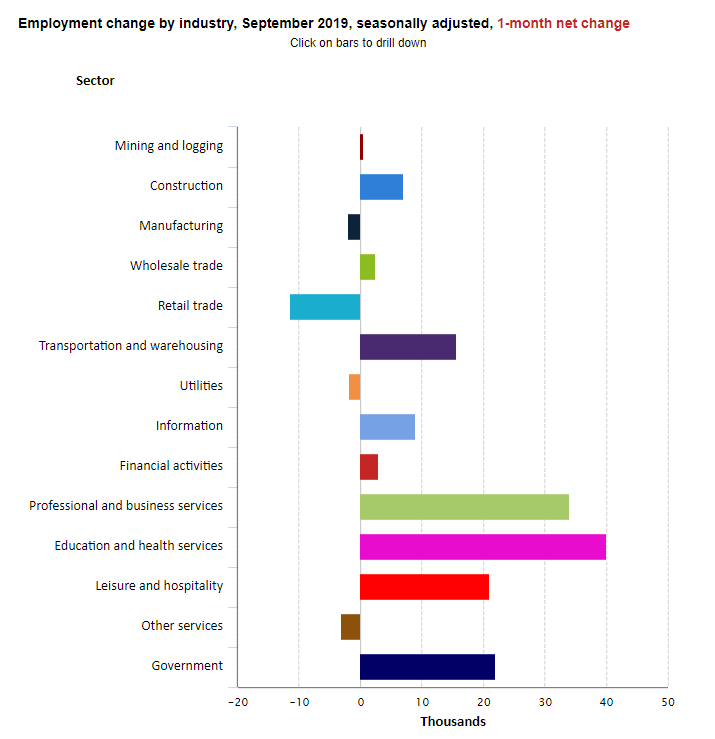
The Labor Department reported that there were 136,000 jobs added in September, below the consensus estimate of 145,000. For the nine months through September, the average monthly increase in total employment has been 161,000, below the average monthly gain of 223,000 in 2018 (note that this will likely be revised down based on the recent preliminary benchmark revision estimate). Health care added 39,000 jobs, in line with its average monthly gain over the past 12 months.

Revisions added 45,000 to the prior two months. The change in total nonfarm payroll employment for July was revised up by 7,000 from 159,000 to 166,000 and the change for August was revised up by 38,000 from 130,000 to 168,000. Monthly revisions result from additional reports received from businesses and government agencies since the last published estimates and from the recalculation of seasonal factors.

The September jobs report is important to the Federal Reserve and analysts because it is the first major piece of data for the fourth quarter. While not entirely consistent, data through the third quarter suggest that both the global and national economies are slowing. Indeed, the U.S. manufacturing sector is weakening as evidenced by a contraction for the second consecutive month in September in U.S. factory activity to its lowest level since June 2009. Expectations for GDP growth in the fourth quarter have also slipped to less than 2%. Global trade is slowing, and business investment is weakening due to mounting concerns about trade-related weakness associated with rising tariffs and geopolitical strife around the world. In fact, the Fed lowered interest rates on July 31st for the first time since 2008 and then again at its September 18th FOMC meeting as it reacted preemptively to concerns of a potential economic slowdown. The fed funds rate is now targeted at a range of 1.75% to 2.00%, down 25 basis points from its prior target range. Until July and since late 2015, the Federal Reserve had been gradually raising rates following six years of virtually 0% interest rates (2009 through 2015).

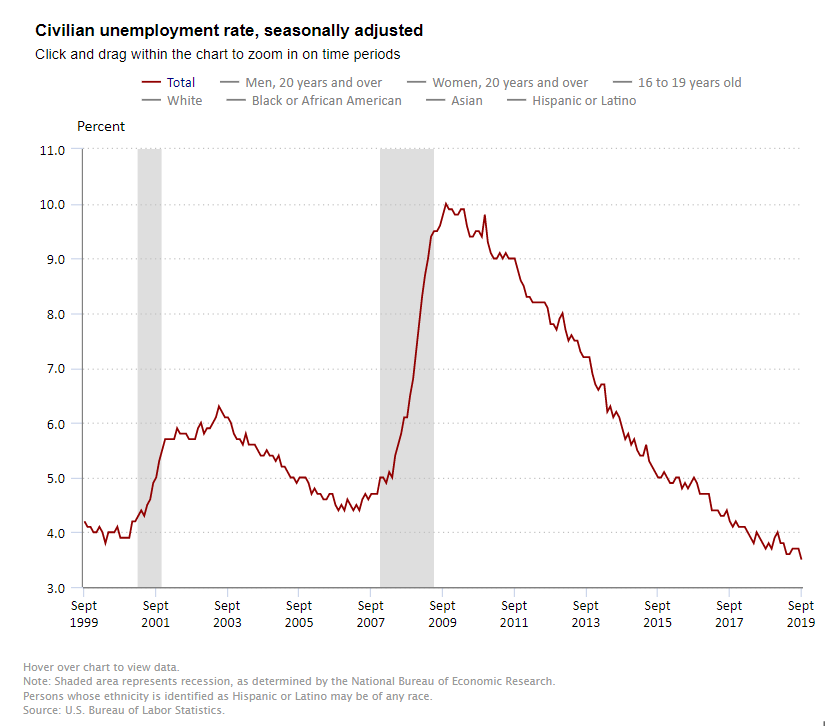
The August unemployment rate fell 0.2 percentage points to 3.5%. The last time the rate was this low was 50 years ago in December 1969. A broader measure of unemployment, which includes those who are working part time but would prefer full-time jobs and those that they have given up searching—the U-6 unemployment rate—fell to 6.9% from 7.2%.

Average hourly earnings for all employees on private nonfarm payrolls fell in September by one cent to $28.09. Over the past 12 months, average hourly earnings have increased by 2.9%, but this marked a 14-month low. For 2018, the year over year pace was 3.0% and in 2017 it was 2.6%.

The labor force participation rate, which is a measure of the share of working age people who are employed or looking for work was unchanged at 63.2% in September, very low but up from its cyclical low of 62.3% in 2015. The low rate at least partially reflecting the effects of an aging population.

2019 NIC Talk Says the Time for Telemedicine is Now

In his NIC Talk, The Future of Telemedicine, at the 2019 NIC Fall Conference, he opens with: “I’m here to tell you about why, and how, the healthcare delivery system that we have today is going to be virtualized. This is important to you because if you have a virtualized healthcare delivery system you can actually bring healthcare to the seniors as opposed to the seniors having to travel into the healthcare delivery system to get their care.”

Dr. Yulun Wang, chairman, founder & chief innovation officer of InTouch Health believes that senior living should be an extension of the healthcare system, with telehealth capabilities allowing senior living to care for chronic conditions and keep people healthier than hospitals can.

In his NIC Talk, The Future of Telemedicine, at the 2019 NIC Fall Conference, he opens with: “I’m here to tell you about why, and how, the healthcare delivery system that we have today is going to be virtualized. This is important to you because if you have a virtualized healthcare delivery system you can actually bring healthcare to the seniors as opposed to the seniors having to travel into the healthcare delivery system to get their care.”

As Dr. Wang points out, over the last 150 years, life expectancy has risen about a year for every four to five calendar years, but at a cost: increased complexity within the system. He pointed to the number of medical subspecialties, which has increased from 20 in 1970 to 150 today. Meanwhile, the number of doctors per patient is decreasing, from 7.3 per 100,000 people in 1980, to 5.0 today. With the significant rise of healthcare costs, which Dr. Wang describes as unsustainable, the challenge of providing quality care to everyone, without negatively impacting our economy, is a major one.

Dr. Wang characterizes the rise of digital technology as our fourth industrial revolution, shaking up markets and industries, and believes that healthcare, while not the first industry to be disrupted, will nevertheless feel the impact of today’s new technologies – and must embrace them in order to become better and more cost-effective.

Telehealth will allow the healthcare system to leverage new technologies to solve its greatest challenges. In today’s system, the expertise of our 150 subspecialties is scattered across the vast network of hospitals, doctor’s offices, and all sorts of brick and mortar locations. Virtual technology allows those experts to be distributed far more efficiently, while keeping frail elders out of the hospital. Dr. Wang shares a vision of the near future, in which we will have a virtual care delivery layer on top of the traditional brick and mortar layer, enabling clinicians to deliver care far beyond their geographic boundaries. “Beaming in” a clinician through the internet is possible with today’s technology – and is becoming more commonplace already.

Dr. Wang points out that a major barrier slowing the adoption of telehealth is a restrictive regulatory and reimbursement environment. But we are at an inflection point right now. Just in the past year, 40 congressional bills were introduced, and have either been passed or are in the process of being passed, that enable telehealth to be used in a wide range of applications, ranging from behavioral health to COPD, congestive heart failure, and more.

The RUSH Act, which stands for “Reducing Unnecessary Senior Hospitalizations” is close to passing this year, he said. It will allow CMS reimbursements to skilled nursing and senior living for technology, in recognition of the fact that, according to CMS, 45% of transfers from SNFs to hospitals can be avoided. Other regulatory changes, which are either already in place or on the near horizon, expand payment policies and increase payments for telemedicine.

Dr. Wang said that the use of telehealth is far from hypothetical. “Now is the time to link your senior living facilities with healthcare systems in partnership, with financial business models that work.”

This and all of the 2019 NIC Talks can now be viewed on NIC.org.

Industry Gathers at NIC Fall Conference: Managing Margins, Realizing Returns and Expert Insights

Industry Gathers at NIC Fall Conference: Managing Margins, Realizing Returns and Expert Insights

With record attendance, the 2019 NIC Fall Conference in Chicago last week brought together more than 3,300 participants for three days of networking, educational sessions, receptions, and high-profile speakers such as former Federal Reserve Chair Janet Yellen.   

Programming focused on current market trends and innovations as well as how to best address the disruptions facing the industry. Experts provided insights into effective operational strategies as well as changing capital flows and deal structures. 

Session participation got a boost from new formats including town halls, peer-to-peer exchanges and a seven-minute lighting round of tech innovations. 

New NIC-sponsored research on the growing demand for middle–market seniors housing—“The Forgotten Middle”—was spotlighted along with possible solutions. And NIC Talks returned as eight speakers took the stage to challenge our views on aging.  

“The Fall Conference is instrumental in helping deliver on our mission by providing a platform to connect, educate, and discuss,” said Brian Jurutka, NIC president & CEO.  “It is a gathering that allows key industry stakeholders to share ideas, learn about best practices, and exchange views on where the space is headed.”  

Timely themes included how to recruit and retain good workers, the impact of the ongoing shift to value-based healthcare, and the role of technology. In a continuing effort to improve transparency for investors, NIC announced a new partnership with PointClickCare to further enhance NIC’s rental rate data initiative. 

Other program highlights included: 

  • Opening General Session. In a Q&A discussion, former Federal Reserve Chair Janet Yellen provided insights on the economy and interest rates.  
  • Active adult. Two sessions addressed the emerging category of rental active adult properties. The segment shows promise to attract baby boomers. 
  • Consumers. What do they want? Keynote luncheon speaker Joe Coughlin of the MITAgeLab drilled down into the psyche of the baby boomers. In short, they expect a lot. Another session on consumer insights presented lessons from other industries. 
  • Capital. Three sessions brought tougher experts to discuss capital concerns. Topics included sources of debt and equity, valuations, and innovative financial instruments. 
  • Workforce development. Labor shortages and rising wages are making employee recruitment and retention a top priority. Operators shared their real-life success stories.  
  • Skilled Nursing. As payment reform and changing referral networks take shape, two sessions reviewed current market metrics and addressed the challenges ahead for operators, equity investors and debt providers. 
  • Innovations. Presenters highlighted solutions to current challenges, including staff turnover and resident engagement.  
  • Demand trends and home health. Panelists explored seniors housing development cycles while another session addressed whether to own or partner with home health providers. 

Attendees will be provided access to video and audio recordings for most of the sessions via nic.org. Publicly accessible highlights and sessions, including NIC Talks, are being posted to NIC’s YouTube page. 

Join us for the NIC 2020 Spring Conference, March 4-6, San Diego.  

### 

September 16, 2019 

janekadler@gmail.com 

Why “Silver Tsunami” is an Ageist Term

Rather than thinking about a catastrophic “Silver Tsunami” we need to be thinking about the potential benefits of a “Silver Stimulus.”  

bob headshotNo one ever thinks of anything good coming from a Tsunami. A Tsunami is an unmitigated disaster of unparalleled proportions, that causes mass destruction in its wake. The phrase, “Silver Tsunami,” even as it’s used within the aging field, furthers an old and outdated view of aging; it also undercuts society’s ability to see the opportunities that arise from the incredible achievement of lengthening the average American lifespan by over 30 years just in the past century. This outmoded view of aging is bad for our economy, an enormous loss for our workforce, an even greater loss for our social fabric, and is bad for the health of our elders. Rather than thinking about a catastrophic “Silver Tsunami” we need to be thinking about the potential benefits of a “Silver Stimulus.”  

If you live to 65 today you have a better than 50% chance of living past 85. In other words, millions of “retirement age” Americans have over a third of their adult lives still ahead of them. The greatest barrier to that last third being productive, and of older Americans continuing to contribute to society, is not age at all, but outdated views of aging that no longer fit our new realities. Too often, once an individual turns 65, society views them as past their prime, and no longer of value, and hence “retired” because they no longer have anything to contribute. We need to encourage our elders to “re-fire” their passions, interests, and societal engagement rather than force them to retire because we view them as useless.  

According to a 2015 U.S. Bureau of Labor Statistics report, by 2024, 25% of the U.S. labor force will be over the age of 50 in a trend that has been on the rise since the mid-1990’s. This cohort also accounts for a major part of our economy. European Commission studies find that the economic contributions of over-50 workers, termed the “silver economy,” is today the world’s third largest economy, behind only the U.S. and China. A joint report from Oxford Economics and AARP found that in 2015 Americans over 50 accounted for $7.6 trillion in direct consumer spending and controlled more than 80% of household wealth. Countless studies have shown that increasingly older workers are not only gaining satisfaction and purpose with extended working years but are having a significant positive impact on the world’s economies. The idea that one should retire at 65, and cease to contribute, is an unsupported prejudice; an outdated view that hasn’t been true for decades.  

As we see rapidly declining birth rates, workforce shortages, a shrinking pool of available family caregivers, and a host of social issues that are threatening the very fabric of our society, we must shed the outmoded “Silver Tsunami” attitude that views an aging America as a destructive force. Because today’s 65-year-old is healthier and far more productive than his or her counterpart a few generations back and is likely to want to stay connected to society, we have to change the way we view the coming wave of aging baby boomers. We have to switch our thinking about aging in America from a deficit model, which sees aging almost as a disease, to be avoided at all costs, to a benefit model, that sees the aging of society as an opportunity. 

Look for a more in-depth article on the “Silver Stimulus” in next month’s NIC Insider.