Uncovering Relationships Between Occupancy and Rent Growth in Assisted Living Property Markets

Analysis shows relationships between average occupancy rates and rent growth patterns for assisted living from 3Q 2015 - 3Q 2019 and the relative performance of individual markets.

In evaluating the attractiveness of a market for seniors housing investment or development, supply and demand metrics are fundamental data to examine, and layering on an assessment of rent growth and occupancy may provide additional insight. The following analysis shows the relationships between average occupancy rates and rent growth patterns for assisted living over a four-year timeframe—from 3Q 2015 through 3Q 2019—for the NIC MAP® 31 Primary Markets in aggregate—and then looks at the relative performance of individual markets.

The four-year timeframe provides a recent look-back at the time series’ peak assisted living rent growth, inventory growth and absorption, and the time series’ low occupancy rate. The abbreviated time frame seeks to mitigate any potential confounding effects of the Great Recession on the market fundamentals. As the data is considered, it is important to note that the results would differ if the study took a one-year, two-year, or ten-year look-back, with greater or lesser fluctuations in market dynamics on display with various timeframes.

Market-level occupancy and rent growth performance

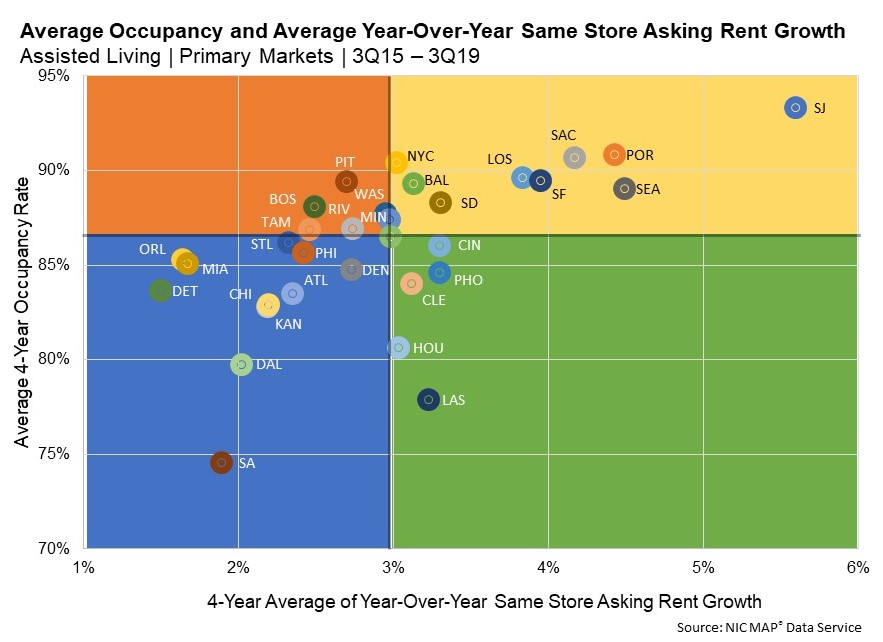
As shown in the following chart, data was plotted for the four-year timeframe (3Q 2015 to 3Q 2019) to understand the relative performance of rent growth and occupancy trends for each of the 31 NIC MAP Primary Markets. The chart displays each market’s performance relative to each other and to the Primary Markets’ average for annual same store asking rent growth and average occupancy for this four-year period (for the Primary Markets, rent growth averaged 3.0% over this period, while the occupancy rate averaged 86.5%). The differing colors for the markets’ marks is simply to help distinguish each market’s plotting relative to that of the others.

  • Nine markets in the upper right quadrant had higher than average annual rent growth (ranging from 5.6% in San Jose to 3.0% in New York City) and higher than average occupancy (ranging from 93.3% in San Jose to 88.3% in San Diego).
  • Eleven markets in the lower left quadrant had lower than average rent growth (ranging from 1.5% in Detroit to 2.7% in Denver) and lower than average occupancy (74.6% in San Antonio to 86.2% in St. Louis).
  • Six markets in the upper left quadrant had lower than average rent growth (ranging from 2.5% in Tampa to 3.0% in Minneapolis) and higher than average occupancy (89.4% in Pittsburgh to 86.9% in Tampa and Riverside).
  • Five markets in the lower right quadrant had higher than average rent growth (ranging from 3.3% in Phoenix and Cincinnati to 3.0% in Houston) and lower than average occupancy (ranging from 86.1% in Cincinnati to 77.9% in Las Vegas).
    4 year rent growth scatter.pptx

The strongest performing markets—those with the highest assisted living average annual asking rent growth rates and highest average all occupancy rates for the four-year timeframe included San Jose, Portland, Sacramento, New York City, Los Angeles, San Francisco, Baltimore, Seattle and San Diego. Many of these markets have limited supply due to constraints such as significant land development regulations, physical constraints on geographical expansion, and extended entitlement processes and/or premium prices on land due to scarcity. Building seniors housing may also not be considered the highest and best use of land, with other types of real estate taking priority. Investors and developers in markets with these characteristics tend to have a long-term hold strategy and are typically rewarded with the ability to maintain or command higher rents because of relatively more restricted competition.

The weakest performing markets—those with the lowest assisted living average annual asking rent growth rates and lowest average all occupancy rates for the four-year timeframe included Detroit, Orlando, Miami, San Antonio, Dallas, Chicago, Kansas City, St. Louis, Atlanta, Philadelphia, and Denver. What do these markets have in common? A simple answer may not be enough as there may be a variety of influences, including but not limited to, demand fluctuations, several consecutive quarters of sustained construction, price pressures from new seniors housing inventory competition or oversupply, lost market share to alternative options for housing and/or care such as age-restricted multifamily apartments, home health services, co-housing, aging-in-place technology, and adverse local economic conditions.

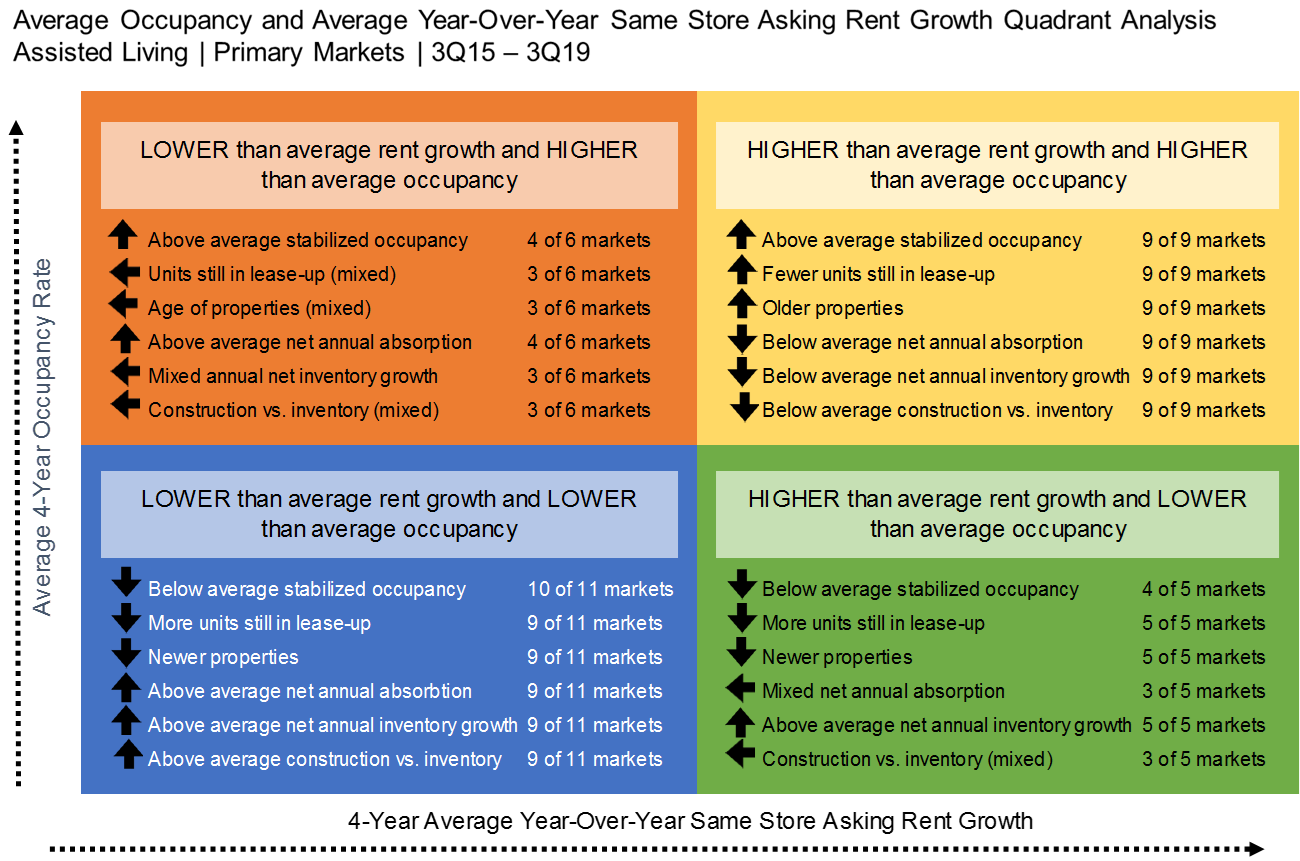
The table below describes the commonalities of each quadrant in the scatterplot chart discussed above for the four-year timeframe. In addition to the assisted living all occupancy rates and average annual same store asking rent growth rates that were diagrammed in the scatterplot chart, stabilized occupancy (defined by NIC as properties that have been open for at least two years or, if open for less than two years, have already reached a 95% occupancy), the percent difference (i.e. “gap”) between the all and stabilized occupancy rates (which denotes the percentage of units still in lease-up), average age of properties in the market, net annual absorption growth, net annual inventory growth and construction as a share of inventory were examined for each of the 31 Primary Markets to suggest potential patterns for further exploration.
 

AL Quadrant

Source: NIC MAP® Data Service


Despite the recent softening in assisted living occupancy and rent growth over the four year timeframe, some markets have experienced high rent growth matched with high occupancy, some have seen low rent growth matched with low occupancy, and others have experienced high occupancy and low rent growth, or low occupancy and high rent growth. What are some of the potential connecting factors?

Markets with either (1) strong absorption of new inventory, (2) a lull in cyclical construction, and/or (3) high barrier to-entry markets with limited new stock often have higher occupancy rates and can typically command higher rates of annual rent growth. In contrast, saturated markets—and markets with sustained construction cycles—may experience suppressed rent growth and lower occupancy rates for multiple years until demand catches up with supply. Under such conditions, operators may struggle to attract enough residents to fully lease-up a market’s new and existing units and may react to occupancy pressures by wholesale reductions in asking rents, and/or by offering point of sale concessions to offset and moderate revenue lost to vacancies.

Indeed, this analysis and blog post has only scratched the surface. Several questions may need to be answered with further research to understand what the key drivers of rent growth at the market-level are, including but not limited to:

  • Influence of market saturation
  • Age of inventory
  • Timing of the construction cycle
  • Geographic economic conditions
  • Staffing costs
  • Rising or falling target market income and home values
  • Quantity and quality of existing and new inventory competition
  • Consumer attitudes and awareness of seniors housing options
  • Availability of alternative options for housing and/or care
  • Demographic growth in age- and income-qualified households
  • Changing resident acuity
  • Levels of and duration of rent concessions

This blog has pointed out the wide differences in market performance by occupancy and rent growth and has suggested possible explanations for some of the disparities. However, to more fully understand rent and occupancy performance by market, an exploration of local market conditions and individual market dynamics should be considered.

If you’d like to learn more about the NIC MAP® Data Service, click here to visit our NIC MAP website.


 

Headlines  Highlight Trends Reshaping Seniors Housing and Healthcare

Journalistic highlights from the past several months, illustrating key trends reshaping housing and healthcare for America’s seniors.

Last year NIC launched seniorcare.nic.org, a website offering the latest information on seniors housing and care collaborations with the healthcare sector.  Providing curated resources and news articles relevant to the new partnerships, innovations, and business deals that are reshaping America’s seniors housing and healthcare landscape, the site offers insights into the rapid evolution of senior care.

In 2019, we posted more than  150 articles on seniorcare.nic.org, from a wide variety of outlets, including the Wall Street Journal, The New York Times, NPR, Forbes, The Boston Globe, every seniors housing and care sector journal, several medical journals, and a growing number of healthcare industry outlets, such as Modern Healthcare, Fierce Healthcare, and Home Health Care News, among others.

Judging by the quantity and size of deals announced just in the latter half of 2019, it appears that numerous organizations—including some of the nation’s largest businesses—are taking steps to adapt to a changing landscape. Stories highlighted the innovative new business models, technological advances, and emerging business strategies which are having an impact on the world of healthcare – and on seniors housing and care.

Below are a few journalistic highlights from the past several months, each of which illustrates a key trend that is reshaping housing and healthcare for America’s seniors.

Big Deals:

Many business relationships are being formalized, largely in response to the new challenges and opportunities presented by an evolving healthcare system, shifting demographics, advancing technologies, and the overarching need to improve outcomes at lower cost. A review of the headlines reveals new deals and partnerships, big and small, all of which may potentially impact the sector. Major recent deals include:

Walmart and Doctor on Demand and Amedisys

CVS and Aetna

Maplewood Senior Living and Penn Medicine

Leverage Health and WellBe Senior Medical

Amazon and PillPack and Health Navigator

Microsoft and Humana

Medica, Genevive, Presbyterian Homes & Services – and 9 other Senior Living Companies

Welltower and CareMore and Senior Resource Group and Belmont Village

Best Buy and GreatCall and Critical Signal Technologies

Sam’s Club and Humana and 98point6

New Partnerships:

Forbes senior contributor Bruce Japsen outlined the newly announced partnership between Microsoft and Humana. The headline, “Microsoft, Humana Partner To ‘Reimagine’ Healthcare For Aging Boomers” reflects growing awareness of the opportunity inherent in a huge population that is growing older and will otherwise stress the current system to its breaking point.

“With an estimated 10,000 people joining the Medicare system daily, we have a tremendous opportunity to address the growing demands on the health care system by improving health outcomes and lowering costs,” Microsoft corporate vice president of health technology and alliances, Dr. Greg Moore, said in a statement announcing the partnership.

“The next step for medical records is to go beyond the collection of information to the delivery of insights,” Humana chief medical and corporate affairs officer Dr. William Shrank said. “Microsoft technologies offer Humana the ability to apply sophisticated analytics to our members’ records, and in turn, provide clinicians and care teams with the opportunities to make a difference in patients’ health.”

Senior Housing News highlights another recent partnership in Tim Mullaney’s article, “Welltower, CareMore Initiative Drives Senior Living Integration with Medicare Advantage”. As Mullaney writes, “The participating organizations anticipate that the initiative will lead to improved health and wellness for senior housing residents, which in turn will reduce hospitalizations and other costly interventions and increase length of stay.” CareMore, which is affiliated with Anthem, one of the nation’s largest health insurers, was looking to scale its successes working with senior living providers on a facility-by-facility basis, according to Dr. Sachin Jain, CareMore’s president and CEO:

“As we started to think about how we could make an even greater impact on American health care and further refine this model, we started to look for broader national partners,” Jain said. “Welltower was an obvious choice.”

For its part, Welltower, a REIT with a portfolio of about 1,300 properties nationwide, is pursuing a strategy that anticipates healthcare increasingly moving out of hospitals and into residences. It is building closer relationships with healthcare systems and payers, while shifting the focus of care – and value – into the senior living realm.

As Welltower Senior Vice President of Business Strategy and Health System Initiatives Mark Shaver said, “We believe this will make our sites of care more consequential.”

New Models:

Within the space of a week last fall, three of America’s biggest retailers announced plans to leverage health care’s move to the home. The Home Health Care News article, “Best Buy, Amazon and Walmart Leading Retail’s Race into Home-Based Care”, by Bailey Bryant, summarizes the separate plans, all of which place big bets on a major shift in the delivery of healthcare in America.

Best Buy announced its goal of supplying “5 million seniors with health monitoring services in five years.” Analysts at Morgan Stanley said of the company’s plans that, “Looking ahead, we believe Best Buy’s deeper push into health monitoring, related efforts to reduce medical expenses for insurers, and right to share in the cost savings represent a significant revenue and profit opportunity in the long term.” The company’s healthcare moves could bring in an additional $46 billion in long term revenues – which is more than Best Buy’s current annual revenues of $43 billion.

The article goes on to point out that, “When it comes to in-home care, Amazon is getting its toes wet with employees first. Last week, the company announced the rollout of Amazon Care, a new virtual care clinic pilot available to Seattle-based employees and their dependents.”

Walmart is also mentioned, “Finally, Walmart is getting in the home-based care game with a prototype of its new Walmart Health clinic, which features an Amedisys Inc. (Nasdaq: AMED) kiosk designed to help educate customers and potential patients on home health services.

Innovation:

A HealthLeaders article by Christopher Cheney, “Walmart, Doctor on Demand Join Forces in Primary Care Telemedicine Deal,” discusses how the retail giant plans to use telehealth to deliver quality primary care to its employees, who pay a $4 copay.

As Cheney writes, “The new partnership provides primary care and behavioral health services via video-based telemedicine to Walmart employees and their dependents in Colorado, Minnesota, and Wisconsin.

According to Doctor on Demand CEO, Hill Ferguson, “We can help patients manage chronic conditions from the comfort of their home, keep them out of the emergency room, and make sure that if they need in-person care that we can route them to the right place where they will optimize for quality and cost.”

Modern Healthcare recently published Shelby Livingston’s article, “CVS’ first HealthHUBs driving more prescriptions, clinic visits,” delving into what appears to be a major early success for the pharmacy giant’s innovative new pilot program.

As Livingston summarizes, “The HealthHUB locations cater to everyday needs, with a special focus on chronic disease management, offering services like blood draws, sleep apnea assessments and diabetes care. Patients can access one-on-one and group counseling with a dietitian in the store. The stores also feature a care concierge to educate customers about the services and connect them with in-store providers.”

Venture “Catalyst” firm Leverage Health and WellBe Senior Medical announced a strategic partnership to “provide specialty geriatric care to frail, polychronic seniors in Medicare Advantage health plans.”

A McKnight’s Long-Term Care News piece, titled “Leverage Health backs WellBe concept in new partnership,” by Kimberly Marselas, quotes WellBe founder and CEO, Jeff Kang, “Building a deep relationship with our patients and physically being in the home allows our team to address both clinical and social determinants of health directly. The result is immediate, dramatic improvement to the person’s overall health and wellbeing as we follow the patient across every care setting.”

The pieces referenced above are just a sampling of those available on www.seniorcare.nic.org. Our team regularly updates a growing list of articles, specially curated for relevance. To stay on top of what’s happening across the seniors housing and care spectrum, in terms of collaborations, partnerships, and innovations involving healthcare, keep an eye on our list, and link to the growing body of journalism that is tracking how our system is evolving, as it happens.


This is an updated version of an article that originally appeared in the Housing & Healthcare blog on seniorcare.nic.org in November 2019.

A Turning Point in Medicare Policy

What does it take to get advocacy groups, insurance companies, foundations, and policy makers all on the same sheet of paper? In the case of caring for chronically ill older Americans, it appears that it takes a shared sense that improved outcomes, lower costs, and strong business performance are achievable – but only with cooperation, […]

What does it take to get advocacy groups, insurance companies, foundations, and policy makers all on the same sheet of paper? In the case of caring for chronically ill older Americans, it appears that it takes a shared sense that improved outcomes, lower costs, and strong business performance are achievable – but only with cooperation, innovation, and a willingness to think differently.

On January 7, we attended an extraordinary and encouraging presentation hosted by Senator Mark Warner’s office, made possible by The SCAN Foundation, and led by the Long-Term Quality Alliance (LTQA), and Anne Tumlinson Innovations (ATI). Titled “Medicare Advantage and the CHRONIC Care Act: Implementing Innovative, Non-Medical Solutions for Older Adults,” the event served to launch and support a set of newly developed guiding principles for an updated Medicare program.

The principles in question were arrived at by an unusual working group convened by ATI and LTQA. As described in the accompanying white paper, “A Turning Point in Medicare Policy: Guiding Principles for New Flexibility Under Special Supplemental Benefits for the Chronically Ill,” the group was “comprised of a diverse array of national experts on Medicare Advantage and long-term services and supports.” The white paper lists the group’s members, stating their support and commitment; it’s a collection of leaders from entities that in other settings have sometimes found reason to take potshots at each other in the press or to cast blame for inaction. We are not accustomed to seeing them working together in a consensus-building process.

Members include classic advocacy groups, such as AARP, The Arc of the United States, the National Council on Aging, the Community Living Policy Center UCSF, the National Association of Area Agencies on Aging, Meals on Wheels America, and Justice in Aging. What makes the group particularly rare is the fact that all these groups worked side-by-side in a collaborative process with leading insurers such as Kaiser Permanente, Centene, CVS Health Aetna, Anthem, Blue Cross Blue Shield Association, and others. Add to the mix funders such as The SCAN Foundation, The Commonwealth Fund, and the Robert Wood Johnson Foundation, and you truly have strange bedfellows. But what they’ve achieved could only be brought about by such an array – and by a shared understanding of a common challenge: to deliver better outcomes at lower cost through utilization of the new flexibility in care for the chronically ill.

Clearly, these leaders have listened to one another and reached agreement on how best to move forward and take advantage of an unprecedented opportunity: the passage of a new law named “Creating High-Quality Results and Outcomes Necessary to Improve Chronic (CHRONIC) Care Act.” Enacted as part of the Bipartisan Budget Act of 2018, the law, as summarized in the white paper, which is subtitled “Guiding Principles for New Flexibility Under Special Supplemental Benefits for the Chronically Ill (SSBCI),” “expands what qualifies as a supplemental benefit to meet the needs of chronically ill Medicare Advantage enrollees.”

The white paper further explains:

“Prior to the CHRONIC Care Act, Medicare Advantage plans could only offer supplemental benefits that were primarily health related, such as dental care, and had to make them available to all plan enrollees. Through the CHRONIC Care Act, Medicare Advantage plans may now offer SSBCI. These benefits may include services that are not primarily health related, such as home care, as long as the service has a reasonable expectation of improving or maintaining the health or overall function of the chronically ill enrollee. The new law also gives the Secretary of Health and Human Services the authority to waive, only with respect to SSBCI, the requirement that benefits be made available to all enrollees.”

A review of the “Guiding Principles” that the group has released indicates that they see a real opportunity in the flexibility now afforded to MA plans to tailor benefits to the needs of a particular individual, rather than to an entire class of plan beneficiaries, as required under former rules. If payers and providers can address the individual needs of the chronically ill population, not all of which are directly health-related, they may have a significant impact on health and healthcare utilization.

This working group is extraordinary, not only for including such an array of interested parties, but for arriving at a shared vision “to guide a diverse array of stakeholders as they work to develop, implement, offer, deliver, and use SSBCI.” The group also serves as hard proof that as our healthcare system continues to move towards value-based care new partnerships will arise – often putting strange bedfellows together in ways they might not have imagined just a few short years ago.

But there are tensions that are real and must continually be addressed. Providing insurers greater flexibility so that they will innovate may be necessary, but there are concerns around giving them too much freedom. It is also likely that some innovations will fail. Convening major players representing such a broad array of interests ensures that every perspective is accounted for, as the system seeks to innovate without failing the people and institutions that it serves. The principles account for a realistic balance of these interests, while providing the tools necessary for everyone to play a role in achieving the common aim.

While every other stakeholder was well-represented, health systems were noticeably absent from this effort. They will likely be the last institutions to fully buy in to value-based care. Most systems today are still operating on the fee-for-service system, and few, if any, have developed expertise in managing chronic diseases, or pre- and post-acute care. These factors, along with their traditional focus on curative intervention may underlie their absence, but as everyone else works diligently to keep patients out of the hospital, and to renew the focus on value-based care, even health systems will have to evolve, or else suffer the consequences of a disruption in their markets.

There is a great opportunity to learn from this period. The working group recognizes that this is the “beginning of a path toward person-centeredness in Medicare.” They include as a principle that the SSBCI should “evolve with continuous learning and improvement.” To be successful over the long-term we will need research, with reporting requirements, as outlined under this principle. We will need some of these stakeholders to pilot innovative programs, measure and compare results, and test new ideas. Across the program, we will need to “build the evidence base” – which is one of several suggested next steps in the white paper – as these initiatives develop.

There is plenty of work to do, both to address major challenges in our approach to caring for frail elders (and everyone else) and to seize new opportunities to succeed. But this unique and surprising effort indicates that our institutions are willing to work together to be successful. And that’s a turning point.

145,000 Jobs Created in December, Below Consensus View

145,000 Jobs Created in December, Below Consensus View

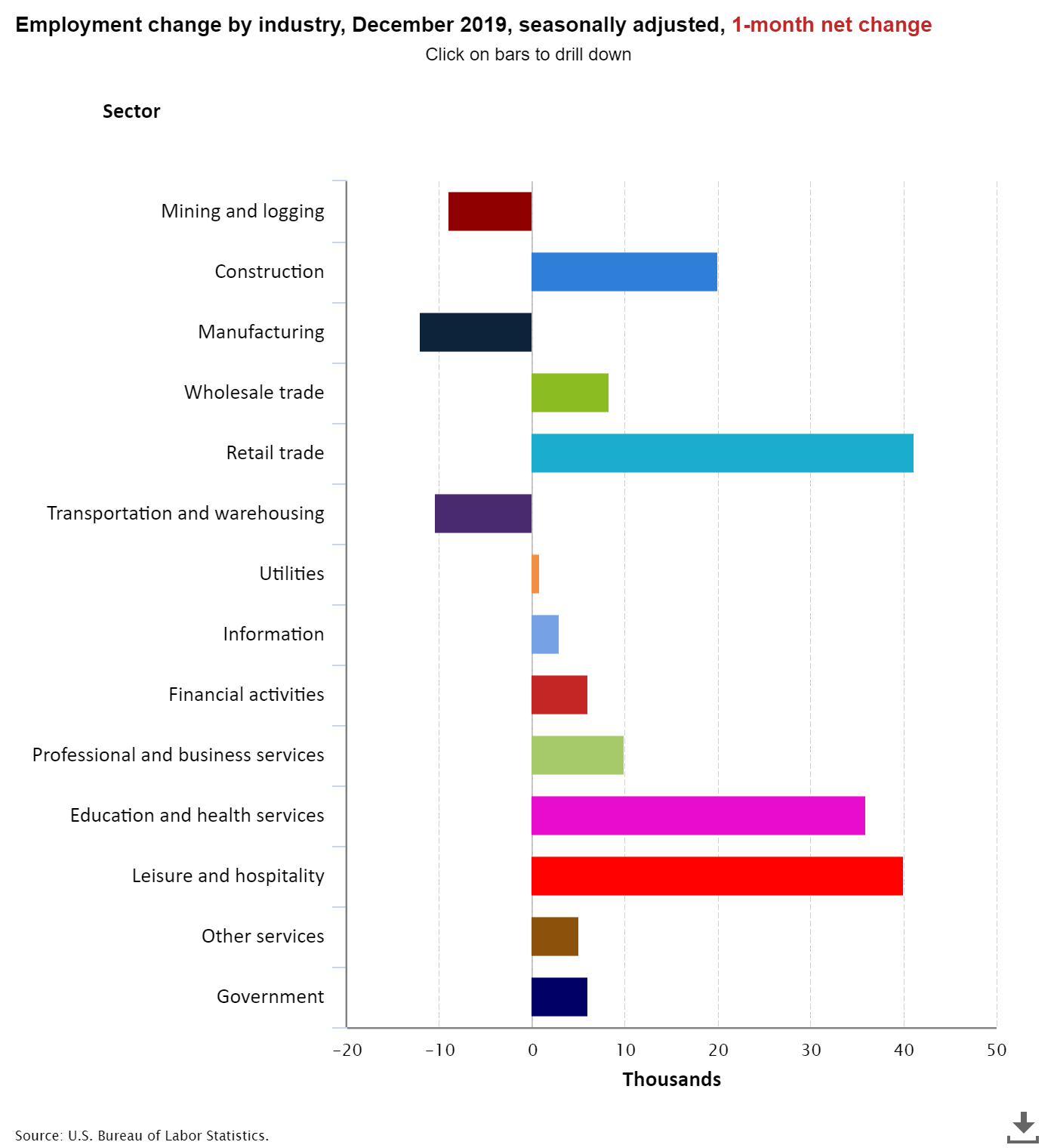
The Labor Department reported that there were 145,000 jobs added in December. This was less than the consensus estimate of 160,000 and marked the 111th consecutive month of job gains. For all of 2019, employers added 2.11 million jobs. That was a slowdown from the increase of 2.68 million in 2018 and ranked 2019 eighth for job growth in the past 10 years.

Revisions also subtracted a number of jobs to the prior two months. The change in total nonfarm payroll employment for October was revised down by 4,000 from 156,000 to 152,000 and the change for November was revised down by 10,000 from 266,000 to 256,000. Combined, 14,000 jobs were subtracted from the original estimates. Monthly revisions result from additional reports received from businesses and government agencies since the last published estimates and from the recalculation of seasonal factors. After revisions, job gains have averaged 184,000 over the last three months, below the average monthly gain of 223,000 in 2018 (note that this will likely be revised down based on the recent preliminary benchmark revision estimate which indicates that private payrolls were over-counted by 43,000 per month in the twelve months ending in March 2019).

Health care added 28,000 jobs, and has added 388,000 jobs in 2019, similar to the increase of 359,000 in 2018.

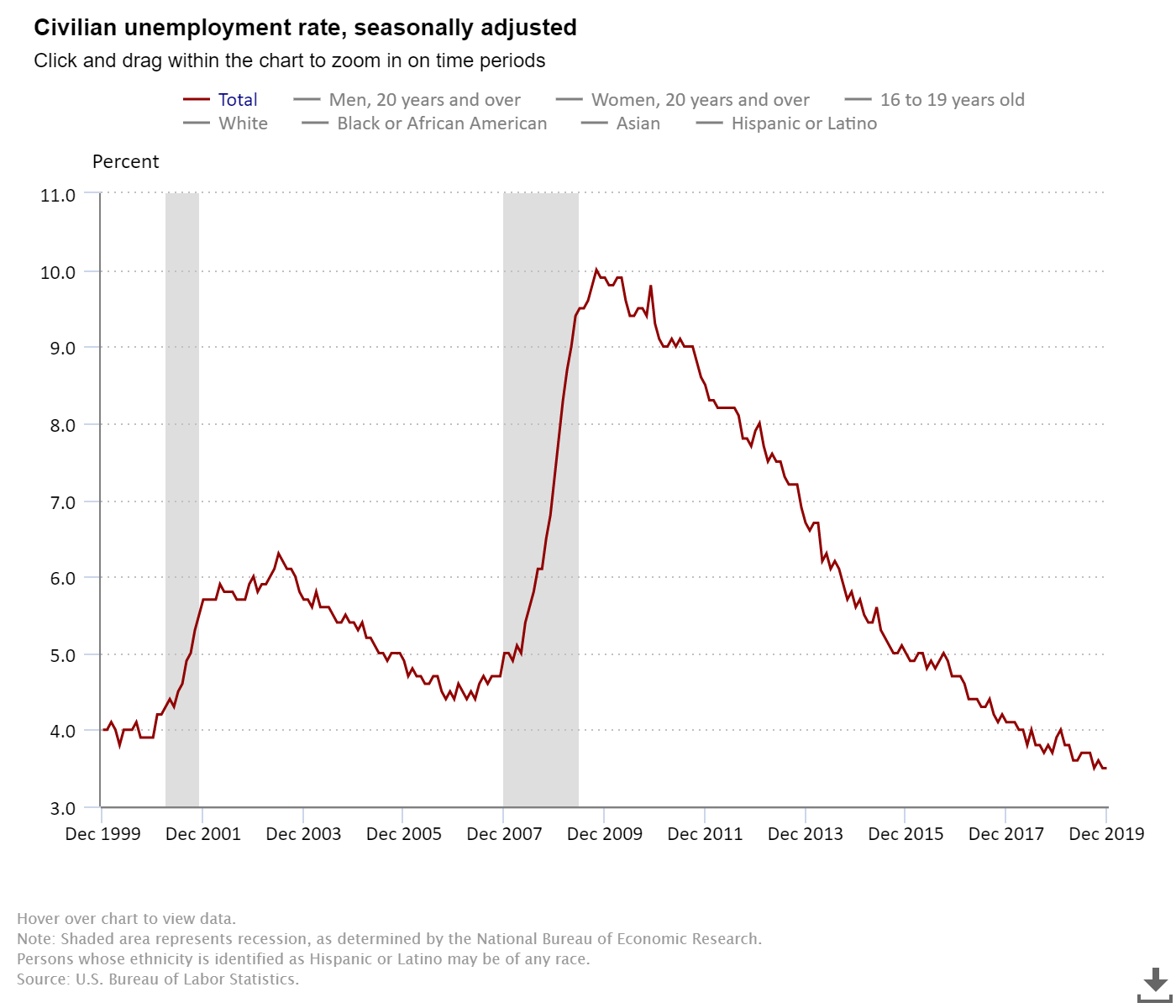
The December unemployment was unchanged at 3.5% in December, a 50-year low. Average hourly earnings for all employees on private nonfarm payrolls rose in December by three cents to $28.32. Over the past 12 months, average hourly earnings have increased by 2.9%. For 2018, the year over year pace was 3.0% and in 2017 it was 2.6%. Reasons why wages are not growing faster include the retirement of highly paid baby boomers and relatively weak productivity growth.

The labor force participation rate, which is a measure of the share of working age people who are employed or looking for work was unchanged at 63.2% in December, which was the highest since August 2013.

The December employment report will support the Fed’s “on hold” stance, at least for the time being. In December, the Federal Reserve left interest rates unchanged and signaled it would stay on hold through 2020, keeping the Fed and its policies on the sidelines during the election year. “Our economic outlook remains a favorable one despite global developments and ongoing risks,” Chairman Jerome Powell told a press conference in mid-December following the FOMC meeting in Washington. He continued that “As long as incoming information about the economy remains broadly consistent with this outlook, the current stance of monetary policy likely will remain appropriate.”

In October, the Federal Reserve lowered interest rates by 25 basis points to a range between 1.50% to 1.75%. This was the third cut in as many months. But Chairman Powell indicated that it may be the last cut, at least in the short term, creating the “on hold” stance viewed by many in the market.
Fed officials also released new quarterly forecasts. These showed:

  • The median estimate for the fed funds rate is at 1.6% at the end of 2020, 1.9% in 2021 and 2.1% in 2022. Thirteen officials expect rates to stay on hold next year, while four see a hike as appropriate.
  • The jobless rate is expected to be 3.5% by late 2020, the same as it is now. The long-run unemployment rate is seen at 4.1%, down from 4.2% in September.

Skilled Nursing’s New Balancing Act – Consultant Marc Zimmet Takes a Deep Dive into the Nuances of the Sector

The skilled care delivery and payments system is going through a significant transitional period and it is increasingly difficult to be financially successful without meeting quality standards. “Financial success is being tied to quality,” said Marc Zimmet, president and CEO of Zimmet Healthcare Services Group, a New Jersey-based consulting firm. “A much more complex system […]

The skilled care delivery and payments system is going through a significant transitional period and it is increasingly difficult to be financially successful without meeting quality standards.

“Financial success is being tied to quality,” said Marc Zimmet, president and CEO of Zimmet Healthcare Services Group, a New Jersey-based consulting firm. “A much more complex system has emerged with so many players, payors and vested interests, but meeting increasingly stringent value targets often results in counterproductive strategies that may improve one revenue source but hurt another. It’s all connected, or said another way, it’s our “Theory of Reimbursementivity.”

Zimmet’s firm advises skilled nursing facilities and other stakeholders on all aspects of what he calls the reimbursement-compliance ecosystem. His firm works with more than 3,000 providers and related stakeholders nationwide.

Based on his broad experience, Zimmet noted the difficulty for a skilled facility to be financially successful today without meeting the quality standards demanded by payors and provider partners. “Rewarding quality is the right thing to do,” he added, cautioning that quality measures can vary. “The issue is that everyone measures quality and rewards quality differently.” The process includes understanding the nuances of bundled payments and the new patient driven payment model (PDPM). “Many operators struggle to manage all these moving parts, and the result is lost reimbursement,” said Zimmet. “Things [] fall through the cracks; we try to make sure that doesn’t happen.”

Another important factor is the growth of Medicare Advantage plans. About 65% of new Medicare recipients are opting for Advantage plans, which push down episodic treatment revenue from fee-for-service Medicare.

Some skilled operators may benefit by joining an institutional special needs plan, or I-SNP, according to Zimmet. The goal of the I-SNP is to treat residents in place. A skilled nursing facility may be able to share in the savings generated by not sending residents to the hospital.

But Zimmet warned, “An I-SNP may be a balancing act for the facility. It has to consider how all the pieces fit together, including the dynamics of contracted services, such as physical therapy, the impact of capitated payments, and the new Patient Driven Payment Model (PDPM). It’s all connected.” An operator that brings down costs in one area may be raising them in another. Also, facilities in states with higher Medicaid rates may be better positioned to benefit from an I-SNP.

Another challenge: In a complex environment, operators can run afoul of regulations, particularly regarding Medicare coverage rules which can be impacted by whether or not the resident is enrolled in the I-SNP or traditional fee-for-service. “Compliance is a big issue that often gets overlooked—facilities must have consistent policies,” he advised.

See an extended interview with Zimmet, including his thoughts on positioning a facility and his outlook for the sector, in the December issue of the NIC Insider newsletter.