26 Million Jobs Lost in Past Five weeks

26 Million Jobs Lost in Past Five weeks

The Department of Labor reported that 4.4 million Americans filed for unemployment insurance benefits in the week ending April 18, 2020 as the COVID-19 pandemic continues to cause businesses to lay off or temporarily furlough workers due to lock down across much of the country. This was a decline of 810,000 from the previous week’s upwardly revised level of 5.2 million. The speed and scale of the job losses is unprecedented. In the past five weeks, more than 26 million people have filed claims. By comparison, 9 million jobs were lost over the course of the 2007-2009 recession.

Continuing claims for regular benefits, which are reported with an extra week’s lag, rose 4.0 million to 16 million. This marks an all-time high in the data series. This measure, which accounts for people who are continuing to receive benefits, will keep climbing as jobs continue to disappear. This has also pushed the insured unemployment rate (the share of the labor force that claims unemployment benefits) higher. The insured unemployment rate was 11.0% in the week ending April 11, an increase of 2.8 percentage points from the prior week and up from 1.2% pre-COVID-19. This marks the highest level of the rate in the history of the data series.


employment blog 4.23

Jobless claims are laid-off workers’ applications for unemployment insurance payments. Gig-economy workers, self-employed people and those seeking part-time work are now eligible to apply for benefits in an expanded unemployment assistance program recently created in response to the pandemic. Further, as of last Monday, more than 40 states were paying recipients an additional $600 a week in enhanced unemployment benefits on top of the usual payments.

The largest increases in initial claims for the week ending April 11 were in Colorado, New York, Missouri, Florida and North Carolina.

This week’s increase in unemployment claims marks the fifth consecutive week of surging jobless claims and indicates just how quickly and sharply the economy has collapsed. An 11-percentage point jump in the official BLS jobless rate to as much as 15% to 20% by April is likely and could exceed 20% in May, according to Capital Economics. This would be the highest rate since the 1930s. As recently as February, the unemployment rate was at a 50-year low of 3.5%. In March, the rate had already increased to 4.4%.

In response to the coronavirus crisis, the Federal Reserve has pushed interest rates to zero and enacted nine new lending programs in recent weeks. These include open-ended asset purchases of $1.2 trillion of Treasury securities in just four weeks and the announcement of a series of new lending facilities aimed at households and non-financial businesses, worth up to $2.3 trillion. The FOMC meets next week and may announce further plans to buy more Treasury securities and create new or expand existing loan programs. The Fed’s actions in recent weeks are unprecedented and indicate how troubled the economy is indeed.

Telehealth Emerges as Lasting Care Solution Amid Disease Outbreak

Interest in telehealth grows as senior living recognize the benefits of caring for residents with virtual visits as the COVID-19 pandemic unfolds.

Interest in telehealth shifted into high gear over the last month as senior living providers quickly recognized the benefits of caring for residents with virtual visits as the COVID-19 pandemic unfolds.

Residents do not have to take the risk of leaving their apartments to see healthcare professionals. Visits can instead be conducted online. Timely consultations help prevent later, more costly interventions.

In a big step toward more widespread adoption, Medicare recently announced that it will reimburse for telehealth provided services for the duration of the COVID-19 public health emergency. The change covers providers such as doctors, nurse practitioners and other clinicians. The visits are paid at the same rate as in-person visits.

Telehealth companies are now fielding more requests for services from senior living providers. The use of telehealth is expected only to grow, becoming a standard tool for resident care across the senior living spectrum.

“Remote healthcare has helped us manage through this crisis,” said Richard Nolden, health center administrator at Monarch Landing, a continuing care community in Naperville, Illinois. “Telehealth is not going away.”

The growing value of telehealth was highlighted at the 2020 NIC Spring Conference.

A session titled, “Telehealth: Boon or Threat to Senior Care,” brought together experts who discussed how the technology will impact staffing, cost of care, site of care, and investment returns.

The category of telehealth covers a broad swath of interventions, noted session moderator Kelsey Mellard, CEO at Sitka, a digital healthcare solutions company. These interventions can include everything from remote monitoring of residents via wearable devices to virtual consultations with doctors who can prescribe treatments and medications.

Telehealth can reduce costs and improve care. Peer-reviewed and anecdotal evidence show up to a 40% reduction in hospital admissions with the use of telehealth in post-acute care settings, according to NIC session panelist Michael Kurliand, director of telehealth and process improvement at West Health, a nonprofit focused on lowering healthcare costs for seniors.

The panel was also joined by Robin Glass, president and chief commercial officer at Doctor on Demand, a virtual care provider.

The timing is right

The overall adoption of telehealth services is surging in the aftermath of the COVID-19 outbreak.

  • Virtual health-care interactions are on pace to top 1 billion by year’s end, according to a report by Forrester Research.
  • Non-COVID related medical visits are expected to reach 200 million this year, up from an original forecast of 36 million visits, said Forrester.
  • March telehealth visits rose 50%, according to research by consultancy Frost & Sullivan.
  • Virtual care provider Teladoc reported April 18 that it is providing more than 20,000 virtual medical visits per day in the U.S., more than double the volume of the first week of March as the coronavirus outbreak continues to drive telehealth implementation.

Senior living communities are adopting telehealth solutions.

Holiday Retirement announced in March that it is providing 24/7 telehealth access and services to the residents of its 261 communities through MeMD’s national network of healthcare providers.

Monarch Landing’s health center has been using Third Eye Health, an on-call physician service, for about a year now. Third Eye physicians are available virtually during off-hours.

The care provider or nurse on staff connects via iPad to a Third Eye doctor, available within minutes. The software is integrated with electronic health record systems, including PointClickCare and MatrixCare. Both Third Eye and primary care doctors have access to the medical records.

The doctor conducts a live video visit, assisted by the on-site provider. “Telehealth helps us manage resident care,” said Nolden. The service does not replace the primary care physician, he added, but it does help minimize emergency room visits at times when the primary care physician is not readily available.

With a current census of 74 residents, Monarch Landing is also using the iPad platform to virtually connect with specialists, such as psychiatrists and wound care nurses. These practitioners who visit multiple facilities can be a potential source of new infection during the pandemic. “We can provide service but minimize our exposure,” said Nolden.

Prior to the COVID-19 outbreak, Third Eye technology was in use at about 400 nursing homes. “Now we are doubling our business,” said Dan Herbstman, CEO and co-founder of Third Eye. The service is available nationwide. Assisted living facilities with high-acuity residents are using the service too. “Providers are accepting telehealth,” said Herbstman. “The skeptics are coming around.”

How do residents react?

“The residents are fine with it,” said Deborah Hart, CEO at Montgomery Place, a continuing care community in Chicago. “They think it’s cool.”

Montgomery Place uses Third Eye in its skilled nursing center and sometimes with independent and assisted living residents. “It doesn’t cost them anything, so they like that,” said Hart. She moved on to the campus herself in mid-March, a change that has been well received by residents. Several staffers also stay overnight in case of emergencies. “Residents feel comfort knowing that someone is here. I am one of them,” said Hart.

Communities are adopting other telehealth platforms.

Belmont Village Senior Living established new protocols in the wake of the pandemic. Routine off-site doctor visits were discouraged early on.

The company contacted residents’ physicians to ask how best to establish a virtual connection, either by Zoom, Skype, FaceTime, or some other method. The effort coincided with the change in Medicare rules that allowed for the reimbursement of virtual visits.

Belmont distributed iPads to its communities to connect residents with their healthcare providers remotely. Disposable anti-microbial iPad pouches were included to reduce contamination. “We are exercising extreme caution,” said Belmont President Mercedes Kerr.

Like other senior living providers finding success with telehealth services, Belmont is now expanding its offerings.

The company plans to roll out a virtual, after-hours physician service this May. The service will be phased in gradually at Belmont communities. And as with other providers, the service is not meant to replace primary care physicians. “It is a supplement for urgent care,” said Kerr. “We hope to reduce transfers to hospitals.”

Telehealth adoption is expected to accelerate as companies forge partnerships with large healthcare systems, insurers, and information technology companies. These big stakeholders share the goals to reduce costs and improve care.

VitalTech, for example, offers a virtual care platform. It has formed alliances with AT&T Business, the American Hospital Association, physician groups and other providers.

The VitalTech service includes wearable devices that monitor the vital signs of residents. Results are delivered via a smart phone application to the resident’s personal healthcare provider or the provider in the building. The company does not employ physicians but facilitates the connection between residents and healthcare providers.

The application includes medication management as well as a video connection to family and friends. VitalTech is a subscription service but it is being offered free for 90 days to senior living providers during the COVID-19 crisis.

Senior communities are stretched very thin, observed Ernie Ianace, executive vice president at VitalTech. He thinks senior living communities were a little behind the curve in terms of adopting new technology, but the unfortunate event of the COVID-19 outbreak is speeding acceptance of virtual care technology. “So many seniors need care,” said Ianace. “Without technology it will be impossible to serve them.”

All-time High Reached for Continuous Unemployment Insurance Claims

All-time High Reached for Continuous Unemployment Insurance Claims

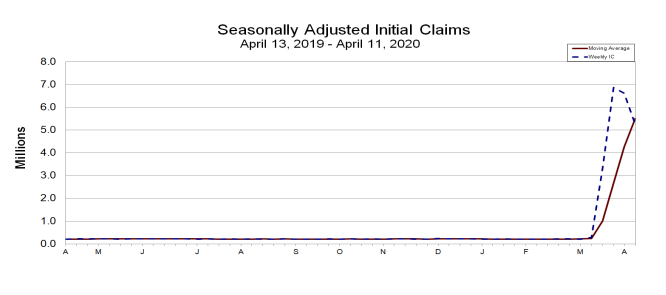
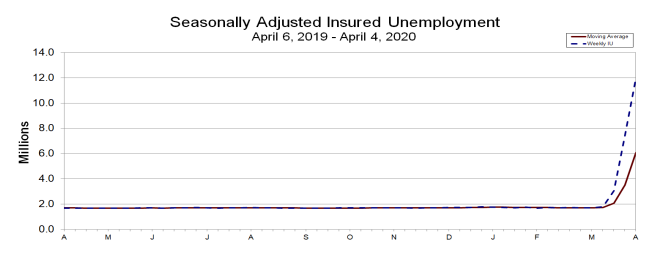
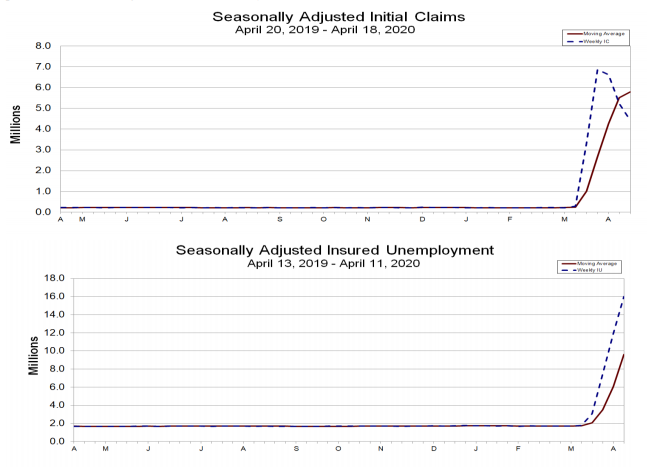
The Department of Labor reported that 5,245,000 Americans filed for unemployment insurance benefits in the week ending April 11, 2020 as the COVID-19 pandemic continues to cause businesses to reduce or furlough their workforces as sales plummet. This was a decline of 1,370,000 from the previous week’s upwardly revised level of 6,615,000. The speed and scale of the job losses is unprecedented.  In the past four weeks, more than 22 million people have filed claims. For perspective, there were about 21.5 million jobs generated during the employment expansion that began in October 2010 or said another way, it took four weeks to lose the jobs it took 9.5 years to generate.

Continuing claims for regular benefits, which are reported with an extra week’s lag, rose 4.5 million to 12 million. This marks an all-time high in the data series. This measure, which accounts for people who are continuing to receive benefits, will keep climbing as jobs continue to disappear. This will push the insured unemployment rate (the share of the labor force that claims unemployment benefits) higher. The insured unemployment rate was 8.2% in the week ending April 4, an increase of 3.1 percentage points from the prior week and up from 1.2% pre-COVID-19. This marks the highest level of the rate in the history of the data series. The previous high was 7.0% in May 1975.

The largest increases in initial claims for the week ending April 4 were in Georgia, Michigan, Arizona, Texas and Virginia.

This week’s increase in unemployment claims marks the fourth consecutive week of surging jobless claims and provides a window into the magnitude of the economic downturn into which we are solidly moving. A 11-percentage point surge in the jobless rate to as much as 15% by April is likely, according to a Bloomberg commentary. As recently as February, it was at a 50-year low of 3.5%. In March, the rate had already increased to 4.4%.

Separately, on Wednesday, the Commerce Department reported the steepest monthly drop in retail sales on record going back 30 years and the Federal Reserve said industrial production fell the most since 1946.

Projections of real GDP growth continue to darken, with JPMorgan economists now predicting an annualized rate decline of 40% in the second quarter of 2020. Earlier, the expectation had been a decline of 25%.

The International Monetary Fund (IMF) is also pessimistic, with an expectation of a global contraction of 3% in 2020. This compares with a 0.1% contraction in 2009, the worst year of the previous recession. This amounts to about $2.7 trillion of global losses for the roughly $90 trillion global economy. Such a decline would be unmatched by anything aside from the Great Depression, IMF’s chief economist said. The IMF projects that the U.S. economy will shrink by 5.9% for the year, more than twice as severe as the 2.5% decline in 2009.

In response to the expected sharp slowdown in the economy, the President signed into law a $2 trillion economic stimulus rescue package that broadly expands unemployment benefits. Independent contractors and self-employed individuals are now eligible, at least in some cases. More fiscal stimulus packages are expected to be enacted in the coming months to further blunt the economic fallout of the COVID-19 pandemic.

Initial Jobless Claims Remain High at 6.6 million in the Week Ending April 4

701,000 Jobs Lost in March, Presaging Further Losses Ahead

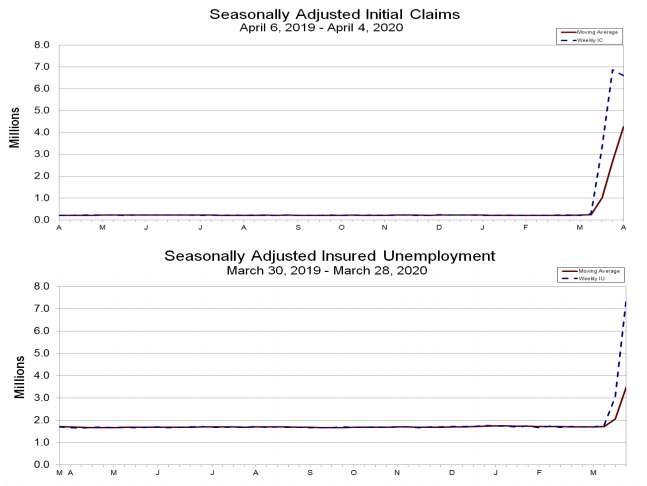
The Department of Labor reported that 6,606,000 Americans filed for unemployment insurance benefits in the week ending April 4, 2020 as the COVID-19 pandemic caused businesses to reduce or furlough their workforces. This was a very slight decline of 261,000 from the previous week’s upwardly revised record high level of 6,868,000. The speed and scale of the job losses is unprecedented. In the past three weeks, more than 16 million people have filed claims. At its worse during the Great Recession, there were 665,000 first-time claims filed in the week ended March 28, 2009. That was second only to the week ended October 2, 1982, when 695,000 first-time claims were filed.

Continuing claims for regular benefits, which are reported with an extra week’s lag, rose 4.4 million to 7.5 million.

The largest increases in initial claims for the week ending March 28 were in California, New York, Michigan, Florida, Georgia Texas and New Jersey.

This week’s increase in unemployment claims marks the third consecutive week of surging jobless claims and provides a window into the magnitude of the economic downturn into which we are solidly moving. Economists from a Wall Street Journal survey now project a spike in the jobless rate to 13% by June from its 50 year low of 3.5% as recently as February. In March, the rate had already increased to 4.4%. This same group of economists predict that real GDP will contract at an annual rate of 25% in the second quarter. In March, the expectation had been a decline of merely 0.1%. For the full year of 2020, GDP is projected to decline by 4.9%. In 2019 it grew by 2.3%.

In response to the expected sharp slowdown in the economy, the President signed into law a $2 trillion economic stimulus rescue package that broadly expands unemployment benefits. Independent contractors and self-employed individuals are now eligible, at least in some cases. More fiscal stimulus packages are expected to be enacted in the coming months to further blunt the economic fallout of the COVID-19 pandemic.

701,000 Jobs Lost in March, Presaging Further Losses Ahead

701,000 Jobs Lost in March, Presaging Further Losses Ahead

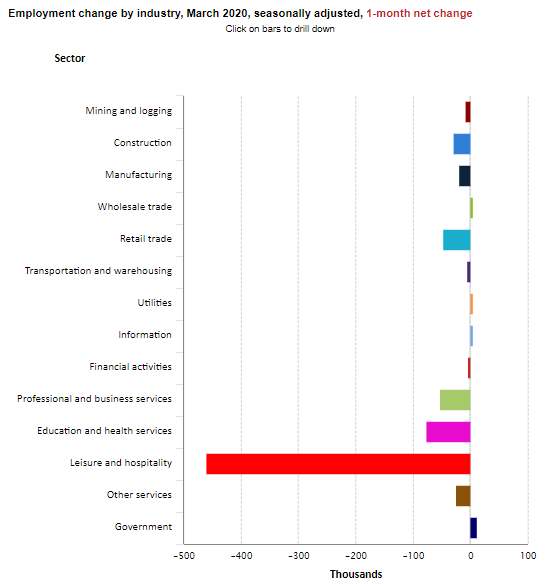
The Labor Department reported that there were 701,000 jobs lost in March. This was the first decline in jobs after 113 consecutive months of job gains and heralds more losses in the months ahead as businesses shed jobs due to the COVID-19 pandemic.

Yesterday, the Department of Labor reported that 6.6 million Americans filed for unemployment insurance benefits in the week ending March 28, 2020. In the past two weeks, 6.5% of employed people or nearly 10 million people have filed claims according to Bloomberg analysis.

Analysts had anticipated that there would be a loss of 100,000 jobs in March. The reason for the discrepancy between jobless claims and the loss in jobs reflects the timing of today’s survey, which took place in mid-March before stay-at-home orders began to be implemented.

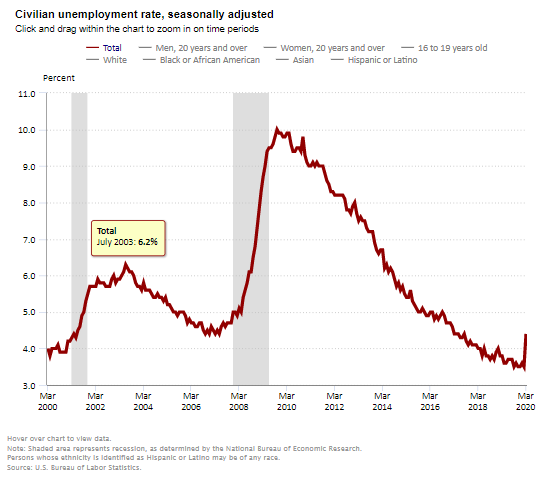
Separately, the March unemployment rate increased by 0.9 percentage point to 4.4% from a 50-year low of 3.5% in February.This was the largest over-the-month increase in the rate since January 1975 when the increase was also 0.9 percentage point. The underemployment rate rose to 8.7% from 7.0%. The number of unemployed persons rose by 1.4 million to 7.1 million in March.

The Congressional Budget Office earlier this week indicated that its projections have the unemployment rate rising to 10% for the second quarter of 2020 and to remain at 9% at the end of 2021. Other analysts project even higher rates. In the last recession, the unemployment rate peaked at 10%. The highest monthly unemployment rate on record, going back to 1948, is 10.8% set in late 1982.

Revisions also subtracted thousands of jobs in the prior two months. The change in total nonfarm payroll employment for January was revised down by 59,000 from 273,000 to 214,000 and the change for February was revised up by 2,000 from 273,000 to 275,000. Combined, 57,000 jobs were subtracted to the original estimates. Monthly revisions result from additional reports received from businesses and government agencies since the last published estimates and from the recalculation of seasonal factors. After revisions, job gains averaged 245,000 per month for January and February.

Employment in health care fell by 43,000 in March. In the prior 12 months, health care employment had grown by 374,000.

Average hourly earnings for all employees on private nonfarm payrolls rose in March by eleven cents to $28.62. Over the past 12 months, average hourly earnings have increased by 3.1%. Over the past 12 months, average hourly earnings increase by 3.1%.

The labor force participation rate, which is a measure of the share of working age people who are employed or looking for work fell 0.7 percentage point to 62.7%. Total employment, as measured by the household survey fell by 3.0 million to 155.8 million.

Today’s report is a precursor of future weak employment reports as the effects of the coronavirus reverberates through the economy. Most economic forecasters are projecting a significant contraction in GDP in the second quarter as the economy shuts down in response to social distancing and the pandemic even with the $2 trillion fiscal stimulus package signed into law by President Trump