Technology Boosts Contact Tracing Efforts in Senior Living Communities

Contact tracing has emerged as a first-line defense at senior living communities in the fight against the pandemic.

Contact tracing has emerged as a first-line defense at senior living communities in the fight against the pandemic. Knowing who has tested positive for COVID-19 and being able to identify their contacts has helped to keep community outbreaks in check.

While many providers rely on manual systems to conduct contact tracing, new technologies show promise to assist in the process to ensure resident and staff safety.

Take, for example, Kisco Senior Living. The Carlsbad, California-based company installed Accushield touchscreen kiosks at its 20 properties. Everyone entering the buildings—employees, outside providers, and visitors—are screened at the kiosks daily.

Individuals sign in at the kiosk which records the time, date, and, if applicable, who they’re seeing. The individual answers a series of screening questions about their current health condition. The questions can be customized to better identify those who might be at high risk for exposure to the virus. An immediate alert is generated if the individual has tested positive in the last 30 days.

Temperatures are checked manually at the kiosk, though an automated infrared temperature scanner is now being rolled out to expedite the process. Individuals who pass the screening receive a photo badge to wear while on site, an assurance for residents that the individual is authorized to be in the building. Individuals sign out at the kiosk when they leave the building.

Executive directors can log on to a dashboard to monitor data collected at the kiosk. If a home health agency, for example, calls to say an employee of theirs tested positive, Kisco can quickly access the records to determine which residents might have been exposed.

Of course, successful contact tracing relies on the ability to test those at risk. Kisco conducts surveillance testing depending on local mandates and whether the positivity rate in the county is 5% or higher. “We are data driven,” said Ed Ward, vice president of operations at Kisco.

Twenty-five percent of employees and outside providers are tested every two weeks. Residents are tested free of charge if they ask for a test. If a positive test is found, 100% of employees are tested every two weeks until two testing cycles show no positive cases.

“The Accushield system has proved to be exceptionally helpful with contact tracing,” said Ward. “Families and residents have a higher level of security and peace of mind.” He added that the company has initiated a campaign—Kisco Confidence—focused on the wellbeing, safety and security of all residents and associates.

Screening Advances

For years, senior living providers have mostly relied on manual sign-in logs to monitor who is in a building. But using these logs to conduct contact tracing can prove difficult, building operators say. Hand-written logs can be hard to read or may be incomplete. Interviews with staff and residents to recall their contacts may not produce an accurate report.

CarePredict launched an automated contact tracing product March 31 called PinPoint. It is an add on to the company’s monitoring solution that uses wearables and beacon technology to chart resident activity.

The PinPoint product allows facility staff to quickly identify all residents, staff, and visitors exposed to a suspected virus carrier. A report provides a breakdown of contacts, location and duration of contact.

“It’s a tool to break the chain of spread,” said Jerry Wilmink, chief business officer of CarePredict, which has offices in Fort Lauderdale, Florida, and Menlo Park, California.  

Contacts are classified by risk, so the staff can test and isolate those who pose the most significant threat. Another advantage, according to Wilmink, is that the Pinpoint solution reveals which individuals have not been exposed so they don’t have to be isolated. “They can get their life back,” he said.

CarePredict is being used at more than 20 communities, said Wilmink. Inquiries from Arizona, Texas and Florida have increased recently because of the uptick in COVID-19 cases there.

Costs of automated visitor management and contact tracing systems typically include installation and monthly subscription fees.

Many operators use a combination of approaches to trace cases. Montgomery Place, a life plan community in Chicago, has an automated check-in system for employees, visitors and outside service providers. The check-in system was enhanced in the wake of the pandemic with health questions and temperature screens.

COVID-19 cases are tracked manually. But the information is entered into the community data base system to generate email and cell phone alerts for the staff, residents and family members. “We know automated tracing technology is out there,” said Deborah Hart, executive director at Montgomery Place. “But I’m not going ‘Big Brother’ and putting chips on people. I’m not there yet.”  

With different tools available, communities are sorting through the options. “We are debating automated contact tracing,” said Nancy Kao, executive director at The Forum at Rancho San Antonio, Cupertino, California. LCS is the management company. Contact tracing is currently done manually.

The life plan community is undergoing a $100 million repositioning that incorporates a lot of technology. The new memory care building, for example, includes a GPS tracking system for residents.

Kao chairs the Innovation Council at LCS, which manages about 140 senior living properties. The Council evaluates different products and recommends best practices.

“Communities are reaching out for more guidance on technology because of COVID-19,” said Kao. “Every community is in a different place on the adoption of technology.”

Pandemic Strengthens Link Between Healthcare and Housing

Health system takes equity stake in senior living project Prior to the COVID-19 outbreak, senior living providers already recognized the value of forming alliances with healthcare providers. Easy access to good healthcare helps residents live well and longer. On-site clinics and insurance plans for residents have been growing in popularity over the last several years. […]

Health system takes equity stake in senior living project

Prior to the COVID-19 outbreak, senior living providers already recognized the value of forming alliances with healthcare providers. Easy access to good healthcare helps residents live well and longer.

On-site clinics and insurance plans for residents have been growing in popularity over the last several years. But the pandemic has put an exclamation on the point that caring for a frail, elderly population requires close collaboration with healthcare providers. Residents cannot be kept safe without rigorous protocols and the input of experts on infection control.

Two new projects by Belmont Village Senior Living, in Florida and California, are examples of how healthcare partnerships are key today. The projects also show how the healthcare sector has growing appreciation for the value of collaboration with senior living.

In June, the City Commission of Coral Gables, Florida, approved Belmont Village Coral Gables, a mixed-use senior living community. Press reports estimate the project value at $100 million.

What’s different here is that Belmont’s equity partner isn’t a private investment firm or REIT. Instead, the partner is Baptist Health South Florida, the largest nonprofit healthcare organization in the region.

It’s not unheard of for health systems to own seniors housing, but the approach has not been widespread, and the projects tend to be limited in scope. For example, CentraState Healthcare System, a nonprofit provider in Freehold, New Jersey, operates three senior living communities.

Belmont Village Coral Gables will offer 232 apartments for independent living, assisted living and memory care, along with a three-story garage and more than 18,000-square-feet of retail and commercial space.

The ground floor of the new building will include a Healthy Living Center by Baptist Health. The Center will provide services and programs to residents as well as elders in the wider community.

“This is the first partnership of its kind,” said Patricia Will, co-founder and CEO of Houston-based Belmont Village. “Our joint venture was created to reimagine the integration of hospitality and healthcare in seniors housing.” She added that the equity stake by Baptist Health aligns the financial interests and broader missions of both organizations.

The Coral Gables project is expected to break ground in late 2020 and open near the end of 2022. It is the first in a series of communities planned for the region by Belmont Village and Baptist Health South Florida.

Commenting on the project, Will said her company never saw a dichotomy between great healthcare and great hospitality. Both elements are vital to the success of a senior living community.

The pandemic highlighted the importance of Belmont’s dual focus, said Will. For example, a number of years ago, the company partnered with the University of California, San Francisco, to develop protocols to mitigate the spread of seasonal flu.

That collaboration helped Belmont pivot and put effective processes in place to combat the COVD-19 outbreak. “When you have those kinds of partnerships going in, you are better prepared for what to do when clinical challenges present themselves,” said Will.

Collaboration takes many forms

In June, Belmont Village and residential developer Greystar broke ground on a new 17-story project in La Jolla, California. Belmont Village Senior Living of La Jolla will offer 180 units of independent living, assisted living and memory care. Harrison Street Real Estate Capital is the equity partner.

The project is Belmont’s third in the San Diego area. The company already has ties to the University of California San Diego School of Medicine. The new project is located around the corner from UCSD’s main campus.

Belmont plans to collaborate with UCSD’s Center for Healthy Aging which will have input on programming at the property. Last year, the Center launched a study on how to improve the resilience of seniors. Residents at the two existing Belmont projects in San Diego were included in the research. Results show that certain individual activities can improve the resilience of an elderly population. “We can enhance their experience,” said Will, adding that the lessons learned were carried over to residents during the lockdown.

“COVID-19 was life interrupted,” said Will, reflecting on the broader implications of the pandemic. “But we are growing our capabilities through collaboration.”


Silver Linings in a Crisis

Despite the pandemic, senior living providers have inspiring and heartwarming stories to share.

No dining room service. Family visits on Zoom. Routine caregiver tasks transformed into something out of a science fiction movie.

Despite the enormous obstacles, senior living providers have a lot of inspiring and heartwarming stories to share.

Case in point: Police officers and firefighters recently rolled up to Aspired Living of Westmont with horns and sirens blaring to honor the anniversaries of two couples who were married on the exact day 69 years ago. Fellow residents and team members at the assisted living community in suburban Chicago joined in with noisemakers of their own. The mayor of Westmont FaceTimed with the couples offering his well wishes. The staff baked anniversary cakes and gave live piano serenades of old favorites such as “Let Me Call You Sweetheart.”

The celebration looked different than traditional anniversary parties because of the COVID-19 lockdown. But it’s just one example of the good things happening at communities upended by the coronavirus. “We’ve never seen anything like this,” said Mike Ulm, vice president of culture and brand loyalty at Pathway to Living, the operator of Aspired Living. “We’re all in this together.”

The pandemic does have some silver linings.

In many cases, the wider community has stepped up to help which has created new and lasting ties. Bonds have been fortified between residents and staff. They’re more like family. And creative approaches have introduced an element of fun.

Above all, corporate culture has been strengthened by a shared mission to keep residents safe, according to senior living providers. Managers can’t say enough good things about the dedication of the frontline staff under stressful circumstances.

“I am so proud of our team members,” said Lori Alford, a co-founder and COO at Houston-based Avanti Senior Living. The company owns and operates assisted living and memory care properties in Texas, Louisiana, Florida and Arizona. She recalls the uncertainty faced by operators at the start of the outbreak. ‘We didn’t know how this would shake out.”

But the Avanti care teams came through, said Alford. In fact, the company has experienced its lowest absentee rate and the least amount of overtime among workers during the lockdown than at any other time in company’s history. “This pandemic has shined a light on our culture,” she said.

To support staffers, Avanti offered them free telehealth services typically only available to residents. “It was a good way to show the team that we wanted to take care of them,” said Alford.

The pandemic has also galvanized the work culture at Avista Senior Living, according to Kris Woolley, founder and CEO at the Mesa, Arizona-based company. “It’s been a scary, uncertain, isolating, frustrating and nerve-racking period of time for everyone,” he admitted. But it’s also united his team to fight a common enemy that they were determined to overcome. “It’s brought out a lot of goodness in us,” said Woolley, noting how the staff stepped up to cover shifts for each other. “We’ve been pleased and comforted to see that humanity come out.”

The Grand at Twin Lakes, an assisted and independent living community in Palatine, Illinois, offered its workers themed goodie bags weekly. The “movie night” bag included chips, popcorn, soda and candy. Executive Director Melissa Cosentino said it’s a small gesture of thanks and commented that the pandemic has brought the staff closer together. “Our culture has only gotten stronger.”

Pathway to Living created an “inspiration team” to boost worker morale. The team developed an ongoing communications program—the “Voice of Viva.” Team members receive encouraging messages three times a week. Sunday’s message is inspirational. Wednesday is humor day. Friday features success videos, such as a family member praising the staff.

Other positive approaches at Pathway include Zoom trivia and Bingo competitions for the staff and thank you stations with giveaways. “We wanted to create a fun, safe way to connect,” said Ulm.

Connections to the wider community have been strengthened too. Avista posted requests on JustServe.org. a website that links volunteers and good causes.  Local volunteers created gift baskets and hand-sewn face masks for the residents and staff at Avista communities.  

While resident safety is the top priority, it feels good to have fun.

During the lockdown, Avista residents made dance videos on the social media platform TikTok. To facilitate visits, window chats positioned resident inside and their loved ones outside. Residents use a telephone to talk to their families. It’s been a great way to show off milestones like a new grandchild or learning to ride a bike.

Outdoor parades have lightened the mood. Motorcycle, antique car and pet parades have been popular. Community groups perform outdoor concerts for residents.

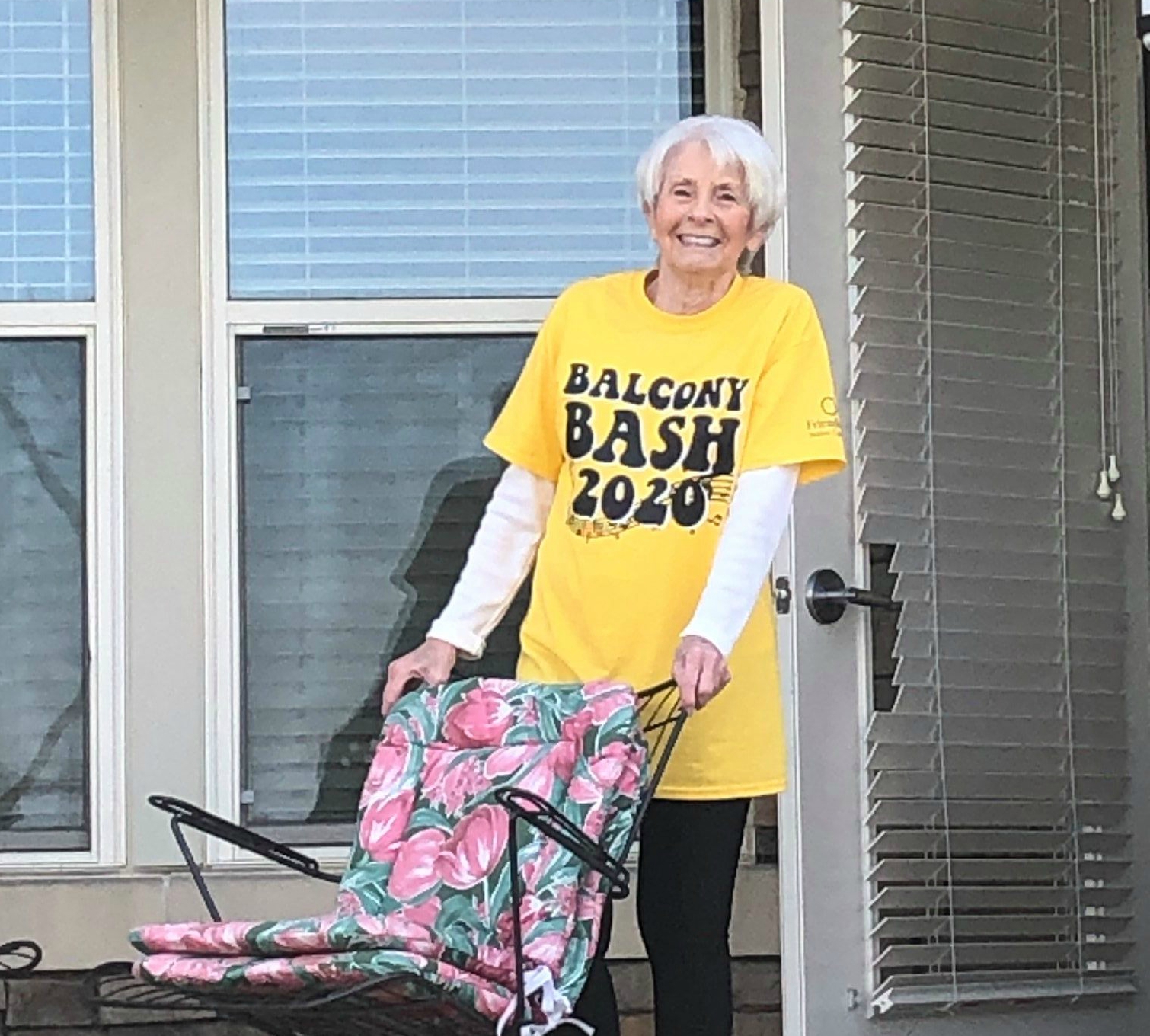
balconybash5GreenFields of Geneva, a life care community near Chicago, held a “balcony bash.” Six different bands were stationed around the property, including an orchestra and Elvis impersonator. Residents received bright yellow “balcony bash” t-shirts to wear while they enjoyed the concert from their patios and balconies. The staff delivered refreshments to the residents’ apartments.

Family drive-bys help everyone feel better. At Avanti’s Houston project, Augusta Pines, a car parade included family, friends and local community groups. Residents came outside to watch a stream of cars decorated for the occasion and filled with smiling and waving loved ones. “It was really cool,” said Alford. “As I was leaving, a resident said the parade was one of the best days of her life.”   


{{cta(‘05843e86-7aea-4b9a-9eb8-25a86f116f95’)}}

New Solution Taps Healthcare Dollars to Fund On-Site Services

Pandemic underscores impact of social determinants of health Before the pandemic hit three months ago, one of the hottest industry topics was the social determinants of health. Recognition has been growing over the last several years that a huge amount of healthcare costs is driven by people’s lives outside of the doctor’s office. Factors such […]

Pandemic underscores impact of social determinants of health

Before the pandemic hit three months ago, one of the hottest industry topics was the social determinants of health. Recognition has been growing over the last several years that a huge amount of healthcare costs is driven by people’s lives outside of the doctor’s office. Factors such as food insecurity, isolation, and lack of access to services are just a few of the social elements that contribute to healthcare outcomes. A frail elder without social support is unlikely to manage the intricacies of a complex healthcare system.

The pandemic has drawn even more attention to the link between health and life circumstances. Communities that face social challenges, particularly those of color and the frail elderly, have been hit hard by the disease.

“People’s needs are spiking,” said Michael Monson, senior vice president of Medicaid and complex care at Centene, a St. Louis-based insurer and the nation’s largest Medicaid managed care organization.

While living conditions are widely recognized as a health factor, a big question for seniors housing operators has been how to pay for support services that impact health. Should health systems, or insurers, pay seniors housing operators to track the health habits of their residents and provide interventions?

“We do not have sustainable flows of funds from the healthcare sector to seniors housing,” said Monson.

Piece-meal solutions are slowly emerging. Some Medicare Advantage plans are starting to offer benefits that address the social determinants of health, such as meals and exercise plans. Pilot programs test new approaches but are not widely available.

Because of its impact on vulnerable groups such as seniors, the pandemic could accelerate the push for more social services, experts say. But collaboration will be key to success.

How to link healthcare and housing

In 2019, Centene launched a new subsidiary called Social Health Bridge. Monson is the CEO. Social Health Bridge acts as a financial and interventional layer between the healthcare sector and community organizations, including housing providers. The goal is to improve health outcomes and lower healthcare costs by providing social supports and access to critical services for residents.

Social Health Bridge offers a market-based solution for seniors housing operators, explained Monson. “This is a way to create a regular funding stream to pay for certain services.”

Here’s how it works. Residents sign up to join the Social Health Bridge Network. It includes local health systems, hospitals and physician groups in value-based arrangements that tie compensation to certain performance measures. Residents can have any kind of insurance, whether a Medicare Advantage plan, Medicaid, or a private plan.

The Network pays for a resident service coordinator on-site at the building. The service coordinator links residents to needed services and interventions on behalf of the healthcare providers. Typical services include case management, transportation, and other social supports. A long-term program goal is to place doctors and nurse practitioners on-site with office hours to fill care gaps.

The idea harkens back to the 1960s when HUD-financed senior apartments introduced service coordinators on-site. Centene beefed up that model and introduced standardized protocols, policies, technology systems and oversight. “We give them the tools they need to improve quality health scores while lowering healthcare costs,” said Monson.

Lower healthcare costs result in savings which fund the program. “Seniors housing pays us nothing,” said Monson, adding that many assisted and independent living properties don’t have the budget for an on-site service coordinator. It’s important to note that the seniors housing operators bear no insurance risk, he added, in contrast to programs where the housing operator forms its own Medicare Advantage plan.

The program is suited for independent and assisted living communities, not skilled nursing facilities.

The business model works best with a large risk pool of participants, probably 10,000 individuals or more, said Monson.  To reach that scale, Centene seeks markets where it already has a strong customer base.

Last January, Centene launched its first community partnership in New Orleans with an affordable housing provider. The first step is to assess residents and find them access to care, though Monson said the pandemic has slowed the process. An agreement with a seniors housing community is in the works.

“We are in early days,” said Monson, commenting on the roll-out of Centene’s program. “But this is an option to bring together the seniors housing provider and health system network.”

$15 Billion HHS Distribution Will Reach Assisted Living and Skilled Nursing Operators That Serve Medicaid Residents

Overview of HHS $15 billion distribution for providers serving Medicaid and CHIP recipients, including eligible assisted living facilities who serve Medicaid residents.

The Department of Health and Human Services (HHS) has announced an additional $15 billion distribution, targeted at providers serving Medicaid and CHIP recipients. Included among these recipients are eligible assisted living facilities that serve Medicaid residents. According to the National Center for Assisted Living, 16.5% of assisted living residents rely on Medicaid. Skilled nursing properties serving exclusively Medicaid residents are also eligible. To qualify, providers must not have received a payment from the Provider Relief Fund General Distribution. 

Medicaid providers can use the HHS portal to complete the application process for funding requests. Funding will start at 2% of reported gross revenue for patient care. HHS will use additional information, including number of Medicaid residents served, to ultimately determine the final payment amount. 

Industry associations continue to advocate to secure an allocation of funds to provide relief to private pay seniors housing operators who have served, and continue to serve, on the frontlines of the COVID-19 pandemic. 


{{cta(‘05843e86-7aea-4b9a-9eb8-25a86f116f95’)}}