130,000 Jobs Created in August, Below Consensus View

130,000 Jobs Created in August, Below Consensus View

The Labor Department reported that there were 130,000 jobs added in August, below the consensus estimate of 160,000.  About 25,000 of the jobs added were temporary positions associated with the 2020 census.  For the eight months through August, the average monthly increase in total employment has been 158,000, below the average monthly gain of 223,000 in 2018. The private sector added 96,000 jobs in August, weaker than the monthly year-to-date pace of 145,000 and down from an average monthly gain of 215,000 in 2018.

Revisions subtracted 20,000 to the prior two months.  The change in total nonfarm payroll employment for June was revised down by 15,000 from 193,000 to 178,000 and the change for July was revised down by 5,000 from 164,000 to 193,000.   Monthly revisions result from additional reports received from businesses and government agencies since the last published estimates and from the recalculation of seasonal factors.

The August jobs report has garnered special attention since there are broad-based concerns about a slowing national economy amid signs of a weakening manufacturing sectors, slowing business investment and trade-related weakness associated with rising tariffs.  In fact, the Fed lowered interest rates on July 31st for the first time since 2008 as it reacted preemptively to concerns of a potential economic slowdown.  For several months, concerns about trade wars and slowing growth in Europe, China and the U.S. have been on the radar screen of the Fed.  Federal Reserve Chair Jerome Powell said the cut was “intended to ensure against downside risks from weak global growth and trade tensions.” The move is being labeled an “insurance cut” because it is meant to keep the economy’s engine pumping.  The fed funds rate is now targeted at a range of 2% to 2.25%, down 25 basis points from its prior target range. Until July and since late 2015, the Federal Reserve had been gradually raising rates following six years of virtually 0% interest rates (2009 through 2015).  The August jobs report is likely to add pressure to the Fed to lower rates further at its upcoming September 18th FOMC meeting.

The August unemployment rate was unchanged at 3.7%.  This is still close to the lowest rate in 50 years.  A broader measure of unemployment, which includes those who are working part time but would prefer full-time jobs and those that they have given up searching—the U-6 unemployment rate—rose to 7.2% from 7.0%, reversing a July drop.

Average hourly earnings for all employees on private nonfarm payrolls rose in August by eleven cents to $28.11. Over the past 12 months, average hourly earnings have increased by 3.2%.   For 2018, the year over year pace was 3.0% and in 2017 it was 2.6%.

The labor force participation rate, which is a measure of the share of working age people who are employed or looking for work was unchanged at 63.2% in August, very low but up from its cyclical low of 62.3% in 2015.  The low rate at least partially reflecting the effects of an aging population.

One Year Later: An Update on the Welltower-ProMedica Partnership

Welltower’s Tom DeRosa discusses how the game-changing deal is taking real estate to the next level   In July 2018, a groundbreaking partnership provided further evidence of the industry’s quickly changing trajectory. In a $4.4 billion deal, the big healthcare REIT Welltower and ProMedica, a large nonprofit healthcare system, formed an 80/20 partnership for the […]

 
Welltower’s Tom DeRosa discusses how the game-changing deal is taking real estate to the next level  

In July 2018, a groundbreaking partnership provided further evidence of the industry’s quickly changing trajectory.

In a $4.4 billion deal, the big healthcare REIT Welltower and ProMedica, a large nonprofit healthcare system, formed an 80/20 partnership for the real estate linked to HCR ManorCare, the nation’s second largest post-acute long-term care provider.  ProMedica purchased HCR ManorCare’s operations in a separate transaction.

The anniversary of the deal represents an opportune time to check in on the partnership’s progress. NIC recently spoke with Tom DeRosa, chairman and CEO at Welltower about the alliance of healthcare and housing, and what it means for the industry going forward.

Here’s a recap of the conversation:

NIC: Why was Welltower originally interested in forming a joint venture with nonprofit ProMedica to acquire HCR ManorCare?

DeRosa: The partnership demonstrates how a health system can further vertically integrate across the heatlhcare continuum. Prior to the joint venture, ProMedica was an acute care system with ambulatory care that also owned a payor, Paramount Health Care. As an insurance company, Paramount offers Medicare Advantage and managed Medicaid plans, and dental and vision plans. The acquisition of HCR ManorCare with Welltower more deeply vertically integrates ProMedica into post- acute care, rehab, skilled nursing, home health, hospice, memory care and assisted living. ProMedica is one of the best examples of a fully vertically integrated health and wellness delivery ecosystem. Welltower was excited to have a role to demonstrate the viability of our platform to facilitate a landmark healthcare transaction.

NIC:  What is the status of the integration of ProMedica and HCR ManorCare?

DeRosa: The integration is multi-leveled and going quite well. One of the things we’ve seen is that ProMedica has done a very good job of assessing the talent pools at both ProMedica and HCR ManorCare and has chosen the best people to run respective functions. For example, ProMedica’s CFO Steve Cavanaugh had been CEO of HCR ManorCare. The acquirer has demonstrated that they will go with the best people. It’s not just “my way or the highway” which often derails business combinations.

NIC: Are the business systems integrated?

DeRosa: It’s still in process. ProMedica is vertically integrating as their business is evolving. This requires management to be very nimble because so much is changing as we speak. It’s hard to put a timeline on that. Welltower is evolving everyday too. Management has to be able to change direction based on where the market may go in the future.

NIC:  Is HCR ManorCare now a nonprofit entity?

DeRosa: Yes, that was the first milestone after the closing. They have achieved a nonprofit status. It’s very beneficial to ProMedica from a financial standpoint but also beneficial in that there may be potential opportunities for ProMedica with HCR ManorCare to provide services to other health systems on the post-acute skilled nursing side. In certain cases, the fact that HCR ManorCare is a nonprofit makes them a preferred provider.

NIC:    Does HCR ManorCare’s nonprofit status impact your ownership structure?

DeRosa: Not at all.

NIC: Are the financial results what you expected so far?

DeRosa: They’re on track. This is a long-term investment for us. We have a master lease with ProMedica for the properties.

NIC: Is the partnership driving meaningful integration that leads to better care and outcomes for seniors?

DeRosa: Definitely. I have two observations. ProMedica’s protocols from the acute care business are being shared with the post-acute skilled nursing and senior living businesses of HCR ManorCare. Also, ProMedica is probably the first major U.S. health system to have an operating and strategic focus on the social determinants of health. ProMedica CEO Randy Oostra has had a lot of foresight to build resources around that. I think this is a space where other health systems are playing catch up.

Experts say 80 percent of health, especially for seniors, is determined by factors other than healthcare, such as where you live, the broader environment, and socio-economic circumstances. ProMedica is improving outcomes by implementing successful strategies around these factors. Take the area of nutrition. When you’re dealing with a population of people being discharged from the hospital to skilled nursing, you’re trying to treat them in a lower cost setting to get them back into their home as soon as possible. They don’t need to be in a hospital bed, but they need a certain amount of rehabilitative care before their physicians believe they can be living independently again. One of the areas we know is so important to prevent that individual from bouncing back into the acute care system is food. A huge issue is food insecurity. It’s not always about having the money to buy food, but knowing how to eat well to control various health conditions.

For example, a hospital patient might be a type 2 diabetic, arthritic and have COPD. If the person is eating a high salt, high fat, high sugar diet, like many people in this country do, the diet is working against whatever benefit he or she may have received from the hospital stay. ProMedica understands this. They’ve done everything from working with individuals to understand how they can eat better to the fact that they were the first health system to introduce food pharmacies. Physicians can write prescriptions so patients can get fresh fruits and vegetables and higher quality proteins from a food pharmacy. That’s a game changer.

NIC: Can you comment on the importance of the physical structure of the building as a way to deliver improved outcomes?

DeRosa: A good example is HCR ManorCare’s Arden Courts business, which provides specialized memory care. These buildings are designed for people with memory impairments and that makes a difference. Research shows people who suffer from dementia are comfortable when they don’t run into dead ends, so the facilities are designed on a circular racetrack-type model. We know this helps to soothe an unquiet mind.

People are living longer, so there are more people suffering from memory loss. Hospitals today are unprepared for the influx of older patients with dementia. A health system with a competency in memory care like ProMedica has with HCR ManorCare will be better able to manage this population. It’s an example of a how to create a broader ecosystem of care.

NIC:  Any lessons learned so far from the partnership?

DeRosa: Bringing three parties together has created an opportunity for innovation. Welltower has a skill set in residential care. We’ve combined that with ProMedica’s acute care system and HCR ManorCare’s post acute, home health, and hospice services to form a collaborative culture. That’s exciting. We’re looking at new ways to manage the aging population more effectively.

NIC: What is the size of the market opportunity with nonprofits?

DeRosa: There are hundreds of millions of dollars in real estate sitting on the balance sheets of nonprofits that was built under a very different fee-for-service model. The whole profitability structure of the nonprofit health system has changed over the last 10 years. These were double-digit margin businesses and today they are low single-digit margin businesses. Given all the places nonprofits need to invest in a more competitive market, the question is whether they have the ability to continue to control all that real estate. Some of it needs to be phased out. We have developed a strategy at Welltower around that thesis. The joint venture with ProMedica is a perfect example of how a real estate healthcare infrastructure platform like Welltower can help a nonprofit health system grow, and develop an advantage, in a much more competitive business going forward.

NIC: Will this be a driver for Welltower’s growth? If so, what kinds of partners will Welltower be seeking?

DeRosa: There will be many opportunities that come from the integration of residential care concepts and nonprofit healthcare systems. We’re very optimistic about how these types of joint ventures actually capture another layer of value for the senior living sector. For so long, values have been based on the real estate alone. But there is a growing recognition of the role real estate plays to drive lower costs and better outcomes in healthcare.

Leadership Development, Industry Networking, and Lessons in Advocacy at the 10th Annual NELS Summit

Leadership Development, Industry Networking, and Lessons in Advocacy at the 10th Annual NELS Summit

www.nelssummitIn mid-July 2019, I had the pleasure of attending the 10th Annual NELS Summit in Washington, DC. NIC is a proud co-sponsor of the three-day event, where emerging leaders in health and aging services can connect with peers, develop their leadership skills, learn about advocacy, and network with industry leaders. The majority of NELS attendees hold Executive Director or Administrator positions at skilled nursing facilities, assisted living and independent living communities, CCRCs, rehabilitation hospitals, affiliated organizations, and home- and community-based services.

I was struck by the candor, professionalism, and dedication of attendees, organizers, and presenters. Their enthusiasm for improving the lives of residents, staff members, and families was truly moving and representative of the ideals that draw people to careers in health and aging services.

On the first day of the Summit, Dr. Kevin Hansen, Assistant Professor at Bellarmine University, and Director of NELS, introduced the history of NELS, the purpose of the summit, and data from a pre-summit survey. Michael Muetzel, President, Author, Leadership Development at Mx Marketing Management Solutions, provided insight focused on generational differences in the work force and the strategies and benefits of leading diverse teams and creating positive workplace culture. Attendees also shared best practices and perspectives on a range of topics like regulatory environments, staffing pressures like recruitment and retention, and culture in small round table discussions. These presentations and conversations provided attendees with new, practical strategies and ideas they could implement in their communities after the Summit.

On the second day of the Summit, attendees listened to a panel presentation and discussion of NELS alumni moderated by Dr. Douglas Olson, Professor at the University of Wisconsin Eau Claire, and Senior Advisor for NELS. The panel discussed what NELS meant to them and provided valuable lessons in their journeys in leadership— not only as leaders in their respective organizations, but also in their professional organizations and advocacy efforts.

Liz Liberman, Senior Analyst Manager at Bulletin Intelligence, and Dr. Kevin Hansen discussed legislative policy advocacy. Liberman detailed how NELS attendees and others can comment on potential legislation from the executive branch to make their experiences and voices heard on topics impacting their communities. Hansen also discussed advocacy strategies that NELS attendees can implement with the support of their communities to impact potential legislation. NELS attendees finished the day by traveling to Capitol Hill for a meeting with Wisconsin Congressman Ron Kind and his staff.

On the final day of the Summit, attendees met leaders of several major partnering organizations including LeadingAge, Argentum, NAB, ACHA, and ACHCA. The group of leaders presented a panel discussion covering topics including their paths to their current positions, what their respective organizations do and offer members, valuable resources and research for leaders, and current issues affecting health and aging services. Attendees also had the opportunity to speak with leaders in small breakout group sessions to learn more details about their organizations and membership.

Interspersed between the presentations over the three days were group exercises designed to develop attendees’ connections with each other and areas of interest, culminating in final teams. Teams developed ideas for projects for the coming year with the support of Dr. Hansen, Dr. Olson, Mr. Muetzel, Dr. Keith Knapp, Associate Professor, Bellarmine University, and Lindsey Creapeau, HCAD Practicum Coordinator, Health Care Administration Program at the University of Wisconsin – Eau Claire. The attendees of this year’s summit will work in teams throughout the year on the projects— all with the goal of “developing solutions to enrich lives.” Summit proceedings, outcomes, and key conclusions from each year are published in a white paper that is available for download on the NELS website.

If you are interested in attending or know someone you think would be a good candidate, applications for the 2020 NELS Summit will be open on nelssumit.org starting in the Spring. We highly encourage you to send your best and brightest to this excellent opportunity for leadership and professional development in 2020

The Evolving Senior Housing Resident

The Evolving Senior Housing Resident

Zhao_JennyThe seniors housing resident profile has changed since the industry’s early days in the 1990s. Seniors are generally choosing to enter a community later in life as better medical care and quality of life continues to increase life expectancy. Americans are staying healthier for longer, so it’s not surprising that the industry has observed a gradual increase in a resident’s average age as many are now choosing to enter seniors housing well into their 80s. According to a 2013 study conducted by American Seniors Housing Association and ProMatura Group of 6,858 IL rental customers, only 6% of IL rental customers were under the age of 75.

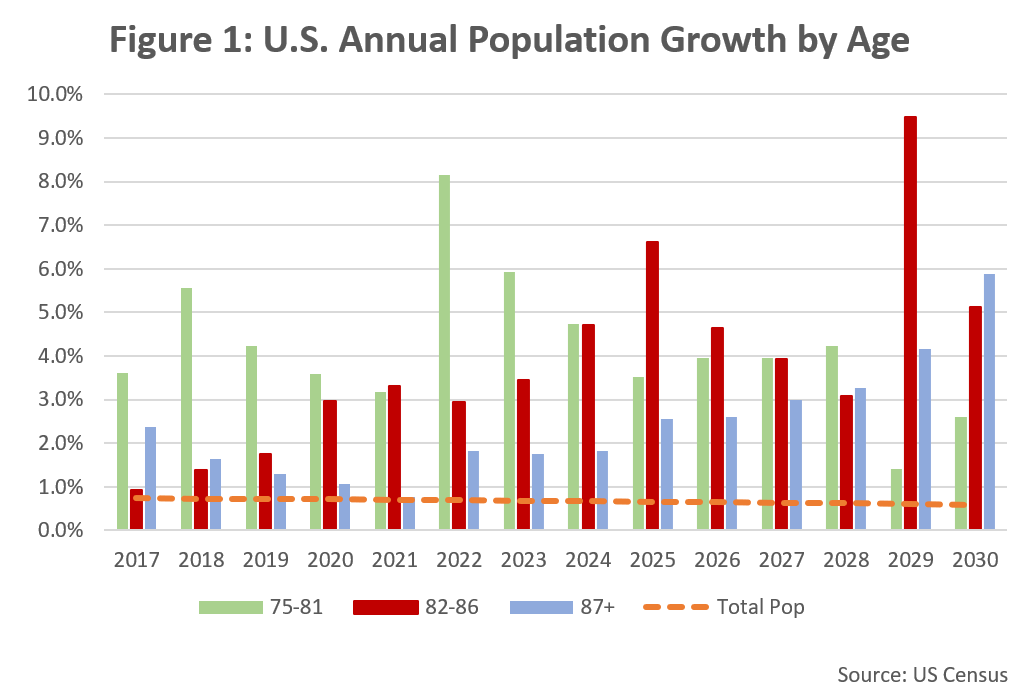
Why does it matter that residents are moving in later? Simply put, the Baby Boomers. Baby Boomers are one of the largest demographic cohorts (74 million in the U.S.) and have begun to reach the age of 65 and older. As shown in Figure 1, the growth in Americans aged 75 and older will accelerate over the next 15 years and comprise 15% of the overall population by 2029 (up from 11% in 2019) as the Baby Boomers age. This unprecedented wave of future demand will have lasting ramifications on the seniors housing and care industry. That said, determining when this will occur has become a moving target as Baby Boomers are waiting longer than prior generations to consider seniors housing options.  

chart_-_Zhao

The Baby Boomers are very different than their Silent Generation parents. First, the Baby Boomers will have a much longer retirement. The first of the Baby Boomer generation was eligible to retire in 2012 and will likely enjoy 25 post-work years. The oldest Baby Boomer is turning 73 years old this year and remains largely independent and active. They are potentially a decade away from requiring any assistance with daily activities that seniors housing provides. Second, Baby Boomers grew up in a period of economic expansion and social progress, and as a group, they are more educated, wealthier, and more physically fit than past generations. Boomers want what they want and many will have the financial means to maintain their desired lifestyle. Their health is a priority – both physical and mental – and Boomers are committed to staying active. They desire a community where they can make new friends and be social. They value convenience and want easy access to healthcare, shopping, dining, cultural events, and more.   

While seniors housing is already prepared to offer tailored services to a new Baby Boomer resident, we may need to patiently wait a little bit longer. 80 is a new 65, which has created a void between Americans who are turning 55 years old and Americans who require independent living services where there are not many choices available. This has resulted in some industry players getting creative because while Baby Boomers may not have any need-based care demands at the moment, they certainly have many want-based demands that remain underserved. The most traditional alternative remains home health, although the sophistication of the business has increased tenfold since its inception. More recently, the biggest disruptor that has come onto the scene is active adult. The biggest players in the space so far are making big bets on what they think the Baby Boomer consumer is looking for and have been first movers in trying to tap into this deep market.  

This new active adult product is nothing like the traditional communities developed by Del Webb. The current offering is a blend of multifamily and independent living. Similar to multifamily, these communities emphasize an independent lifestyle where Baby Boomers are self-sufficient. But like independent living, active adult offers residents a welcoming community with amenities and targeted activities and events.  

While it’s still too early to tell if active adult housing will successfully grab a sizeable piece of the Baby Boomer market, this definitely won’t be the last option we will see. We should expect more disruptor options to emerge as business entrepreneurs try to grab a piece of the Baby Boomer residential market. We are already starting to see this. While the first active adult investors were multifamily developers, some seniors housing veterans have also since entered the space. While it remains to be seen what format of housing and amenities Baby Boomers ultimately will want, they will need access to healthcare, which the seniors housing and care industry has expertise in providing. Our industry has remained nimble as we’ve adapted to our evolving resident, and we will continue to be at the forefront as we figure out how best to serve our aging Boomer.  

Activating Consumer Insights at the NIC

Activating Consumer Insights at the NIC

In NIC’s upcoming Fall Conference, attendees will have the opportunity to learn how to use consumer insights from other industries as they formulate strategies to address some of the challenges facing the seniors housing sector today. The session titled “Activating Consumer Insights: Lessons from Other Industries” is taking place on Thursday, September 12th at 2:15 to 3:30 PM CT and promises to be thought provoking and insightful.

Consumer insights and feedback are routinely used to guide product development and marketing in industries such as hospitality and consumer goods. The seniors housing sector, however, has yet to widely adopt this approach to addressing its own product development and marketing challenges.  This session is designed to help industry participants think about marketing as a feedback loop in which consumers’ input and behavior inform product development and lead to greater innovation.   This is particularly relevant for today’s operators and capital providers since the seniors housing sector faces numerous challenges, including evolving demographics, changing consumer expectations and demands, and, for many potential residents, a lack of familiarity with the product.    

Moderated by Maria Nadelstumph, VP, Organization Development & Program Excellence at Brandywine Living, the discussion will be focused on solutions relevant and appropriate to the seniors housing and care sector. Nadelstumph will use her first-hand experiences to ensure that the discussion is useful to session participants. She has direct experience with the development of Brandywine’s high-end hospitality model, which features numerous innovations designed in response to shifting demographics and consumer demands.  

The discussion will hone in on how the tools and processes used routinely  in other industries can be employed to gather and make use of consumer feedback  in the development cycle for seniors housing and care. Techniques for borrowing successful innovations from other industries will also be shared.  

Jennifer Rasmussen Windbeck is a Managing Vice President in Capital One’s Retail and Direct Bank, leading the national Capital One Cafes and the Louisiana and Texas branches; as well as Customer Experience, Operations, and Physical Network Management for all branches and cafes. She leads the frontline cafe and branch teams and operations. In addition, Windbeck has responsibility for in-store customer experience and market engagement strategy, including innovating and executing upon customer guidance and transactional capabilities; associate experience and development; local community engagement; and scaling digital-first communications and operational processes.  Windbeck has leadership experience guiding experiential design, investigating customer behavior and change, and how to create something really unique in the market. While confined to the brick and mortar of their branches, Capital One has found a way to change the experience within those four walls to meet the myriad shifting tastes and demands of their customers, ranging from millennials to boomers. 

Heather Reavey, Head of Innovation Delivery at EPAM Continuum, will speak to product innovation. She thinks about where innovation is going and shapes EPAM Continuum’s people, practices, and processes to be there first. Reavey’s career has been dedicated to innovation since she began consulting in the role of Envisioner, focused on designing new-to-the-world ideas and strategies, and demystifying complexity through storytelling to catalyze organizations to take action. Over twenty years, Reavey has led teams and helped launch game-changing ideas and strategies for Procter & Gamble, Insulet, Tetra Pak, American Express, and UnitedHealthcare.  

Reavey will share ways to identify what is a good insight for innovation. She will discuss how to re-frame a challenge for innovation, and how to translate and activate novel ideas into new innovation across an organization and in a business environment.  

This exciting session promises to continue the NIC tradition of applying insights from other industries to bring fresh ideas for product development, and help leaders address the challenges facing today’s seniors housing and care businesses. It will take place in Ballroom VIII, Thursday, September 12, from 2:15 PM to 3:30 PM.