Skilled Nursing Occupancy Increased in April 2021

NIC MAP® Data Service, powered by NIC MAP Vision, an affiliate of NIC, released its latest Skilled Nursing Monthly Report on July 1, 2021, which includes key monthly data points from January 2012 through April 2021.

NIC MAP® Data Service, powered by NIC MAP Vision, an affiliate of NIC, released its latest Skilled Nursing Monthly Report on July 1, 2021, which includes key monthly data points from January 2012 through April 2021.

Here are some key takeaways from the report:

The upward trend in skilled nursing occupancy continued in April. Occupancy increased for the third month in a row, rising 94 basis points from March to end April at 73.2%. Occupancy is now up 185 basis points from the 71.3% low point reached in January. There is optimism that occupancy will continue to increase through 2021 as vaccinations continue around the country and as elective surgeries rise, thereby supporting admissions to skilled nursing properties. However, occupancy still is very low relative to pre-pandemic levels and cash flow is a concern at some properties. Occupancy is down 12.3 percentage points from the pre-pandemic February 2020 level of 85.5%.

Managed Medicare revenue mix decreased 30 basis points to 10.8% from March to April. However, it has increased 159 basis points since the end of 2020 (9.2%) and it is up 245 basis points since the pandemic low of 8.3% set back in May 2020 when many elective surgeries were still suspended and significant restrictions to admissions were in place across the country. This revenue mix trend, along with recent increased occupancy, suggests that managed Medicare admissions have been increasing. Compared to one year ago, managed Medicare revenue mix is up 225 basis points from 8.5%.

Medicare patient day mix decreased 40 basis points to 12.0% in April from March and is down 358 basis points from the 12-month high of 15.6% reached in December 2020. In addition, and a similar trend to patient day mix, Medicare revenue mix decreased 41 basis points from March to end April at 21.1% and is down 4.2 percentage points from the 12-month high of 25.2% reached in January 2021. This decline suggests that as resident cases of COVID-19 have declined, there have been fewer patients converted from Medicaid to Medicare, which was helpful when cases among residents were elevated as CMS waived the 3-Day Rule requiring a new 3-day inpatient hospital stay.

Medicaid revenue mix increased 85 basis points from March, ending April at 50.0%. Medicaid revenue mix was 46.7% in December 2020, representing a time-series low. This was due to factors such as CMS waiving the 3-Day Rule and lower Medicaid days overall due to lower admissions. It has since increased 326 basis points. However, it is still down 449 basis points from one year ago (54.5%). Medicaid days are expected to increase as occupancy continues to increase during 2021.

To get more trends from the latest data you can download the Skilled Nursing Monthly Report here. There is no charge for this report.

The report provides aggregate data at the national level from a sampling of skilled nursing operators with multiple properties in the United States. NIC continues to grow its database of participating operators in order to provide data at localized levels in the future. Operators who are interested in participating can complete a participation form at https://www.nic.org/skilled-nursing-data-initiative. NIC maintains strict confidentiality of all data it receives.


Interested in learning more about NIC MAP data? To learn more about NIC MAP data, powered by NIC MAP Vision, and about accessing the data featured in this article, schedule a meeting with a product expert today.

Identifying Trends in CMS Skilled Nursing Penalties

The primary tool the Centers for Medicare & Medicaid Services (CMS) has for enforcing care standards at skilled nursing properties are civil monetary penalties (CMPs). CMPs are essentially fines for facilities found to be out of compliance with CMS care standards. Based on a national average, CMS penalties for skilled nursing properties had been on the rise from 2016 to the third quarter of 2019.  

The primary tool the Centers for Medicare & Medicaid Services (CMS) has for enforcing care standards at skilled nursing properties are civil monetary penalties (CMPs). CMPs are essentially fines for facilities found to be out of compliance with CMS care standards. Based on a national average, CMS penalties for skilled nursing properties had been on the rise from 2016 to the third quarter of 2019.  

Impact of the COVID-19 Public Health Emergency 

As the country began to grapple with the COVID-19 pandemic and the public health emergency was announced, average CMS penalties for skilled nursing properties declined. This is likely a reflection of the more collaborative, less-punitive surveys that took place while surveyors – the CMS regulatory staff who assess compliance with Medicare health and safety regulations – and operators alike learned about COVID-19 and its spread. 

A new federal government administration and a more thorough understanding of COVID-19 and the importance of strong infection control measures may mean that these penalties could be on the rise again, a trend that seemingly has already begun.   

Source: Data.cms.gov; Nursing Home Services Data Archive, 2016-2021

A Rise in Per-Incident Penalties 

Skilled nursing properties can be penalized through the imposition of a CMP for either the number of days that a facility has been out of compliance with a federal requirement (per-day or per-diem), for each instance of noncompliance (per-instance), or CMS can deny payments for new admissions. In 2017, guidelines were changed to set per-instance CMPs, rather than per-day, as the default penalty. Per-day penalties are often applied retrospectively and can accumulate to significant fines. Although per-day penalties remained the recommended approach for major violations, their overall use has been curtailed substantially.  

This transition has meant that the total amount of fines collected through per-incident penalties increased more than eight-fold from 2016 to 2020 and are projected to be even higher at the completion of the 2021 fiscal year (on September 30, 2021). As per-day penalties can be applied retrospectively and accumulate to significant amounts, operators benefitted during these years, as they were sheltered from penalties above the per-incident maximum fine of $20,965. There is no cap on the accumulation of per-day penalties. The Center for Medicare Advocacy has opposed the switch to per-incident fines and has been working to reverse what it considers to be efforts to roll back skilled nursing resident protections.  

Source: CMS Quality, Certification, & Oversight (QCOR) Reports 

At the time of the policy change, Dr. Kate Goodrich, director of clinical standards and quality at CMS, said in a statement that unnecessary regulation was the main concern that health care providers raised with officials. “Rather than spending quality time with their patients, the providers are spending time complying with regulations that get in the way of caring for their patients and doesn’t increase the quality of care they provide,” Dr. Goodrich said. 

With a new federal administration, high vaccination rates among skilled nursing residents, and the U.S. Senate confirmation of CMS Administrator Chiquita Brooks-LaSure, we could see a change in focus and policy and possibly a return to a stricter, and potentially costlier, enforcement. 

CMP’s Impact on Workforce and Labor 

Under current law, skilled nursing properties that are assessed civil monetary penalties above a certain threshold on their annual survey automatically lose their authority to train staff to be Certified Nursing Assistants (CNAs) for two years. With critical shortages in labor pools routinely being reported, particularly among CNAs, this penalty could have a major impact on a skilled nursing property’s staffing pipeline.  

In February 2019, the bi-partisan Nursing Home Workforce Quality Act was introduced, which would allow suspensions on in-house CNA education to be rescinded once the related deficiencies are remedied, albeit while allowing additional oversight of skilled nursing properties. The Nursing Home Workforce Quality Act did not receive a vote from the 119th Congress, and in-house CNA training programs can still be impacted by a certain level of civil monetary penalties, even if the fines are unrelated to the quality of care given to residents or if the care deficiencies cited on the survey are unrelated to the CNA training program.  

While penalties from CMS are an essential tool for ensuring skilled nursing properties are complying with care standards and are protecting their residents, both the approach and severity can be markedly different between administrations. A greater emphasis on infection control has broadened the scope of surveys, and subsequently the amount of time and resources involved in survey preparation. Without additional funding, a revival of more stringent surveys and quality standards could result in added annual costs for operators.  

Length of Stay and the Importance of Measuring Net Worth in Senior Housing Market Selection

Whether a development or acquisition strategy is proactively market-driven by identifying specific markets that meet pre-determined criteria, or reactive by reviewing a specific property’s characteristics (such as size, unit count, asking rents and programmatic features), data on demographic, psychographic, and wealth characteristics of potential new residents is critical.

NIC’s recent acquisition of VisionLTC and the creation of NIC MAP Vision integrates the market-leading NIC MAP® Data Service with VisionLTC’s best-in-class data for investors, owners, and operators to provide significantly deeper and broader data for industry stakeholders. This article highlights one of the data concepts available to clients.

Key Takeaway: Typically, in seniors housing market feasibility studies, the target demographic is qualified by households or individuals that can afford to pay the minimum or average annual rent charged by a property. Depending upon the property type under consideration, a simple annual income qualification search metric alone may not always be sufficient—and may return different results.

Some Context: Whether a development or acquisition strategy is proactively market-driven by identifying specific markets that meet pre-determined criteria, or reactive by reviewing a specific property’s characteristics (such as size, unit count, asking rents and programmatic features), data on demographic, psychographic, and wealth characteristics of potential new residents is critical. Gathering data on household net worth (“wealth”) can be particularly challenging but is an essential data point in quantifying a target market with accuracy. An analysis of average annual household income in both a primary market area (PMA) and its respective metropolitan area provides insights into the scale of available purchasing power—but understanding household net worth is also crucial to accurately assessing the marketability of seniors housing to prospective residents—especially when average length of stay by property type is considered.

Financial Resources and Length of Stay (LOS)

Typically, in seniors housing market feasibility studies, target market depth is quantified by whether qualified households or individuals can afford to pay the minimum or average annual rent charged by a property. The metrics commonly used are thresholds for income-qualified age cohorts for either households or individuals. Home value is also often considered because the sale of a home may be used to subsidize the cost of residency. However, there is often a considerable difference between a property’s minimum or average rent (annualized) and the average annual income of age-qualified households when including a consideration of the estimated length of stay to determine how long a typical resident’s financial resources will allow them to live at the community.

The income streams of seniors include earnings, pensions and annuities, Veteran’s payments, alimony, Social Security, retirement savings, assets such as vehicles and other investments such as stocks, IRAs and bonds. These income streams alone do not make up all of a household’s financial resources, however. Housing equity net of mortgage debt is an important source of capital often used to support a move to seniors housing. Combined, these financial resources make up net worth. Unfortunately, obtaining net worth data is challenging at best, especially information on the housing equity component. The U.S Census Bureau’s decennial census and its yearly American Community Survey (ACS) do not measure net worth. And, while the U.S. Census Bureau’s Survey of Income and Program Participation tracks a wide variety of wealth-related data points, it does so only at the national level.

According to the State of Seniors Housing 2020 report, seniors housing median length of stay rates vary widely from 4.8 years (58.0 months) for CCRC residents to 1.4 years (17.1 months) for memory care residents. Therefore, net worth data, which considers all of a potential resident’s financial assets, may be a better source in selecting markets in terms of ability to pay a property’s fees for an estimated duration of residency than average annual income based on one year of minimum or average rents alone.

Seniors often combine income and assets (including the proceeds of home sales) to fund residency in seniors housing—and this is especially true for Continuing Care Retirement Communities (CCRCs, also referred to as life plan communities) which typically attract younger, healthier residents who plan to age in place (across the continuum of care from independent living to nursing care) for a longer period of time than residents that enter senior living with higher levels of care needs. In fact, the relatively newly designated term “life plan communities” is based on the concept that most residents in CCRCs are planners and have adequate savings to take them through retirement.

The primary payment source for CCRCs is the resident’s income and assets. Additionally, the value and liquidity of prospective residents’ houses are particularly important factors in their ability to afford an entrance-fee CCRC.

Different Measures, Different Outcomes: CCRCs Example

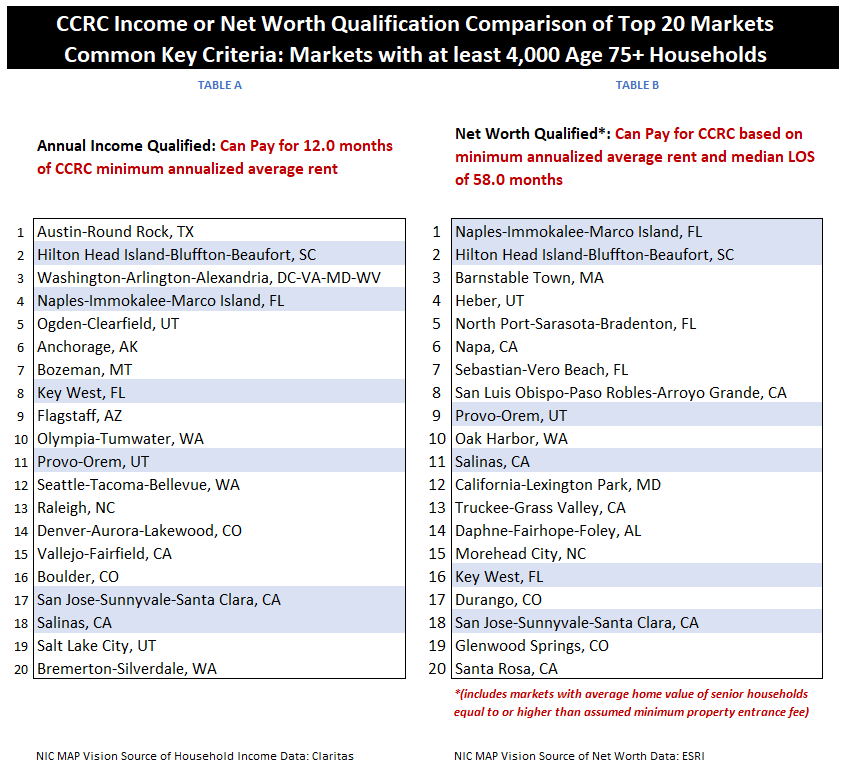
To illustrate different outcomes in broad market selection based on minimum annual income or net worth, the comprehensive datasets provided by NIC MAP and Vision LTC, powered by NIC MAP Vision, in combination with a unique subset of its 4,000-plus data points related to senior housing demand was used to develop a select subset of the top 929 MSAs across the country (Metropolitan Statistical Areas) based on relative target market depth (excluding supply), quantified in two different ways (Tables A & B).

Pre-Determined Target Market Selection Criteria:

  • Age: Households age 75+
  • Markets: 4,000 or more Age-Qualified households
  • Length of Stay: Data sourced from The State of Seniors Housing, 2020
    • Median, all CCRCs excluding nursing care beds, 58.0 months
  • Annual Income (Table A): Minimum, based on annualized average monthly rent at CCRCs in 1Q 2021
  • Net Worth (Table B): Minimum, based on CCRC average entrance fee, average length of Stay (LOS), and annualized average monthly rent as of 1Q 2021
    • Includes markets with average home value of senior households equal to or higher than assumed minimum property entrance fee

As shown below, selecting markets for further analysis by ranking the top 20 markets by either the percentage of age-and income-qualified households (Table A) or by the percentage of net worth-qualified households (Table B) yields generally different outcomes (and some similarities highlighted in blue).

Although six markets were common in both scenarios, looking at the top 20 net worth-qualified markets expands the income-based selection to markets that can be reasonably expected to be able to support the typical resident’s entire stay in a CCRC.

Given the diversity of seniors housing property types and levels of care setting combinations, and wide range of specific turnover rates, any market selection exercise or market feasibility study can be made more accurate with net worth data than relying on annual income data alone.

Having access to a variety of data related to seniors housing markets puts you in the best position to make informed decisions. NIC MAP Vision’s deep database of data points allows the analyst to search for any target market with unparalleled specificity—and creativity—and investment decisions with enhanced accuracy.

Interested in learning more about the data used in this analysis?

To learn more about NIC MAP and VisionLTC data, powered by NIC MAP Vision, and about accessing the data featured in this article, schedule a meeting with a product expert today.

Veteran Operator Ken  Segarnick: “Lifestyle Is the  Differentiator”

As the pandemic eases, seniors housing and care operators are looking ahead. What lessons have been learned over the last 15 months to bolster consumer confidence? What strategies will boost occupancy?  

As the pandemic eases, seniors housing and care operators are looking ahead. What lessons have been learned over the last 15 months to bolster consumer confidence? What strategies will boost occupancy?  


KSEGARNICK“The question now is whether we can really deliver on lifestyle,” said Ken Segarnick, chief corporate officer at Brandywine Living, a New Jersey-based operator of 32 luxury senior living communities in the Mid-Atlantic. “The game-changer is creating an environment that people want to age into.” 

 

An industry veteran, Segarnick is among the thought leaders attending the 2021 NIC Fall Conference in Houston. The Conference is NIC’s first in-person convening of leaders in seniors housing and care since the pandemic began and offers a chance to share ideas with others weathering the same challenges.  


Segarnick said the pandemic demonstrated that seniors housing can provide a safe environment. Acts of heroism and courage by the staff helped to protect residents from infection. Communities helped to provide early access to vaccinations.  Data show that resident outcomes have generally been favorable.


The pandemic also highlighted the fact that a senior living experience must include human interaction. Isolation became a huge issue over the course of the disease outbreak. “Human beings need social engagement in order to thrive,” said Segarnick. “As operators, we need to maximize joy and happiness to help residents have a life well lived.”  


Community programming did reach new dimensions over the last year, mostly out of necessity. Residents and families connected in creative ways through technology and social media. The customer experience became more tailored to individual preferences.  


What’s Next? 

The challenge now is to deliver a next-level lifestyle experience incorporating lessons learned. “Senior living is a consumer-driven business,” said Segarnick. “Though healthcare needs will continue to be a key element to senior living decisions, there’s more to what customers are looking for. They want to enjoy living their lives, they want a better experience.” The goal is to wrap the lifestyle experience around the care needs of residents. “Lifestyle is the differentiator,” Segarnick added.


Segarnick defines lifestyle as part choice, part engagement. Giving residents choices, based on their personal preferences, enhances their lifestyle. It could be offering different dining options or touch as small as knowing which newspaper the resident likes. “Small details build broader experiences,” said Segarnick.  


Engagement is also key to a rewarding lifestyle. But true engagement goes well beyond the basic activities on the daily calendar and includes all dimensions of wellbeing to provide joy and social enrichment.  


Segarnick challenged operators to translate the personal preferences of residents into exciting experiences tailored for them. “Our residents want engagement that meets them where they are,” he said.   


Real estate is part of the lifestyle equation post-pandemic. Residents want more space and connectivity with the outdoors. Common areas should be big and open. Residents want larger apartments to enjoy their own space too. “Where people live is an essential element of lifestyle,” said Segarnick.  


He admitted that more work needs to be done to rebuild consumer confidence in seniors housing and care. But he noted, “Consumer confidence is not something marketed or sold, but earned.”  


Post pandemic, consumers want a more robust senior living option, and providing that will have a direct impact on the operator’s bottom line.  

“Business as Usual” at People’s United: A Conversation with Matthew Huber

NIC Chief Economist Beth Mace recently talked with Matt Huber of People's United about the merger, the benefits for borrowers, and the outlook for the sector.

This past February, M&T Bank Corporation announced its intention to merge with People’s United Financial, Inc. with M&T Bank as the surviving entity. The merger—expected to close in October—brings together two powerhouse seniors housing and care lenders.

Matthew_Huber

The combined company will include about $200 billion in assets, and a network of nearly 1,100 branches spanning 12 states from Maine to Virginia.

People’s United is meanwhile open for business, says Matthew Huber, Market Manager of Healthcare Financial Services at The Bank. His team continues to close loans on a timely basis and provide commercial banking services.

NIC Chief Economist Beth Mace recently talked with Huber about the merger, the benefits for borrowers, and the outlook for the sector. Here is a recap of their conversation.

Mace:  What does the merger mean for existing seniors housing and skilled nursing clients of both organizations? 

Huber: M&T has a big presence in the seniors housing space and has a long-term commitment to the industry. So, I think the merger will be really good for the seniors housing and care borrowers at People’s United. M&T has a robust platform with permanent agency financing from Freddie Mac and FHA/HUD. Borrowers will have more solutions. People’s United is about half the size of M&T. Given their size, we’ll have more room to grow and participate in larger seniors housing and care transactions.   

Mace: Will the merger affect how you traditionally look at borrowers that seek debt funding for seniors housing and skilled nursing mergers?  How about recaps and rehabs? 

Huber: Between now and the actual closing of the merger, we are operating as two separate companies. At People’s United, we have continued to do exactly what we’ve been doing for the last number of years – focus on relationships, advice and tailored solutions. We’re winning new business on a consistent basis. In April, we closed on a refinance loan for Masonicare at Mystic, a life plan community in Connecticut. We recently won a term sheet to provide construction financing for a new project by RSF Partners in New York State. We’re also refinancing a Benchmark property in New England. We’re sticking close to our credit policy in terms of price and structure. Given the pandemic, we’re still winning business because of our relationships with our customers. We’re proud of that.  

Mace: Are you open for business for new development? 

Huber: Yes. 

Mace: What about turnarounds? 

Huber: Other than new construction, we only finance properties with in-place cash flows. If it’s a turnaround, we can only finance what current cash flows can support. 

Mace: You’ve traditionally been a relationship bank, working with repeat clients that have proven track records with experience in either seniors housing or skilled nursing. What should potential new borrowers be prepared to provide you to become eligible for new debt? 

Huber: Though it’s a big industry, it’s small in terms of the number of companies and banks that are fully engaged in seniors housing and care. It would be surprising if a known company with a portfolio did not have a banking relationship. If we don’t know the company, then we ask other industry stakeholders such as attorneys and accountants if they know the company. Mostly, new borrowers for us must be regional in scope and have multiple properties. If they’re one of our top 20 prospects, they have to provide the same type of information we would ask from anyone making a new request. That includes a real estate schedule of their existing properties to see how they’re doing. We conduct full due diligence. As much as we’re seeing green shoots of positivity in the industry, we’re not out of the woods yet. I need to know borrowers have the liquidity to get them through this time, however long that may be. We’re going with the tried-and-true companies that have been there and done that, whether they’ve banked with us or not.   

Mace: You’ve significantly grown People’s United lending volume with the seniors housing and skilled nursing sector in the last few years. What is your secret to success? 

Huber: When I joined People’s United about four years ago, our healthcare portfolio was about $400 million in balances, with about half in seniors housing and the other half to hospitals. Today we are at about $2.5 billion. We’ve grown by hiring the right people and consistently delivering solutions for our customers. I have an experienced staff of five relationship managers who’ve been in the industry for decades. They know commercial banking and they know the healthcare industry. We have consistent solutions and don’t waiver from them. Our process is very simple from term sheet to approval. Certainty of execution is so important to the client and they know what they’re getting from us because we don’t change our terms. We don’t come in the day before closing and ask for more equity or covenants. Our customers are important to us. We learn a lot from them, and we truly enjoy building relationships with them.  

Mace: With the worst of the pandemic hopefully behind us, how will your lending practices change post-COVID?  

Huber: I think we’ll go back to more of a limited recourse requirement once we see facilities have stabilized. Until then, we have increased our requirements to full recourse, though we give borrowers a path to release based on performance. Prior to the pandemic, we were asking for 25% -50% recourse, depending on the deal or borrower. We don’t do non-recourse construction loans.   

Mace: Have you seen a slowdown in construction because of cost overruns? 

Huber: We have seen minor slowdowns in construction, but nothing too concerning yet. The cost of materials and overruns are mind boggling. The projects are so big, $70 million to $80 million. So, having strong sponsors is key for construction projects currently underway should challenges arise that dictate the need for additional project funding. 

Mace: Are you optimistic for the recovery of the sector in 2021?  Beyond 2021? 

Huber: I am optimistic. Seniors housing and care has done a good job of getting residents vaccinated. There is still some work to be done on the employee side. But I think it’s headed in the right direction. We’re starting to see some positivity on occupancy. I think it’s going to take a little longer than we hoped for properties to stabilize. The recovery will continue into the first half of 2022. But I’m optimistic. Baby boomers are 75 years old. The first ones turn 80 in five years and that’s when the usage of seniors housing really escalates. Skilled nursing will undergo some changes that have been accelerated by the pandemic. We’re not going back to the way skilled nursing was in 2019 with a lot of short stays. More rehab will be done at home and we’ll need fewer beds over time. Nursing homes will do more home care for their customers coming out of the hospital.   

Mace: What gives you pause about the sector if anything? 

Huber: I don’t have a crystal ball, but uncertainty gives me pause. Telehealth and Home Care will impact our customer base, and anything like that causes uncertainty in cash flows. Assisted living is still somewhat of a choice. Memory care is coming back quickly. But we need to keep our eye on assisted and independent living and how skilled nursing will mature as an industry. I see a positive future. But the question is: will occupancies be back in the high 80s by the end of the year, or not? 

Mace: Is there anything else you would like our readers to know about People’s United? 

Huber: We are still open for business. We have one of the most experienced teams in the industry. Our team includes: Walt Unangst, David Canestri, Claudia Gourdon, Ginger Stolzenthaler and Ryan Zyskowski. The upcoming merger is a plus for customers. M&T Bank is a well-known lender in this industry and we are confident the combined company will deliver much value to our clients. Borrowers will be in good hands regardless of the name over the door.