SBA Offers Financing Options:  A Conversation with Alex Cohen of Liberty SBF

NIC Chief Economist Beth Mace discussed the SBA program and financing options with Alex Cohen, CEO, Liberty SBF. Here is a recap of their conversation.

Senior living providers and investors are familiar with the financing options from Fannie Mae, Freddie Mac, and HUD. Less well known are the government-subsidized loan programs for healthcare facilities through the U.S. Small Business Administration (SBA). Liberty SBF is a specialty finance company that offers SBA, conventional and bridge loans.  

NIC Chief Economist Beth Mace recently discussed the SBA program and other financing options with Alex Cohen, CEO at Liberty SBF.  Here is a recap of their conversation.  

Alex Cohen Headshot NEW 600x600pxRGB

Mace: Can you tell our readership about Liberty SBF? 

Cohen: We launched the firm in 2011 and have been lending through several business cycles. We work with a lot of businesses that are buying or refinancing real estate for their companies, or what we call owner-user commercial real estate finance. We have closed more than $2 billion in commercial real estate loans. One of the eligible asset classes is healthcare, including skilled nursing, assisted living and memory care. When we first launched the firm, we were co-lending with the SBA and financed a decent number of assisted living and skilled nursing facilities and that’s how we were introduced to the asset class. We now have a full range of loan products for healthcare facilities and medical practice owners. 

Mace: What distinguishes Liberty SBF from other lenders? You are a non-bank lender. What does that mean? 

Cohen: We are a specialty finance company, a non-depository lender. We do not finance our operations through deposits. We have private equity and institutional investors who invest in our assets, but we are not a bank. That gives us some flexibility in terms of the deals we can underwrite. It allows us to operate in an area of the credit space where banks might not feel comfortable during choppy times. Certainly, the last 18 months have been choppy considering COVID-19, but we have continued to lend in the healthcare space. Compared to other specialty finance companies, we tend to provide loans for assets in the $2 million-$20 million range. We are focused on lower middle market or small balance commercial loans.  

Mace:  Is your cost of borrowing higher or lower for a borrower than that of a conventional bank? 

Cohen:  We offer some very attractive rate products. The way we finance these products is very efficient. On the permanent financing side, we can offer very attractive high-leverage, low-cost products. Some of our larger permanent financing deals are being priced in the high 2%-3% with up to 80%-85% leverage. That’s very attractive financing for these healthcare facilities which are an eligible asset class for government subsidized or quasi-subsidized programs. We tend to work with the SBA. Some of its offerings beat comparable offerings from HUD, Fannie Mae, and Freddie Mac. The SBA programs aren’t as well known in the sector. We are trying to educate the healthcare facility owner community about other financing options available for ground-up construction, transitional type business plans for existing assets, or permanent financing for stabilized properties.  

Mace: What types of loans do you provide? 

Cohen:  We offer SBA, conventional, and bridge loans for healthcare facilities. One of the most attractive loan products we offer is the SBA 504 loan. Facility owners can get up to 85% loan-to-cost financing through the SBA with Liberty SBF as the co-lender. The loan can be used for ground-up construction, for example, and the borrower can secure up to the total cost of financing. It is a recourse loan. The way the program works, we partner with a Certified Development Company (CDC). A CDC is a nonprofit organization that promotes economic development within its community through 504 loans. CDCs are certified and regulated by the SBA, and work with the SBA and participating lenders, such as Liberty SBF, to provide financing to small businesses. The CDCs underwrite the loans with us and submit it to the SBA. When the loan is authorized, we fund the entire project. The SBA takes us out either at completion of construction, or shortly after the loan closes.  

Mace: Is the process similar to the way Fannie Mae and Freddie Mac partner with Delegated Underwriting and Servicing (DUS) lenders? 

Cohen:  Each government program works a little differently. There are many CDCs, and we work with the largest ones. CDCs also work with other state and local subsidy programs. The CDCs are typically well versed on healthcare facilities. We manage the process, not the borrower, so it’s pretty seamless. And because we’re specialists, we can get these deals done in 45-60 days, whereas a large bank lender may take 90-120 days to close.

Mace: When you say healthcare facilities, can you define the types of assets? 

Cohen: The types of assets we finance are assisted living, skilled nursing, memory care, and rehab facilities. The assets typically have a higher acuity of care. We also finance medical office buildings, which are eligible under the SBA program. Active adult and independent living properties would be considered investment real estate from our perspective. We do offer bridge lending on multi-family properties, including some age-restricted senior housing.  

Mace: Do you offer conventional and bridge financing?  

Cohen: Yes, we offer conventional and bridge financing. Our leverage is not as high with those products. But our borrowers can obtain permanent financing through our conventional offerings.  

Mace: Do you finance the operations/cash flow part of the senior housing business or just the real estate? 

Cohen: We only finance the real estate.  

Mace: Were you active lenders during the pandemic?   

Cohen: We were very lucky. We were designated as a Paycheck Protection Program (PPP) lender. We made PPP loans to a lot of companies in our servicing portfolios as well as to new businesses. We financed close to $200 million in healthcare-related businesses and financed about $1 billion in total for all types of companies. We were able to help healthcare borrowers, including our own existing borrowers, to weather the storm. Our bridge loan business has been active, helping owners refinance their facilities at a lower leverage point. The PPP program was successful and popular with borrowers. Now, we are working through the PPP forgiveness process with our borrowers and new customers. They must demonstrate the funds were used for legitimate operating expenses. And at that point, the loan becomes a grant that is tax free income for the business. Facility owners, particularly smaller, closely held healthcare facility owners, should keep in mind that the SBA was chosen as the vehicle through which the government provided stimulus to the entire business community, not just small businesses. The SBA has provided loan and fee deferments, and some rules have been changed. For example, borrowers can refinance SBA and HUD debt into an SBA 504 loan, an option that was not available before. It can be an opportunity for borrowers to pull cash out and lower the interest rate. Also, the government continues to provide other subsidies to healthcare facility providers, through programs such as the Provider Relief Fund. We have a great originations team, and we can be helpful if anyone has questions on the programs.   

Mace: How large is Liberty SBF’s book of business for senior housing?   

Cohen: Our servicing portfolio is several billion dollars. Our goal, as we transition from PPP to core lending, is to deploy about $100 million-$150 million between now and the end of the year. We have a number of healthcare transactions in the pipeline. There is a lot of interest from borrowers who believe we are at or near the bottom of the rate cycle and want to take advantage of the low-cost financing.  

Mace: Has your bridge lending program been especially active during the pandemic? Why is that? 

Cohen:  Yes, our bridge lending program has been active. Borrowers with loans at maturity on their existing conventional debt or with an underperforming asset are taking advantage of bridge financing to reposition the facility. Or perhaps a buyer making an acquisition needs a bridge loan to execute a business plan to improve the census or put CapEx into the building to stabilize the property to get permanent financing or sell the asset.  

Mace: Do you offer non-recourse bridge loans? 

Cohen:  We do offer non-recourse bridge loans. They are typically larger in size than recourse loans. Non-recourse bridge loans range from about $5 million to $15 million, with about 65% loan-to-value.   

Mace: Broadly, what do you look for in a borrower?  

Cohen: Operating experience is key. What is their operating experience for these types of facilities and sizes? Do they understand the market? Are they in town? We look at the borrower’s net worth and liquidity relative to the loan amount we are making. We focus on the recourse guarantors—ultimately the owners of the business—and the non-recourse carve out guarantors.   

Mace:  Do you often turn anyone down? 

Cohen:  We look at deals all day long. We are focused on originating deals that fit our credit box. We offer a large swath of products to the industry and can cater to different borrower profiles. Certain situations are not financeable for us and those are deals we cannot move forward with.  

Mace:  Where do you get your lending ability from? Institutional groups? High net-worth individuals?  

Cohen: Our limited partners are primarily family offices. We have a well-capitalized operating company. The decision makers at our company are principals and managers. We were successful with the PPP program, and we are deploying that capital back into the market through our core programs with our limited partners and other institutional investors. They are very aggressively seeking investment opportunities at this point. We feel good about our capital position and our ability to lend.  

Mace: What else would you like to share with our readership? 

Cohen: I’m looking forward to the NIC Fall Conference in Houston. If anyone would like to set up a meeting during the Conference, please contact us. 



COVID-19 Discussions with Senior Housing and Care Operators

Topics include workflow changes, testing strategies, PPE access, dementia care challenges, addressing loneliness and social isolation, and vaccines. 

In March and April of 2021, researchers from the National Investment Center for Seniors Housing and Care (NIC) and the nonpartisan and objective research organization, NORC at the University of Chicago (NORC). spoke with a dozen senior housing and care operators about their experiences, challenges, and successes throughout the COVID-19 public health emergency during 2020. Discussion topics included workflow changes implemented in response to various state and federal requirements, testing strategies employed, PPE access, challenges with dementia care residents, interventions to address loneliness and social isolation, and efforts to vaccinate residents and staff.


“The collaboration and creativity between departments and team members was probably the silver lining of all of this. It knocked down a lot of silos.”


These qualitative interviews come from senior housing and care operators located in Colorado, Connecticut, Florida, Georgia, and Pennsylvania. Operators ranged in size from just a few properties to several hundred and included both for-profit and not-for profit status, freestanding and mixed-use properties, and Continuing Care Retirement Communities (CCRCs), aka Life Plan Communities. These interviews supported the quantitative analysis on COVID-19 mortality rates by care setting and allowed the research teams to better understand the context of the COVID-19 death data as well as the challenges they faced throughout the various stages of the COVID-19 pandemic and associated public health emergency.


The predominant theme from the interviews is that senior housing and care operators were incredibly agile and dedicated through the pandemic and worked 24/7 to keep residents safe while continuing to compassionately care for residents. NIC has published a selection of stories and quotes from our series of interviews to highlight the efforts that operators have successfully made to protect, safeguard, and maintain engagement with their residents and staff. Read the full white paper.

The Labor Crisis: A Ripple Effect and Dilemma for SNFs

This blog post provides a NIC Analytics review of data that highlights and quantifies the number one issue facing operators of skilled nursing facilities: staffing shortages. Labor shortages are particularly acute for nursing staff and aides.

This blog post provides a NIC Analytics review of data that highlights and quantifies the number one issue facing operators of skilled nursing facilities: staffing shortages. Labor shortages are particularly acute for nursing staff and aides who are often the hands-on workers with direct and intimate relationships with residents and patients. Staffing has generally been a challenge for the sector but since the onset of the pandemic staffing shortages have become pervasive across the industry.

Some have called the current skilled nursing labor shortage the worst the sector has ever seen, and many are worried it will intensify. To be fair, many sectors of the economy are experiencing significant labor shortages for a multitude of reasons such as a reduced pandemic-related labor force, worker fear of catching or spreading COVID-19, childcare and elder care responsibilities, and generous pandemic-related unemployment insurance benefits (many of which have recently rolled off). There is some debate about the causes of labor shortages across the country, but one thing that is certain is many sectors of the economy are being impacted in ways that are creating major operational hurdles.

Skilled nursing facilities (SNFs) face an all too familiar dilemma in competing with other industries in retaining and recruiting workers to provide care for high acuity residents. Further, the industry is challenged with maintaining operating margins due to very low occupancy rates, elevated operating expenses, and the often-inadequate Medicaid payment rates in many states.

Staffing shortages are a critical part of the much bigger story of today’s aging society. In 2020, the American population over 75 was estimated to be 23 million, according to the Bureau of Labor Statistics (BLS). By 2025, this figure will rise to 29 million (up 26% from 2020 levels), and by 2030, this figure will rise to 34 million (up 48% from 2020 levels). At the same time, other broad demographic trends suggest labor force challenges as older adults reach retirement and as they are not fully replaced by younger experienced workers.

According to the Demographic Drought Report released by EMSI, a leading provider of labor market data, “the US labor force participation rate (LFPR), which measures people working or actively seeking work, has dropped to lows we haven’t seen since the recession of the mid-1970s.” The report also highlighted the mass exodus of baby boomers and the lowest birth rates in U.S. history. Notably, the number of baby-boomer retirees increased by over a million in 2020, and the national birth rate hit a 35-year low in 2019. These demographic trends suggest a tightening labor market ahead, and that a large and growing labor pool of essential workers are needed today and in the foreseeable future.

What healthcare workers are in high need and have the biggest shortages within the skilled nursing sector?

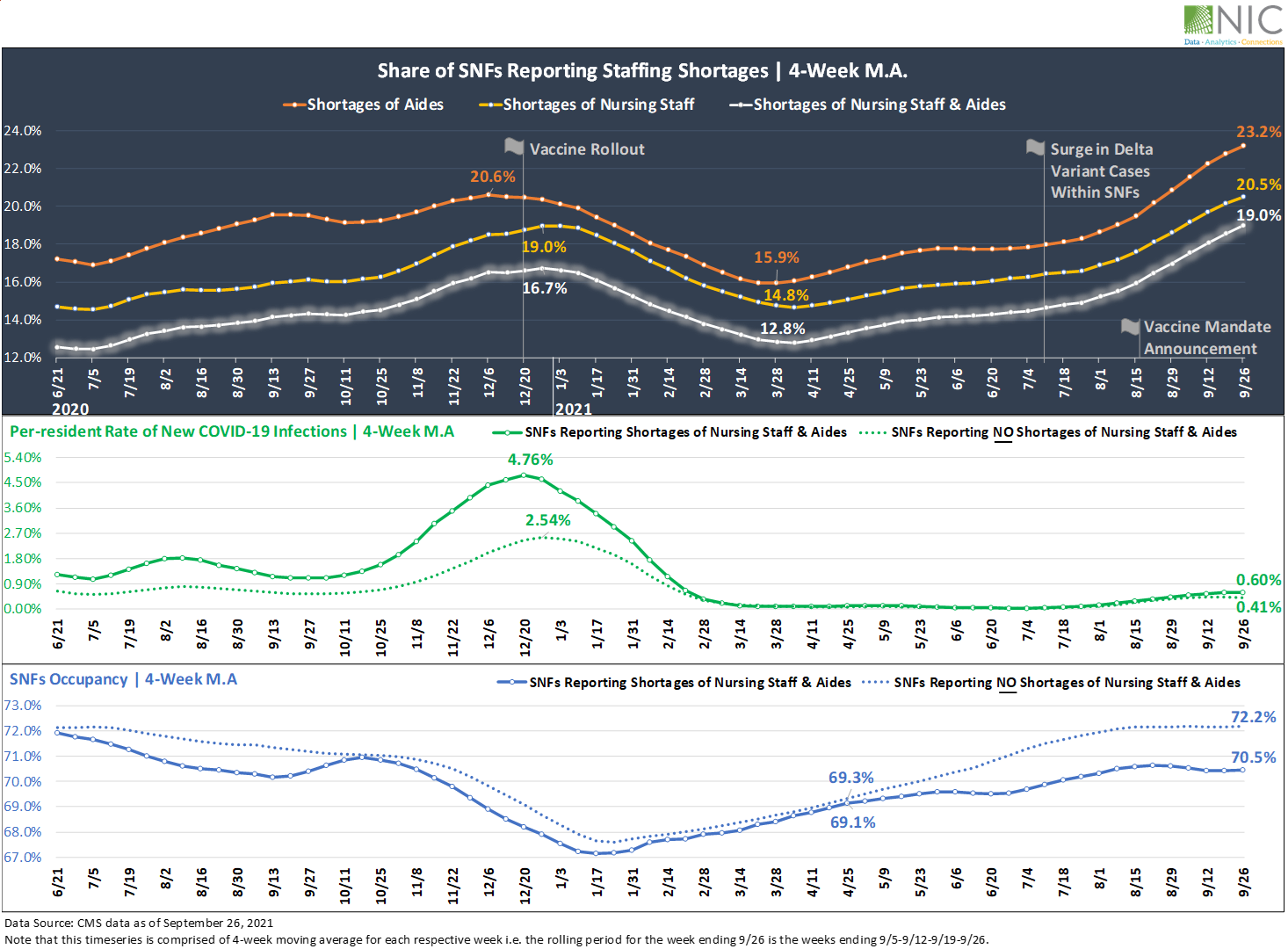
Exhibit 1 below depicts the share of skilled nursing facilities reporting shortages of nursing staff and aides since CMS began reporting this data in May 2020. The highest shortages of staff reported by SNFs have been among aides and nursing staff. Further, nursing staff and aides represent the largest share of all SNF staff. Indeed, according to the BLS Employment & Wage report compiled by NIC MAP®, powered by NIC MAP Vision, nursing staff and healthcare support occupations, including aides, represent over 60% of all staff within the skilled nursing sector.

Following the launch of the long term care vaccination program in December 2020, the share of SNFs reporting shortages of hands on essential workers started trending down and reached a low level of 15.9% for aides in March 2021, 14.8% for nursing staff and 12.8% for both nursing staff and aides. Since then, the proportion of SNFS reporting shortages began to rise again as move-ins and occupancy rates increased, although these percentages remained below the high levels seen in December 2020 prior to the vaccine rollout (20.6% for aides, 19.0% for nursing staff and 16.7% for both nursing staff and aides).

Unfortunately, a surge in COVID-19 delta variant cases within U.S. skilled nursing facilities in July 2021 as well as the recent vaccine mandate announcement in August 2021 exacerbated shortages of on-hand essential workers. By the end of September 2021, 23.2% of SNFs reported shortages of aides (up 7.3 percentage points from March 2021 levels), 20.5% reported shortages of nursing staff (up 5.7pps over the same period), and 19.0% reported shortages of both nursing staff and aides (up 6.2pps since March 2021). These are the highest levels seen since May 2020.

What impacts do shortages of nursing staff and aides have on SNF residents, SNF performance and the recovery of the sector as a whole?

Staffing shortages have likely not hit the peak yet and may get worse in the next few months. Indeed, a recent survey by the American Health Care Association and National Center of Assisted Living (AHCA/NCAL) shows nearly all the nursing homes participating in the survey are currently asking staff to work overtime or extra shifts and more than half are limiting new admissions due to staffing shortages. The survey also highlights that 78% of the nursing homes surveyed admitted to being concerned about having to close their facility due to workforce challenges.

The ripple effect on residents and the performance of SNFs is even more profound. Since CMS began reporting data in May 2020, skilled nursing facilities experiencing shortages of both nursing staff and aides have been reporting relatively higher per-resident rates of new COVID-19 infections and lower occupancy rates compared with SNFs reporting no shortages of these hands-on essential workers.

Notably, in December 2020 and prior to the vaccine rollout, infection rates peaked at 4.76% on a 4-week moving average (476 in 10,000 residents tested positive) for SNFs reporting shortages of nursing staff and aides, nearly double that of SNFs reporting NO shortages of hands-on essential workers (2.54%, equivalent to 254 in 10,000 residents tested positive). This suggests that shortages of staff translate into lower staff-to-resident ratios and consequently increase “one-to-many” interactions between available staff and residents. These “one-to-many” interactions could lead to higher virus transmission among residents.

The occupancy chart featured in Exhibit 1 below shows that SNFs reporting shortages of hands-on essential workers (in this case, defined as nursing staff and aides) have also had somewhat lower occupancy rates compared with SNFs reporting no staffing shortages since May 2020.

The widening gap in the last four months is something to watch going forward. By the end of September 2021, as staffing shortages intensified, the occupancy rate for SNFs reporting shortages of nursing staff and aides was 70.5% (4-week moving average, based on CMS data), 1.7pps below the occupancy rate for SNFs reporting no shortages (72.2%). Back in April 2021 when staffing shortages and virus cases within SNFs were relatively low, the occupancy rate for SNFs reporting shortages was 69.1%, only 0.2pps below the occupancy rate for SNFs reporting no shortages (69.3%).

The recovery in demand in the last few months is promising but staffing shortages could slow down the occupancy recovery for the sector and limit the improvement for SNFs experiencing staffing shortages.

Exhibit 1 – Staffing shortages vs. per-resident rate of new COVID-19 infections and occupancySNF Staffing Shortages

Staffing shortages and the impact on vaccination rates

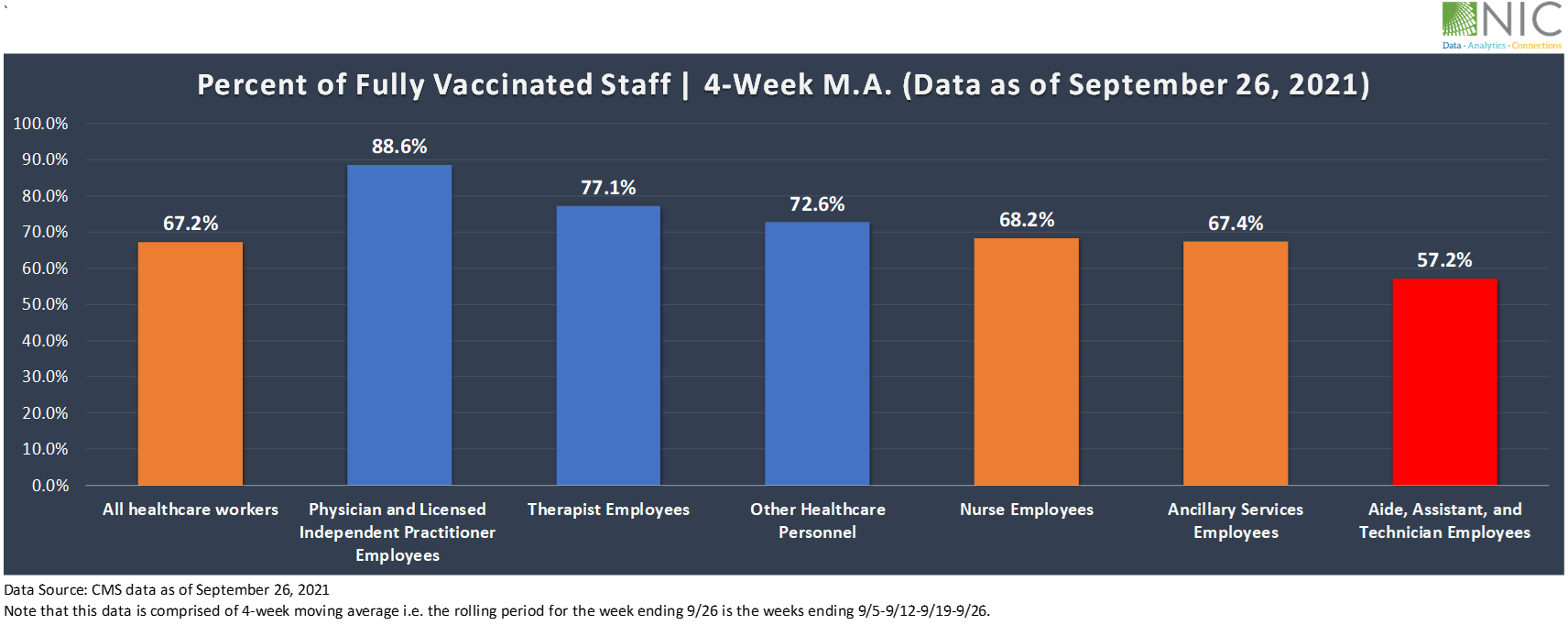
The effects of staffing shortages continue across vaccination rates, which have been relatively low among nursing staff and extremely low among aides. In September 2021, 67.2% of all healthcare workers had been fully vaccinated, up 8.7pps from 58.5% in June 2021. Vaccination coverage has certainly improved in the last three months, but the disparity in vaccination rates among healthcare workers in SNFs has been dragging down the overall vaccination rate among staff and could be leading to higher virus transmission among residents.

Exhibit 2 below shows that the highest rate of fully vaccinated staff was among licensed independent practitioners at 88.6%, followed by therapist employees (77.1%), and other healthcare personnel (72.6%). However, vaccination rates among aides are still lagging, with only 57.2% of aides having been fully vaccinated, 11pps below the vaccination rate of nursing staff (68.2%) and 10pps below the overall staff vaccination rate of 67.2%, and even below the vaccination rate of all healthcare workers recorded three months ago in June 2021 (58.5%).

Staggering as this disparity in vaccination rates among SNFs healthcare workers is, none of this comes as a particular surprise. Aides and nursing staff represent the largest number of workers within the skilled nursing sector, and both have the highest shortages and most likely the highest turnover and churn rate. Recent studies have shown high turnover and churn rate among staff at nursing homes.

Skilled nursing facilities keep recruiting and losing these critical workers. In addition to the time and effort of recruiting and training these -hands on essential workers who interact directly with patients, a higher turnover rate is likely having a significant impact on operational costs, productivity, and infection control protocols to prevent virus transmission among residents.

Exhibit 2 – Vaccination rates among SNFs workers

Shortages of nursing staff and aides vary by state

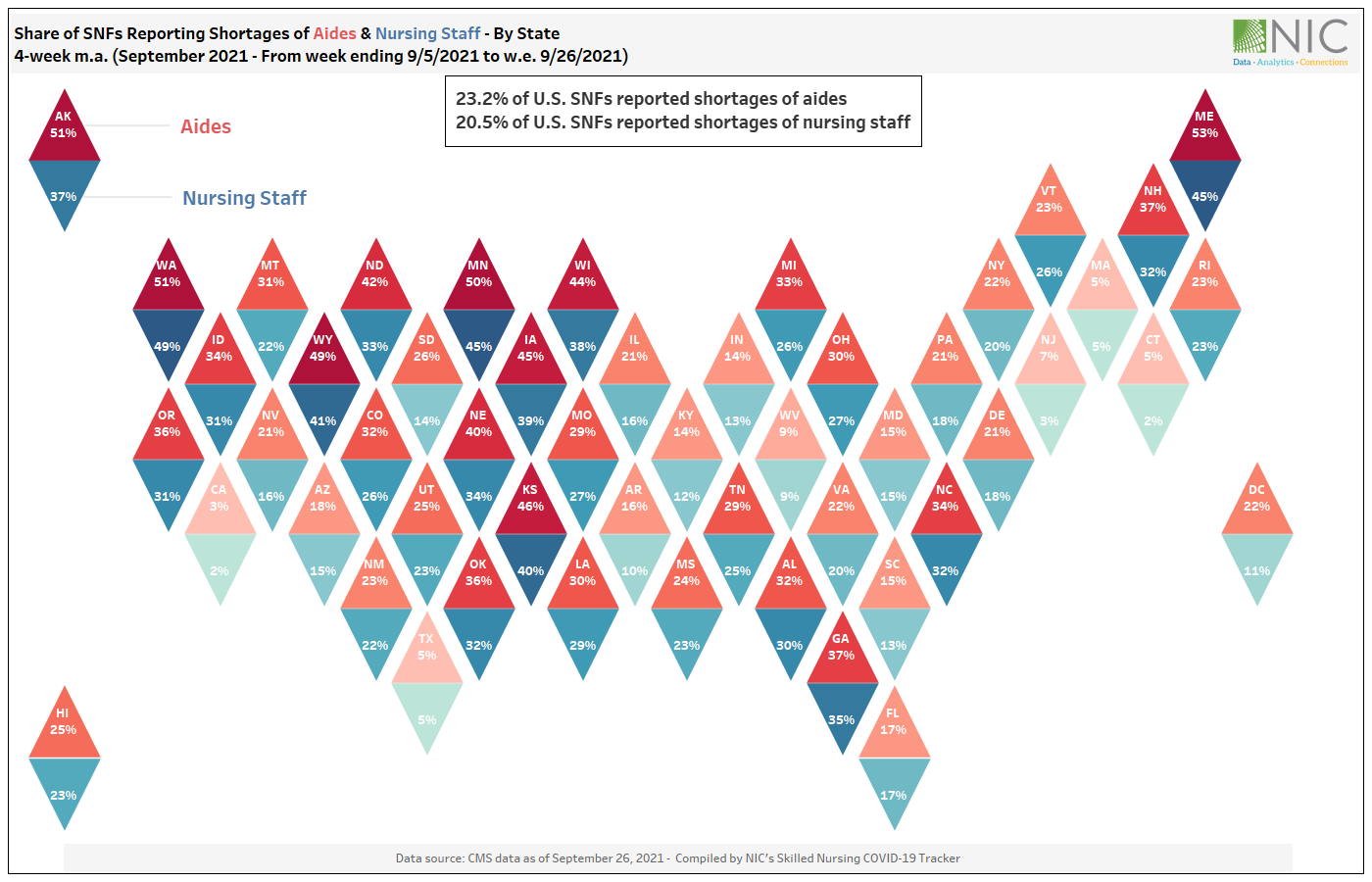
Exhibit 3 below shows that shortages of nursing staff and aides vary by state. In September 2021, over 40% of SNFs reported to be experiencing shortages of both nursing staff and aides across several states, including Maine, Kansas, Wyoming, and Minnesota.

While the majority of states are currently experiencing high staffing shortages, there are some states where staffing shortages have been comparatively very low among both nursing staff and aides. These states include California, Texas, Connecticut, New Jersey, and Massachusetts. Some of these states may have access to a larger labor pool. However, having access to a large labor pool doesn’t necessarily mean high retention rates among hands on essential workers (aides and nursing staff). Retention seems to be a real challenge facing all SNFs, regardless of labor availability.

Staff availability and retention may become the leading factors in identifying a competitive market or property for senior housing and skilled nursing constituents, and key attributes for residents in choosing between facilities.

Exhibit 3 – Share of SNFs reporting shortages of aides vs. nursing staff – By state

In this NIC analysis, we examined what group of workers and roles are in high needs and have the largest labor shortages within skilled nursing facilities, and the impact that shortages of these essential workers (aides and nursing staff) have on SNF residents, SNF performance, and the recovery of the skilled nursing sector.

Forthcoming analysis will examine what’s driving labor shortages among these critical and essential workers. and explore potential solutions and limitations to address this major issue.

Social Security Benefits to Increase Significantly in 2022

The Social Security Administration announced they will raise Social Security and Supplemental Security Income (SSI) benefits by 5.9% for approximately 70 million Americans.

The Social Security Administration announced they will raise Social Security and Supplemental Security Income (SSI) benefits by 5.9% for approximately 70 million Americans – 64 million Social Security beneficiaries and 8 million SSI recipients. This adjustment is set to take effect with benefits that Social Security beneficiaries receive beginning in January 2022.

The announced increase in benefits will mark the highest one-year bump in almost four decades. For comparison, the cost-of-living adjustment (COLA) was 1.3% in 2020 and 1.6% in 2019.

The elevated COLA comes as a result of steep price increases as the U.S. economy emerges from the COVID-19 public health emergency. The Social Security Act ties the annual COLA to the increase in the Consumer Price Index (CPI) as determined by the Bureau of Labor Statistics (BLS). The most recent BLS CPI report indicates that over the last 12 months, the all-items index increased 5.4%.

Experts caution, however, that seniors utilizing Medicare Part B will see substantially less than the 5.9% bump, as Medicare Part B premiums are expected to increase 6.7%, from $148.50 to $158.50 in 2022. Medicare Part B premiums are tied to seniors’ income and deducted from beneficiaries’ checks.

Social Security and SSI beneficiaries are normally notified by mail starting in early December about their new benefit amount. The Social Security Administration has provided a fact sheet showing the effect of the various adjustments.


Time-Series Data and Pre-Pandemic Benchmarks: The NIC Investment Guide

In tune with NIC’s mission of educating the market on the opportunities and challenges of investing in seniors housing and care properties, The NIC Investment Guide: Investing in Seniors Housing & Care Properties, serves as a primer on the senior housing and care sector.

In tune with NIC’s mission of educating the market on the opportunities and challenges of investing in seniors housing and care properties, The NIC Investment Guide: Investing in Seniors Housing & Care Properties, serves as a primer on the senior housing and care sector.

The Sixth Edition of the NIC Investment Guide, based on year-end 2019 time-series data, serves as a benchmark to the sector prior to the COVID-19 pandemic. Takeaways from this edition include:

  • The investment-grade senior housing and care market is estimated to have a nationwide inventory of nearly 24,500 properties inclusive of more than 3.0 million units, and its overall market value is estimated at $474.5 billion.
  • The market value estimate is based on an average $210,000 price per unit for senior housing properties and an average $81,000 price per bed for nursing care properties.
  • The largest owner category of senior housing and care properties are private for-profit entities with ownership of 55.4% ($2 billion) of units in senior housing properties and 67.2% ($78.6 billion) of units in nursing care properties. Publicly traded REITs own 11.6% ($41.4 billion) of units in senior housing properties and 6.5% ($7.5 billion) of units in nursing care properties.

The technical chapters of the NIC Investment Guide include a detailed description of each senior housing and care community type. The community type descriptions incorporate resident profiles, supply data, industry operating structures, operating economics, and current trends. The Guide also discusses underwriting criteria, the development and construction of new properties and the acquisition of existing properties, debt and equity sources, and valuations, returns, and loan performance.

As in prior editions, the Sixth Edition features a chapter on Emerging Trends and Observations written by members of NIC’s Future Leaders Council (FLC). Drawing upon the acumen of industry participants to make observations and discuss emerging trends for which contemporaneous, empirical data may not be available, the topics put forth are forward-looking considering operating strategies, capital markets, joint venture preferences, labor shortages and the rising costs of labor, fragmented senior housing regulation, provider partnerships, and the growing market share for Managed Care, just to name a few. It also includes detailed appendices related to alternative housing and services, active adult communities, factors affecting demand, trends in technology, risks and mitigating factors, and the collaboration between housing and healthcare.

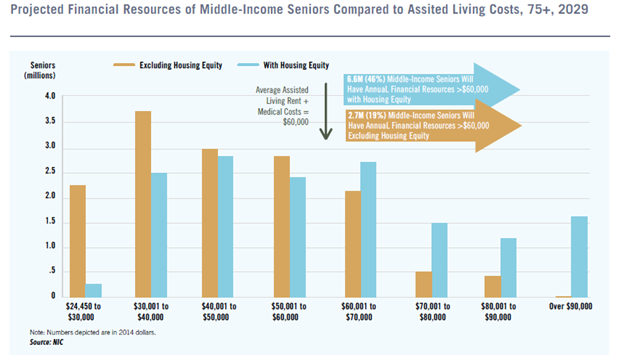
The large and growing middle market is also addressed. In 2019, The Forgotten Middle: Middle Market Seniors Housing Study was completed with results of the analysis published as a manuscript in Health Affairs. The study defined the middle-income cohort as people aged 75 and older who do not qualify for government assistance for senior housing—such as Medicaid—but are not wealthy enough to afford traditional private pay, market-rate senior housing for a meaningful amount of time. As shown below, the study determined that 54% of middle-income seniors will not have sufficient financial resources to cover projected average annual costs of approximately $60,000 for assisted living rent and other out-of-pocket medical costs by 2029.


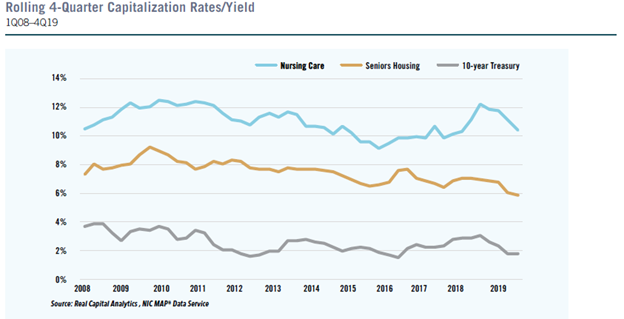
Additionally, through NIC’s strategic alliance with Real Capital Analytics, the NIC Investment Guide provides pricing and volume metrics on closed sales transactions of senior housing and care properties throughout the U.S. for the prior 10 years, and cap rates by property type. When comparing valuations among different senior housing property types, the use of cap rates and price per unit (PPU) are common measures. As shown by the exhibit below, development cap rates have historically been 250-500 basis points higher than those of existing properties, although recently those spreads have narrowed.


A reflection of NIC’s mission to provide data, analytics, and connections, all of which advance the access and choice of seniors housing and care for America’s elders, examples such as these and more are widely accessible through NIC’s Investment Guide. The Executive Summary of the NIC Investment Guide is available free of charge as a PDF download from nic.org. The full NIC Investment Guide, Sixth Edition is available both as a PDF file priced at $50 per copy and as a print publication priced at $100 per copy. Both can be found at store.nic.org.