NIC’s Skilled Nursing COVID-19 Tracker Shows Worrying Pace of Cases Across the U.S.
Since May 31, 2020, NIC has been publishing a regular updated weekly surveillance report on the incidence of COVID-19 cases among residents in our nation’s nursing care properties.
Since May 31, 2020, NIC has been publishing a regular updated weekly surveillance report on the incidence of COVID-19 cases among residents in our nation’s nursing care properties. Using raw data collected and reported by the Centers for Medicare & Medicaid Services (CMS), NIC’s Skilled Nursing COVID-19 Tracker (Tracker) reports CMS nursing home data and provides insights into the rate of virus spread within skilled nursing properties.
The Tracker is an easy-to-use interactive visualization tool that shows where cases are spreading, slowing, or remaining flat. In addition, the Tracker provides charts and tables that depict the incremental week-over-week change rate in three important metrics on a same-store basis, i.e. the same nursing properties are tracked each week across regions, sub-regions, states, and counties. The metrics include: (1) new COVID-19 confirmed cases per same store properties, (2) new COVID-19 confirmed cases as a share of residents, and (3) occupancy rates (based on CMS Data). Importantly, the Tracker allows users to drill down to a smaller market or a specific property and access the underlying data. The Tracker is available in the NIC COVID-19 Resource Center.
As a backdrop, COVID-19 cases are accelerating at a worrying pace across the U.S. and alarming new records are being set every day. According to the Johns Hopkins Coronavirus Resource Center, there were 11,065,237 cases in the U.S. as of November 16, 2020, and 246,626 deaths. This is up from 8,833,396 and 227,000, respectively, as recently as October 28, 2020. Moreover, there were 166,000 new cases and 73,014 hospitalizations reported on Monday, November 16, 2020 according to Johns Hopkins University and the COVID Tracking Project.
For the U.S., these figures represent 19% of the world’s cases and deaths, a disproportionate amount for a nation that only represents 4.3% of the globe’s population. While the mortality rates associated with COVID have declined, the rising incidence rate is disturbing, particularly for operators of seniors housing and skilled nursing properties, given the health vulnerabilities and comorbidities of these populations. Further, staff of these properties have been relentless in their efforts to combat the virus and safeguard residents and a level of exhaustion and fatigue exists for virtually everyone. Unfortunately, heightened diligence is further warranted.
The Tracker shows that new infections are on the rise across skilled nursing properties, but the coronavirus hot spots are changing over time within the four regions of the U.S.—Midwest, Northeast, South and West. The trends depicted in Exhibit 1 show when each of the regions peaked in terms of COVID-19 confirmed cases as a share of residents. The number of new cases was highest in the Northeast in late May and reached 1.35% of residents testing positive, whereas the South and West regions peaked in late July and reported 1.50% and 1.29% of new confirmed cases as a share of residents, respectively.
For the week ending November 1, the Tracker shows that positivity rates are increasing dramatically and reaching very undesirable numbers in the Midwest. In the Midwest, all 12 states saw an increase in new COVID-19 confirmed cases from the prior week (October 25). The data also show new confirmed cases in skilled nursing properties reached a record high in the Midwest: 4,688 new cases within 4,499 facilities, or the equivalent to 1.66% of newly confirmed cases among residents. The South reported the second highest rate of 0.91%, followed by the West (0.58%) and Northeast (0.37%).
Although the West and Northeast reported cases remain relatively low compared to the Midwest and South regions, the Northeast saw an uptick in new confirmed cases on November 1, increasing by nearly 0.2% from the week ending October 11. Just like the overall new confirmed cases across the country rising to new records, the new confirmed cases in skilled nursing properties hit new highs on November 1, nearly 1% of residents testing positive within the U.S. skilled nursing properties.
Because of this outbreak of COVID-19 cases, new rules are being reimposed across the U.S. These requirements include more frequent testing, greater emphasis on physical distancing, and masking guidelines. These restrictions continue to be the best weapon against the virus until a vaccine is approved and widely distributed.
The U.S. map in Exhibit 2 below shows the week-over-week change in new COVID-19 confirmed cases as a share of residents within skilled nursing properties by state, as of November 1. Over 40 states showed an increase in new confirmed cases from the prior week (October 25).
To gain in-depth insights and track the week-over-week change rate for new resident cases of COVID-19 within skilled nursing properties, visit NIC.org. You can also access the Skilled Nursing COVID-19 Tracker along with a rich trove of analysis and insight on the NIC COVID-19 Resource Center.
NIC is committed to provide data, analyses and insights that increase transparency and understanding of the sector, especially in this difficult time of COVID-19. We strongly support all actions and efforts that prioritize testing and availability of PPE to protect frontline workers and residents.
*CMS Data – As of November 1
3Q20 CCRC Care Segment Performance Better than Non-CCRCs, Year-Over-Year
As the leading data provider for the seniors housing and care sector, the NIC MAP® Data Service (NIC MAP) tracks occupancy, asking rents, demand, inventory and construction data for independent living, assisted living, memory care, skilled nursing and continuing care retirement communities (CCRCs)
As the leading data provider for the seniors housing and care sector, the NIC MAP® Data Service (NIC MAP) tracks occupancy, asking rents, demand, inventory and construction data for independent living, assisted living, memory care, skilled nursing and continuing care retirement communities (CCRCs), also referred to as life plan communities, for more than 15,000 properties across 140 metropolitan areas. NIC MAP currently tracks 1,208 not-for-profit and for-profit entrance fee and rental CCRCs in these 140 combined markets (1,137 in the 99 combined Primary and Secondary Markets).
CCRCs offer multiple care segments (at a minimum independent living and nursing care) typically by a single provider on one campus. This analysis breaks the care segment types apart from the CCRC community type that NIC MAP includes under the main category of seniors housing. Care segment type refers to each part or section of a property that provides a specific level of service, i.e., independent living, assisted living, memory care or nursing care. The following analysis examines current conditions and year-over-year changes in inventory, occupancy, and same store asking rent growth—by care segments within CCRCs (CCRC segments) compared to non-CCRC segments in freestanding or combined communities to focus a lens on the relative performance of care segments within CCRCs.
Current CCRC Occupancy by Payment Type and Profit Status
In the third quarter of 2020 (two quarters into the COVID-19 pandemic) CCRC occupancy, which is inclusive of stabilized and non-stabilized units, entrance fee and rental payment types, in both not-for-profit and for-profit communities across the Primary and Secondary Markets fell 260 basis points from 2Q 2020, when it was at its lowest point since NIC MAP began reporting the data (89.2%). Prior to the 2Q 2020 trough, CCRC occupancy oscillated around 91% for 22 consecutive quarters. Non-CCRC occupancy averaged 77.7% in 3Q 2020—a very wide 8.9 percentage points lower than CCRC occupancy. Entrance fee CCRC occupancy (89.0%) was 6.4 percentage points higher than rental CCRCs (82.6%), and not-for-profit CCRC occupancy (88.2%) was 6.0 percentage points higher than for-profit CCRCs (82.2%).
The wide discrepancies in occupancy rates during the COVID-19 pandemic are varied. They can be explained, in part, because new CCRC residents are generally healthier than residents in other types of seniors housing resulting in lower resident turnover in CCRCs. CCRCs also typically have larger campuses and differentiated residential environments separated by care segment—which may allow operators to mitigate spread of the virus by protecting more vulnerable populations in autonomous settings. Additionally, the contract stipulations of entrance fee CCRCs, which tend to be varied and unique, may attract retirees who may have been less inclined to move out during the pandemic. A special report from NIC’s Executive Survey Insights, regarding CCRC performance for two time periods during pandemic (March 24-April 12 and April 27-May 24) from owners and C-suite executives of operators of seniors housing and care properties across the country, can be found here for additional insights regarding move-in and move-out rates, and changes in occupancy.
Another potential reason for the difference in occupancy rates may be a result of the relative influence of the majority inventory mix in CCRCs compared to non-CCRC communities (freestanding and combined). As shown in the chart, in aggregate, CCRCs are comprised of a majority of independent living care segment units (55.4%), followed by nursing care units (27.0%), assisted living units (13.8%), and memory care units (3.8%). Compared to CCRCs, non-CCRCs have lower proportions of independent living care segment units (14.5%), and higher proportions of nursing care units (52.1%), assisted living units (24.7%) and memory care units (8.6%) than CCRCs. Thus, the overall CCRC occupancy rate, compared to the overall non-CCRC occupancy rate, may be influenced positively by majority unit mix.
CCRCs vs. Non-CCRCs in Detail
The CCRC independent living care segment (which represents 55.4% of CCRC units) garnered the highest occupancy in the third quarter of 2020 (90.4%), as well as the least drop in occupancy year-over-year, falling 2.2 percentage points. The current nursing care segment occupancy rate in non-CCRCs, which represents 52.1% of non-CCRC units, was much lower at 75.5%, and fell 10.4 percentage points year-over-year.
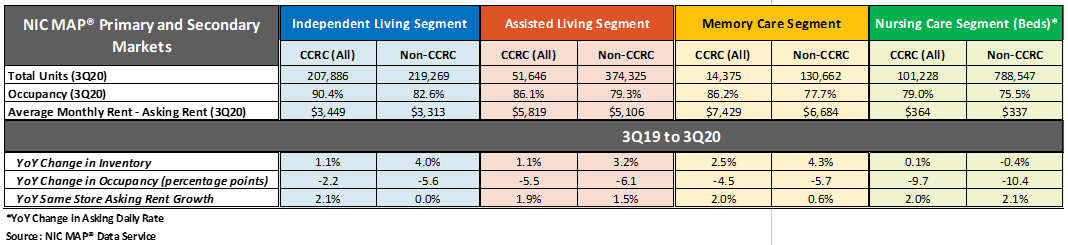
The table below compares each of the care segments—independent living, assisted living, memory care and nursing care—in the Primary and Secondary Markets. The table shows the 3Q 2020 total open units, occupancy and average monthly asking rent—and year-over-year changes for CCRCs and non-CCRCs.
Click to Expand
Higher Occupancy at CCRCs
The CCRC independent living care segment had the highest 3Q 2020 occupancy (90.4%), followed by CCRC memory care (86.2%), assisted living (86.1%), and nursing care (79.0%). Among non-CCRCs, the independent living care segment had the highest 3Q 2020 occupancy (82.6%), followed non-CCRC assisted living (79.3%), memory care (77.7%) and nursing care (75.5%).
The difference in 3Q 2020 occupancy between CCRCs and non-CCRCs was the highest for the memory care segment (8.5 percentage points), followed by the independent living care segment (7.8 percentage points), the assisted living care segment (6.7 percentage points) and the nursing care segment (3.5 percentage points).
Occupancy declined, year-over-year, for each of the care segments. However, CCRCs had lower declines in occupancy than non-CCRCs Among CCRCs, independent living care segment occupancy declined the least (-2.2 percentage points), followed by memory care (-4.5 percentage points), assisted living (-5.5 percentage points), and the nursing care segment (-9.7 percentage points). Among non-CCRCs, independent living and memory care segment occupancy declined the least (-5.6 and -5.7 percentage points, respectively), followed by assisted living (-6.1 percentage points), and the nursing care segment (-10.4 percentage points).
Higher Annual, Same Store Asking Rent Growth at CCRCs
CCRC same store year-over-year asking rent growth in the third quarter of 2020 was 2.5%, down from the time series high of 4.7% reached in the first quarter of 2019, but higher than the time series low of 2.1% at the end of 2010, beginning of 2012, and the end of 2013. Year-over-year asking rent growth did not vary significantly across the CCRC care segments unlike the non-CCRC care segments; the variation was only 20 basis points for CCRCs but 210 basis points for non-CCRCs. Among CCRCs, the highest year-over-year asking rent growth was 2.1% in the independent living segment; among non-CCRCs it was highest in the nursing care segment (2.1%). The lowest year-over-year asking rent growth was noted for CCRCs in the assisted living care segment (1.9%); in non-CCRCs it was noted for the independent living care segment (0.0%), followed by the memory care segment (0.6%).
Significantly Weaker Inventory Growth at CCRCs
Non-CCRCs had significantly higher rates of inventory growth (year-over-year change in inventory) by segment, than CCRCs. The highest rate of inventory growth was reported for non-CCRCs in the memory care and independent living care segments (4.3% and 4.0%); the lowest was reported for both CCRCs and non-CCRCs in the nursing care segment (0.1% and -0.4%, respectively).
Regional Occupancy Differences are Highest in the Mid-Atlantic, Northeast, and Pacific The current occupancy rates for CCRCs and non-CCRCs by region are shown in the table below. Overall, CCRC occupancy was stronger than non-CCRC occupancy by 8.9 percentage points. Seniors housing and care communities in the Mid-Atlantic, Northeast, and Pacific regions, which were more significantly impacted earlier in the pandemic than other regions, currently have the strongest CCRC occupancy rates ranging from 89.2% to 88.0%. The weakest CCRC (and non-CCRC) occupancy is in the Southwest at 80.9% and 71.5%, respectively—a 9.4 percentage point difference.
Look for future blog posts from NIC to delve deep into the performance of CCRCs. For further information on NIC, its reports, data, and analytics available to providers, please visit the NIC website at www.nic.org.
To learn more about NIC MAP® Data Service, and the latest metro-level data available to support your organization, schedule a meeting with a product expert today.
Telehealth and Senior Living | Telehealth is Here to Stay: A Guidebook
Telehealth, telemedicine, virtual care, eConsult, store-and-forward…what does this all mean? Telehealth brings incredible promise to our highest risk populations in this pandemic, and has transformational implications for the way healthcare will be delivered even once the pandemic is behind us.
Telehealth, telemedicine, virtual care, eConsult, store-and-forward…what does this all mean? More importantly, how do you better serve your resident populations — in a global pandemic and onward? Telehealth is a broad term that seems to get caught in a tangled web of policy, compliance, and reimbursement. However, telehealth brings incredible promise to our highest risk populations in this pandemic, and has transformational implications for the way healthcare will be delivered even once the pandemic is behind us.
Imagine an 87-year-old woman living in a senior living community. She falls on her way to the bathroom, hurting her hip and hitting her head. She is able to call for help and the night staff comes to her room. The young man on duty helps her back in bed, but knows she needs medical attention. He types her name into the iPad on the wall and is immediately connected with an ER doctor. The physician introduces herself, asks a few basic questions, and directs the night staff employee through a physical examination. She then directs the night staff employee to take a photo of the resident’s eyes to include in a neurology consult. The physician reassures the woman that everything is fine for now, but that she will need to get an x-ray in the coming days. The physician also explains that she will deliver the news from the neurologist in the morning, but there is nothing to worry about now. The woman is able to fall asleep and wakes up to a message from her ER doctor and a neurologist providing her detailed instructions around her care plan and the next steps — reassuring her she will be alright. She shares the videos with her senior living facility staff, children, and grandchildren.
How was this possible? First, the senior living community had synchronous primary and urgent care telehealth services. The operator of the property had already gathered key health data, emergency contacts, and consent, all of which was integrated into their in-room tablet and HIPAA compliant telehealth portal. The telehealth ER doctor was able to immediately access the key information and pair it with the incident requiring medical attention. Second, the operator and telehealth provider had asynchronous telehealth services for specialty care and video communication. This enabled the ER doctor to access specialists and receive care plan guidance within hours while also communicating key information to the resident in a shareable, repeatable, and personalized video message. This solution is what enabled the woman to have a neurology consult without leaving her room and receive a summary of her experience and next steps to re-watch, show her staff nurses, and share with concerned family.
Effective use of telehealth can result in reductions in ER visits, readmissions, and unnecessary COVID-19 exposures, while empowering front-line staff and improving the resident and family experience altogether. Telehealth has the potential to drive immense value for residents and providers alike within seniors housing. It may feel like this vision is a long way off, but the solutions are ready and available — operators need only understand what their options are and thus what best fits with their priorities.
A Brief History
The history of telehealth goes back several decades. Telehealth was first authorized in Medicare in 1997. Shortly thereafter, the internet boom democratized access to information, accelerating innovation across industries and instigating the rise of consumer choice (“consumerism”). The Affordable Care Act initiated a healthcare course correction toward value-based care, all while consumers were starting to expect the same kind of options, service, and convenience with their healthcare that they were experiencing when buying groceries, booking a plane ticket, or customizing a pair of shoes.
By the beginning of 2020, the majority of healthcare providers and hospital systems had started offering telehealth or at least had it on their strategic roadmap for the coming years, as it demonstrated the potential to not only please healthcare consumers, but also address rising healthcare costs and quality care access inequities. As such, telehealth has been on an upward trajectory for decades, albeit a slow one, until now.
When COVID-19 hit the U.S., cities, counties, and numerous states went under shelter in place policies. For millions of Americans, and thousands of healthcare providers, the need for telehealth options became urgent. CMS used emergency rulemaking to provide Medicare telehealth flexibilities for the duration of the pandemic. This expanded telehealth-eligible services, provided tech mode flexibilities, and expanded the types of practitioners eligible to provide telehealth services. Adoption skyrocketed, both by physicians and their patients, primarily older adults.
COVID-19 has significantly accelerated the proliferation of telehealth as a key element in care delivery. Now, telehealth is in the toolkit of nearly all providers and is an option for nearly all patients, including millions of seniors housing and care residents. According to a study done by McKinsey & Co, by May 2020, 76% of consumers said they are now interested in using telehealth going forward. User adoption coupled with telehealth’s impact potential on triage, coordination, productivity and convenience will ensure its continued presence in healthcare — and seniors housing — as we know it.
Telehealth Today
Telehealth can simply be defined as care delivered via virtual communication between patients and healthcare providers or providers to other providers.
There are many vendors offering a variety of telehealth solutions in today’s market. it is important to understand the defining variables that sit behind the vast array of options.
Modality: Telehealth can be delivered through a variety of media — audio, video, or text. It is critical to consider the richness of the media. Video and other virtual media are the closest to in-person, while text may feel impersonal or automated.
Timing: Telehealth can be delivered both synchronously and asynchronously. Synchronous refers to live communication such as a phone call. Asynchronous refers to communication that is delivered and then stored until the recipient reviews it — think of a voicemail (this is also referred to as store and forward). The value of synchronous telehealth is that it most closely resembles an in-person appointment. Asynchronous telehealth can also provide significant value to both patients and providers, as it eliminates the need for scheduling and can be referred back to, shared, or re-consumed.
Participants: The most common use for telehealth is between patient and healthcare provider. Telehealth also empowers senior living care workers to take an active role in their residents’ care journeys, through three-way visits. The ability to include family or caregivers in the care process leads to better communication and decision-making for the resident. Telehealth also extends to virtual communication for care delivery purposes between two healthcare providers — think of a second opinion, or a consult. This mode of telehealth can collapse the care cycle by empowering frontline providers with specialist expertise — reducing wait times, coordinating care, and reducing medical costs.
Provider integration: Many telehealth companies offer hardware or software to facilitate care. Others offer integration with provider networks, and occasionally operate as their own health system. Doctor On Demand, for example, has a network of board-certified primary care physicians, psychiatrists, therapists, and physician-led care teams. Similarly, Sitka is supported by a vast network of specialty providers such as dermatologists, cardiologists, neurologists, etc.
There are a myriad of options, and there is a lot to consider, but this should help set structure around the landscape of offerings.
Telehealth and Senior Care
Senior housing and care providers are uniquely positioned to reap value from telehealth for residents, families, staff, and the senior living communities themselves. Seniors housing has a captive user base around the clock and immediate economies of scale upon adopting a new solution. These communities largely have the power to control access and devices, while the expertise needed for physical examinations is usually available on site, oftentimes eliminating the need for in-person visits to your community. By employing telehealth solutions, operators can significantly decrease the need for in-person trips to the doctor’s office, or the emergency department, which families and residents now prefer to avoid.
The seniors housing population itself has greater need and greater reward for telehealth. The senior population accounts for the highest proportion of medical costs in the US, driven by ER visits and inpatient stays. Many times, conditions are worsened by travel and unnecessary exposures — avoidable with telehealth. Also, the senior population is eligible for value-based care (e.g., capitated Medicare Advantage Plans), which eliminates the incentive for excessive doctor visits or procedures and instead encourages timely and preventive care.
Seniors housing and care communities are home to over three million older adults, most of whom have multiple chronic conditions. The pandemic has brought with it heightened fear by these seniors and their adult children of traditional healthcare delivery settings, such as the hospital, the emergency department, and even the waiting room of the doctor’s office. Seniors increasingly both want and need to have healthcare services brought to their residential communities.
A clear opportunity exists for every type of senior living property, but telehealth is not one size fits all. Each senior living type, brand, and property should be assessed to identify how telehealth can be implemented to solve its most pressing needs.
First, structural elements must be assessed: skilled nursing availability, staff coverage, resident health plan membership mix, technological infrastructure (e.g., wifi, device access). Each of these factors will be key considerations as you balance budgetary constraints and feasibility of the different telehealth offerings.
It’s also important to factor in the intangibles: brand, culture, family involvement, resident investment in community decisions, staff / management relationship. Think about the goals of your proposed telehealth solutions and how they fit into your organization’s identity. While telehealth poses significant value, does the solution you are considering align with your organizational strategy and mission? Consider making small adjustments to better fit with competing priorities.
As you set off on this journey, it will be important to remember the fundamental rule of change management: key stakeholders must be included in the conversation and bought-in at each step. Such stakeholders may change depending on the operator or property type, but consider leadership, staff, residents, and families. Inclusion may entail conducting a pilot with specific residents and staff that have high likelihood to champion the chance, or hosting a marketing event with families early on to communicate the goal for the new telehealth solution. Buy-in will be critical to early stage implementation and to long-term success of telehealth in your organization.
Telehealth is Here to Stay
Change management may be daunting, but telehealth is here to stay. The sooner your telehealth solution is up and running, the better your communities and your residents will be in the long run. Telehealth is a powerful way to offer your residents safe and timely care, and will only become more essential in the future.
In his recent “NIC Talk,” given at the 2020 NIC Fall Conference, Dr. Tim Ferris, CEO of the Mass General Physicians Organization, said that when it comes to the utilization of telehealth to bring services to seniors with chronic conditions, “We are not going back.” Indeed, telehealth offers senior housing providers opportunity for onsite triage and proactive management of residents’ chronic conditions, allowing this high-risk population to stay at home. Pandemic necessitated telehealth will hopefully diminish soon, but continued investment and change management will ensure improved healthcare services, outcomes, and comfort for seniors in years to come.
Sources: McKinsey report — Telehealth: A quarter-trillion-dollar post-COVID-19 reality?
This article was originally posted on Medium by Sitka, Inc.
Skilled Nursing Occupancy Hits New Low in August 2020
NIC MAP® Data Service released its latest Skilled Nursing Monthly Report with key monthly data points from January 2012 through August 2020.
Managed Medicare revenue mix at 8.2%
NIC MAP® Data Service released its latest Skilled Nursing Monthly Report on October 29, 2020, which includes key monthly data points from January 2012 through August 2020.
Here are some key takeaways from the report:
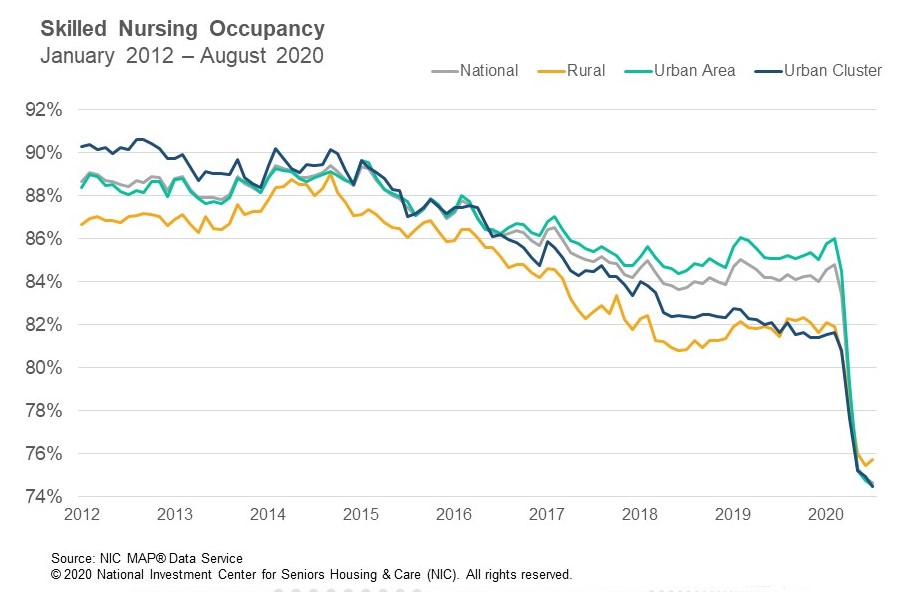
The trend of declining occupancy rates for skilled nursing continued in the month of August due to the on-going impacts of COVID-19. The downward pressure on occupancy has been significant since the pandemic, with another 81 basis point drop from July to August to a new low of 73.8%. This represents a 9.6 percentage points drop in just the five months since March (83.4%) and a 10.9 percentage point decline since February. On a year-over-year basis, the occupancy rate is down 10.5 percentage points from August 2019. The occupancy trend was consistent across geographies as both urban and rural areas decreased from July to August ending at 73.7% and 75.1%, respectively.
Patient day mix across all four payor types, i.e., Medicare, managed Medicare, Medicaid and Private, trended differently as Medicare and managed Medicare increased from July to April but Medicaid and Private decreased. This suggests the weakness in occupancy from July to August may be due to Medicaid admissions and/or patient days.
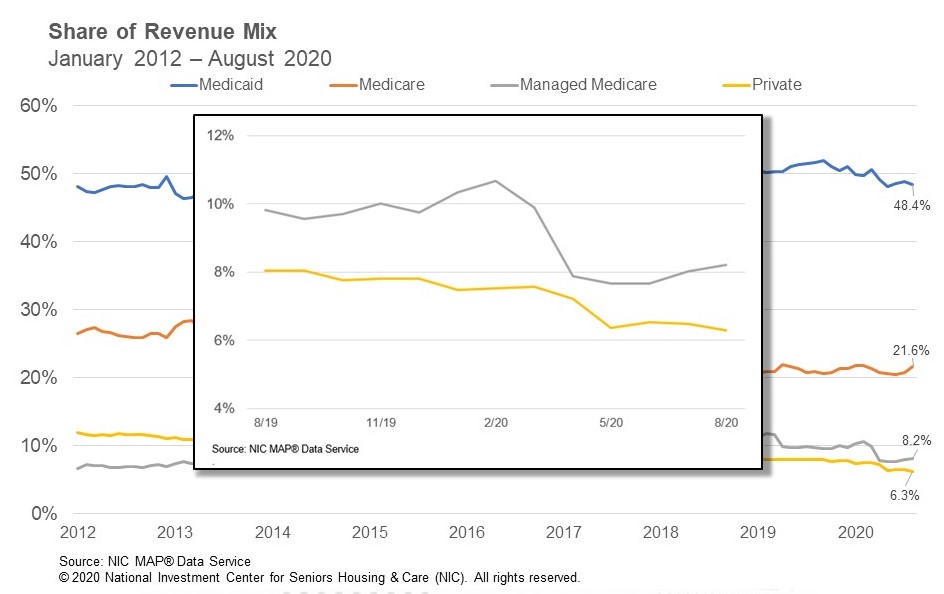
Medicare patient day mix increased 40 basis points from 12.1% in July to 12.5% in August. Since March, it is up 114 basis points and since last year, it is up 125 basis points from 11.2%. In addition, Medicare revenue mix increased 87 basis points from July to August, increasing from 20.8% to 21.6%. The combination of the overall decline in occupancy and the increase in Medicare patient day mix and revenue mix suggests that the waiver of the 3-Day Rule imposed by the Centers for Medicare and Medicaid Services (CMS) is having a positive impact on Medicare days. Meanwhile, Medicare revenue per patient day (RPPD) declined 0.3% from July to August, ending at $549. It has now decreased 1.1% from June after an initial increase during the earlier periods of the pandemic as skilled nursing properties were likely receiving more Medicare RPPD because of additional reimbursement due to COVID-19 positive patients requiring isolation.
Managed Medicare admissions have seemingly stabilized after decreasing significantly during the pandemic. Its patient day mix increased 14 basis points from July ending August at 5.9% and up 40 basis points since April. In addition, managed Medicare revenue mix is up 21 basis points from July ending August at 8.2% and up 34 basis points since April. The current stabilization in patient day and revenue mix is at the same time managed Medicare revenue per patient day (RPPD) is decreasing. RPPD decreased from $449 in July to $447 in August and is down 1.1% since February. The latest decrease in August suggests the downtrend in RPPD may be continuing after initial reimbursement stability from insurance companies during the earlier pandemic days. Although some stabilization occurred in August, managed Medicare revenue mix is down 168 basis points since March and down 246 basis points since February when it was 10.7%.
Medicaid revenue mix declined 46 basis points from 48.8% in July to 48.4% in August. Medicaid revenue mix has declined 222 basis points since March when the mix was 50.6%. Furthermore, it has decreased 324 basis points from August 2019. Medicaid patient days likely decreased as well, due to lower overall admissions during the pandemic thus far and some Medicaid patients converted to Medicare because of the waiver of the 3-Day Rule. Meanwhile, the increases in Medicaid RPPD seen at the onset of the pandemic have slowed. Medicaid RPPD is up 0.4% since April but has increased 2.5% since March when initial increases in reimbursement from states helped skilled nursing properties related to the number of COVD-19 cases at properties. RPPD was flat from July to August at $233.
To get more trends from the latest data you can download the Skilled Nursing Monthly Report. There is no charge for this report.
The report provides aggregate data at the national level from a sampling of skilled nursing operators with multiple properties in the United States. NIC continues to grow its database of participating operators in order to provide data at localized levels in the future. Operators who are interested in participating can complete a participation form here.
NIC Conference Keynote on Policy Offers Candor and Optimism
Journalist Soledad O’Brien moderated a discussion with Mark Parkinson, president and CEO, American Health Care Association (AHCA) and National Center for Assisted Living (NCAL), and Andy Slavitt, senior advisor for The Bipartisan Policy Center and former Acting Administrator of the Centers for Medicare & Medicaid Services (CMS) at the 2020 NIC Fall Conference.
Seniors Housing and Government Can Work Together for a Bright Future.
One of the attractions of any NIC Conference is the caliber of thought leadership and insight provided in main stage keynote sessions. Typical keynotes, held in large ballrooms, hardly feel intimate. In contrast, much of the 2020 NIC Fall Conference, hosted on a virtual platform that put every speaker and attendee on a face-to-face basis, felt close, personal, and disarmingly genuine. This dynamic was on display for one of the most anticipated keynote discussions of the nation’s most important seniors housing and care event.
Award-winning journalist Soledad O’Brien adeptly moderated a discussion with Mark Parkinson, president and CEO, American Health Care Association (AHCA) and National Center for Assisted Living (NCAL), and Andy Slavitt, senior advisor for The Bipartisan Policy Center and former Acting Administrator of the Centers for Medicare & Medicaid Services (CMS). Both leaders were frank and forthcoming regarding the impact of COVID-19 on seniors housing and care. Despite coming from the often opposing viewpoints of industry leader and policymaker, the discussion demonstrated that, for seniors housing and care, the pandemic promises to teach industry leaders a great deal – and has created opportunities to work with government to craft a bright future, while delivering better outcomes for America’s frail elders.
Trump and COVID
O’Brien’s first question was for reactions to the news which had just broken, that President Trump and the first lady had tested positive for COVID-19. Parkinson took the opportunity to express his hope that, “As bad as the news is, maybe it will be a wakeup call some people needed, that you’ve got to take this stuff seriously. You have got to wear a mask because anybody, under any circumstance, can get this virus.”
Slavitt pointed out that, in addition to the President, “43,000 other people were diagnosed with COVID yesterday.” He agreed that while we shouldn’t be politicizing the President’s health, the country might learn two lessons from the news, “One is, a thin piece of cloth would have prevented this from happening…the second lesson is simple consideration. Trump and his staff and his family entered a room, sat around Chris Wallace, were feet away from Joe Biden. None of us know whether we have COVID-19 or not…that’s why we wear masks.” He hoped that, like (UK Prime Minister) Boris Johnson, who fell seriously ill with the virus, Trump would take this more seriously, wear a mask, and encourage others to do so.
The Second Wave
Asked whether the seniors housing and care industry is prepared for a second wave, Parkinson was optimistic. “We are. We were completely unprepared for the first wave.” He explained that the virus’ ability to spread via asymptomatic carriers wasn’t understood at first. That, and the lack of masks and appropriate PPE, “really caused it to spread like wildfire in nursing homes and assisted living facilities across the country…the other thing we needed was testing, and we didn’t have that either.” He pointed to “horrendous policy mistakes made at multiple levels, that created the challenges we had.”
Parkinson continued, “For phase two we’re in better shape. The policymakers have not done great, but the scientists have. The testing we now have…as well as a little better position on PPE, I think we’re in a much better position. Clinically, we also know a heck of a lot more about how to take care of people, so the mortality rate is down.” Nevertheless, he echoed Slavitt’s frustration with America’s failure to enact simple preventive measures. He said, “We don’t have to have a second wave. What’s so damned frustrating about this is that if everyone would just wear a mask, just that simple, considerate thing, if we would just make a decision as a country that everywhere we go we wear a mask and socially distance, we wouldn’t eliminate this in two weeks – but we would grind it to very low numbers.”
Slavitt raised community spread as another key factor impacting nursing homes. He said, “It is very, very difficult, once there is community spread, to prevent that spread from getting into the nooks and crannies where everybody lives.” While agreeing that the industry today is better prepared to protect frail elders, he appealed to everyone, politics aside, to be considerate of others and help to contain the spread of the virus.
“A Business Disaster”
The discussion turned to the state of the industry, which has seen a fall in occupancy rates and a simultaneous rise in costs associated with fighting the pandemic. Parkinson said that, “My overriding message to the folks who are watching this, who are primarily investors in long term care, is that we’re going to get through this, and this is going to continue to be a good space to invest in and that’s not just hollow cheerleading. I believe there’s good data and good reason to believe that.” He went on, however, to outline how the pandemic has caused a “clinical nightmare and a business disaster.”
Parkinson offered a litany of dismal facts, including over 50,000 deaths in nursing homes, and tens of thousands in assisted living facilities. He pointed to census data that dropped from 85% to 75% in just a “month or two,” and half that in assisted living. He pointed to major increases in expenses, as operators scrambled to acquire PPE, often at “ten times the normal rate” on the black market, while paying ‘hero pay’ to staff and incurring other related expenses.
Asked how he can be optimistic in the wake of such grim realities, Parkinson said, “The good news is the government recognizes that we are an essential service, and thank god for the CARES Act funds, that have now provided nursing homes a combined, probably, almost 20 billion dollars.” He also pointed to long-term demographic advantages, saying, “people need our services. We have a growing demographic, really exploding in the age group that we take care of, and as reluctant as people will be for a while to move into our buildings, which I completely understand, people don’t move into our buildings because they want to, they move into our buildings because they have to. They just can’t be taken care of safely at home anymore. It will be bumpy, and it will take some time, but the demographics are compelling. We will win the public’s confidence back, and I think this will be a good space to be in, eventually.”
The Opportunity to Improve
In agreement with Parkinson, Slavitt said, “industries through time emerge stronger from crises, often, if they do some self-examination, like Mark’s talking about, if they really, genuinely look at what they’re doing and say, ‘here are four or five things that can help us.’” He added, “This is an industry that everybody cares about, every Congress person, every senator, every presidential candidate needs this community to be successful. It’s not too big to fail, it’s too important to fail.” He said, “I love the fact that the industry is opening dialogue, that the industry is talking to the White House and HHS every day, that we’re figuring this out together.”
Parkinson warned industry decision makers not to miss this opportunity to improve. “The knee-jerk reaction for some might be, ‘Hey, let’s just get this behind us and try to move on with business as usual.’ That would be a huge mistake. You cannot ignore the fact that close to 100,000 people have died in long term care facilities. If we don’t use that as a moment of reflection, to not just look at what caused this, outside of our control, but look in the mirror and figure out those things that were within our control that could have slowed some of this down, and what could we do to be better in the future, then we’re missing an enormous opportunity.”
Regulatory Reform
Both panelists agreed in other areas, as well. On the burden of regulations, Parkinson pointed out that skilled nursing is more heavily regulated than “virtually all other healthcare providers,” and stated the “amazing statistic” that “80% of the enforcement budget at CMS is spent on nursing facilities.” He suggested that CMS focus regulations on “things that really matter,” such as infection control, person-centered planning and activities, and other areas where nursing homes can improve care for their residents.
“Mark’s right. You can’t regulate culture,” Slavitt responded, then advocated for “what works best,” which he described as an industry that recognizes what it needs to improve and asks for investment from the taxpayer to get there, as well as the accompanying regulations, which, “would make everybody comfortable, and provide assurances.” He added, “If the industry is able to move itself to that point, I think the industry will find a very ready and willing partner in the government, no matter which government…”
Workforce
On workforce issues, Parkinson said, “We don’t pay our healthcare workers enough, particularly the frontline workers in long term care.” He asked the question, “What do we do to make sure that we not only have enough people to work in our facilities, but that they can do so and take care of their own lives?” He linked the answer to the need for funding, as well as immigration reform. In response, Slavitt again offered some agreement, saying, “Right now, people who spend their day caring for the rest of us, if they somehow don’t have enough money to make ends meet, that is a litmus test that we should address…there’s plenty of resources in this country to do that.”
On immigration, Parkinson advocated for resolving the “dreamer problem,” as well as reviving programs that bring nurses in from foreign countries. “The challenge that economies will face in the 21st century, is where they will get the workers that are needed. The demographics of a declining workforce are very bad across all of the developed world.”
Addressing the politics of immigration, and acknowledging the need for workers, Slavitt said that “there actually is a center point of agreement on a number of these topics.” He explained that while they may not make everyone happy, they offer solutions to “add fairness” and move the country forward. “Sometimes it takes an event, sometimes it takes a new Congress, sometimes it takes a new way of looking at things, but one day, hopefully soon, we can resolve some of these issues.”
Medicare and Medicaid
Another issue that both experts addressed was Medicare and Medicaid. On Medicare, Parkinson acknowledged that the new payment plan, PDPM, initiated under Slavitt’s administration and recently put in place, is working well. He views Medicaid, on the other hand, as a politicized program that is now underfunding care in many states. “We’re going to have to figure out what our priorities are. Instead of just talking about these workers, these heroes, and the greatest generation, are we really willing to put some resources behind that, to give them the kind of care, and the kind of jobs, that they deserve.”
Slavitt responded, “In some point of time, whether it’s before or after the election, we’re going to have to do that [fund Medicaid], or many people who are on Medicaid today are going to face challenges, and payments are going to get even lower.” He pointed to a recent actuarial report that indicated, “Over the last year, Medicare lost two years of the life of its trust fund, and is now projected to turn insolvent in 2024.” What worries him, he said, is that during the next presidential term, the program will become underfunded. He explained that the next President may be in a position either to fund the program or cut benefits and payments under the program.
Towards the close of the discussion, addressing national priorities, Slavitt said, ”What we need is some radical introspection, as a country, into what kind of country we want to be. Part and parcel of this is the question of how we take care of people who need our help; they’re no longer at the stage where they can care for themselves, whether it’s because they have a disability, whether it’s because they’re aged, whether it’s because they’re low income, whether it’s because they’re sick. I think that is an enormous part of our national debate.”
We use cookies on our website to give you the most relevant experience by remembering your preferences and repeat visits. NIC's privacy policy can be viewed here. By clicking “Accept”, you consent to the use of ALL the cookies.
This website uses cookies to improve your experience while you navigate through the website. Out of these cookies, the cookies that are categorized as necessary are stored on your browser as they are essential for the working of basic functionalities of the website. We also use third-party cookies that help us analyze and understand how you use this website. These cookies will be stored in your browser only with your consent. You also have the option to opt-out of these cookies. But opting out of some of these cookies may have an effect on your browsing experience.
Necessary cookies are absolutely essential for the website to function properly. This category only includes cookies that ensures basic functionalities and security features of the website. These cookies do not store any personal information.
Functional cookies help to perform certain functionalities like sharing the content of the website on social media platforms, collect feedbacks, and other third-party features.
Performance cookies are used to understand and analyze the key performance indexes of the website which helps in delivering a better user experience for the visitors.
Analytical cookies are used to understand how visitors interact with the website. These cookies help provide information on metrics the number of visitors, bounce rate, traffic source, etc.
Advertisement cookies are used to provide visitors with relevant ads and marketing campaigns. These cookies track visitors across websites and collect information to provide customized ads.
 Exhibit 1 – Source: NIC Skilled Nursing COVID-19 Tracker*
 Exhibit 2 – Source: NIC Skilled Nursing COVID-19 Tracker*