The ‘Essential Virtual’ NIC Fall Conference Concludes – But Remains a Value

For the past two weeks, over a thousand seniors housing and care leaders from across the U.S. have logged on, often from their own home offices, to participate in their industry’s most important event. Of course, ‘the NIC’, in response to the COVID-19 pandemic, is now a virtual experience.

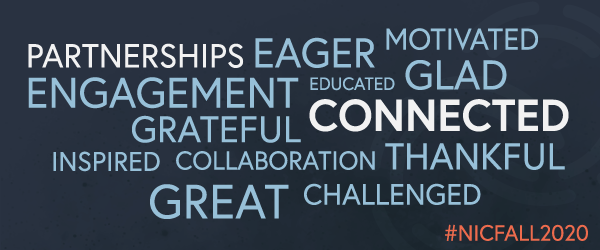
For the past two weeks, over a thousand seniors housing and care leaders from across the U.S. have logged on, often from their own home offices, to participate in their industry’s most important event. Of course, ‘the NIC’, in response to the COVID-19 pandemic, is now a virtual experience. But industry professionals have embraced what it has to offer. Many have discovered that ‘the NIC’ is as rich in thought-leadership and opportunities to connect with other decision-makers as ever – and that in some ways, the ‘essential virtual’ experience offers surprising advantages over traditional events.all_words_cloud-1
In the runup to the conference, NIC Founder & Strategic Advisor, Bob Kramer, pointed out that the new platform offers real value for attendees. He said, “The 2020 NIC Fall Conference is not only a uniquely affordable educational opportunity, it also provides an unprecedented new dealmaking platform, the NIC Community Connector™.” The vast majority of attendees are now registered on the NIC Community Connector, ensuring that there are, indeed, plenty of opportunities to connect directly with people in a position to make a deal.
NCC_Conf_1024x512

In practice, attending companies were able to extend opportunities to connect and learn to more of their staff than they would otherwise send in person. “We are taking advantage of the virtual format by including more of our team to build on essential relationships and gain invaluable insights from the educational sessions,” said Marilynn Duker, CEO of Brightview Senior Living. Without the cost, both in dollars and time, of travel and booking accommodations, and with a lower price for registration, the conference attracted numerous attendees who might otherwise not have made the trip.

By Popular Demand

In many ways, the conference adhered to traditional educational and thought-leadership programming. In total, more than 50 sessions offered insights, opportunities to participate in substantive discussions, presented the latest data and analysis, and featured some of the nation’s foremost experts and industry leaders. As in any in-person NIC conference, keynote general sessions featured panels of experts who needed no introductions.

Award-winning journalist Soledad O’Brien moderated a discussion with Mark Parkinson, President & CEO, American Health Care Association (AHCA) and National Center for Assisted Living (NCAL), and Andy Slavitt, senior advisor for The Bipartisan Policy Center and former Acting Administrator of the Centers for Medicare & Medicaid Services. Both leaders were frank and forthcoming regarding the impact of COVID-19 on seniors housing and care.

Parkinson, on whether the seniors housing and care industry is prepared for a second wave, said, “We don’t have to have a second wave. What’s so damned frustrating about this is that if everyone would just wear a mask, just that simple, considerate thing, if we would just make a decision as a country that everywhere we go we wear a mask and socially distance, we wouldn’t eliminate this in two weeks – but we would grind it to very low numbers.”

On funding Medicaid, Slavitt said, “In some point of time, whether it’s before or after the election, we’re going to have to do that [fund Medicaid], or many people who are on Medicaid today are going to face challenges, and payments are going to get even lower.” Towards the close of the discussion, Slavitt had this to say about national priorities, ”What we need is some radical introspection, as a country, into what kind of country we want to be. Part and parcel of this is the question of how we take care of people who need our help, they’re no longer at the stage where they can care for themselves, whether it’s because they have a disability, whether it’s because they’re aged, whether it’s because they’re low income, whether it’s because they’re sick. I think that is an enormous part of our national debate.”

Another highly anticipated general session featured an O’Brien-moderated discussion with seasoned political commentators, David Brooks and David Gergen. It felt like an honest, forthright assessment of the impact of the coming election on the sector. David Brooks offered a mea culpa on his 2016 predictions of a Clinton victory, and described his efforts since then to reconnect with the segments of the American populace with whom he’d grown out of touch. Both men offered their insights and predictions for the election – as well as their assessment on the impact it will have on American life and business interests.

The popular NIC Talks series, now a highly anticipated staple of the traditional event, returned —featuring another group of uniquely qualified, passionate thought-leaders, including JoAnn Jenkins, CEO of AARP, addressing the question, “How will COVID-19 impact the future of aging and aging services?” In the style of “TED-Talks,” these often emotionally powerful presentations added some punch to the analysis and data on offer in week one. A week two peer-to-peer discussion offered an opportunity to further discuss the NIC Talks presentations, with moderator Bob Kramer and NIC Talks presenter, Dan Cinelli.

In addition to one of the richest educational programs ever offered at a NIC conference, the event extended a variety of means for attendees to build and grow their business and social networks. Echoing in-person events, the virtual platform reveals to its users who else is in the lobby, or in a breakout session, and allows them to message one another, either in text or via video chat. Anyone who misses running into old friends in hallways should be heartened by this means to interact in such an organic, impromptu manner.

New Ways to Network

The unique, new NIC Community Connector launched in parallel to the event, and is currently only available to its attendees, who may continue to use it free of charge through the end of 2020. The innovative online platform provides a means to search for potential new contacts, and to communicate directly with the deal-makers they need to meet with. NIC is continuing to develop the platform, with new features scheduled to launch this year.

Attendees were also able to set up ‘braindates’ with each other, either one-on-one or in small groups. These intimate, focused exchanges provided not only a means to share thinking, but to connect with fellow attendees, and potentially to begin to build and grow new relationships with peers, based on those interactions. Through braindate™, attendees set up their own focused discussion groups, joined groups set up by fellow attendees, or arranged one-on-one meetings of their own.

In week two, called ‘connections week,’ NIC hosted numerous peer-to-peer discussions, on carefully curated topics of immediate relevance in today’s world. These moderated events offered participants expert thought-leadership, as well as frank discussion, and often eye-opening insights and ideas, offered up by attendees sharing their own real-world experiences and perspectives in more intimate small group breakout discussions.

Beyond educational sessions, the event offered attendees a variety of opportunities to spend time with each other, network, engage in self-care, and even share some cocktails or world-class entertainment together.

A series of ‘Brand, Brain, and Being’ sessions offered attendees a chance to focus on themselves and gain expert tips on improving personal brand, productivity, creativity, and overall wellness. Just as in traditional events, there was a LinkedIn expert on hand to help improve social profiles.

Meanwhile, for NIC MAP® Data Service power users and novices alike, there were opportunities to learn from NIC MAP experts, discuss how they use the NIC MAP Data Service platform, and meet (virtually, of course) with NIC MAP staff to discuss how the industry’s leading data service might benefit their businesses. Discussion groups for NIC MAP users delved into how they use the platform to analyze market feasibility, inform underwriting, and effectively target markets.
virtual_expx_header-png

As with traditional NIC events, the attendee experience also included world-class entertainment. As week one drew to a close, the Young@Heart chorus, introduced by an impressive collection of A-list celebrity admirers, charmed and entertained with their talented, and infectiously fun, performances. Perhaps the most anticipated session of week two was a behind-the-scenes experience with Broadway and film cast members from “Hamilton!”, who also delighted fans of Broadway’s most popular show with exclusive performances that were simply not to be missed.

Although the conference has ended, attendees will retain access to a library of its many educational sessions and will also be able to use the powerful NIC Community Connector through the end of 2020. As expressed by NIC CEO Brian Jurutka in a press briefing, “I believe this conference – and the NIC Community Connector – will be valuable to thousands of leaders and their businesses, as they begin to craft a new normal and build towards a successful future, both for their businesses and for the millions of America’s elders seeking access and choice in seniors housing and care.”
How to Partner with a Healthcare Provider in the COVID Era

The pandemic is fast-tracking the link between seniors housing and healthcare. Residents want to be protected from infection and access to onsite care, no matter the setting.   

Educational session at 2020 NIC Fall Conference highlights onsite service.


Key Takeaways 

  • Seniors housing is emerging as a key part of the healthcare continuum. 
  • Keeping residents out of the hospital is a major objective. 
  • Seniors housing providers are managing healthcare risk onsite for their residents—both for infection and for social isolation/loneliness. 
  • Health and healthcare must become an essential focus for seniors housing providers—but they don’t have to be the provider of the healthcare.  

The COVID-19 outbreak has accelerated emerging trends. Consumers are making more purchases online. Virtual meetings are now routine. Telehealth has gone mainstream in a matter of months.   

Likewise, the pandemic is fast-tracking the link between seniors housing and healthcare. Residents not only want a hospitality-type experience but also expect to be protected from infection. Many want access to onsite care, no matter the setting.   

Different approaches are emerging.  

One example of how to partner with a healthcare provider was presented during  Education Week at the 2020 NIC Fall Conference during a session  titled: “What Does Senior Living Look Like in the COVID Era: The New Role of Health and Healthcare Onsite.”    

Separately, a peer-to-peer discussion on the topic was held during the conference Connections Week. Participants shared their experiences with onsite healthcare. 

The educational session was led by Bob Kramer, NIC founder and strategic advisor, and president at Nexus Insights. Participants included Michael Grust, founder and CEO at San Diego-based senior living provider SRG; and Jim Lydiard, staff vice president at CareMore Health, a division of insurer Anthem.    

SRG collaborates with CareMore to offer onsite healthcare services, a partnership that has deepened during the COVID-19 crisis.  

Kramer provided context, noting that older adults have become more fearful about visits to traditional healthcare settings, such as doctors’ offices and clinics. At the same time, new models of care are emerging, including the use of telemedicine. 

“We are at a nexus point as an industry,” said Grust. He explained that the ability to protect the health of residents while creating environments where they can thrive will make a big difference in their decision to leave their homes and move into senior living communities. “We are focused on quality of life,” said Grust. 

CareMore’s insurance program—called Touch—provides a full range of medical services to residents who enroll. Many of the CareMore visits by healthcare providers are proactive, which helps contribute to the overall health of residents and improve their quality of life.  

The program is meant to compliment the work of SRG’s hospitality and wellness teams. CareMore does not offer dining services or help with the activities of daily living.  

Kramer noted the distinction between health and healthcare services. Health is related to prevention and wellness. SRG’s ZEST program, for example, keeps residents healthy and engaged. CareMore provides the actual medical services. “Health and healthcare have to be an essential focus, but you don’t have to do it all yourself,” said Kramer. “Partnerships can deliver benefits.” 

Teamwork Succeeds 

CareMore works together with the wellness team onsite. They can communicate with CareMore via text, video and phone. “Residents can get help right way,” said Lydiard, which helps keep them out of the hospital.  

Residents voluntarily sign up for the CareMore program. Enrollees receive a health assessment and a customized care plan. Regular visits from healthcare practitioners are provided as well as telehealth sessions. Mini clinics, operating three to five days a week, are created on campuses with a sizable number of enrollees.  

SRG does not pay a fee to CareMore. The patient’s insurance pays for the service under Medicare, Medicare Advantage or Medicaid. “This does not cost the operator more money,” said Lydiard. He added that the arrangement can help reduce the operator’s costs by eliminating unnecessary healthcare expenses that the operator might incur. Also, residents who enroll in the CareMore  Medicare Advantage plan may save as much as $200-$300 a month.  

Another plus: The partnership aligns the interests of the insurer and the operator. SRG keeps its residents healthier, often resulting in a longer length of stay. CareMore is motivated to keep residents healthy because it is paid through a capitation contract or risk-sharing model.   

Scale matters, however. The ability of CareMore to greatly impact resident outcomes depends on enrolling a critical mass of residents in the program. Membership grows virally after about 20 percent of residents sign up as CareMore’s presence on campus increases and residents see the value of onsite care. “We have to build membership,” said Lydiard.  

CareMore handles the marketing of the plan. But the staff at the community is educated on the benefits. 

 A hurdle to enrollment has been the reluctance by residents to switch insurance plans. They want to keep their primary care doctors, specialists and healthcare networks. 

But a big change will make it easier for residents to sign up. CMS is expanding its value-based care model to allow groups like CareMore to enroll residents with a traditional Medicare plan. They can keep their providers and still get the wraparound services provided onsite by CareMore. “This is a game changer,” said Grust.  

 The panelists agreed that senior living is now a part of the healthcare continuum. “We need to raise our game,” said Grust, noting “We are not post-COVID.” Senior living providers must continue to protect residents while providing an environment where people can thrive. “We have always been focused on the quality of life,” said Grust. “That is our unique selling proposition.”

Pace of Occupancy Decline Slows in Skilled Nursing

NIC MAP® Data Service released its first Skilled Nursing Monthly Report, which includes key monthly data points from January 2012 through June 2020.

NIC MAP® Data Service released its first ever Skilled Nursing Monthly Report on August 31, 2020, which includes key monthly data points from January 2012 through June 2020.

Here are some key takeaways from the report:

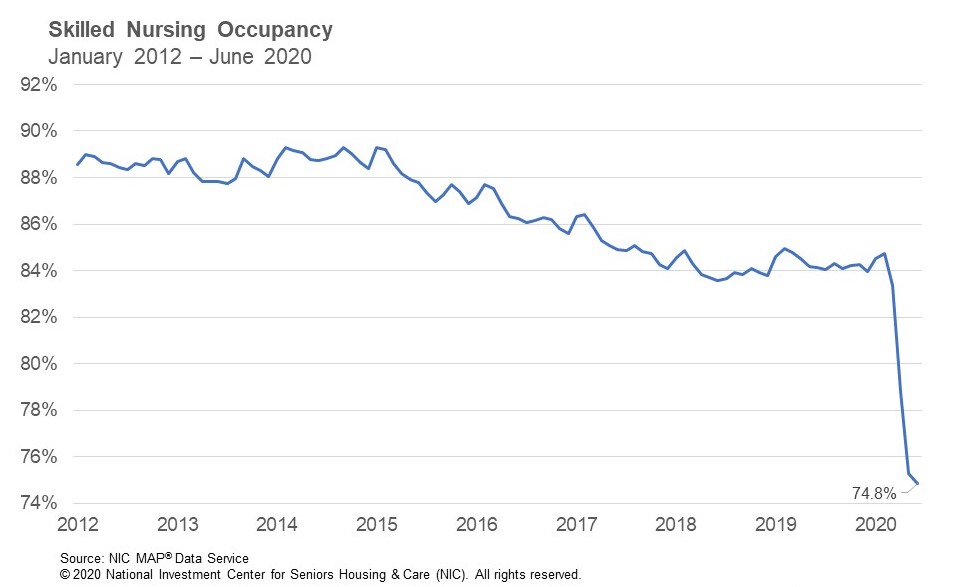
  1. With few signs of abating, the effects of the COVID-19 pandemic were still evident in the June skilled nursing data. The pace of the decline in occupancy slowed in June, but the rate hit a new record low of 74.8%. The 41 basis-point decline from May was the first month-over-month decline in occupancy less than 100 basis points since the start of the pandemic in March. This suggests that occupancies at skilled nursing properties may be starting to stabilize. However, significant uncertainty remains, especially as fall and winter approach. New challenges could arise with arrival of the flu season complicated by a possible resurgence of the COVID-19 virus. Since March, the occupancy rate has fallen 853 basis points from 83.4%. It is now down 990 basis points below February’s level.  The year-over-year occupancy rate is down 930 basis points from June 2019 and down 871 basis points from the previous low set in June 2018, prior to the pandemic. Urban area occupancy has declined significantly more than rural areas, declining 970 basis points since March compared to 539 basis points in rural areas.Skilled Nursing Occupancy through June 2020-1
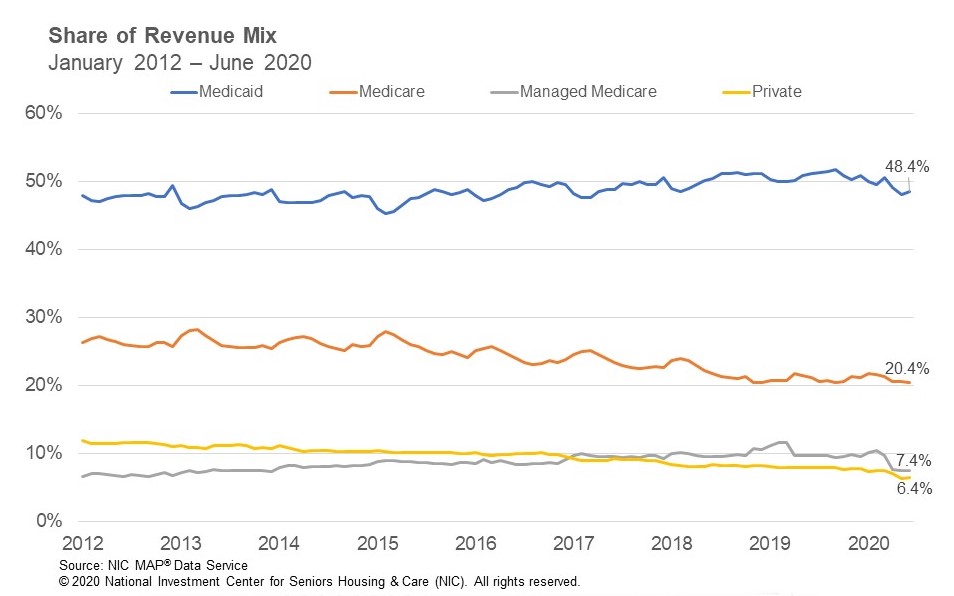
  2. Managed Medicare patient day mix increased slightly from May, ending June at 5.5%. This was the first month-over-month increase, albeit small, since the pandemic started. However, it is still down 109 basis points since March and down 158 basis points since February when the managed Medicare patient day mix was 7.0%. In addition, managed Medicare revenue mix seems to be stabilizing. It was flat from May to June, ending June at 7.4%. However, it has declined 224 basis points since March and 303 basis points since February when it was 10.5%. The stabilization in June suggests that insurance enrollees may have started to resume elective surgeries as states began lifting the suspension of such procedures.
  3. Medicare revenue mix declined slightly from May to June, ending at 20.4%. Although down, Medicare revenue mix has held up relatively well since the pandemic began in March, compared with other payors. It is only down 89 basis points since March compared to managed Medicare (down 224 basis points) and private (down 102 basis points). In addition, Medicare patient day mix has increased since March, from 11.2% to 11.9% in June. Although overall occupancy has declined dramatically during the pandemic creating significant pressure on skilled nursing operators, Medicare patient days likely did not decrease as much as it would have given that the Centers for Medicare and Medicaid Services (CMS) waived the 3-Day Rule, which required  a 3-day inpatient hospital stay prior to a Medicare-covered skilled nursing stay. Share of Revenue Mix through June 2020
  4. Medicare (RPPD) was essentially flat from May to June, ending at $557.76. However, Medicare RPPD has increased 1.9% since March. It likely increased because of additional reimbursement for COVID-19-positive patients requiring isolation, in addition to the temporary suspension of the 2.0% sequestration cuts by CMS (effective May 1-December 31, 2020). The trend varies, however, in urban and rural areas. The increase in Medicare RPPD since March was only 0.2% in rural areas, but 2.4% in urban areas. This most likely reflects the increase in Medicare support for urban areas with higher levels of COVID-19 cases.

To get more trends from the latest data you can download the Skilled Nursing Monthly Report. There is no charge for this report.

The report provides aggregate data at the national level from a sampling of skilled nursing operators with multiple properties in the United States. NIC continues to grow its database of participating operators in order to provide data at localized levels in the future. Operators who are interested in participating can complete a participation form here. https://www.nic.org/skilled-nursing-data-initiative. NIC maintains strict confidentiality of all data it receives.

Staff Mental Fatigue and Burnout: The Hidden Toll of COVID-19

Caring for the mental health of senior care staff during the pandemic is essential so they can continue providing compassionate care for residents.

A recent study from North Carolina State University and Georgia Tech found that healthcare workers in the United States are struggling with significant mental-health challenges during the COVID-19 pandemic, including depression, anxiety, and insomnia. While all healthcare workers are at risk, one key feature of caregivers in a seniors housing and care setting is that many of these caregivers have spent months, if not years, developing relationships with the residents they serve and their families. This means the emotional toll experienced by these staff may be that much more overwhelming.

Adding to the stress load is that filling staffing gaps amidst the pandemic has become even more difficult, stretching existing staff thinner. While attracting and retaining personnel has long been an issue for many seniors housing and care operators, the current crisis has exacerbated this challenge. The most recent wave of NIC’s Market Fundamentals survey indicated that 85% of organizations were offering overtime hours to mitigate labor shortages and 42% were tapping agency or temporary staff.

A Pandemic of Grief

In the initial months following the COVID-19 outbreak, much of the media focus was on hospital emergency room and ICU staff – those who would most traditionally be considered as the frontline healthcare workers. There has also been coverage of long-term care and senior care resident well-being and the impact of social isolation and loneliness on resident mental and physical health. What seems to get less attention is the impact of the pandemic on seniors housing and care staff. These staff have been facing high levels of stress resulting from many months of continued crisis as they seek to protect and care for residents while observing the latest infection control protocols. They have also been coping with forced isolation and, in some instances, death of residents for whom they have become the only ‘family.’ Finally, they carry the burden of concern for their own families’ health and safety.

Increasingly, however, these frontline workers are sharing their own deeply personal experiences of mental anguish, symptoms of post-traumatic stress disorder, and burnout. Many have highlighted these experiences to draw attention to the plight they and their colleagues are experiencing to reinforce that these workers absolutely should be considered frontline healthcare workers, and to underscore their need for supportive mental health services.

Tools for Identifying At-Risk Workers

The University of North Carolina School of Medicine, UNC Health, and Google have launched a mobile app that is designed to provide healthcare workers with mental health resources. The Heroes Health app is designed to identify mental health stress among healthcare workers and apprise leaders about the times of day or particular units that might need additional support, without identifying specific employees.

Healthcare workers complete weekly questionnaires on symptoms related to various mental health conditions. These questionnaires then feed summary reports of the user’s symptoms and trends over time. The summary reports include an assessment of their sleep quality, anxiety, and potential PTSD symptoms.  

Additionally, apps like Headspace and The Breethe meditation app are supporting healthcare workers by offering free access to their platforms in an effort to help mitigate the stress and anxiety felt by those who are caring for sick patients and residents. Such access includes breathing exercises to reduce stress and meditation for anxiety.

Proactive Coping Strategies

Given the high-stress nature of frontline healthcare roles, forward thinking operators are striving to combat the mental fatigue that working during a pandemic poses to their staff. It is crucial to find ways to support staff mental health and provide them with tools for managing the very real personal toll this crisis is taking on them. As an example, frontline caregivers may find themselves restarting old habits like smoking amid the stress. Without effective mitigation strategies, there is going to be a great deal of burnout, and the risk of these staff leaving the field going forward.

Overcommunication

Overcommunication is one of the strategy pillars Aegis Living has employed throughout the pandemic to keep staff current on the latest information. In the early days of the pandemic, these were daily communications that served to provide the most up-to-date information. These frequent touch points with staff provide leadership the opportunity to connect with their staff, to validate their experiences, and to be a source of support and encouragement for them. As Aegis Living President Kris Engskov has stated, these interactions were in part “to be a cheerleader” for staff. These points were further emphasized during the most recent NIC Leadership Huddle: Coping with the Pandemic held on August 17 when Lori Alford, Co-Founder and COO of Avanti Senior Living and Lynne Katzmann, Founder and CEO of Juniper Communities discussed “COVID-fatigue” and its impact on staff.

Managing Staff Emotions

As residents have become ill or passed away, staff and caregivers are understandably grieving. However, the work of caregiving and supporting residents and their families does not go away during the grieving process. Staff need support from one another, and to be able to talk and listen to each other, sharing feelings of anxiety, grief, panic, or guilt. While staff are all sharing in collective grief, leadership should reinforce with staff that this is in no way indicative of their failing.

The unfortunate reality of the pandemic is that residents may get sick despite all that staff do to protect and care for them. Given all these stress factors facing staff, managers should be on the lookout for warning signs, such as distractions while on the job, incomplete work, irritability with families or clients, and emerging lateness or absence from work which did not exist previously. Operators should also be encouraging staff to seek professional help as needed, especially as tele-mental health services have become increasingly available. Remind staff that there is no stigma in doing so. Empathy and understanding are key when addressing these issues and encouraging staff to seek help.

As Executive Coach Dan Brown of Arden Coaching pointed out during NIC’s recent Leadership Huddle, operators and administrators should be attuned to the signs of high stress amongst frontline workers. Brown listens for maladaptive thoughts, or feelings, and whether they are persistent. “One of the feelings that you really want to listen to, when you’re working with people on the front line, is a feeling of guilt, that ‘I can’t do enough.’”

Advising Staff

One of the most important aspects to keep in mind when considering the mental health and well-being of senior housing and care staff, is that staff cannot consistently offer great care to residents unless they are taking care of themselves. This may mean remembering to schedule their own relaxation time, whether that is a warm bath, an in-home movie, a favorite food, or a glass of wine.

Staff are going to be worried about bringing the virus into their own homes, so operators need to be providing regular testing for staff as well as reminding them to follow safety protocols at work, and to shower and change their clothes before engaging with family members at home.

One thing is clear – there will be no resolution to the pandemic anytime soon. The mental toll that it is having on frontline caregivers is real and could be extremely detrimental if this brave and needed workforce succumb to depression, PTSD, and other mental health challenges. As the battle with COVID-19 shifts from a sprint to a marathon, one of the key tasks of executive leadership teams and management at all levels is to be attuned to and address the mental health of their staff. Caring for the mental health of staff—especially during a pandemic that has caused high levels of mental stress and fatigue, and profound depths of grief—is essential to avoid burnout and enable staff to continue providing great, compassionate care for residents.  


{{cta(‘05843e86-7aea-4b9a-9eb8-25a86f116f95’)}}

NIC Leadership Huddle | Coping with the Pandemic: Shifting from a Sprint to a Marathon

In NIC’s tenth “Leadership Huddle” webinar, operators, joined by an executive coach, discussed how they are shifting to this new paradigm, and how this longer-term vision of the pandemic will impact psychology, overall costs, and the bottom line.

The COVID-19 pandemic is far from over, and still threatens older adults. Operators are implementing new protocols to keep residents safe, but the future is still very unclear, particularly regarding the duration of the pandemic. As a result, operators are shifting their approach from a sprint, dealing with immediate, life-threatening emergencies, to a marathon without a known finish line. In NIC’s tenth “Leadership Huddle” webinar, operators, joined by an executive coach, discussed how they are shifting to this new paradigm, and how this longer-term vision of the pandemic will impact psychology, overall costs, and the bottom line.

huddle10-speakers

NIC Chief Economist, and moderator, Beth Burnham Mace, began the discussion by acknowledging that, “Many of the challenges that were evident in the early days of the pandemic remain, unfortunately.” She mentioned the continued need for adequate PPE and pointed to the need for timely testing: “In recent weeks we have seen that the turnaround time for test results is inadequate. If tests are meant to be helpful and an effective surveillance tool, we need to act further on this.” She also encouraged operators to continue to improve transparency and trust, by providing data to NIC as part of the effort to track and understand the impact of COVID. “As the COVID-19 pandemic has developed, it has become increasingly clear that the availability of data on seniors housing and skilled nursing communities is vitally important,” she said.

From Sprint to Marathon

The panelists started off by reminding attendees of the scale of the sprint so far. Lynne Katzmann, Founder & CEO, Juniper Communities, by way of introduction, shared some numbers illustrating the effort her organization has put in during the pandemic: “1,500 or more days that associates sheltered in place, the 2,000 separate, different, communications to families that I authored, 5,100 status reports, 6,400 personal calls, and more than 2,500 virtual programs that we put together.”

Katzmann outlined how her organization was moving from that initial sprint to a longer-term challenge, saying, “how we look at the world has shifted.” She outlined a three-phase approach to the pandemic: “phase one is crisis management, phase two is what we’re calling the path forward, and phase three is something that will be a new normal.” Now in the second phase, her organization’s goals are, “to restore profitability while keeping our residents and our associates healthy, safe, and engaged.”

“What’s most noticeable about the paradigm shift is how we look at the world, and I think this is true not just at Juniper but for all of us. I think we can simply say that the new certainty is uncertainty.”

A key to Katzmann’s strategy at this stage is to jump-start move-ins through a variety of adjustments, including doubling the sales team, doubling her digital spend, and changing the way the organization communicates and “packages” its offering to consumers. Underlying the new approach is a new vision, “What’s most noticeable about the paradigm shift is how we look at the world, and I think this is true not just at Juniper but for all of us. I think we can simply say that the new certainty is uncertainty.”

Lori Alford, Co-Founder & COO, Avanti Senior Living, agreed that the sprint has become a marathon, adding, “Now we’ve embraced it being a journey. COVID is here, it’s not going away, there’s not a finish line that we can see anytime soon.” Her company has begun to focus on shifting mindsets. She explained, for example, how sales staff have had to adapt to the loss of the opportunity to walk prospects through their properties: “that’s been taken away from us.” Adapting to such challenges, by employing virtual tours, in this case, needs to be viewed as a new normal, which, she said, “is not wrong, it’s just different.”

Mental Health Impacts

Asked about mental health impacts of the pandemic on staff, Dan Brown, Executive Coach, Arden Coaching, pointed out that the impacts can be severe, particularly on frontline care givers. He discussed the high rate of suicides among doctors, which is double that of the overall population. “This isn’t something that’s abstract or theoretical. It’s actually happening.” In response to high stress levels, operators, administrators, even investors, according to Brown, should be attuned to the signs of high stress amongst frontline workers. He said he listens for maladaptive thoughts, or feelings, and whether they are persistent. “One of the feelings that you really want to listen to, when you’re working with people on the front line, is a feeling of guilt, that ‘I can’t do enough.’”

Another thing to look for is an “incongruence,” such as smiling or laughing upon the loss of a patient or resident. “There could be emotional numbness…that, too, is a worrying sign that something may need to be addressed; that they’ve lost touch with their own emotion, their own humanity.” He suggested gently observing and checking in with staff showing these types of signs of stress. He recommends that his clients, most of whom are administrators, have the national suicide hotline number on hand at all times, for immediate intervention in such cases. He also suggested using wearables to monitor their own stress levels, and techniques such as meditation to help control the impact of stress.

Alford has begun to focus on mental wellness in her company. She said, “families are tired, residents are tired, our teams are extraordinarily tired, not just mentally from all of the changes, but the physical draining of being up late to take calls because families are in panic, or keeping the staff calm…they have a mental fatigue and they have a physical fatigue…COVID fatigue is very, very real.” She has found that traditional team motivations, such as, “high-fiving people, passing out candy bars, passing out kudos, sending flowers and adult beverages to their homes” which were effective pre-COVID, are no longer sufficient.

Taking a different approach to deal with the stresses of COVID, Alford’s home office and executive team are engaging in a six-week coaching program, focusing on individual needs and shifting to a more positive approach to dealing with the new normal. “We’re all learning together and it’s OK. Shifting into this more positive mind-set has been incredible; you can see the team standing taller…they bring that home to their families and so if we can get our key folks in the communities to not only lead their team and residents and families, but can send them home and be that great leader at home too, its just a well-rounded approach and makes a difference.” With the positive results of the program, Alford said the organization plans to extend the program to department heads, and eventually to line staff and nurses. She said, “We’re a lost industry. We’re invisible. Because we don’t work in a hospital or a skilled (nursing community), we often times forget our folks on the frontline. They’re facing it every single day, probably a little bit more than even some of the other healthcare workers, and they need just as much support.”

Katzmann shared that the pandemic, particularly early on, was very hard on her own emotional wellbeing. “I learned that I couldn’t work hard enough, and nothing that I did could control some of the outcomes. The sadness and the feelings of guilt…were really difficult, and I think it’s important for each of us to acknowledge that we have feelings and that this has impacted us at every level. That vulnerability in myself enabled me to accept that vulnerability in others.” She pointed to the “great source of support and strength and solutions,” provided by her peers in the industry, which she said has been very supportive. “You know the hashtag at the beginning of all this was, ‘we’re all in this together’…regardless of what side of the industry you play with every day, we are all in this together. At the end of the day we all benefit when we all do well at the end, so we need to support one another through this.”

The Importance of Testing

Shifting gears, Mace asked the panel, and in particular Katzmann, who she described as “one of the leading experts on how to go about (testing) as an operator,” to share “what you’ve learned about testing, where we are today, and where it needs to get to.” Katzmann described reading about how Asian nations, which experienced COVID-19 ahead of the U.S., instituted mass testing early on, and how effective that proved to be. Speaking of the successful South Korean strategy, she said, “Their strategy is simple: test early and universally, regardless of symptoms.” She explained how that approach identifies who is carrying the virus, which then allows for effective contact tracing and isolation. “If you do it early enough, everyone doesn’t have to be isolated.” Katzmann said that Juniper made the decision in late March to test everyone, and that, at the time, “We thought we would do it once.”

“No one was actively symptomatic in our communities and guess what we found? Roughly 50% of our residents and staff were positive.”

Using a private lab, they tested all their residents and associates in hot spot areas. Katzmann relayed how their first test went: “No one was actively symptomatic in our communities and guess what we found? Roughly 50% of our residents and staff were positive.” Of those, according to Katzmann, “94% of our staff and 72% of our residents were not showing any symptoms, no matter how mild. The vast majority of those never showed symptoms. This was April 4th when we’re getting this information. All of a sudden, we knew that this disease was not being transmitted the way everyone was being told. This disease is transmitted by asymptomatic and presymptomatic individuals.”

With their testing data, Katzmann’s team was able to put together a “battleplan,” which involved creating “bubbles,” and sheltering in place. “We thought we could keep it out and within three weeks COVID would not be an issue,” said Katzmann. Of course, when they realized that wasn’t the case, Juniper, in addition to infection prevention strategies, cleaning, disinfecting, and PPE, realized they would have to test regularly to prevent the spread of disease within their communities. Since then, the company has been testing all associates who have not tested positive in the past, and a number of residents, based on state and level of care. “The thought is that the disease is being transmitted from the outside in, and that if we can catch it early enough, before it spreads within the community, and use proper PPE, we do universal masking, we’re still cohorting, although not at the same level we were earlier, we’ve been able to keep the disease at bay.”

Additional Costs

“we did spend $100,000 a week on testing. So, if you have 1,000 employees and the test is a hundred bucks, you do the math.”

Asked about cost, Katzmann said, “we did spend $100,000 a week on testing. So, if you have 1,000 employees and the test is a hundred bucks, you do the math.” She went on to say, “until there is a vaccine, and not just a vaccine but a vaccine that’s proven, that’s taken by enough people to develop herd immunity, effectively, we must find a way to mitigate the spread of this disease, and I believe rapid, accurate, cost-effective testing is the only way to do that.” She described a number of initiatives designed to streamline the testing process, some of which will also help reduce costs, and suggested new testing technologies will likely drop costs while improving ease-of-use. A new cheek-swab test may soon drop costs to $50-$60 per test. “We’ll be doing it for a long time and eventually it will look like a pregnancy test,” Katzmann summarized, adding, “it’ll be much cheaper and much easier to administer.”

Alford also addressed the impact of COVID costs, likening the new normal of dealing with COVID to the additional preparation, regulatory requirements, and processes in place where hurricanes are a risk. She discussed the likelihood of regulatory requirements which would mandate such things as PPE supplies, testing, cleaning and chemical supplies, all of which would likely impact the cost of doing business.

Questions on the New Normal

NIC Senior Principal, Healthcare, Ryan Brooks posed some attendee questions to the panelists. The first was on hero- or hazard-pay, and how big a role it plays in beating fatigue, and whether it’s cost-prohibitive to offer long-term. In response, Alford said that while her organization used hero pay early on, they have since done away with it. “In order to do that you just have to have a really good culture and programs in place.” Katzmann had a similar position, adding that communication around the issue is critical.

Responding to a question on facility design and architecture, Katzmann discussed the use of ‘neighborhoods’ as a means to cohort and isolate small groups of residents and staff, while providing a degree of socialization. “I think you’re going to see more neighborhood, small house design in the future.”

According to Brooks, many questions centered on the counseling program offered by Avanti Senior Living. “We’ve been fire-hosed with negativity,” responded Alford. “It doesn’t matter what the topic is; it seems every time we turn around the news is just filled with negativity. It’s been really, really hard. So, the focus is really mind-shifting from old habits…how do you shift your mind in a positive way, so that you can reflect inward first, believe in yourself, believe in your company, and then strategize, which then leads to results.” She said, “what we were doing in January doesn’t work anymore,” and suggested that this kind of counseling can benefit entire organizations, saying, “any leader deserves access to that, and it does make a difference, and so we’re looking at actually crafting a program that can be ongoing for our teams.”

Another question addressed the impact of COVID on consumer demand. Katzmann said that Juniper, in the last several weeks, “has seen leads skyrocket to levels that are about 30%-40% above the same period last year,” and suggested the rise is due to immediate need. “How that will translate into the type of demand that we experienced before, a mixture of immediate and longer-term need, will be difficult to know at this point in time.”

Katzmann also mentioned a recent Pro Matura study, which looked at what adult children, particularly eldest daughters, wanted when looking at options for their parents. “They wanted a clean and disinfected environment. They wanted to know that there was regular testing, and they wanted to know that there was access to primary care onsite.” While surprised at the finding, Katzmann sees it as evidence that demand is there. She ended her comments on the subject by asserting that, while it may take time, the industry will be able to restore their bottom line performance, but, Katzmann warned, “We’ll have to be creative, we’ll have to be continuously resilient, we’ll have to adapt, but most importantly…people have to have the cash wherewithal to ride the storm. We are still in the storm and it’s very important to be able to get through it successfully. We can get through it, but people need the support during that process.”