The NIC Senior Housing Affordability Calculator is designed to expand how affordability is evaluated in senior housing, with an initial focus on the assisted living care segment. The calculator introduces a time-based approach to assess how long older adult households can sustain assisted living rent—defined as asking private-room rent plus care service fees—under defined assumptions.
Building on insights from NIC’s recent assisted living penetration research, this new measure complements traditional affordability metrics by adding a financial durability lens. It is intended to help operators, investors, lenders, researchers, and policy stakeholders better understand the sustainability of private-pay assisted living across markets.
To learn more, explore the Senior Housing Affordability Calculator, as well as the supporting methodology and glossary.
How Affordability is Evaluated in Assisted Living
Most assisted living affordability conversations start with a simple question: can a household afford today’s rent? It is a reasonable place to begin, but it is not where the story ends.
For assisted living providers, affordability is often framed as a threshold. How many households fall within a certain income band? What share of income goes toward housing and care? These measures are useful, but they only capture part of the picture.
Assisted living affordability measures need to include a time-based perspective. According to the ASHA/ProMatura Senior Housing Consumer Sentiment Report, cost concerns are the most cited barrier to consumer decisions to move into assisted living, often expressed through uncertainty around future expenses and the ability to sustain housing and care costs over time. Many prospective residents are evaluating how long their financial resources will last and whether rising costs could affect long-term financial security.
How Households Actually Finance Assisted Living Housing and Care
Assisted living does not operate like traditional rental housing, and older adults do not finance housing and care in the same way as younger households. While some residents rely primarily on income, many draw from a combination of sources, including but not limited to fixed income, accumulated savings, adult children’s contributions, and often home equity that is converted into spendable resources over time. In some cases, outstanding mortgages or other obligations reduce the amount of home equity available, meaning proceeds from a home sale do not always translate fully into usable funds.
As a result, affordability unfolds over time. This becomes clearer when looking at households that appear similar on paper. Two households with comparable incomes may face different outcomes depending on their overall net worth. One may be able to sustain assisted living rent for a decade or more, while another may begin to experience financial pressure after only a few years. Their incomes may look similar, but their financial capacity to support assisted living housing and care over time can differ significantly.
What Penetration Tells Us about Affordability
This perspective became more apparent in NIC’s recent research on assisted living penetration, where we examined why penetration rates differ across markets. A long-held industry assumption is that markets with stronger income levels among older adults aged 75+ would consistently translate into higher penetration rates. That pattern did not hold.
Markets with similar socioeconomic profiles often showed different penetration rates. The variation was shaped by a broader set of factors, including awareness, cultural norms, workforce conditions, and policy environments. Affordability was part of that story, but not in a straightforward way.
The analysis suggests that affordability is often shaped by a combination of financial reality and perception. In some cases, households have the resources to support assisted living through a mix of income, savings, and home equity, yet lack confidence in their ability to sustain expenses over time. Factors such as limited financial planning, lack of visibility into assisted living price ranges, and concern about future costs can weigh heavily on decision-making.
For a more detailed discussion, see the “Affordability Can be a Mix of Perception and Reality” section (pp. 13–15) in the penetration research report.
A Time-Based Approach to Affordability
To quantify this dynamic, NIC developed a time-based approach to affordability. Instead of focusing only on whether rent fits within income in a given year, this measure evaluates how long a household can sustain rent expenses under a set of assumptions. It brings together income, assets, rent levels, and growth rates, and projects forward year by year. The result is a timeline, a measure of how long housing and care remains financially viable.
Viewing affordability through this lens shifts the conversation. Assisted living is often part of a broader care journey that may include transitions to higher levels of care, such as memory care or skilled nursing, each with additional cost considerations. For many households, these future needs are part of the financial calculus.
Affordability unfolds over multiple years. Rent typically increases over time, while income tends to grow more gradually. When a gap emerges, it is often funded through assets, which may decline over time. The pace of that decline matters. Even modest differences in rent levels or growth rates can notably extend or shorten the duration over which assisted living remains financially sustainable. For that reason, time-based affordability is inherently sensitive to underlying assumptions.
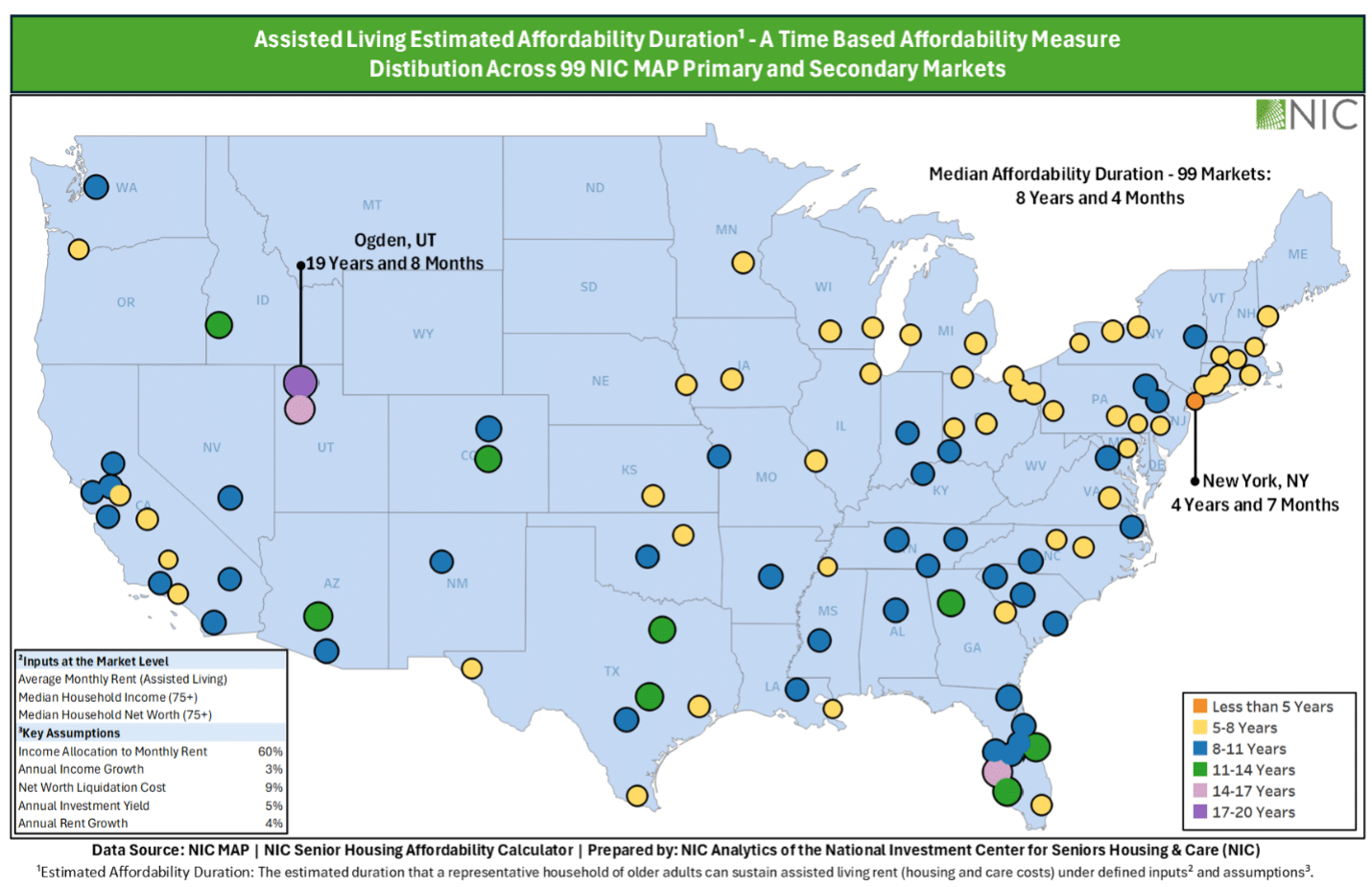
The exhibit below illustrates an example of time-based affordability across geographic markets (based on the 99 NIC MAP Primary and Secondary Markets). Using assisted living average monthly rent, along with median income and net worth for households aged 75+, plus assumptions around income allocation, investment yield, net worth liquidation costs, and growth rates, the model estimates how long a typical household can sustain assisted living market rents.
Across the 99 markets, the median affordability duration is approximately eight years and four months as of 2025. This indicates that, under baseline assumptions, a representative household can sustain assisted living costs for more than eight years.
However, the variation across markets is notable and reflects regional differences in income, wealth, and pricing. Markets in the Northeast, Mid-Atlantic, and Midwest generally fall within a range of five to eleven years, while many Sunbelt markets show relatively longer affordability durations, between eight and fourteen years. In some markets, affordability extends well beyond a decade, while others show relatively shorter timelines.
Across all 99 markets, New York, NY has the lowest estimated affordability duration at about four years and seven months, while Ogden, UT has the highest at approximately nineteen years and eight months.
NIC’s Senior Housing Affordability Calculator allows users to explore these dynamics further by adjusting key inputs and assumptions to see how affordability changes across different scenarios.
Conclusion
Expanding middle market access to senior housing depends both on increasing the number of households that can afford rents and on how long those households can realistically remain.
In some markets, there are units priced within reach of median-income households, even before considering assets. Yet those units remain unoccupied. That points to a different kind of constraint, one tied to confidence, planning, expectations, and how pricing is communicated.
Improving access and addressing the supply challenge also involves reducing uncertainty. Greater transparency around pricing ranges, clearer expectations around long-term costs, and earlier financial planning can all support more informed decision making. When households better understand what affordability looks like over time, decisions become more timely and more deliberate.
Affordability in assisted living reflects both the ability to enter and the ability to remain (Affordability = Entry + Duration). Incorporating a time-based perspective helps connect those dimensions and provides a more complete view of how assisted living housing and care decisions are made, financed, and experienced over time.
For questions or feedback on the NIC Senior Housing Affordability Calculator tool and methodology, please contact analytics@nic.org.