In this article, we focus on the memory care sector, a senior housing segment designed for residents with Alzheimer’s or other forms of dementia, within the combined 99 NIC MAP Primary and Secondary Markets, analyzing occupancy rates as well as supply and demand dynamics across property and campus types. Note that memory care uses the NIC MAP segment-type designation, meaning the data reflect memory care units located at any type of property.
According to the Alzheimer’s Association’s 2026 Facts and Figures report, an estimated 7.4 million Americans aged 65 and older are now living with Alzheimer’s – up from the 6.5 million estimate only three years ago, and a figure that crosses 7 million for the first time. About one in ten people aged 65 and older (11%) are affected, and roughly 74% of those living with the disease are age 75 or older. By 2030, that population is projected to rise to nearly 8.5 million. Notably, the first of the Baby Boomers turn 80 in 2026, the age cohort most directly associated with entry into memory care, and marking a demographic inflection point that the sector has anticipated for years.
Fundamentals of the Memory Care Segment
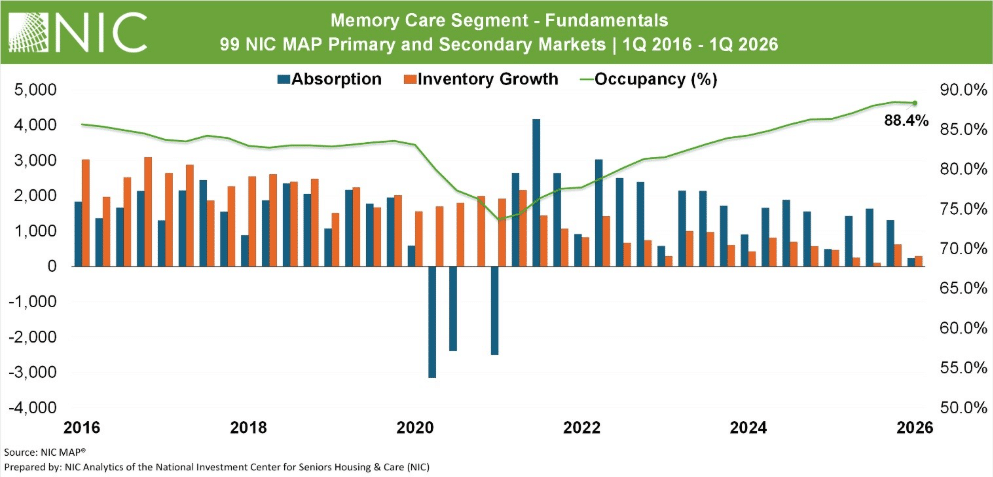
Occupancy. Memory care occupancy in the 99 Primary and Secondary Markets stood at 88.4% in the first quarter of 2026, up 2.1 percentage points from year-earlier levels and about 6.0 percentage points from early 2019. As background, independent living segment occupancy moved above 91% and assisted living reached about 88.6%.
Supply Dynamics. Memory care inventory in the 99 Primary and Secondary Markets grew by 908 units, up 0.5% year-over-year in the first quarter of 2026. Since early 2019, inventory has increased by roughly 22.0%, or about 29,950 additional units, reflecting a more measured pace of new supply growth in recent years.
Demand Dynamics. Demand has continued to outrun new supply across senior housing in general. Within memory care specifically, occupied units in the 99 Primary and Secondary Markets increased by 2.9%, 4209 units, year-over-year and by 30.1% since early 2019, equivalent to roughly 34,000 additional occupied units in that period. Notably, occupied units have grown faster than inventory over that span (30.1% vs. 22.0%).
Memory Care Segment – Occupancy by Campus Type
As of the first quarter of 2026, there were approximately 5,750 properties offering memory care services within the 99 Primary and Secondary Markets. Among them, 76% were combined properties offering at least two service types, roughly 13% were freestanding (offering memory care as the sole level of care), and 11% were continuing care retirement communities (CCRCs).
Memory care remains most frequently offered within combined properties, typically anchored by assisted living with a dedicated secured wing or floor. As of the first quarter of 2026, memory care segments within CCRCs continued to report the highest occupancy at 91.2%, followed by combined (88.2%) and freestanding properties (87.9%).
The exhibit below shows each campus type’s occupancy differential in percentage points relative to the memory care segment’s overall average occupancy since 2016.
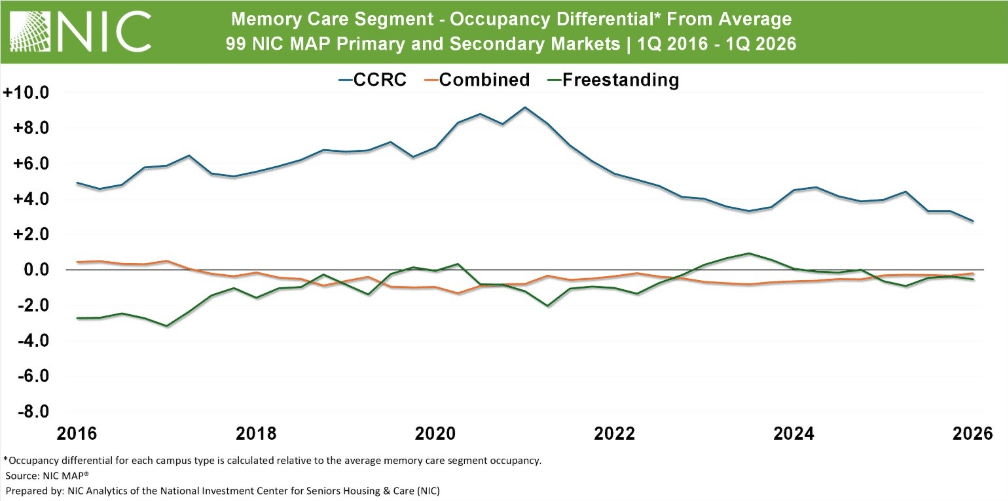
Memory care occupancy in the CCRC campus type remains above the segment benchmark throughout, with the lead widening during periods of stress. It peaked at about 9.2 points above the segment average occupancy in the first quarter of 2021, while freestanding and combined campus types trailed by 1.2 and 0.8 points.
As of the first quarter of 2026, CCRCs led by about 2.8 points, with combined and freestanding slightly below the segment average occupancy at 0.2 and 0.5 points.
With Alzheimer’s cases projected to approach 8.5 million by 2030, the sector’s ability to meet rising demand through new development will be a key theme in the years ahead.
NIC produced a prior research piece on the Memory Care Segment in 2023. For those interested in a deeper dive into historical figures, that analysis can be accessed here.