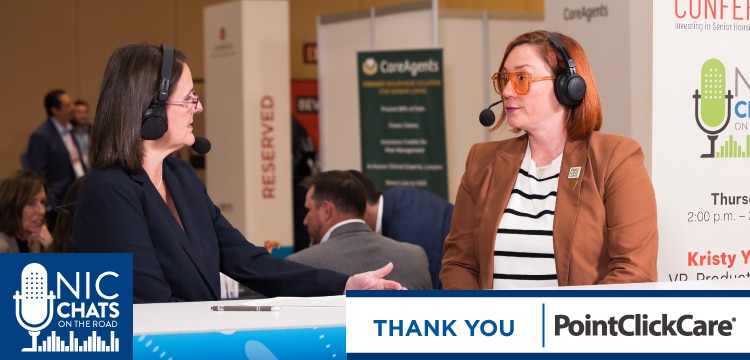
Recorded live at the 2026 NIC Fall Conference in Chicago, this episode features Kristy Yoskey, vice president of product development and growth at PointClickCare.
Host Lisa McCracken talks with Yoskey about how senior housing providers are taking on more care coordination, and what that means for health technology. They cover PointClickCare’s co-development partnership with The Springs Living, including how product and engineering teams will work on site with frontline staff. They also discuss how AI can fit into existing workflows, why a “human in the loop” matters for staff buy-in, and how connecting data across vendors can help care teams spot changes in a resident’s condition sooner. Plus, hear why Yoskey thinks independent living is a growing opportunity for wellness planning.
Want to join the conversation? Follow NIC on LinkedIn.
View transcript
Lisa McCracken: Good afternoon. Hi, I'm Lisa McCracken. I'm the head of research with NIC, and we are on the road in Chicago at the 2026 NIC Fall Conference. This is the NIC Chats podcast. I'm super excited to have Kristy Yoskey with PointClickCare with me. So we're going to talk here for the next 30 minutes. Can't wait. We have a lot to cover, and you and I have known each other for a number of years.
Kristy Yoskey: It should be fun.
Lisa McCracken: And, actually, when you and I were reflecting back, I actually think you, started at PointClickCare about the same time I started at NIC about three years ago. So okay, before we go any further, I'd like you to introduce yourself. Tell us what you do at PointClickCare. And although PointClickCare has been around for a very long time, for those that may be new to the industry or don't know the organization, give a little bit of background on the organization. So introduce yourself and a little bit of company background.
Kristy Yoskey: Got it. Kristy Yoskey. I'm actually an occupational therapist. I don't know if we knew that about each other before. So in healthcare the last 20 years, and started as an OT, moved into consulting, did a lot of skilled home health and senior living. I actually met Murray Mercier, who is, was with PointClickCare for 12 years, and we started working on some projects. All of a sudden, the VP and market leader for senior living became open, and I said, "I'm jumping in." So I started three years ago, same time we both kind of made career changes which was very cool, supporting each other through something different. And my role has evolved. I'm actually now the VP of product development and growth.
So I'm heavily focused on the products, the customer voice in the products, moving it to beta, and then getting it to market, which is very cool because we're in a space, we'll talk about it, we've never been. I'm from Pittsburgh, Pennsylvania. I am a Steelers fan. And I love the WNBA, so all the teams. Got the finals going on. So that's me sort of in a nutshell. For those who don't know PointClickCare, we've been around for just over two decades. Pretty heavy on the skilled nursing side and really early on, got into all of post-acute. So we support not only senior housing and senior living, but physician groups, acute and payers. We do value-based care payer arrangements like American Health Partners. So we do a lot. We're really involved. We've got a long history in sort of health tech and electronic health record.
And I don't know if I, most people know this, but it started out sort of family with the Wessingers. Their mom was actually a CPA in long-term care, and so both the boys, Mike and Dave, got involved in long-term care loved it, and said, "I think we can make this not heavy and have a documentation system that works for long-term care." So they built PointClickCare. And it's since evolved into the entire post-acute network. So what I think is really cool and why I'm here is that mission of, families building for frontline caregivers who take care of families. That's very cool. And I would think your title's so cool too because the Industry is changing for And companies need to adjust and change and innovate and develop and so forth. So, as you look at PointClickCare and think about how the industry's changing, how would you observe some of the biggest evolutions happening right now?
Oh, gosh. I mean, I think we've heard it on main stage, all day yesterday and probably today. There's a huge focus. I think COVID, Bob Kramer said this, COVID kind of blurred the line between healthcare and hospitality. So we're in this spot where we're sort of healthcare, coordination agents as Senior living providers, and we're trying to be the stewards of what a resident who needs to move in or wants to move into our communities, what they need and how to keep them well and how to coordinate appointments and the right appointments or the right specialties how to get them there, so transportation. The food that they're eating. Like, it's opening up that more than just a place to stay. Correct. So that's the evolution. Correct. We're obviously in a good spot with that PointClickCare, but we're needing to evolve as well.
You know, and we talk about senior housing and care, but that care has very much migrated into the senior housing.
Lisa McCracken: And I think there has always been this mindset of, well, senior housing is housing. And you're during the pandemic, it was very much reminded of, oh, we are very care intensive. And I think that the expertise that all of you have, I think, brings great value certainly to those partnerships. So how do you pay attention to the client needs? I mean, again, part of this evolution is being very, uh intimate in those relationships and keeping your ears to the ground. So talk a little bit about that back and forth that you have in terms of those partnerships with your clients. I mean, we've always done a pretty decent job of spending time with the customer.
Kristy Yoskey: I think we're evolving that a little bit, but we've, we've got advisory councils of, like the top senior housing executives and their teams to help us really dive into, are we building the right thing? Where's the future? What's the next three to five years look like? So that future forward. But then there's the development practice of getting on site with the frontline staff and the executives, and making sure we align from move-in to clinical to billing to collections to all of that. Not just on the private pay side, but Medicaid side. And we're hearing, what's the challenge? What's the workflow? Where do we need to focus? Today's very cool because we've got AI, so it's, it's like where do we build efficiencies? Let's get you out of the EHR and back in front of the resident, and let's capture what we can in that EHR without you having to spend so much time.
So that's what we're trying to do, but we're doing that with advisory councils, frontline. Our product and engineering teams are on site. And then I know you're going to ask me this So I'm just going to dive in. Tell it. Let's go there. Dive. Big headlines. Big headlines. This week, I think. This week, Go for it. Just announced our co-development partnership with Springs Living. They had just announced a partnership with Scan Embrace. They're moving and shaking, so I love it. I love it, and that's exactly what we're looking for. You know, we think we are really the health tech that can help a value-based care provider, in senior living get where they need to go. Whether it's value-based care or you're just trying to look at your overall community's longevity, that should be PointClickCare.
So Brenda Connolly, Feast Stubblefield, my leadership team with Dave Wessinger, David Pessis, and our product division, all met and said, "Let's do this together. Let's send our teams on site with your frontline staff. Let's get those aha moments and really see, what are we missing? Where is it challenging? How are we missing and capturing what's really happening at the front line?" And then in real time with our forward deployed engineers, get that technology up and running.
Lisa McCracken: So like give me a day-to-day of what that's going to look like. They're going to be there like really like in-house working side by side with the staff and observing, getting feedback.
Kristy Yoskey: Well, I would say it's two parts. So we're going to be ideating. Break it down for me. We're going to be ideating new technology that we haven't even thought of Because we're, we're on the front line. We're seeing, we're identifying what the problem is, what's the problem to solve with the technology. And then there's going to be technology that we've developed, with The Springs that we beta test. And so we've got it live and we're seeing is this the right workflow? Is this the right spot? Is it truly in the workflow? Is it giving you the right actions? Is the large language model working? Is there anything that we need to fix right there? And that's where our forward deployed engineers can just start to make the change to make sure everything's flowing properly, and then we can roll it out on a more global scale.
Lisa McCracken: And I know you and I talked about the wanting to carve out some time to talk about AI, and you've mentioned it a couple times and, you know, I know large language models are sort of a part of that. I'm not an expert in all of that, but yet I think a big part of it is the organizational readiness too. I think there's the possibility of it, and I want to talk a little bit about some of your thoughts because I know organizations like you have visions of sort of what is possible but how can organizations think about on their end being ready for all of, things that you develop, whether it's You know, with organizations like The Springs or whatever you guys have brewing, how can they prepare on their ends to be, to be ready for quite frankly, what's moving very quickly on the AI side of things? I
Kristy Yoskey: There's so many organizations that are in various stages of AI readiness. I do want to say with The Springs, it's very easy, it's an effortless partnership because they need to be ready to healthcare coordinate for the Embrace Plan. So we've got to be able to have a connected ecosystem. So they're sort of we're walking alongside of them on every single meeting and every single process that they have to make sure the technology supports it. So it's a very well coordinated between Scan Embrace, The Springs, and PointClickCare, and then any vendor partners that they have to make sure we're all fully connected. But a lot of, a lot went into that.
They had to get ready for the plan and enrollment for their residents, but also getting the staff to understand that things and change are going to, are going to be coming And we're going to need you to spend time with PointClickCare watching and observing and asking questions, and then you're going to have to provide feedback. So the, a long part of that was they've been planning for this for some time. So it's easy for us to get started and kind of jump in at this juncture. But other organizations have to understand that what we're trying to build isn't a huge thing that's going to uproot everything. We're trying to build AI into the workflow. So you're already doing the workflow, um We built something called Vox Advantage, and it's an ambient listening technology. I think those are so cool. Awesome. Awesome. And it does take a minute.
A, you've got to make sure you're not a two-consent state, or if you are, there's a process around that. You've got your, consents written for your residents and family members and your staff, depending on the state that you're in. And then how do I use it? Am I going to use it while I'm with somebody? Am I going to use it after? And how is that going to impact my overall documentation? So there's a lot that goes
Lisa McCracken: So it listens and records. Listens and records
Kristy Yoskey: And it, more than just one person, and it identifies who's talking. So you could be in an interdisciplinary meeting recording that meeting, and then it's saying, "Here's who said what," And then that could go into the chart with the human in the loop to put what they need into the chart. So it's very cool, but it does take readiness and policies and procedures, and who's going to be the responsible party for human in the loop to make sure what hits the health record and what doesn't. That's really important.
Lisa McCracken: I've heard that multiple times, the human in the loop. And that's a, that sticks With me because I think that's memorable, and it resonates with folks, you know? And I think gives people some peace a little bit with the, with the AI thing. Um
Kristy Yoskey: Well, one thing on stage yesterday was we're not going to replace people, and that's absolutely it. We don't have enough people. So we need this technology to help surface insights, and then the care worker, frontline wellness nurse, whoever it is, to be able to solidify that. So, speed connection and just being able to go with really information that you trust and be able to say, " I'm going to follow this recommendation, and I'm going to take the next action," Or, "You know what? I don't like this. I'm going to dismiss it, and I'm going to do my own action." And there's got to be a process for that. So we're creating the technology for the people who currently work, not to say you don't need these people. You need all the people, but we need them focused on the resident and not the chart.
Lisa McCracken: And that's important because if you don't have staff buy-in, forget it with all of this. 100%. So we've talked about, the scan relationship with The Springs. So obviously that's involves a value-based care relationship and so forth. So, you see all of you know, beyond that relationship playing a role in this, and that involves prevention Wellness. And so talk to me a little bit about where you think you can make an impact on that.
Kristy Yoskey: So we worked with The Springs early on because they knew that they were doing some sort of value-based care partnership, and without telling everybody, they needed a data relay from us with all of their value-based care data. So we decided let's, let's get together, let's give you that, but let's get together and build a dashboard. And then that dashboard ideated into AI recommendations or what we're calling an action center. So you've got your dash that you could send to scan. You could look at yourself from a high level corporate or community level, how am I doing? How is my community performing, and where do I have areas of opportunity? AI will tell you, "Here's what's-- here's where you need to focus based on either an AI recommendation or a role. You've had hospitalizations increasing over the last 30 days at Mission Hills.
This is where you need to focus, and here's what we would recommend doing." And then to be able to action right from that action center to message the care team, message your primary care physician. So the piece of it is actually coming up with what we needed was to connect all your providers, all the data in one place, and then give you insights to action. So we're moving from a system of record to a system of action, and the Springs helped us build that before we even started this partnership, and it's because we need a connected ecosystem of your therapy, of your remote patient monitoring, of your eCall system, of, our record, plus your physician, and there needs to be a line of communication and flow back and forth. And if we can't do that as health tech We're going to be in trouble and very disconnected with any kind of value-based care or longevity.
How do you coordinate care if your ecosystem isn't connected?
Lisa McCracken: Who owns that communication? Because sometimes I think that can be a challenge in terms of, who owns ultimately the care For that resident. And I don't know that's fully an answer for you, quite frankly. But in this relationship, obviously you're a part of that solution. But I just throw that out to you to react to. I'm just curious.
Kristy Yoskey: I mean, we're putting the whole care team One team around that resident.
Lisa McCracken: Do you feel like you're part of the glue for that?
Kristy Yoskey: Feel like we're part of the glue, but at the same time, our system is going to be the one that connects and passes and finds that proactive wellness or change in condition or subtle change, whatever you want to call it. When you look at the workflows, it's, it's really change in condition, but sometimes we want to look and see, like something has gotten better. You know, Mary's participating more in activities and she's got more visitors. Like, let's check in and see how that's going. Like her wellness is actually improving. So that's a little bit on the wellness nurse to kind of coordinate. Your staff that's really seeing that resident every day to be able to pull in the physician, but the physician also owns that Or nurse practitioner. Oftentimes I see value-based care arrangements where we're just going to do a routine visit. We'll come in.
If we if something's up, we'll go in and see them. What ends up happening is they end up in the hospital. That physician or nurse practitioner, that ACO group, IE, SNF, they lose the covered life, the attributable life to the hospital. And so you're taking care of them, but we're not catching them sooner. So it's really whatever information, which is why I love our ambient tool, I want it to be Observation as sort of a vital sign.
What is happening with a resident that we may be missing today is ending up sort of in an observation portal for the wellness nurse to say, "I want this in the medical record, and we need to act on it, and I need to get that physician involved now," Versus a month from now when it's too late, and now we've got an ED visit or a hospitalization, and that resident has to receive something that we could have done in-house In a strange environment for two days sitting in an bed, and then sent back, and that's very disorienting. So how do, how do we act as the conduit to say, "Did we get the information in? Did we surface it? And then did we connect the dots to get the physician involved or nurse practitioner Here immediately?"
Lisa McCracken: So can you give me any examples of some types of the data that all of you are tracking? So. Examples.
Kristy Yoskey: This is our bread and butter, you and me. I think right now on We're calling it the community advisor which is what we built. We've got a polypharmacy. We got a wellness score that we're sort of a proprietary assessment score that will be, ebb and flow with some of the clinical and observational information within a chart, and then long-term will be impacted by our third-party vendors like eCall, remote patient monitoring. We are looking at chronic disease management. Hospitalization and ED visits obviously. And then, important pieces within the technology are we following, like we're, we're logging all of the tasks that need to be completed, what types of unscheduled tasks were, done that may impact maybe a change in condition, and then just overall compliance with documentation.
So we can start to say, "Hey, we've got some hospitalizations here, but they're also not documenting their point of care tasks, and we've got a wellness score that's dropping because your hospitalization is up. What's going on at this community?" And we can kind of dig in, and there's a lot more to it that we're building out within the community advisor and feedback from the frontline staff, both the wellness nurse and the corporate staff I would say for this one. But it's heavy on the value-based care side, and then we want to get sort of into a little bit of the shared savings. Like, what's the financial impact? So we're, we're kind of building that out now. And And I think part of the financial impact of honestly just this business model is increased length of stay And so forth. So the shared savings I think are a bonus. And if you do it.
But also part of doing it right and having the right business model is fewer hospitalizations, longer length of stay, and obviously there's a financial return on that.
Lisa McCracken: You had touched on earlier when we were talking about the care coordination piece, because one of the things, that we hear is a frustration often with technologies and platforms is the lack of interoperability. And that systems don't talk. How are you tackling that and dealing with that?
Kristy Yoskey: This is a super hot topic for PointClickCare right now. I think I started three years ago. I went to, my first conference in November, and it was all about the lack of connection, and I've got 27, a tech stack of 27, and nothing Talks to each other in a really meaningful way. So first and foremost, we were the first to develop the bidirectional marketplace. We have over 500 different vendors in there. Oh, wow. It's not, it's not enough. It's not there, It's great, it's amazing, and it's probably one of the things that we're, ahead of everybody on. But what we're trying to do specifically on the senior living side is, as we build our wellness score, we need a place to put data that's coming in from eCall, from I think it was Charles at LifeLoop, and everybody knows him as Charles, so I don't have to say his last name. Oh
Lisa McCracken: They were forming an Alliance or different group.
Kristy Yoskey: Exactly. And so we're working on with some of our clients that use both of us a research study on the data that's coming in. But his post around, it's not just clinical, it's, it's social. Correct. And that's so true. So we need his technology or Cubigo or another resident family engagement software to pull in the data that's coming in so we could really say, is there a social issue here? Is there an isolation or a loneliness issue that could be impacting wellness? We wouldn't know in PointClickCare if they're using a third party. So today we have a bidirectional API, but we're not pulling that in and using it to get insight to action and say, "Okay, we probably need to have life enrichment take a peek and see what's going on," As well as the physician, because something may be going on medically That requires a treatment, back pain or, a therapy.
As a therapist, that's one of the big things. I just, I can't get around as much and I'm afraid I'm going to fall, so I'm staying in my room. Now I've cut my socialization at least in half. That's a problem.
Lisa McCracken: And I think this gets to sort of the question around strategic partners. You know, you've mentioned a few, um Obviously, the EHR, you're a huge platform You're a huge part of an organization. And, there are other, tech platforms or point solutions that groups do use. Are there certain strategic partners above and beyond maybe certain operators like the Springs or whatever, but certain strategic partnerships that you think about, as part of your platform, whether they're other tech vendors or maybe even outside of our ecosystem?
Kristy Yoskey: I mean, at PointClickCare, we've got a bigger ecosystem than most because we're pulling data in from hospitals, specialty physicians through, Care Quality or PointClickCare Connect. What we want to do is continue to leverage that data so that you can kind of st you don't have to start from scratch when you
Lisa McCracken: Can you tell what they are so people don't know what they are? You just said Care Quality and Point. Define that
Kristy Yoskey: So Care Quality is like a national, ecosystem of healthcare data that are hospitalizations and hospital records, like a CCD, and then your ED visits. So you've got a potential move-in that says, "I've my mom never goes to the hospital," And she's been in the hospital 15 times. So we've got a better sense. And then we can pull those records, pull the diagnosis. We don't have to start from scratch. If you think of really a good assessment is not just getting to know that resident today, but really having a much better rounded view, history, so you can have a better service plan. So we call that PointClickCare Connect. And it pulls the data for a new move-in, somebody who's been out and is back, any new information. They could even go to a specialty visit and don't have their packet.
Now we can take a peek once that specialty visit's over as long as they're on the network and pull that information into PointClickCare. So it gets your team started at a better starting point than just, hey, this is day one with this resident. So that's number one. Number two, we have advanced partnerships like Senior Sign, on our move-in and our post move-in packets for signatures. So it's that communication and really great experience for the resident and/or the family member or responsible party. But to take that to the next level, other than embedding it in, having single sign-on, which we do today, our goal is to take the information that's in that system and stop the duplication of services. So advance that strategic partnership to be able to pull in more information so you're not having to type, "Well, we just typed that in the move-in.
We Or the resident put that in the move-in documentation. Now we're having to look at that."
Lisa McCracken: It's frustrating. It's frustrating.
Kristy Yoskey: So we're looking at a lot of strategic partnerships like that. And I will say one other thing, it goes, sort of around the marketplace ecosystem. Remote patient monitoring, eCall, therapy, lab and radiology, physician group. I'm probably missing one here, but there's five or six that are so important for us to really drive a wellness score and a potential change in condition. I think point of sale, another great example. Like, who's going to the dining room versus not? A behavior change is so important, good or bad, to how well your community is or that length of stay. If we can't capture something early, that length of stay is going to drop.
Lisa McCracken: You mentioned something about family. How often how much do you interface with family with your platform? And I'm asking that because I have actually no idea.
Kristy Yoskey: That's a great question. So our senior sign was a really big piece of it. So it's like the family experience. We wanted that to be, a much easier, intuitive experience so you're not having to go through our previous system to fill out paperwork. The other side is we have a connected care center which is a portal, so any resident or family member can be assigned and logged in. But part of the springs living is developing our mobile app for resident and family for that resident to have agency in their care, but also for the family to be able to communicate if they're cleared, with staff and the physician and everybody. So there's no way we can have a connected ecosystem without the resident and/or their family at the center. That's probably one of the most important pieces. And then think about independent living. It's all about the resident and their family.
So we're not going to be doing assessments, but they're going to be doing wellness assessments maybe on the mobile app that goes into our system, so we could have a wellness plan for them while they're in independent living, so we can keep them there as long as possible instead of ignoring it and letting them do whatever and having really no plan, no understanding of their likes, dislikes, wants, baseline.
Lisa McCracken: I was going to ask you about that because I think often people think of the EHRs with, the nursing the assisted living memory care. Independent living's a little trickier because often they may come, they may still have their outside physician groups and so forth. But you see the opportunity more Probably that wellness prevention. And I would observe that is their expectation too. And that's the opportunity. So you see that as sort of your, the role and the place?
Kristy Yoskey: I mean, if you think about it, we, are pretty heavy on the life plan CCRC. We community for point Click care. You are. There's a lot out there. The PACE programs which is in the community, or assisted living, which is their home. And then we have CCRCs without walls, So we are already needing to care for not only independent living, but folks who need an extra support and wellness who are living in the community that come in for activities and social services and all of that support.
So, we built our new platform, EHR For Senior Living, a part of it for IL, which is the census and occupancy part and the private pay billing and payment portal, and now we're in the process of the wellness score with the mobile app so that they can have access to that, and they can go ahead and do their own assessment and tell us what they need and like and want, and then we can derive a plan for that to keep them well and have staff to do that because a lot of the ACO models in senior living today are heavy on the independent living side. They definitely are more the upstream and seeing that opportunity there.
Lisa McCracken: So we just have a few minutes left. So if we're sitting here one year from now what's the world at PointClickCare look like?
Kristy Yoskey: I hope, and we're already on that track, is I want to be able to take the pressure off of somebody needing to come back to type and enter in certain spots. So our Vox Advantage to really collect observations is a vital sign, so we can get more information in the medical record than we have today, so we can identify those potential changes in condition and get the data. The data's only as good as what you're putting in and today we are missing a ton. Independent living, forget about it. Assisted and memory care, there's a lot missing. So to me, ambient is going to play a role in pulling in observations that we're hearing, seeing. I noticed Mary's, holding onto the wall. She dropped her cane yesterday and needed help picking it up.
So we could say, "Oh, this may be something we need to look at." So there, the bigger care coordination, but less dependency on actually typing and more dependency on, I've gotten an observation and a recommendation, now I'm going to go ahead and hit the action button and take care of it. Are there any regulatory hurdles on the ambient stuff? Oh, the two consent state is a big one And that doesn't just mean the resident and the person in the room, it's anybody. So if there's another caregiver in the room and you've got a wearable on, every single person, like Oregon is one of those, So we're working with the Springs Living in Oregon, so we've got to make sure we've got consent from all staff, any families, and the resident who may or may not be in that room when that technology Is used. We've got a process to hit record. You have to do something with that.
But it's, it's usually the two people, the resident and the person using it. Not necessarily there may be somebody in the room who says something. So that's a big one.
Lisa McCracken: Well, it's been great talking with you. You've got a whole crew here. How many folks?
Kristy Yoskey: Seven. Seven folks and our entire C-suite is coming to our event tonight.
Lisa McCracken: Well, it's been great to see the legacy of PointClickCare, over the years. So it's been nice speaking with you. Wish you the best of luck at the conference.
Kristy Yoskey: Thank you.
Lisa McCracken: Appreciate all of you listening in. Again, another NIC Chats podcast on the road. It's Chicago at 2026 NIC Fall Conference. Tune into more NIC podcasts at nic.org. Thank you.