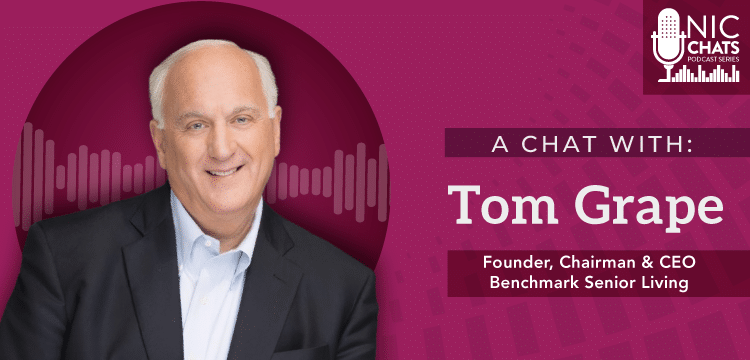
Benchmark Senior Living CEO, founder, and chairman Tom Grape joins host Lisa McCracken to reflect on nearly four decades in senior housing and what the sector needs to get right next.
Grape discusses how the sector has matured, from the growth of assisted living and memory care to better data, and where gaps remain, especially in consumer research and the potential for true customer segmentation.
The conversation also covers:
- Why capital and operator alignment has the opportunity to evolve, and how long-term partners can strengthen operating infrastructure
- Advice for smaller and midsize operators looking for capital
- Why Benchmark kept developing while many others paused
- Benchmark’s workforce culture, including its One Company Fund
Want to join the conversation? Follow NIC on LinkedIn.
View transcript
Lisa McCracken: Welcome everyone to the latest edition of the NIC Chats podcast. This is Lisa McCracken with NIC, and I am really excited to have Tom Grape, the CEO, founder, and chairman of Benchmark Senior Living with me today. Tom, I appreciate your time. Thanks.
Tom Grape: You bet, Lisa. Nice to be with you.
Lisa McCracken: So, I wanted to have you here today because I feel like there’s a dozen different things that we could talk about. And I know people are excited to listen to this because you are an industry veteran, one of those people that whenever your name is out there for… I think we’ve done webinars with you, different things...people always tune in.
We’ve got 30 minutes. There’s a bunch of different things we could talk about, but I’m going to go way back. And I’m sure people have done this with you before, and I’ve not known you for this long, but I did a little history. And I think I have the year right. So I want to know a little history about what got you into the industry.
But if I’m correct, you graduated from Ithaca College. Is that correct?
Tom Grape: Correct.
Lisa McCracken: Okay. But it was not anything to do with a senior-led degree in senior living or anything like that. And my question is, because a lot of us enter this industry not really because we wanted… we grew up wanting to enter this space or whatever, what got you into senior living, senior housing?
What was the journey? I’m very curious what got you from Ithaca College, and I don’t even know what your degree was in, to this space.
Tom Grape:Yeah. So for me, it was total serendipity. I was a marketing major at Ithaca. And after graduation, I joined Procter & Gamble at their headquarters in Cincinnati in brand management and worked on Pampers and Bounty in marketing, which was the sort of mecca of marketing in those days. I worked on… Remember Rosie in the Quicker Picker Upper commercials?
Lisa McCracken: Yes.
Tom Grape: And all those things. I did all that for about five years and loved P&G and loved Cincinnati and had a ball. Decided after a few years, though, that the big company, watching market share go up or down by a tenth of a point each month, wasn’t really quite as exciting as I thought it might be.
So I made a career shift into real estate and joined a company in Washington, DC, called Spalding & Slye, which was actually based in Boston, but they had offices in other cities. And I joined them in Washington and built some office buildings. And one day the CEO called me and said, “Do you want to move to Boston? We’re starting a new subsidiary to develop retirement communities.”
I’d never been in a retirement community, I didn’t know my grandparents, but I thought it’d be exciting to be part of something new. I think they thought my marketing background might be helpful as they got into a new field, and I thought it’d be cool to move to Boston.
I was in my mid-20s. And so I did that, and that actually, in about two months, will be 40 years ago when I got into senior living. I’ve been at this a while. But I fell in love with the field and have been at it ever since. So, for me, it was total serendipity.
And ironically, by the way, the CEO of Spalding & Slye who called me that day 40 years ago was Benchmark’s first investor and is still involved in our company to this day. And is actually about to move into a Benchmark community himself. So there you go. Small world.
Lisa McCracken: That is so cool. Yeah, it’s definitely one of those industries where you get into it and you do fall in love, right? And people move around, but you never leave, right?
Tom Grape:That’s right.
Lisa McCracken:It’s super cool. I love that. But, conversation for another day, we need to have that more direct pipeline, though, in our industry, right? And it’s too much serendipity, I think, a little bit. But so you founded Benchmark in ’97. Do I have that math correct?
So gosh, looking back all of that time, you’ve seen a lot of changes and ebbs and flows, and I would love your perspective on what you think some of the biggest changes have been, for the good, maybe for the bad. Maybe we can… let’s go on the glass-half-full side of things.
Yeah. Or just your perspective on some of the biggest evolutions in the sector across your tenure.
Tom Grape: I think first, just the vast expansion of options, and particularly the growth of assisted living, I think has been great for consumers. Obviously, to have a more residential option and a vast expansion of options in our country has been great for elders and seniors in America.
So hallelujah for that. And particularly for folks with dementia, to have a more residential option available, terrific. That’s been a boon for everybody. I think we’ve also seen the industry become a bit more sophisticated. It still has a long way to go.
It still is a pretty unsophisticated industry relative to others, but we’ve seen things like NIC MAP create availability of data and information. There are still gaps in information that other industries have that we don’t have, but that was a huge step forward. Obviously, capital availability has expanded greatly over the last 40 years.
Awareness of the industry is much better, although a lot of people still think of senior living as nursing homes. And we’re… It’s better, but it’s not where we’d like it to be. So things have come a long way. And I think it’s a testament to a lot of the folks who’ve been at this for a while that the progress that’s been made is where it is.
And yet, in the future, there’s so much more progress to be made and so much more exciting growth ahead, given where the demographics are and what the need is and what consumers are telling us they’re looking for. It’s such an exciting time in the field. It’s been exciting for 40 years, and it’s even more exciting now.
So it’s a very cool field to be in. It’s so dynamic. And I tell people how exciting our field is, and they yawn and say, “Really?” They compare it to high tech or being at Google or something like that. It may not be quite as sexy as that, but it’s just as dynamic and has just as much opportunity and so on.
So it’s a cool field.
Lisa McCracken: No doubt. Because definitely when you think about the demographics, if people think that the demographics are just impacting our industry right now, talk about societal change for sure. We could talk about that forever. And I do want to talk about our industry being at a pivotal moment, but I’m biting on something that you talked about.
And you said data, we still have some gaps in information. What gaps do you think that we still have in terms of data and information in our industry?
Tom Grape: I think, given maybe my marketing, my P&G background, consumer data is woefully lacking. Customer satisfaction data can…
Our industry has not really been a consumer-driven field.
Lisa McCracken:Yeah.
Tom Grape:We’ve benefited by the fact that, years ago anyway, “build it and they will come” generally worked in a lot of cases.
But now the baby boomers, as we know, have turned everything on their heads that they’ve touched, and our industry has not really been a marketing-driven industry.
It’s starting to evolve to that. We’re now starting to see more segmentation of models. We’re seeing more urban models, we’re seeing more mixed-use models, we’re seeing people… But it hasn’t really taken on the kind of sophistication of other fields that really do have segmented markets.
And people can talk about the different market segments. People in our industry think of market segmentation as independent living, assisted living, memory care. That’s not market segmentation. And yet we’re at such a rudimentary level in really thinking about this from a customer segment model and understanding different positioning.
And so the customer awareness and customer sophistication is data that’s woefully lacking in our field. So that’s one major area that I think, and I think a huge area that, as an industry, we have to get a lot savvier about. And I think, again, the boomers are going to start to demand that, and are demanding that.
Some companies are getting better at it, but I think we’ve a long way to go compared to where other industries are.
Lisa McCracken: So interesting you say that because we have, at our Fall Conference coming up in Chicago, a session with folks and veterans from the lodging, in the hotel industry, and they have so much data on the customer. They have brands galore. I think some of them have 30, 40 different brands at this point under one umbrella, Hilton, Hyatt, Marriott, whatever it is.
And when you talk about customer segmentation, it’s really unbelievable, the data. Now, they’ve got some credit cards where they… that we don’t have some of those loyalty programs, but it’s really interesting, to your point, with some of that data and information.
Tom Grape:So the use of market research, we have customer profiles for each of our communities. We’ve been mapping customer journeys, and I bet very few firms in our industry do those kinds of things as a matter of course, and then factor that into how they’re thinking about their new communities or running their existing communities. And I think that’s standard fare for so many other industries, so it’s got to become more commonplace for ours.
Lisa McCracken: I appreciate you pointing that out. So in terms of looking ahead and change, it does feel like we are at this pivotal moment, and maybe it is some of that consumer pressure and the excitement of just the demographic wave and the opportunity, and maybe some of the attraction and the attention we’ve gotten from capital because of that and so forth.
So to me, it feels like we’re at this moment of change. Now, I think there’s opportunity, but we’ve got to be positioned right for it. If we don’t get it right, I think there’s danger in that too. Does it feel like this sort of pivot point for you in our industry? Would you agree with that?
Tom Grape: Absolutely. I think we’re at the… I’m not a surfer, but it feels like a surfer, and there’s an enormous wave that’s beginning. But I guess my worry is that we’ve had smaller waves in the past of great attention from capital and great inflows of capital.
And in the past, the capital hasn’t always been a good thing. And the capital has forced the industry in the past to… When a lot of companies were going public back in the ’90s, companies with seven and 10 communities were going public and doing crazy things.
At one time there were, I don’t know, 16 companies or whatever the number was that were public. I think almost none of them exist anymore. They had no business going public in the first place. So sometimes great inflows of capital are a good thing, and sometimes great inflows of capital force people to do things they shouldn’t otherwise do.
And so that’s the worry. I think capital’s a lot smarter and savvier about our industry these days, and hopefully the experienced capital are going to back the platforms that are more stable and more mature, and will help growth occur in a more reasonable and responsible way.
The capital that comes in and just wants to blow and go is going to be causing trouble, and unfortunately there will be some of that, and I think that’s what we have to watch out for. But I think capital that’s going to come in and really build platforms and help grow platforms in a responsible way, that’ll be all good for the industry and for the customer.
Lisa McCracken: I don’t disagree. And I’d love to spend just a few minutes on the capital and the capital-operator alignment. As we know, there can be tension there sometimes, and sometimes maybe it’s a control conversation, it’s an alignment issue, whatever it may be. And maybe it’s conversations that aren’t had and it’s, again, different goals or whatever.
What advice do you have just related to that about how to ensure there’s alignment? And you do have operators at different sizes with different needs sometimes. And obviously, you’re an organization at a point where you’re at a different size and level of maturity, and you probably can be a little choosier on that front.
But I’d just love your perspective because I do think that’s a pain point a little bit in the industry. And I think alignment is ideal for the industry, quite frankly. So I’d love your thoughts on how we can best navigate that, honestly, as an industry and then improve that a little bit.
Tom Grape:I think it remains a huge issue for the industry. There’s not a capital provider that I’ve ever met that doesn’t say, “Oh, we believe in alignment, and we’re totally aligned, and we support… we’re more than just capital. We help you in ways beyond just providing money.”
Everybody says that. There are capital providers that are really just interested in investing in real estate. And there are capital providers that will go beyond that. For example, we had a terrific joint venture relationship with KKR recently that we just concluded.
We recapitalized them out earlier this year. But they were wonderful. Even through COVID, they were absolutely wonderful in supporting us through difficult times. By the way, that’s when you find out how good a capital partner is, when you’re going through difficult times.
But they were also supporting us in terms of helping us invest in systems. So electronic medical records, and HRIS systems, and other things. A lot of real estate investors wouldn’t do that. They’d say, “Wait a second. That’s not a real estate investment. That’s part of operational at the management company.”
Tom Grape: And yet, that’s being shortsighted in my view, because that’s how you support the real estate, is by having a stronger management company with operational infrastructure. And it’s got to provide an ROI. It’s got to be good for the investment. But those kinds of investments in the operating infrastructure of a management company do support the real estate.
And so it’s that kind of perspective that is not common, in my view. And folks that are investing and just looking at the real estate-only side and not supporting the management company side, in my view, are very shortsighted. And I think there’s, unfortunately, a lot of folks who take that view.
The rigid 5% management fee perspective, I think, is shortsighted. I think not being able to get folks who invest in the management companies themselves is a problem and a challenge. So I think this lack of alignment persists in having folks who want to own just the real estate with short-term cancelable contracts. To me, it makes no sense at all in this industry.
You can’t run a management company, you can’t invest in a management company when the bulk of your contracts are cancelable on short-term notice. You can’t get anybody to invest in a management company when your contracts are cancelable. So there’s a whole host of issues that I think remain huge issues for our industry.
And being able to build what we really need is a good, solid group of long-term, stable operators that can invest in their infrastructure like the hotel industry has.
And we don’t really yet have that in our industry. It’s a real problem.
Lisa McCracken:So think back to your early days when you were looking for investors and that capital.
What advice would you have for those smaller, growing operators? So one of the things that NIC has really done in the last few years is we’ve really tried to provide some options and support for those groups. We’ve established this Growth Conference. A lot of folks may not know about this.
We know the big Fall and Spring Conferences, and we know those can be big and intimidating for folks too. So we’ve carved out this Growth Conference in May that is really for smaller, midsize operators that are looking to grow. It’s smaller. It’s 400 people. But it’s, again, to give them some tools and to get their sea legs, and part of it is the capital conversation.
I would just be curious, what advice would you have wanted to get back in those early days of ’97, ’98, ‘99? Everything you said, it rings true, but that may be easier said than done from somebody that’s saying, “I may not have all those luxuries.”
Tom Grape: I did it, and I’d started a previous company in ‘91. And those were very different times than they are today. In starting a management company, it’s tough. It’s a tough thing to do. It, of course, requires more capital initially, unless you start off with some group of communities, then you’re likely going to have the revenue to support it. It’s a very hard thing to do.
I guess ideally you’d find some capital backer who gets it. There are some out there. There are folks out there that understand it and that buy into the philosophy of how important it is.
And again, folks from other industries, whether it’s hospitality or multifamily or other sectors, understand this notion of the importance of having a strong operating infrastructure for the long term. And finding somebody like that who believes in that philosophy and who will support that, that’s, I think, the critical thing to find.
Lisa McCracken: And actually we’ve had a number of folks that say, actually, one of the benefits of some of this new capital coming into our space is that some of them have some of this different lens. Some of this, I would say, newer lens that may bring some of that perspective that you refer to.
Okay, so speaking of capital, I want to pivot the conversation to development. So you guys are the few, I would say the smaller percentage right now, that are actively developing. And we know it’s tough. But your team is moving forward with some developments.
What has given you guys the confidence to move forward with some projects right now, where others are still sitting on the sidelines or moving a little slower?
Tom Grape: Actually, we never stopped developing, and it was a very conscious move on our part as we watched, to your point, nobody else develop.
And we’re in a market that we continue to believe in. We’re all in the Northeast, which has been generally a better part of the country from an economic perspective. And while it got hit harder in COVID, it’s weathered economic recessions better than other parts of the country and so on.
Tom Grape:So our view has been we’re in a good market, and we want to keep developing. And boy, I can’t wait to be opening new communities in markets that have had no new development, no new communities open in five or six or seven years. I can’t wait to be the new one opening, and we’ve been doing that.
We’ve opened a few this past year. We’ve got five under construction today and an active pipeline of ones that will be starting over the next several years. We opened a new community in May that’s already 75% full.
And we’ve got others that are on similar paths to open in the coming months. So we’re feeling very bullish and very glad that we have been continuing to develop. We’ve also been fortunate to have capital partners who’ve shared our view that we’d like to be the ones opening new communities at times when others are not.
So not every capital partner has had that view. We’ve been fortunate to partner with folks who’ve had that perspective. And it looks like it’s going to pay off. But it’s really because we have a long-term perspective about our market. We knew we’d want to be continuing to be here.
Lisa McCracken: Certainly, I think you have the advantage of being in markets where the Northeast is definitely among the tops with occupancy. I don’t need to tell you Boston has been number one for occupancy. Now, I know you’re building in markets outside of Boston, but I don’t know the last time Boston has not had the top spot in terms of the markets for occupancy, and it fell the least during the pandemic.
That’s not to dismiss, obviously, where things were during the pandemic and so forth. But you’ve moved forward in terms of conviction, obviously, with those healthy markets, and there’s power in moving forward when others haven’t and being the first to open.
And clearly, being able to open in May and be at 75%, that gives your capital partners faith in the execution, which is key right now. So we definitely are excited to see that, and I think that shows others that it can be done, for sure. And it meets a need because I think one of the things that we worry about too is when you look at those markets that are so highly occupied, you think at the end of the day it’s the consumer that loses out because they look and there’s a lack of supply and a lack of choices and limited options and so forth.
All of you have leaned into memory care. And I have not studied that a whole lot, other than I have seen that you guys really have carved out some significant commitment to that.
Tom, would you mind talking a little bit about that and really your, again, specialty focus? And a lot of groups do memory care, but I know you guys have really, I think, devoted a little bit more subject matter expertise, if you will, to that.
Tom Grape: As you said, we have a lot of memory care.
Almost every one of our communities has memory care neighborhoods, and we have 10 standalone, freestanding memory care communities. So we’re a believer. We see the demand. Again, back to the customer, we know memory care demand is growing. Memory care occupancy, again, in all of our markets is very high.
Again, it just goes back to the same fundamental premise of where’s the demand and where’s the opportunity? And so we’re not doing any freestanding memory care right now, but we’re certainly continuing to invest in refreshing our memory care neighborhoods and continuing to invest in our memory care operating programs and so on.
We’re, again, just continuing to see growing demand for that program.
Lisa McCracken:I’ve heard you talk before about your commitment to your employees and your staff. And I’m just thinking back, you’ve spoken at some of our conferences before just about how, thinking about workforce, something that does keep you up at night a little bit. Obviously, that’s something nationally that I think we’ll all be thinking about in our industry for a very long time.
Can you just talk a little bit about that? Just your employees. Everything from when you think about executive directors to frontline staff, a little bit of how do you think about that?
Tom Grape:Yeah, this is a great passion of mine. I’ve said forever that if we win the people game, we win.
And people have asked me for 40 years, “What keeps me up at night?” And my answer’s always been the same. It’s people. Capital markets ebb and flow, and competitors ebb and flow, and all the rest, but the one constant in our industry is it’s people. I love our staff and our folks.
Tom Grape: We are very proud of our culture. And, for example, The Boston Globe has its Top Places to Work list. We’re the only employer, not just senior living employer, we’re the only employer that’s made it all 18 years they’ve had the list. We’ve been on the Great Place to Work list all the years they’ve had that for aging service providers.
We get very high scores for all of our internal surveys and so on. One of the things we’re very proud of, we started something 20 years ago called the One Company Fund, where when our employees hit a crisis in their lives, they can turn to us for a grant.
Not a loan, but a grant up to $10,000.
Lisa McCracken: Oh, wow.
Tom Grape: When you’re a frontline employee and all of a sudden your house burns down, or somebody has cancer, or whatever, and as we know, national statistics show that the average family doesn’t even have $1,000 for an unexpected crisis in their lives, they can turn to our One Company Fund, and it’s confidential, and it’s a 501(c)(3). So we raise… This year, we’ll raise over a million dollars.
Lisa McCracken: Oh my gosh.
Tom Grape: And we’ll give out… We’ve given out grants to over 5,000 employees over our history. And some of the grants are $1,000, some are whatever.
And we do things like when there were the earthquakes in Haiti, we had a lot of Haitian employees. We automatically, within 24 hours, sent out $500 checks to every Haitian employee, no questions asked, and they could apply for more. We just immediately sent them out. And it’s just been a great thing that we do.
It’s confidential, by the way. And we raise money not just by management doing it for them, but all of our employees. We have a lot of folks on payroll deduction. Each of our communities has a small fundraising target each year, so they do car washes and bake sales. Then we also hold some golf tournaments where our vendors participate, so it’s something we all do together.
It’s not something that we do for them, but everybody does it together, and it’s been an awesome cultural program for our company. I am very passionate about our workforce and our staff, and we do a lot of things for them, and it’s never enough. I just am so inspired by our folks and feel great about what we do. We do a lot, and we just can’t do enough.
Lisa McCracken:Yeah.
Tom Grape:I’m not sure if… I don’t even remember your question, but you got me going.
Lisa McCracken: No. Hey, you answered it tenfold. I always say it, at the end of the day, it always comes down to people, right?
Tom Grape: You bet. It does. Absolutely.
Lisa McCracken: And it’s hard work, for sure. And they have to step it up. I’m going to end with a heavy question.
Tom Grape: Okay.
Lisa McCracken: You can answer this however you want. And you may not know the answer, but I’m going to roll with it. Have you thought about what you want your legacy to be?
That’s a heavy one. I teed it up. I told you it was heavy.
Tom Grape:Yeah. I’d like my legacy to be that I was a caring leader, that things are better because I was here. That Benchmark made a difference. That we cared for a lot of our residents and families well, and we took good care of our associates, and that things are better because I passed through this chapter of life.
So maybe not very eloquent, but that would be a good thing.
Lisa McCracken: That was fantastic. I think the last 30 minutes were better because of this conversation, so we’ll end on that note, Tom. Thanks. Appreciate your time.
That’s this edition of the NIC Chats podcast. We encourage you to check out other chats on Spotify and the NIC website. Thank you, Tom. We appreciate your time.
Tom Grape: Thanks, Lisa. Nice to be with you.