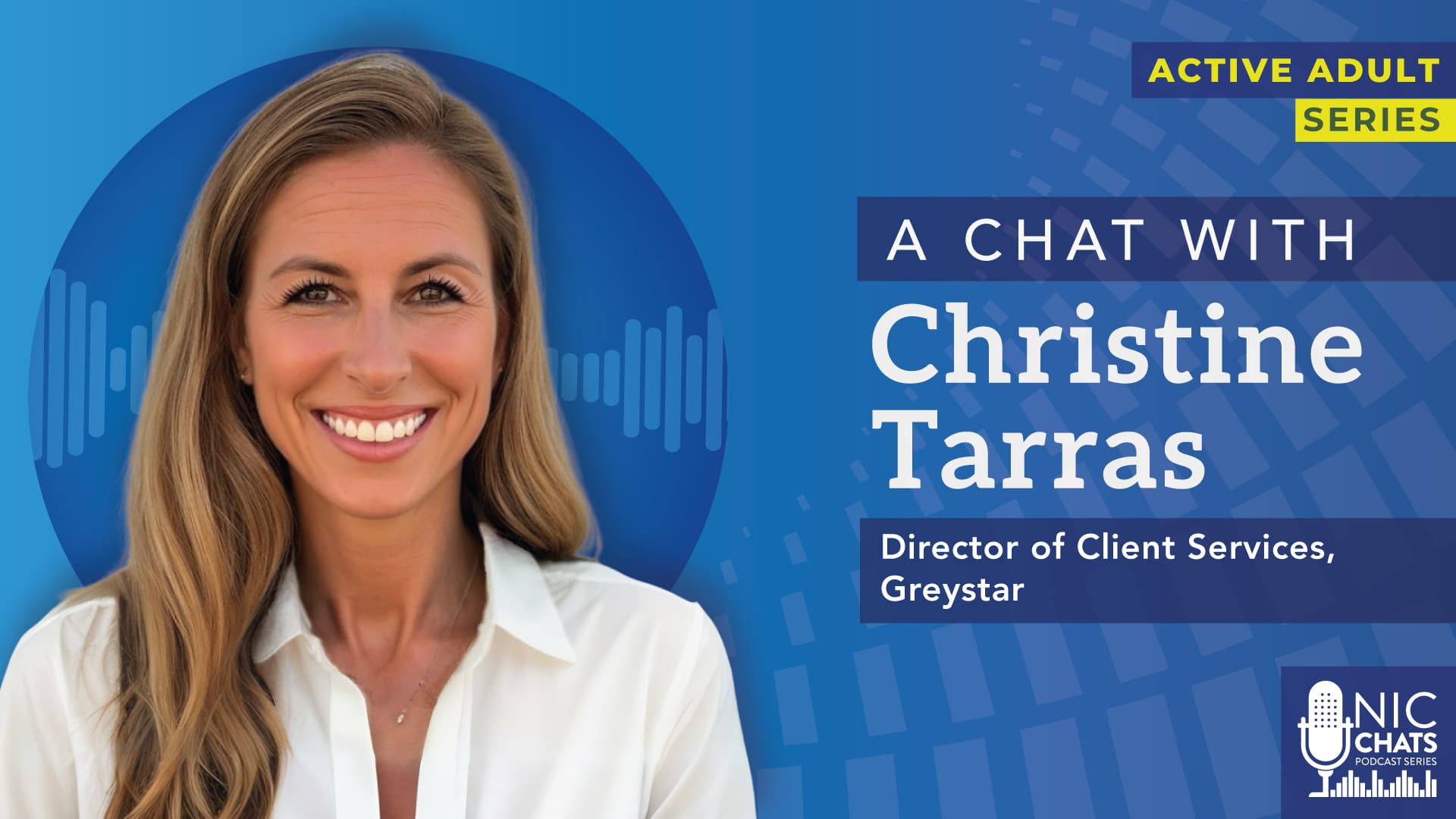
In this third episode of NIC’s Active Adult podcast series, Christine Tarras, Director of Client Services at Greystar joins host Caroline Clapp to share insights on how operators can build resident programming that drives both satisfaction and NOI.
Tarras draws on Greystar’s experience as the largest active adult operator to explain the mindset shift multifamily operators need to make when entering the sector, from longer pre-leasing timelines to a deeper understanding of resident psychographics and demographics. The conversation covers how lifestyle programming should evolve across an asset’s life cycle, how to design a calendar that serves residents spanning multiple decades in age, and the must-have amenity spaces and programming elements that support leasing velocity and retention.
Hear what doesn’t work — including programming that sounds compelling on paper but fails to gain resident traction — along with how to hire and retain a strong Lifestyle and Engagement Director, where technology fits into programming today, and how resident expectations may shift as younger cohorts enter the sector. Tarras closes with advice for operators launching their first active adult community.
This episode offers a practical look at building lifestyle programming that residents value and capital partners can measure. Thank you to Treplus Property Management for sponsoring this episode.
Want to join the conversation? Follow NIC on LinkedIn.
Interested in sponsoring an episode of the NIC Chats podcast? Align your brand with NIC thought leadership. Various sponsorship opportunities are available. Learn more.
This podcast series is brought to you by:

View transcript
Caroline Clapp: Hi everyone, and welcome to NIC's Active Adult podcast series. Thank you to Treplus Property Management for sponsoring our NIC Chats podcast on Active Adult. From pre-lease to operations to lifestyle engagement, TPM's full-service management solutions are purpose-built for active adult communities, designed to maximize NOI for owners and investors.
I'm Caroline Clapp, Senior Principal on the Research team at NIC, the National Investment Center for Seniors Housing & Care. We are a nonprofit real estate research organization focused on senior housing.
One of my subject matter areas at NIC is active adult rental communities, which NIC defines as age-eligible, market-rate, multifamily rental properties that are focused on enhanced lifestyle programming without providing meals. Those are the parameters that NIC MAP uses to track active adult rental communities.
Now we welcome to episode three in NIC's Active Adult podcast series, Christine Tarras, Director of Client Services at Greystar. Christine will cover this episode's topic, Lifestyle and Engagement: Determining the Must-Haves and Beyond in Resident Programming. Thanks for being with us today, Christine.
Christine Tarras: Thank you so much for having me, Caroline.
Caroline Clapp: To kick things off, please tell us about your role at Greystar and how your work in client services connects to active adult lifestyle and programming specifically. How large is Greystar's active adult footprint today?
Christine Tarras: Sure. Thank you so much for having me. It's an honor to be here.
I lead our new business pursuits across the country, working collaboratively with all of our different functional areas within Greystar. We've built out a dedicated active adult platform, so we have not only our operations team, but our sales team and our lifestyle team as well.
We connect all of those together. Whether it's a ground-up development or an acquisition, our team works to understand the client's goals and the market as well. That's very key because you really have to dive deep. You're going to hear a lot in active adult about psychographics and demographics and understanding who that consumer base is in any given market.
Christine Tarras: Understanding the adult children, where they're located, and where our demographic is located is very important as well.
Then we look holistically to determine what the expenses are going to be that are going to drive the revenue. So really, it's that core customer value proposition of the lifestyle program. What value is the resident going to see and want to pay for in order to drive that NOI?
We work directly with developers to build out spaces in each of the communities and intentionally design them as purpose-built active adult communities to engage the residents long term.
Right now, we have 166 communities, a little over 29,000 units across the U.S. We have 65% external partners and 35% owned assets. We're in 27 states and 110 markets.
Caroline Clapp: Awesome. Quite large. Great. With all of that geographic breadth and expertise, can you tell us, for operators or new entrants who are coming to active adult from conventional multifamily, what's the single biggest mindset shift they need to make about their job?
Christine Tarras: Sure. It really is understanding the consumer, understanding the demographic, and what they're looking for. What is the value that they perceive in any given community?
The other thing, if you're looking at a ground-up development, is definitely going to be that pre-leasing timeline. I know a lot of multifamily developers are used to three or four months of pre-leasing activity, and we truly are, call it, 10 to 12 months.
That does change in different markets and with different product types, but it really is a much longer process. In a new market where there is active adult, there is a lot more education that needs to go into the market so that people understand what it is, as opposed to traditional senior housing, independent living, and assisted living, and how we're different.
So there's a lot of education there. There's also different pricing strategies that they need to understand. What our residents look at is a lot different than the multifamily consumer. Effective rent versus concession strategies, things of that nature.
Caroline Clapp: Yep, that makes a lot of sense. So yeah, there's a lot to learn coming from conventional multifamily if you're going to move into active adult.
How does Greystar define lifestyle and engagement, which we talk a lot about in active adult? In the context of active adult, why does the quality of programming matter as a business outcome and not just a resident satisfaction metric?
Christine Tarras: Sure. To me, it's defined in three words: connection, credibility, and our core values.
That customer value proposition directly correlates to the value residents perceive and what they're going to pay for. But it needs to match the market. It's not a one-size-fits-all programming approach. You definitely need to be able to adapt to what the market is telling you is viable for that market.
There are a lot of examples of maybe overbuilding or developing a lifestyle program too quickly or too robustly. Our demographic is one that you never want to take things away from, so you have to be very careful and very strategic about that.
Caroline Clapp: Yeah, that makes a lot of sense. So there's a distinction between programming that helps lease up a property, and you started to touch on this, and programming that keeps residents renewing year after year.
How do you think about that difference, and how does your approach differ across the asset's life cycle?
Christine Tarras: Sure. It really is culture over curriculum. That core programming is in place, but it shifts and evolves as you work through a lease-up.
You have to listen to your residents. We do a lot of surveys and a lot of communication with them to understand what they're looking to see more of, what they like, what's new, and what their passions were throughout their lives. A lot of those passions can be implemented within the community.
It also gives them ownership when they get to lead some of those resident activities. That sense of belonging creates what I like to say: your vibe is your tribe.
As the on-site team works very closely to build those relationships and connections with people, that vibe carries into what the lifestyle program is going to look like. It evolves over time through the lease-up, at stabilization, and as the years pass, it changes and adapts as well. You really just have to keep listening to the residents.
Caroline Clapp: Yeah, that's really interesting. In a similar vein, active adult residents' ages may span from those who are closer to 55 to those who are into their 70s.
How do you design a programming calendar that serves the full spectrum of your resident population without diluting the experience for anyone?
Christine Tarras: Yeah. Connection is the common language. Many times we'll adjust the timing of events to capture the younger demographic that may still be working with events they're interested in.
A lot of times it's changing the timing, but it's also not diluting the experience. Our residents do age in place as long as they possibly can. That's one of the beautiful things about an active adult community.
But once again, like I said, you don't want to dilute the experience. Yoga is yoga, and having very experienced professional instructors who can adapt yoga to an individual's ability is different than changing the whole yoga experience just for an 85-year-old demographic.
They'll individualize the experience instead of adapting the whole experience, so it's good for all.
Caroline Clapp: Yeah. Okay, that makes sense. So modifications and personalization.
Similarly, thinking about lessons learned and looking back, how has Greystar's programming philosophy evolved over the last, call it, maybe five years? Are there things that you used to do that either the data or resident feedback told you to stop? You mentioned the surveys. And vice versa, is there anything positive that you added?
Christine Tarras: The content of the events definitely evolves over time, but the framework remains the same. We nurture innovation.
Some of the most well-received and heavily adopted events across our communities have been events brought up by our on-site team members in response to resident feedback, just like you said.
A lot of times, a casino night can evolve from a group of residents who love playing poker and wanted to bring that experience to more of the residents in the community.
So it really is listening to them and building out that programming based on their wants and needs.
Caroline Clapp: Yeah. So keep listening to your residents.
Christine Tarras: Keep listening and keep evolving.
Caroline Clapp: Keep evolving, yeah.
One of the reasons we're having this particular podcast today, which I talked to you about, Christine, is at NIC I think new entrants are starting to get the message that lifestyle, programming, and engagement are important.
Now they're calling us and saying, "What do we absolutely need to have in programming?" So let's dive into that.
If you had to identify the programming or lifestyle elements that are absolute must-haves, where if they were absent it would hurt your leasing velocity or might spike turnover, what are they? What are the must-haves?
Christine Tarras: I want to back up a little bit. I think it's definitely about striking a balance between self-led events and facilitated events.
Both team members and residents represent the constituents of our community, so building rapport and fostering a sense of belonging must take place in both contexts.
While mix-and-mingles are a big staple event at a lot of our communities, there are some markets and some states where they're not well received. Being flexible and having tea time or other events that really draw in that community are important.
Looking at amenity spaces that are must-haves, that great room and demonstration kitchen are the heart and pulse of the community. Having them strategically placed by the entrance is also very important so that you always feel there are people in there, whether they're working on puzzles or just having a cup of coffee together.
Having that right at the entrance of the community, where you can bring in prospects and it's felt immediately when you walk into the building, is very important.
Large yoga studios are very important in active adult communities. Going back to multifamily developers getting into the space, that's one of the biggest differences in the fitness area: flipping the size of the equipment room and the yoga studio, because they really love their fitness-led classes.
Christine Tarras: That's a big one. Pools and hot tubs are really expected in most markets. Even in colder markets in the Northwest, they're still a staple in most communities, so they're expected.
Those are really the core areas. Outside spaces and green spaces, being able to walk and be active, are very important. Having shade in those outdoor spaces is important to our demographic as well.
I would say those are the key amenity spaces.
Caroline Clapp: That's very helpful. Thank you.
On the flip side, what are the programming categories that might sound compelling in a marketing deck but that residents don't engage with meaningfully?
Christine Tarras: Sure. We did have a big lesson learned on our platform in the very beginning, and it was with weekday breakfasts and continental breakfasts that were served.
It sounds good in theory, but in practice only a small percentage of the residents really came out to take advantage of it. Likely due to that, and the staffing required to set it up and execute it well, with so few residents engaging, it didn't make sense financially for the property.
We were able to take that out of the communities very strategically. Like I said, you don't want to take things away from our demographic once you've implemented them. But if you can survey them, let them know why, and help them create value somewhere else, it works.
A lot of times that's through enhanced mix-and-mingles, adding lunch-and-learns and dining events that really add value to a larger group of residents who come out to experience them.
That's really one of the key examples that came to mind when you asked that question: our continental breakfast.
Caroline Clapp: Yeah, that's helpful. We have heard that was something that was common at a lot of properties at the beginning, and the offerings have evolved since then.
Christine Tarras: Yeah. Honestly, I also think about the salon and massage rooms. We've seen a lot of those in many communities since the beginning of the active adult thesis, if you will.
Those were challenging as well. Our demographic is very active. They're still driving, they're out in the community, and many of them have been going to the same nail technician or hairdresser for 20 years.
Having those services in the community wasn't as readily adopted as it was in more traditional senior living, where residents didn't necessarily drive or get out as much, and those services became their connection to the outside world.
That's been another lesson. But like I said, it is still very market-specific because there are markets where those amenities are well received and have thrived.
Caroline Clapp: Yep. Yep. That makes a lot of sense, and it's helpful to hear how the use of those amenity spaces has evolved over time.
Turning a little bit to measuring results, social connection and combating isolation are frequently cited as core value propositions of active adult communities.
How do you tackle that in a programming calendar, and then how do you measure whether you're delivering on it?
Christine Tarras: That's a really great question. Achieving this form of engagement is attributed to the interactions that take place beyond the event calendar.
We strive for intention from the start. When it comes to establishing connection, residents' very first interaction with our team members is key.
The ways we measure this include community town hall meetings, resident surveys, and software that tracks attendance at some of our events and measures resident engagement.
I think having a strong resident ambassador program is also a key indicator of how engaged your residents are, as well as how many clubs residents form and take ownership of on their own. That means they're truly investing in the community and in their friendships within that community.
You'll hear that active adult communities are often on the smaller side, around 160 to 180 units. That's the sweet spot, if you will, and it helps foster that sense of community and keeps engagement within a close-knit environment.
Caroline Clapp: So fitness and wellness programming seem to be universally included, but the range of execution is enormous.
What separates a fitness program that residents generally use and talk about from one that just fills space on a schedule?
Christine Tarras: Sure. I would say it's the variability in the offerings, as well as the consistency of the instructors.
To be honest, just like our on-site team members, residents get very attached to them, and it's no different with our fitness instructors. So having consistency is key to having a successful fitness program.
Caroline Clapp: That's great, and that's a theme we're hearing about retention. If you can retain staff, you can retain residents. So that makes a lot of sense with the fitness programming as well.
How much of a programming calendar should be structured and staff-led versus resident-driven and organic?
Christine Tarras: Sure. While our on-site teams play a part in scheduling all of the events within the community, our team members generally lead less than half of the events, with the remaining events being either resident-led or vendor-led.
In active adult, we aim to first articulate to prospective residents the opportunities that await them to get them excited, and then we have to deliver on that.
We follow up by encouraging each resident to create additional opportunities within the community. We've touched on that a little bit already, but it's really about getting to know them, understanding what their passions and interests are, and then developing those into the program.
They want purpose. They want to teach others what they've learned throughout their lives, and that's very important in our communities.
Caroline Clapp: Yeah, that's great. That's very helpful.
Moving further into staffing, the Lifestyle and Engagement Director role, often called L&E, is frequently described as the most important hire in active adult operations.
What does an exceptional lifestyle director look like in terms of background and skill set? And how difficult is it to find and retain that talent today?
Christine Tarras: Yeah. When it comes to the background of our lifestyle coordinators, it definitely varies widely.
Some enter the role with experience in property management, while others are charting a new course after careers in education, wellness, or even finance, to name a few.
We've been fortunate to see exceptional talent from individuals with all of these backgrounds and more, thanks to three common threads we look for: consistency, creativity, and care.
Having a passion for working with our demographic is extremely important.
We don't expect our lifestyle coordinators to coordinate lavish banquets week after week. Instead, we seek individuals who are committed to delighting residents and delivering memorable experiences and interactions every single day.
Even something as simple as sharing a smile and a greeting is very important.
They need to be creative in terms of event coordination, marketing tactics, and identifying ways to connect with residents from all walks of life, as well as connecting those residents with one another.
Above all, our lifestyle coordinators care about what they do and who they do it for, and that comes through every day in their interactions within the community.
One thing that's been great on our platform is that we have a Regional Lifestyle Manager who brings all of the lifestyle coordinators across the country together. Sharing creative ideas, discussing what has worked and what hasn't, is very important as we continue evolving in this space and keeping things new and fresh.
Caroline Clapp: That's great. So yeah, a lot of hospitality, but also sharing ideas and evolving.
Once you've made that staffing decision, if you have capital partners, institutional equity, lenders, or family offices, they might not always see programming as a value driver.
How do you make the business case that investing in lifestyle staff and programming is accretive to NOI rather than a drag on it?
Christine Tarras: Yeah. We're very fortunate that our partners do believe in and invest in lifestyle programming.
One of the key ways of talking to new people in this space is getting them to tour our communities and see that lifestyle in action.
Once they step into the building and there's a grand event going on, or even multiple smaller events throughout the community, they really become engaged. Our residents will walk up, introduce themselves, tell them all about the community, and immediately they can see why active adult is one of those game changers and how it's changing the lives of our demographic every day.
I think that's very important.
Caroline Clapp: Yeah. So walk it, live it, and see the difference.
Christine Tarras: You got it.
Caroline Clapp: Are there programming costs that should maybe be captured as a resident amenity fee or included in rent rather than operating expenses? And how does that presentation affect the asset's attractiveness to capital?
Christine Tarras: Sure. Most of our events are included in the rent premium, so they're shown as an expense line on the general ledger, generally within the marketing expense bucket.
Our communities are committed to transparency and delivering on our promise. As I mentioned earlier, our lifestyle programs are what set our communities apart.
It's our philosophy that everyone who lives in our communities deserves to enjoy the full extent of the event offerings.
Events that incur additional costs, such as specialty events, generally take place off-site. Going back to residents creating their own clubs, we've had adventure clubs where they take vacations together and do things of that nature.
Those types of extras are usually organized independently by the residents themselves.
Caroline Clapp: Yeah. Okay. That makes a lot of sense.
We are hearing a lot about travel clubs lately too, so that's great.
We're getting close to the end of our time, so let's talk about innovation and technology.
What's the most innovative or unexpected programming element you've seen work exceptionally well at a Greystar active adult community, something that wasn't in the original business plan but became a winner?
Christine Tarras: Sure. Over the years, we've witnessed innovative ideas introduced by countless team members.
Many of these ideas have gained attention and traction across our communities, steadily becoming staples at several sites.
Game shows, theater productions, and choreographed dances are among the most memorable programming efforts we've seen.
Watching the communities pivot during COVID was a huge aha moment for active adult.
It became very clear that through Zoom calls and virtual fitness classes, our demographic still yearned to stay connected with one another.
Being able to pivot on a national platform, keep everybody engaged, and reinforce the value of living in an active adult community was one of the best things I've ever seen in my career.
Caroline Clapp: Yeah. That is impressive.
Christine Tarras: Yeah.
Caroline Clapp: Technology is showing up everywhere in multifamily operations, and you started to touch on this.
Where does technology, whether that's community apps, wearables, or AI-driven programming, add value in active adult lifestyle operations today? And where is it more hype than substance?
Christine Tarras: Sure. We've benefited greatly from the insights granted to us by data aggregated across our communities. We use that to make informed decisions in lifestyle operations through various customer management systems.
It's still new and evolving. It's also worth noting how impactful social media has been for our business. Early on, it may not have been as well regarded in active adult, but our residents are truly engaged on social media and actively share content about their communities.
As far as wearables and things like that, I think we're on the cusp of a lot of new technology. It's not completely integrated into communities yet, but I think we're heading in that direction.
Caroline Clapp: Yeah, that makes sense. In traditional senior housing, there's a lot of age tech being developed specifically for that sector, but I think we're still trying to figure out where it fits in active adult.
That's really helpful. Looking ahead, as the active adult cohort evolves, for example, the leading edge of the millennial generation will reach age 55 in less than 10 years, how do you see the programming expectations and lifestyle preferences of future residents differing from today's 55-plus resident? And how are you preparing for that shift?
Christine Tarras: Yeah. We anticipate that certain activities may not be as sought after by the next active adult cohort.
I'm a pickleball lover myself. I can't imagine life without pickleball, but there may come a day when that's starting to phase out.
I do think, to your earlier point, there's going to be much more technology integrated into active adult in the coming years, and that's going to evolve a lot of our lifestyle programming. It'll be interesting to see that evolution become part of our programs.
Our business model is built on one principle, and although the way people approach it may change, we're prepared to continue offering opportunities for people to connect for generations to come.
That connection is at the core of what our lifestyle program will continue to be.
Caroline Clapp: That's fantastic. We've got the baby boomers, people are focused on Gen X right now, and then we've got millennials, so just keep the connection going.
Christine Tarras: Yep.
Caroline Clapp: As we wrap up, I'm going to put a slide up that shows the many active adult resources available today from NIC and NIC MAP.
While we're looking at those resources available on our website, one last question for you, Christine.
For an operator or new entrant launching their first active adult community who wants to get the lifestyle program right from day one, what's your single most important piece of advice?
Christine Tarras: Sure. For long-term resident satisfaction and business success, I would encourage team members at any active adult community to develop a lifestyle program that not only appeals to both current and prospective residents, but also excites the team members themselves.
Residents are much more inclined to become stakeholders in a community's calendar of events if the on-site team takes a personal interest beyond simply scheduling the events.
I say this all the time: our number one KPI is our on-site teams. Our team members are phenomenal in what they do and how they execute this lifestyle program, and that's incredibly important to our industry.
Caroline Clapp: That's great. Thanks so much. Is there anything else you'd like to add before we wrap up?
Christine Tarras: No. Thank you so much for your time and for allowing me to speak. Thank you.
Caroline Clapp: Great. Thank you to everyone listening to this episode of NIC's Active Adult Podcast Series.
You can find additional podcasts on our website, nic.org, or wherever you listen to your podcasts.
Thank you again to our guest, Christine Tarras, Director of Client Services at Greystar, who joined us to discuss today's topic, Lifestyle and Engagement: Determining the Must-Haves and Beyond in Resident Programming.
And thanks again to Treplus Property Management for sponsoring this episode.