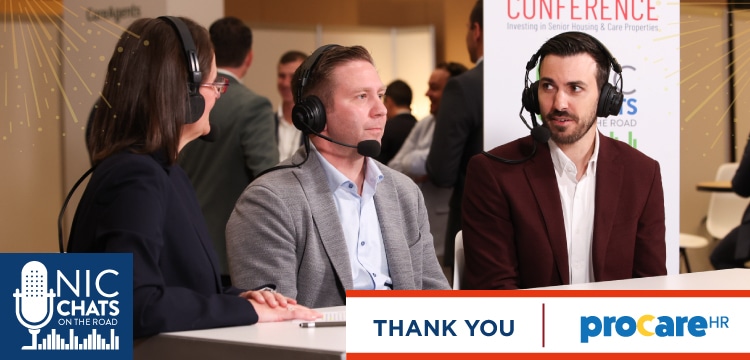
Recorded live at the 2026 NIC Fall Conference in Chicago, this NIC Chats On the Road episode brings back Brett Landrum, founder and CEO of Procare HR, and Ryan Galea, CTO of Procare HR and CEO of Go Icon.
Host Lisa McCracken speaks with Landrum and Galea about the synergies gained after Procare HR and Go Icon joined forces, and how combining HR data with resident engagement data is revealing a direct link between staff and resident experience. They discuss what motivates frontline team members, the significant rise in resident app adoption, and why they see “engagement density” as a better goal than talent density. They also cover how AI is shaping product plans, how managers can act on retention signals, and why workforce costs matter more as occupancy rises.
Want to join the conversation? Follow NIC on LinkedIn.
View transcript
NIC Chats Podcast – 26NFC On the Road – Procare HR
Lisa McCracken: Good morning. This is Lisa McCracken, and we are live in Chicago at the 2026 NIC Fall Conference. This is the NIC Chats podcast On the Road. So excited that you are tuning in, and we have a familiar guest. So I don't know if you know this is our seventh time. Whoa, I've been counting. And this is the first time that you and I sat down here three years ago in Chicago
Brett Landrum: Really?
Lisa McCracken: At the 2023 Fall Conference here in Chicago. So excited that you're with us, Brett Landrum, Ryan Galea.
Ryan Galea: Yeah, you got it.
Lisa McCracken: Before we go any further, I wanna do some introductions. Procare HR is our guest here today, and we're gonna get further into their company, what they're all about, their evolution, and there's so much to talk about and unbundle 'cause you guys, in your journey have, I think, evolved so much, and even across the three years we've been talking. But introduce yourself. We'll start with you, Brett and then we'll go to you, Ryan. Who you are, a little bit of background on ProCare HR, and then we'll do the same thing with Go Icon. Yeah.
Brett Landrum: Brett Landrum. I'm the founder and CEO of Procare HR. Procare HR traditionally and for the last, 11 years has really been a HR partner to the senior care operators, really focused on how do we take the work that we're doing in HR and translate it to, ultimately business outcomes for our clients. And then, most recently now with Go Icon and Ryan and team, have really pivoted to be a technology and services partner to the senior care operators, really focused on how can we connect the work that we're doing in these two different functions, HR and life enrichment, to, the business outcomes that our clients are driving towards.
Lisa McCracken: Yeah. And I do wanna unbundle that. We've got a lot to talk about with that. So Ryan, can you introduce yourself too?
Ryan Galea: Thank you. So I'm Ryan Galea, the CTO of ProCare and the CEO of Go Icon. Go Icon is a resident family and staff engagement platform. We're really singularly focused on helping our communities deliver phenomenal experiences to all their stakeholders, and making it possible to do that at scale by enabling it with technology.
Lisa McCracken: You have a longer title from the last time that you were here...
Ryan Galea: There's more to it. I didn't even give the whole thing. It's a mouthful.
Lisa McCracken: So we sat down at the NIC Spring Conference, and we talked about your partnership and so forth, and that has obviously evolved a little more formally since then. And we'll talk a little bit about that. But maybe to tee that up you were founded in 2015. Yeah. So I'd like for you to in the introduction, I think you teed it up a little bit, but, from your founding, I think, I don't wanna put words in your mouth, but probably were a little more narrowly focused than clearly where you are today. 'Cause again, I think back from the last three years of our conversations to where you've evolved. Can you talk a little bit about that journey and maybe the vision of where you started and the platform that you are today?
Ryan Galea: Yeah, it's evolved. I always tell people it's not something like we woke up in the morning and had a brilliant idea. It's just as the business grows you bring on new team members, they've got new ideas. You have some success. You bring on new clients, they have great ideas. And it just it's every year kind of our collective kind of bar of what we want to achieve and the outcomes we wanna drive and impacts we wanna have just kind of continues to elevate. And it's just a kind of natural cycle. And so, I'd say since 2015, it's felt like very incremental changes. When you look back it's like, wow, it's very significant changes. But yeah, when we first started the business, the idea was, okay, people are such a critical part of senior care. There's not a great, nobody's really figured out a solution. Everybody's talking about how can we do it better. You talk to any operator and say or really any stakeholder in senior care and say, "Give me a top three challenge today, top three challenge for five years." Workforce is gonna be one of them to everybody, for everybody you talk to. So there's a clear kind of opportunity to go and have a big impact. And it was really, okay, foundational HR, and then how can we use the foundational HR platform to build other things within the people function that really drive impact? And, then as the business has evolved, we've been able to continue to kinda expand kind of what we do and, how we can drive impact in the HR function. and frankly, the Icon conversation really came up naturally. It kind of started out a little bit opportunistically with, as most good deals happen, Ryan and I in a bar. And as we started talking about, Go Icon and their vision and Procare, we really realized like there's this kind of really special connection between the life enrichment, resident engagement side of the world and an employee and HR side of the world. And we started coming up with a kind of a thesis for, huh, if we brought these two organizations together, beyond like kinda the business synergies and value that kinda both organizations brought, it was like, there's like a potential really special opportunity here to have a really great impact.
Lisa McCracken: Now, I appreciate how you're building upon that core. You've got that base obviously offering on the HR side of things, but it's much more complex than that. Yeah obviously. I wanna ask you a question, Ryan. So I've gone on your website, and the website reads, "You want to turn engagement into your community's competitive edge." What do you mean by that?
Ryan Galea: Yeah, I think in this day and age, a lot of communities have started to look similar, right? And it's how an outside family or senior can identify where it's gonna be the best home for them. And so I had this idea, I call it the Netflixification of senior living, which is just this concept of everyone's been exposed to Netflix and AI now, where everything's so personalized to you as an individual. And so how can we enable senior living communities at scale to personalize the experience to their market, to the seniors the community at a given point in time and really differentiate beyond just, we have a wellness program and, we have nice amenities, right? And so we, through the data we collect on the residents and through, surveys, through our resident interview platform, are able to sort through all the noise and identify very clearly what types of programming can you offer to really make you unique that's really gonna help satisfaction and make you stand out from the noise?
Lisa McCracken: Yeah, that personalization is incredibly important, particularly for the incoming customer. Yeah. This cookie cutter thing is not gonna fly, for sure. Okay, we've talked about this before, and I wanna go deeper into it. You both are very passionate about this connection. I think this is what obviously brought you together in terms of the, with the staff and the resident satisfaction and engagement. And, obviously many of us intuitively say, "Oh, yeah, okay, a happy resident or happy staff, happy residents," and so forth. But you guys go deeper than that, and really wanna take a look at the data. Can you talk about that? This isn't just a nice to have, warm, fuzzy type of thing. What is your commitment to this?
Brett Landrum: Ryan's the mad scientist behind the curtain, so I'll let him answer.
Ryan Galea: So we're working on some pretty cool stuff right now, but we have shown already empirically with all the data that we now have access to, having our resident data and the Procare employee data, that there's very clear statistical significance between you cannot have happy residents without happy staff. If you have unhappy staff, your residents will be unhappy, and it's very correlated very directly. So we've really proved that out. Now, it does slightly diminish. It's not, once you get happy staff, it's not like all your residents are gonna be phenomenally happy. You still gotta do more things beyond that. But at least on the downward sloped trajectory, the two are pretty one-to-one in terms of relationship. And so we're working on a lot of product now where we really wanna help tie those together and influence how you can improve the staff experience, and in turn, help drive the resident experience.
Lisa McCracken: What are the types of things that are at the top in terms of what are most important to the staff? We hear a lot about wages, and we know that I'm gonna speak anecdotally here. We know, we, whoever we are. Wages are important, but maybe not number one. There's other things. But can you give us some insights into that?
Ryan Galea: Yeah, part of what we've seen in the data is it's not the same for everyone. Okay. It's a little bit. There's a little bit of nuance around what motivates different individuals. And so for some, recognition can be a big thing, recognition for a job well done, and just that kind of, whether it's from a peer or a manager, that can go a far way. Compensation is obviously important as one element as well. Career growth is another one. Flexibility in your schedule. There's a lot of different factors, and so you need to look at them all. And it makes it really tough too when we're trying to come up with some of the predictive stuff we're doing to figure out, what signals are gonna drive, 'cause you need a lot of data to figure that out for a lot of different people.
Lisa McCracken: So that's a very important insight, because I think sometimes we tend to jump to conclusions around macro observations of this is what everybody wants. But it's, we talked about the personalization for the resident customer, but I think it's a very personal thing. Not that there aren't some trends, but it can be a very personal thing for an employee too, and I think we can forget that. How do you equip your management team with some of these insights? So I know you obviously you bring in HR professionals and so forth. So how do you bring this data and this information to them to do a better job?
Brett Landrum: So I think you can talk about, to the point Ryan was making, we can look at some of the broad, sweeping themes of what's important to employees and, whether it's compensation or recognition, et cetera. But if you equate an employee's experience to a senior's on one day in a senior housing community their experience, they might value food or, the life enrichment activities or programming. But their experience and their sentiment is gonna be the accumulation of tons of data points or tons of interactions throughout that day. It's like, "Hey, I got up and I went to check my mail, and the receptionist was really friendly and we had a great conversation. And then I walked over and I saw my favorite housekeeper that I talk to all the time about this thing." Or on the opposite side is, "I talked to seven people throughout the day. Everybody was off. People were rude." So there's I think what we're trying to do is we're drawing out what are the big sweeping themes, but then how do you really drive day-to-day interaction and interventions when those interactions go off course? 'Cause if you think about your own travel experience, you can probably think back to "I had this really wonderful experience because I had all these fantastic interactions, and the hospitality was amazing, and every single thing went well." And then conversely, you have the other experience where, like man, I went to a really nice place. I expected this great hospitable experience, but for whatever reason it was like this little cut and that little cut and this little cut. So part of what we're trying to do for the managers is how do we surface those little cuts on the, from the team member side so that we can get ahead of it and say, "Hey, look, we know that the experience wasn't fantastic today Right or the last hour or whatever. Let's talk about it. Let's have that conversation so that we can move on and have the, listening and problem solutioning conversation in the moment after that, like one day or one hour of poor experience."
Lisa McCracken: Cause our environments are very different. It is a home. It is 24/7. And you're not gonna have every experience go perfectly, but having that relationship where you can have that dialogue and say, "All right, let's talk through that and work through that," and so forth. So I'm gonna say you have a vision, and you guys may be there. I know there's a lot of data crunching and stuff behind the scenes and, the north star of what you're working for, but again, it's okay, connecting residents, engagement, staff engagement, and data and all of that, but and again, some people might still see that as a little, soft data, nice to have, You feel strongly and, there's many in your camp that say, I agree that can ultimately lead to improved lengths of stay, which leads to improved financial outcomes. That there's real return to this stuff. Those are things when the rubber hits the road, that are some real outcomes and benefits here. So talk to me about that sort of long-term vision of what you guys are ultimately looking to connect as well.
Brett Landrum: Yeah, part of, we've worked really hard over the last, four to six months since we've brought the two organizations together to work with our Procare clients to really, to start deploying Icon. And one of the reasons for that, or one of the drivers behind it, was really wanting to start being able to connect the dots in real time to say, as our outcomes on the employee side change, how do we start seeing some of these kind of the business outcomes we're shooting for on the resident, you know Right resident side? How do we see ultimate business outcomes start moving? And because of, the data Icon has, we can see average length of stay. We wanna start looking at referral rate, referral rates. average occupancy may not be the best indicator, but resident and family satisfaction. And so because we're gonna have everything in one platform, we can now start looking at it and saying, "Okay, as these different outcomes are changing on the people side, month over month, week over week, here's what we saw on, the resident and family side of the world."
Lisa McCracken: And there's some things I think intuitively too. If you're, if that engaged employee's gonna observe more and document more. Again, if Mrs. Smith in the dining room doesn't seem like herself or whatever, those things are gonna get documented and, those are things that avoid hospitalizations or whatever. I'm curious to know about with your platforms and engagement, do you see changes in, some of this may be attributed to the incoming resident population in terms of the number of residents that, are engaged in logging into your platform today versus maybe five years ago. Those numbers continue to go up. Can you talk a little bit about that?
Ryan Galea: Yeah, it's actually fascinating. So I'd say, let's call it six or seven years ago when I first got into this the average weekly login per resident, about 35% of residents who had access to the app were logging in. That number on average across our full footprint is now 55% log in every single week. So over seven years is a pretty dramatic increase. And if you slice the data by generation and look at baby boomer versus silent generation, it's baby boomer's like 85, 90%. Wow. So it's really phenomenal. That wave is just, as they move into the, being the main population, just increases exponentially. It's really amazing.
Lisa McCracken: It's interesting. I sound like an older i'm ageing myself a little bit in the industry, but I remember when some of the engagement platforms were a little bit more of a nice to have. That speaks to the must-have of what you offer. Can you speak to that on sort of the staff side of things the staff engagement and sort of some of the platforms that you have?
Ryan Galea: Yeah, so that's, we're adding a lot more there. I think it's a similar trend where a lot more, we actually our initial staff engagement was all text messages, just communicating via text message 'cause a lot of people didn't have smartphones still. and again, we're seeing that trend towards wanting the smart mobile app that has everything in there that the staff can access in one spot. And so we're actually working on rolling out a dedicated employee portal product now that brings together a lot of the stuff we've been doing, yeah, into one spot.
Lisa McCracken: Fantastic. I wanna ask about one more thing that you said that you're maybe beta testing a little bit on the retention side, then I wanna go to the, a little further into the life enrichment stuff. Again, data tying together different observations. You shared with me on a prior conversation I'm like, I thought this was so cool, and I think you said oh, you love data. You're a data nerd too. Let me show this to you. Some stuff you're looking at where it's, a supervisor or whatever can take a look at some different flags of a loyal employee, but that may so show some signs that maybe there's a little discontent. Maybe they're, they've show they've called off or, they've had to pick up extra shifts a little bit late. Just some things that you need to check in or I'm gonna let you explain it better than I did. Talk to me a little bit about maybe some things about you see some potential products in the future where you're using data to help better inform those supervisors to nip some things in the bud.
Brett Landrum: Yeah, I can talk about the services side and Ryan can talk about the data and technology. So we're, what we're doing is trying to, Procare's got about 175,000 employees that we have data on for the last 11 years, and we have very rich data on those employees. And we're Again, I'll let Ryan talk smart about all the, machine learning stuff he's doing in the background. What we really wanna do is be able to surface those insights on a daily basis to supervisors to say, "Hey, this employee, great employee, at risk for these reasons." And then, also in conjunction with that, there's we can surface the data all day, but if people don't know how to execute to it and/or, maybe don't aren't in a systematic rhythm or don't have the discipline to execute to it, like the data's useless. And so part of what we're doing is we've got the technology side, which is what Ryan's building, and then we have the services side, which is, hey, how do we come alongside those communities and those leaders as a partner and give them an accountability and kinda framework for executing against the data so that we get consistent, kinda consistent action of the insights that we're surfacing?
Lisa McCracken: That's awesome.
Ryan Galea: Yeah. We're working to, with the power of AI now, it makes it possible to deliver things that might've been in service before via technology. And so in conjunction with what they're all doing on the services side, we're working on a I don't know if we have the official name for it yet. But we'll have a, we'll have a fancy name for it soon. But some sort of dashboard product that lets you identify, you know, employees who might have, high, low sentiment issues or engagement issues, and then give managers very actionable things that they can actually do to engage that individual to help from an engagement or sentiment standpoint. With those two, engagement and sentiment, being very distinct things Ryan has a very strong vision about that, and I think that's, it's the right way of looking at it, that those are distinct concepts. One is about happiness, which could be related to a lot of different factors. The other one's kind overall in fact, effectiveness in the role. And it's being able to measure those two distinctly and identify where people fall on those two spectrums.
Brett Landrum: Netflix became famous for their people strategy, or, they've got the book. I can't remember the name of it, but, and one of the concepts that they really, perfected was this idea of talent density, is how do you assess the kind of the talent within the business, and you're constantly trying to raise the bar in your talent density. And, they did that with, equity and income and lots of, things that Netflix is famous for. Senior living doesn't have the luxury of saying, "We're gonna go get a rocket scientist to come in and, do caregiving." So talent density, I don't think, is actually, at least within, for frontline team members, is the right concept. But the idea is how do you raise engagement density? Because if we have...
Lisa McCracken: I love it
Brett Landrum: ...if we have team members that are more engaged with the community, the residents, their other team members, the mission of the organization, at, literally every outcome gets better, right?
Lisa McCracken: Love it
Brett Landrum: every problem you have, turnover, overtime resident satisfaction, you know, good life enrichment and hospitality experience, like literally everything gets better if the engagement density in the community goes up. And so to Ryan's point, kind of the two different dimensions is, am I engaged, and then am I happy? And if I'm really engaged and not happy, I'm either not gonna be there or I'm probably gonna be less engaged. And so you have to look at both. You have to work on both dimensions and I think view it that way in order to ultimately raise up the engagement.
Lisa McCracken: I love it, I think about, you need those people at every level regardless of what their jobs are, whether it's, again, the maintenance person, the frontline staff. And I think giving, those managers the tools and the insights, you mentioned accountability, I think that's one thing. But also just the reminders. I think sometimes the managers get just so busy and stuck in their day, I think that the information to check in and to do that I think is so important. Life enrichment. So I think, all of you have gotten very good at providing, staff and specialists in certain roles. you see an opportunity there. Can you talk a little bit about that?
Brett Landrum: Yeah. Procare for probably 11, 11 years until Icon, like we were a good tech-enabled services company. So we took other people's technology and would build it out, and we'd do all the configuration. But we didn't really, we didn't have the muscle to build our own stuff, for lack of a better term. But we got fairly good at how do we use fractional use of experts, strong alignment between, our teams and our clients to really drive outcomes and most scenarios, hopefully providing a really fantastic kind of service and experience for our clients. Icon really has been a fan is a fantastic technology org. And so they've, what they brought to Procare was an ability to now build our own technology and do so at a pace that's pretty exciting. And then for Procare, because of that services muscle, we feel like there's a good opportunity to take conceptually this fractional use of experts kind of partnership type model that we have with Procare and apply it to life enrichment on top of the Icon platform.
Lisa McCracken: Yeah. And we talked about the, some of the staffing of that. I think there's an opportunity to bring some real expertise and enhance, I think, the some of the, Yeah, some of the expertise at different types that you, we I know we talked about within memory care, which is very different than maybe within independent living and so forth. And again, this is me talking. You may see it differently or not. Again, when it comes to the incoming generation, I think that's defined very differently when you're looking at a, at an incoming boomer that's coming into independent living. I think they're gonna define, life enrichment at a very different level and have very different expectations for it.
Brett Landrum: Yeah. Even, so our, the executive on our team that's building up the service we were talking to a client and about this, about the service, and they were mentioning that actually, like for them They have a number of skilled communities, and their transitional care, they said, is incredibly hard on programming because people think they don't want to engage life enrichment, 'cause they're like I'm just here for a period of time. I'm not gonn" Oh get into that rhythm. Interesting. And so as an example that's an area where you can build deep specialization Very interesting and expertise Yeah hey, how do What is, programming and what, a how do we build a muscle that really resonates with, residents that are in that transitional period? And that's gonna take a lot of experimentation and expertise and trial and error, but again, once you've done it's like, hey, we now have this kind of unique this unique experience and capability that a lot of organizations probably aren't gonna have the time or resources to develop in-house.
Lisa McCracken: Okay. We have a few minutes left. I wanna go back to some core stuff, and it's a little bit of focusing on where our industry is right now. So we are NIC reports on a lot of the NIC MAP data. So third quarter, we're at 90.4% national occupancy. Next quarter, we're probably gonna hit record occupancy. We're in a little different operating environment right now, so a lot of communities are I don't wanna say max full occupancy, but they're looking at some different level, levers in terms of revenue, expense management. You can only raise rent so high, so now they're looking at, okay, you know better maybe expense management, how can we fully maximize the NOI? And I think that makes what you guys do on the HR management side even more important now. Are you seeing that? I'm sure you're like, "Oh yeah, I agree with that." But I'd love your reaction to that. And staff scheduling, efficiency, just management of those, I think, workforce expenses, I think in this operating environment is incredibly important. It, which maybe sounds a little counterintuitive at that high occupancy point, but I think there's less levers to pull in terms of because of that high occupancy from a revenue and expense management standpoint.
Brett Landrum: Yeah we're seeing, frankly on the Icon side, I think we're seeing more of an uplift from like the revenue from where the market's at. Yeah. Because, in '22, '23, '24, even '25, we're still kinda coming out of COVID. We have workforce pressure. Yeah. We're really working on occupancy. Stuff's not trading. I think there's some questions on value, you know right valuations, et cetera. Sure. So we have less trading than maybe the market wanted. Now all of a sudden, occupancy's going up, revenue, growth Sure et cetera. And I think because of that, and then, obviously a new generation, lots of excitement about silver tsunami, and there seems to be now a focus on, hey we must optimize the resident experience. Yes. And so I think, we're seeing some really exciting tailwinds there from our life enrichment, from Icon and life enrichment. On the HR side, I think again through '22 through '25, there was a lot of momentum because of the workforce pressures Sure and because of revenue and occupancy wasn't really where we wanted it to be. So you didn't have a choice. If you didn'manage expense you didn't have a community. I think, the revenue lift has relieved a little bit of that pressure. My suspicion is that, over the next 6 to 18 months, you will see a kinda reversion back to, okay, we got occupancy there. We've optimized the resident experience. Where else are we gonna optimize in the business? And like to your point, there's either ancillary revenue streams, or there's expense management. Correct. Which is gonna be, 60% of your, 50% of your P&L is labor.
Lisa McCracken: Correct. Yeah. Okay, I think we got about one minute left. I'm always gonna ask what's next 'cause I feel like there's always a what's next. We talked a little bit about some things you're working on, but anything else about, on the horizon that you wanna share?
Brett Landrum: Ryan, what's next?
Ryan Galea: I guess without revealing anything that's you know any secret sauce yeah, any secret sauce, I think, everyone's seeing the news, AI. Yes. We can develop a lot faster, more ambitiously than we've ever been able to before, and I think we will be kinda tongue in cheek leaning into that a lot more, and I think we have some pretty big product roadmap items we're gonna be biting off next year.
Lisa McCracken: Okay. Great. Keep up the great work. It's always awesome to speak with you. And I feel like, when we're together it's not the same old conversation. You keep moving forward, you keep innovating. So Ryan, Brett, keep up the great work. And thank you all for tuning in to the NIC Chats on the Road in Chicago at the NIC Fall Conference. And tune into further NIC Chats podcasts at nic.org. Thank you all.