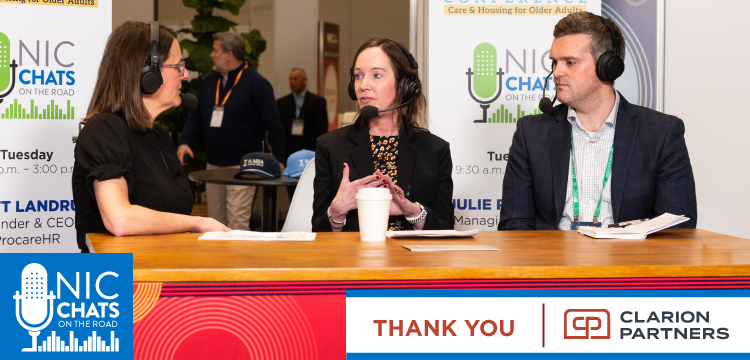
Host Lisa McCracken sits down with Julie Robinson and Andrew Wantoch of Clarion Partners — a roughly $70 billion private investment manager — to talk about their growing commitment to senior housing. The duo shares how Clarion approaches the sector with intention: from market-level labor analysis and purpose-built, private-pay asset selection to the “yellow flag” philosophy that guides their operator diligence process.
The conversation gets candid on what true capital-operator alignment looks like, why staff compensation structures matter all the way down to the department head level, and what questions operators should be asking their capital partners before signing on. Julie and Andrew also weigh in on technology expectations and share their long-term vision for Clarion’s role in the senior housing space.
Want to join the conversation? Follow NIC on LinkedIn.
View transcript
Lisa McCracken: Good morning everyone. Thank you for tuning in to the NIC Chats podcast, on the road live at the NIC Spring Conference here in awesome Nashville. So my name is Lisa McCracken and I'm the head of Research and Analytics with NIC, and I am super excited to have two esteemed guests from Clarion Partners with me today.
We've got Julie Robinson and Andrew Wantoch and lots to talk about in 30 minutes and I'm super excited 'cause I've got a lot of questions for you and I know we're gonna have some fun dialogue here. But before we dive into that, for those that are listening Yeah. Who is Clarion Partners, and then if each of you could just introduce yourselves and your roles in the organization.
Julie, we'll start with you.
Julie Robinson: Yeah, sure. Julie Robinson. I've been with Clarion Partners for coming up on 18 months now. I most recently was at Ventas and prior to that was with GE Capital. So. About 20 years in the healthcare diversified healthcare real estate industry. Clarion Partners is an approximately $70 billion private investment manager, investing primarily on behalf of institutional capital.
We also have access to the private wealth channel as well through a non-treated REIT. We can talk a little bit more about how we're investing in this space, on behalf of those investors, both on the institutional and private wealth side. What Clarion historically has been known for is two things.
One is great sector selection, primarily historically, I would say an industrial multi-family. We are actually the second largest industrial platform and we have a significant multi-family presence as well. The other area, what Clarion is known for from their institutional investor base is open-end fund structure.
We really take a long-term sector thesis and we invest in that way. We care about having aligned interests and making sure that we are focused on the long-term and not just, you know, short term, sort of in and out of a particular sector, for short-term gain. So our investors, again, both institutional and the private wealth channel, think of us in terms of that open-end fund structure.
Really taking that long-term, very research-based sector focus, and that's what we're doing in healthcare as well. And again, it can get into it a little bit more when we talk about that. But like Andrew, go. Yeah.
Andrew Wantoch: Yeah. Andrew Wantoch. I'm the head of our senior housing asset management team at Clarion.
I had privilege of working with Julie previously at Ventas and was really excited to rejoin here. But I started my career in the senior housing industry about a decade ago on the operator side, and eventually made myself over to the capital side. So I'd like to hope I can bridge that gap between our operating and capital partners.
Lisa McCracken: And we're gonna come back to that in a little bit. It's important. It is. And it's a big part of your thesis and your team structure. And I appreciated the background in terms of Clarion in general the history of the organization and as we were preparing for this, or I was preparing, 'cause I knew we were gonna sit down.
I know I shared with you, I think it was March 6th, I opened up, the, the daily newsletter for McKnight and there's this great article on Clarion partners and your commitment in senior housing and all the activity. I feel like I've seen your name a lot lately.
So you gave a little bit of the background in terms of the multifamily and industrial, but clearly the company is very bullish on senior housing. So can you talk a little bit about just like senior housing and then healthcare where that fits in your overall commitment to this space?
Julie Robinson: I mean, like everyone right now very bullish on seniors housing, and I would say everyone sort of probably knows the thesis that they're at this conference in terms of why we're all so focused on seniors housing, but in particular, Clarion really centers their focus on areas where we think we have a repeatable edge.
Lisa McCracken: Okay.
Julie Robinson: And we love and favor sectors where execution is what drives value. Mm-hmm. Because we are excellent at execution and we will be in seniors as well. And what we see in seniors in the impetus for us joining Clarion is this combination of institutional real estate discipline with deep sector knowledge and being able to deliver that for our investors, but also our operating partners has been really motivating for us. In terms of building out the platform, I will say yes, our name has been.
Lisa McCracken: It's been good.
Julie Robinson: Yeah, no, it's great. We've been growing a lot, but, importantly, the growth comes with discipline.
Our investment screening process is very deliberate.
Lisa McCracken: Okay.
Julie Robinson: We think about first the market in terms of both. The resident profile, the wealth dynamics. Understanding who's gonna move into this community, and what does that community need to look like to serve that aesthetic appeal and design for both the seniors, but also their adult children who often make the decisions and assist with payment as well. We also though, and maybe even more importantly now, think about the labor dynamics in the markets. Yes. And think about that positioning relative to the asset as well. Is the commute gonna be convenient?
What does the current wage pattern look like for each of the community leadership team, but also the vocational workforce. We look at the softness in the labor market in terms of number of positions that are opened and how long they've been vacant. So that to me, is a bigger piece of what our focus is now and going forward.
And then most importantly, after thinking about the market and the asset and how those align, of course, is the operator and their strategic value that they can add to the asset. We love operators who are invested in the market with us and have an ability to drive real growth and competitive positioning there.
Lisa McCracken: There's so many things that I want to jump off of what you just said, which is good, but I want to ask it what might be a little more of a simplistic question. So do you have a typical profile for your investment in terms of like a property type and so forth?
Julie Robinson: Yes. Yes, we do. So I would say primarily invested in purpose, built private pay communities, primarily private pay communities.
The way that we describe our asset profile is either, one of two formats. One is going to be kind of your 90 to 150 unit assisted living and memory care. And the other is going to be approximately your 120 to 250 unit independent, assisted, and memory care.
Those are really the two formats that we feel are future-proofed and also create the best balance in terms of cash flow, stability, and price in elasticity.
So you tend to see. On the independent living side, just higher absolute values for occupancy. And then you've seen, you tend to see on the assisted living and memory care side, inability to drive growth through care pricing and acuity, et cetera. So, right. That combination in those two formats are what we would describe as our investment thesis from an asset perspective.
Lisa McCracken: So what you went through in terms of just explaining how you look at the markets and so forth, just enhances the sophistication or the, some of the complexities, I would say of investing in senior housing compared to multifamily, and others, and I think just underscores the expertise that you need on your team. So it's not just making an investment, it's in the investment, but really understanding the dynamics of the space. So you've really built out a team, and it speaks interesting when you introduce yourself, you come from operations. so can you talk a little bit about the team that you've built, and maybe Andrew, you can talk a little bit about how you bring that operational perspective into investment?
I mean, it's, I think a really, for me, I think a strength, in terms of how you're approaching, a cap from a capital partner's perspective.
Julie Robinson: Agree. that was again, I think the word that you'll hear from us a lot is intentional or deliberate. And again, the team building at Clarion has been really intentional.
We recognize and respect that there's not only the real estate fundamentals that need to be addressed when thinking about seniors housing, but importantly. And in my view and Andrew's view, more importantly, the operational aspect. So we're really hiring so that we can engage in the sector at all levels, not just from an investment committee seat.
And Andrew was a key part of that hiring strategy and bringing it to your point, his operational expertise to our team, the returns are shaped by operations and labor dynamics and clinical capabilities and sales culture and local execution. It's much more than what a multifamily or not to sort of knock on that asset class, but sure.
It is a bit more simple, more complex and exactly. So that's not lost on us and, that is the intentional way we're building the team, is to focus in that way.
Andrew Wantoch: And I would just add that we approach these as real operating businesses and so we manage and as such our operator diligence is very deep across every function. But at the same time, we want to give the operators room to execute, but also be there being a constructive partner. Be there to provide, to be a resource through investment cycles, and to provide judgment on the investment. And the last thing I would add to operator alignment is just, it goes both ways. Right?
Lisa McCracken: Absolutely.
Andrew Wantoch: Operators should be diligent seeing us just as much in understanding how do the capital partners align with their long-term goals which we think is a big advantage of Clarion.
Lisa McCracken: And I think we unfortunately do hear that repeatedly about this misalignment. I think too often there's the right questions are not asked up front. Or, and or sometimes it's just not a match potentially. And there's just different goals and so forth. So I'd love for you to comment maybe a little bit, not say you need to give away your secret sauce or whatever, but what, what are questions that you ask of potential operator partners?
And then conversely, I'd like for you to say, if I'm an operator, what should I be asking? My potential capital partner. So pepper some of that in there.
Andrew Wantoch: Well, yeah. So a lot of things is, there's what I would call kind of the table stakes of an operator. How are you handling technology and trying to just understand those basic things.
But where we spend a lot of time is focusing on the process and the approach and the philosophy around depth of leadership compensation throughout the structure. How are they retaining? Because I think that in order to retain talent over the long term and attract and retain talent, it's about building out compensation, structure systems and processes that build the best teams.
And that's what we're really trying. I would say that's where you know, the ethos to the questions we're trying to get at and then asking us for questions from a capital partner perspective is, what is our, what are our long-term goals as a capital partner? Are we trying to buy something that's broke, fix it and sell it? Or are we trying to create long-term value where I think Clarion partners kind of sits in that in that second bucket. And that's how we think about our investments. We're not thinking three months, six months at a time. We're thinking very long term.
Julie Robinson: And I have two comments I want to add on to that one from each side.
So when we think about partnering with an operator, everything that Andrew just said. But I would point out that we recognize that there's not going to be perfection. I think a lot of times there's this idea of sort of like scoring.
Lisa McCracken: I love that you said that.
Julie Robinson: Sort of creating a score system or for an operator and we're not that technical.
We have a very long sort of list of questions that we ask and do so over multiple hours in, in one time and days and data requests. But what we're looking for in my mind, is the yellow flags. And everyone's going to have a yellow flag. I have yellow flags. I have one yellow flag.
But we're looking for where we can offer support and scaffold, because we know that it's not going to be perfect. Every business can't be run perfectly at all times. So we're just looking for, okay, everything we hear is great, but there's this one area where we think we can add a little bit of value, and that's it.
When we talk about our operator selection, I would think about it also that way. So I feel passionately about this. I think the questions that should be asked specifically from operators looking to partner with capital, or maybe said another way what, where we add a lot of value, going back to what I said earlier, we have open-end fund structure. So when you think about, are you guys in this for the long term? I think. Everyone's going to say yes. And so I think a way to really understand that is truly what is the time horizon for your investment.
And having an open-end structure is a great indication that someone actually is long-term in their thesis for their investment. The other is the investor base. If you are partnered with a capital partner who has, let's say, one investor, for example. That one investor could come under new leadership who all of a sudden decides seniors housing is pretty operationally intense, and that makes me nervous. I don't want to be in this sector anymore. Our commingled funds that we invest out of are all 12 plus. One is the private wealth channel, so it's much more liquid than that. But our open-end funds, our commingle funds are a dozen plus. Investors and we feel really comfortable with the fact that they all have gotten behind our thesis and that not one of them is going to make a decision to say, never mind, we don't want to do this anymore.
So I think those kind of deeper level questions, I think that is really important for people to start to think about.
Lisa McCracken: Okay, so my follow up question was going to be, you definitely position yourself as a very collaborative partner. So beyond the upfront interview process.
Julie Robinson: Process, which is super collaborative.
Lisa McCracken: So, because there's always going to be bumps along the way somewhere. Even though like the A plus assessment upfront stuff happens. And clearly that's a win-win when you've got a capital partner that's there to work with you along.
Do you have any examples of where you could say, this is where, an example where we've been collaborative and come to the table?
Julie Robinson: I think you should start in terms of our general thesis on collaboration. Things like that.
Andrew Wantoch: Well, I will say being collaborative doesn't mean soft or, we still want to be diligent and be mindful of how we're managing together.
But where I think of collaboration is to your point, something inevitably will go wrong. And we not to get into too many details. We've had those same challenges starting up. At the end of the day, it's about building trust with your operating partners so that you can have effectively work through these issues together.
It's not, we're on the same team. We trust each other, we're sharing information timely, and we're coming together and figuring out the best solution to go forward. And I think, not to go back to like our alignment discussion, but when you have operator and capital partner alignment, it makes those problems easier to work through.
Julie Robinson: But I think, you talked about examples, let's say of collaboration where we've had to use that. We're fairly new at Clarion. But what I will say is that because we have the longevity tenure in this space, that generally speaking, there's no problem we haven't seen before, across all at least the two of us.
And then we have a few more. And the team as well, so, I would say we've sort of figured it, we've seen something like it, if not exactly that before, so I think that makes us much quicker to be able to, react and respond to any situation. And we're just very commercial people.
We're not in general, as a Clarion subset in healthcare, but Clarion more broadly too. We just tend to be really pragmatic people and are looking for ways to grow together and not sort of, not hold expectations higher than, than what could be achieved.
Lisa McCracken: So you've got deep subject matter expertise, deep obviously experience in the industry.
You have mentioned labor workforce staffing like multiple times already. Clearly that's a very core focus of yours, it's a challenge in our industry. So, can you just comment a little bit more about how that's such a core underpinning of what you focus on? Maybe how you track it, pay attention to it, support you provide.
You've brought it up multiple times. I just wanna go down that a little further.
Andrew Wantoch: Julie started to touch on it. We think labor is the most important issue in the sector. One benefit I think that we have it clear on is we're very research driven organization.
So we have a lot of really smart people that are trying to help us understand data, understand trends, and help us underwrite and share this information better. The market level, right? We're looking at availability, house affordability, commute, convenience, wage pressures, and then at the operator level, that's where you start to get into our diligence around recruiting, retention, training. And then where we always love to come back to is compensation structures, not just through incentive fees with the operator, but how do we think about bonus incentive structures in the community, even inside the community leadership team. Down to the department heads all the way up through the regionals and above.
Julie Robinson: Picking up on that we joke, but not really joke that if you, and back to your collaboration question too. If you operator partner with us, we wanna pay you a lot of money, but we also expect you to pay your teams a lot of money. So we know what drives value. I mean, I not wanting to sort of, set a standard for ourselves and other capital partners that is not yet market.
But I do think that when you look at the split of profit between capital and operator, it's still misaligned. Generally speaking in the way that we as an industry, even with the JVs, you know, everyone wants to talk about how the JVs are sort of getting to that, that better. The better sharing, more aligned sharing.
And it is, but still, when you look at the split, it's not appropriate for who's actually creating the value. And so we're willing to move and push that edge of market. But we also expect that our operators are compensating their regional teams, their community leadership teams in a way that is also keeping them focused and keeping them engaged.
And making them have an owner mindset. So, 'cause
Lisa McCracken: ultimately that is a smart investment.
Julie Robinson: Yeah. Exactly.
Lisa McCracken: It's the ROI on that investment. Yes. And I think too few people have that mindset.
And I think you're spot on. I think we've gotta move the needle in the industry. Without a doubt.
Julie Robinson: I know no operators will disagree with that.
Lisa McCracken: You may be getting a couple feedback that I think might get repurposed of the time. You also mentioned technology 'cause investment technology and where you see operators investing, that can be a tension point sometimes. I observe between the operator or the capital partner sometimes like. You know, who's investing? Do we invest? Should we invest? I mean, it's an expectation that you do, but sometimes it, from an expense standpoint, sometimes it feels like a luxury and it can be a little bit of a rub. I know we don't have like that, we could talk for hours on it, but where are you in terms of like maybe bare bones expectations that the operator has versus your role in that?
I would just love a little commentary on that one.
Andrew Wantoch: We think of technology in a lot of ways has table stakes as a starting point. When we are doing our operator diligence and trying to understand what systems do they have across kind of all functions, we expect there to be technology adopted.
But second, we expect there to be a way to measure. And have a process to effect, to effectuate that data and use that to drive better outcomes. Yes. And drive decision making process. So just putting technology in is not enough. You have to use it. And then lastly I would say is we want a willingness to innovate.
So when we think about our operating partners, we know there's so much that is changing and we're not wet to one technology or the other. But it's clear if you can show the results and show the value, not just in an expense saving, but also the better outcomes for residents and for staff. Then we're generally bought in and we want to try and figure out what the best technology is as we grow.
Lisa McCracken: It is so much to pay attention to. I mean, we're, this is one of the things that we hear particularly from operators a lot if they get inundated. With so many technologies and vetting all of it. Do you help with any of that noise. I call it noise often. I mean, it's, I don't know if you've got your preferred list of folks or whatever.
And, again, there's just hundreds and hundreds of companies, many of whom are here, offering fantastic solutions. But it's a lot.
Andrew Wantoch: We try and be an advisor. So I try and learn and, that's a benefit of working with different operators. We try and gather feedback of what's working, what's not working, what's the best for what situation.
So that we can be an advisor and say, look, we're hearing in this situation that this technology might be better. I think we're building towards maybe a preferred technology partner. But we haven't said, this is who we are, we're still trying, we're still trying to learn.
Julie Robinson: It's changing so quickly. You know?
Lisa McCracken: No doubt. No doubt. The companies merge.
Julie Robinson: And it's hard to be prescriptive about it because each operator has their own view of how they want to use it. So I think it just goes back to what Andrew said in terms of wanting to hear their rationale.
And if it's a sound rationale, then to your point, there's a baseline in terms of CRM and A RAP and care management and hiring and you know, all that in terms of, but. Any of the additive technology, particularly with respect to care and staffing that we're hearing about nowadays.
I think that's, I mean, it's, it's awesome. And that's where it's hard to be a little bit prescriptive yet, I think, because some of it is just changing so quickly and there's just different reasons to implement one or the other. We actually at our, we have an annual investor meeting for our institutional clients in the spring.
And so it's end of April every year. And so in about a month we actually have a session including a representative from each of Vitality, Argentum, and Inspirion talking exactly about that. About staffing and labor. Labor and obvious headwinds there, but then the tailwinds that can come from technology, and other tailwinds in terms of culture and branding for, from a retention standpoint, but that sort of convergence of staffing dynamics and higher acuities as people move in later, and the technology that can help with that. And visibility into pricing and all. It's fascinating and it's definitely, where we spend time now.
Andrew Wantoch: We joke that technology is becoming so elaborate that. There used to be like 10 years ago, it's like, oh, do you have an EHR? Do you have a CRM? And now it's like the map of technology and all the services is like you almost need to have your own, like you need your own in-house expert.
Lisa McCracken: No doubt. Just on that. Yeah. Right.
Julie Robinson: Yeah. Yeah. Interesting.
Lisa McCracken: So we've got a few minutes left. I would love for you to look ahead five years from now.
Julie Robinson: Yes.
Lisa McCracken: 10 years from now. What's Clarion Partners look like in the senior housing space?
Julie Robinson: So I would say in five years we at Clarion would like to be thought of as one of the most respected partners in this space, both with our investors and with our operating partners.
We'd love to build a platform that is scalable, certainly, and has that diligent, repeatable framework around it. That is thought of as not just growth for its own sake. But growth that comes from a place of wanting to really think about each asset that we're investing in and how it fits into the market, how it fits with that operator, whether the, again, sort of the amenities and design aesthetic and the layout and the sort of the mix of units and unit size, that all fits.
And that's what we've done so far, and we want to keep building that way. We have not acquired anything in a portfolio transaction. everything has been single asset acquisitions intentionally, because I just don't think it works in this space, unless, again, you're, I think Kurt Read called them a tourist.
Unless you're a tourist and you wanna come in and then come out, fine, you see the potential, cap rate compression. But yeah, for us, it's not that. That's what I hope that we can continue to do, is to build this really durable platform and to have senior housing woven into the DNA of Clarion really have them understand at the level that, you know, we think we do about this sector.
Lisa McCracken: Fantastic. So I appreciate your time. It's been fantastic seeing your name and seeing you grow and obvious you're gonna be around here at the conference. So people can seek you out.
I know you've got a lot of meetings, we were talking about that. But wish you the best and we're gonna continue to pay attention to you. So thank you. Thank you all for checking out additional NIC Chats podcasts at nic.org. And this is Lisa McCracken signing out for Nashville.