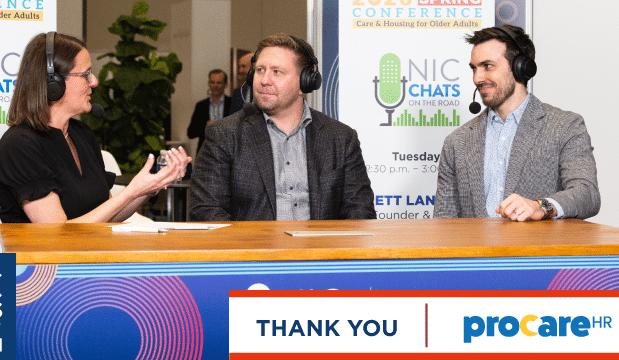
Live from the NIC Spring Conference in Nashville, this episode of NIC Chats brings together Procare HR founder and CEO, Brett Landrum, and Go Icon CEO, Ryan Galea, to explore how aligning staff and resident engagement can transform outcomes in senior living communities. Host Lisa McCracken, NIC’s head of research & analytics, moderates a candid conversation about rethinking turnover as an engagement challenge, the power of real-time data, and the promise of connecting the employee and resident journey on a single platform.
- Learn how Procare HR’s tech-enabled HR services and Go Icon’s engagement and communication tools have the potential to work together to boost employee sentiment, increase “engagement density,” and directly link the staff experience to resident and family satisfaction.
- Hear why traditional, twice-a-year surveys fall short and how pulse surveys, multi-channel feedback, and gamified recognition apps can support daily, incremental improvements at the community level.
Want to join the conversation? Follow NIC on LinkedIn.
View transcript
Lisa McCracken: Good afternoon everyone. Welcome live to the NIC Chats podcast On the Road at the NIC Spring Conference in Nashville. I'm Lisa McCracken. I'm the head of research and analytics with NIC, and I'm so excited that you're tuned into us here this afternoon.
So I am very excited to have back, for I was counting number six. We've got our sponsor today. It's ProCare HR, and I've got beside me here, the founder and CEO Brett Landrum. And we also have Ryan Galea, who's our friend here today with Go Icon. We're gonna talk a little bit about how their two organizations partnered to bring forth great services and solutions to all of you, but, thanks for being here again.
We've been doing this for some time, for quite a few conferences and, super excited to have you sponsor this with us and excited to dive into conversation. Before we do that, not everybody might know who ProCare HR is, so just take a step back and give the little one on one elevator speech and let everyone know who you are and what the organization does. And we'll do the same with you then, Ryan, too.
Brett Landrum: Yeah, absolutely. Brett Landrum, CEO of ProCare HR. We're an HR services company. Really the vision for the organization is how do we really galvanize all of our resources and the HR function to drive, better quality of care, financial performance, resident satisfaction and growth within senior care.
And really not, transitioning out of and evolving out of HR being just a function that we have to do because we have employees, but how do we really connect the work that we do and can do and should be doing to the outcomes that ultimately operators are looking for.
Lisa McCracken: And I would say over the six times that we've talked at these conferences, it's been nice to see your company just grow and evolve.
And before we wrap up here today, I'm going to ask what's next? Where you're going? Because you always have a vision for the company, but for all one of your strategic partners here, obviously you don't do it alone when you're going in with the communities and so forth. So Ryan, I'm going to ask you to introduce yourself and talk a little bit about who Go Icon is too.
Ryan Galea: Absolutely. Thanks for having me. So Ryan Galea, the CEO at Go Icon. We are a resident, family and staff engagement and communication platform. We serve just over 2000 communities throughout the US and Canada. Really with one singular goal, and that's to help our communities deliver a phenomenal experience to everyone involved in that aging experience.
Lisa McCracken: Fantastic. Okay, so in that background, you obviously heard you are heavily on the staff side of things. You offer obviously some staffing solutions, but heavily on the resident engagement side, the family member side of things. Those are not mutually exclusive entities and parties and obviously, there's the intersection between the two of them and I think that's what brings, the two of you aligning in terms of, where are some of the solutions that you bring to the table, the services and solutions you bring to your clients and so forth.
Saying, where can we together, bring those forth together. So where do you see the intersection between the staff side of things? And the resident side of things. I'm going to let you go first and then Ryan will like you to comment too.
Brett Landrum: So Ryan and I have been talking about this for about, 12 or 18 months and truthfully when we first started talking, I was like, I just, I don't see, not that I don't see the connection between, employee staff and the outcomes we can achieve there and outcomes for residents.
But I didn't really see how, like the software platform, I didn't really understand all that it did. And also just, it was just very conceptually hard for me to wrap my head around. But as we started like digging into it and talking about it and, lots of working sessions over sodas.
What we started figuring out is that having all of the data in one platform where you're engaging, simultaneously engaging employees and engaging residents. It gives us the ability to correlate some of the outcomes a little bit more tightly than if, we had an engagement platform for employees and he had residents and we tried to get the data together, like having, he can talk a lot more intelligently about the technology side.
As we look to, have like a better machine learning overlay, his view and I would agree with it is it's a lot more powerful having it all in one place.
Lisa McCracken: Clearly a more engaged staff and a happier staff is going to trickle down to the resident side of things. So talk to me about how you see that intersection working.
Ryan Galea: I think that's well said. When we started getting into employee engagement about two and a half years ago, it was based on the data we had seen very clearly.
We'd always track satisfaction data. Both actually on the staff and the resident side for the longest time. And it was very clear in the correlations that, again, happier staff equals happier residents. And so we felt of the areas in the business that we could influence. That was one we felt armed to actually do so with. And so we started looking into employee technology and actually our product had been used by communities off label. In an employee engagement sense already. So it was a very natural transition for us to start investing in building out actual dedicated products to target that audience.
Lisa McCracken: So when you and I spoke previously, you said about wanting to connect the resident and the staff journey. That word journey has stuck in my head. What do you mean by that? From a journey standpoint?
Brett Landrum: So number one, or maybe I'll back up a little bit. One of the things that I'll highlight that as Ryan and I started talking, that we felt like this really kinda synergistic right between the two organizations was, we are a tech enabled service company. We come in, we partner with organizations, we provide services. we're not haven't been a great technology company necessarily like building our own technology, understanding how to use machine learning or AI to exchange data.
Whereas, Icon is really fantastic there. And so as we started talking, this is a long-winded way of getting back to your question. What Ryan had been telling me for a long time was like, Hey, look, we've really talked about doing services. We're not a services org or a tech company.
And I said: Hey, it'd be really great to have a partner who could build some of the technology and the employee, employee engagement and would be, particularly if we wanted to get on the resident life enrichment side, would be able to support our desires there. And as we started talking about how do we connect the employee and resident journey it was really how do you have the same technology platform?
And then also how do you start looking at a central point for services and feedback and consolidation of strategy. And then a more of a more of a tactical level really, kind of as we've thought about it. It's the biggest, the big challenge that we feel in the industry is that nobody has the data to really be able to understand what are the actions I can take and that I am taking that are going to both improve the employee engagement. And then how is that going to correlate and to what extent will it with resident engagement satisfaction like the stay, etcetera. And that's really what we're, we've been driving towards is how do we connect the dots there.
Lisa McCracken: And you've been talking about the technology data strategy for some time, and I know that's been part of your vision for sure. Talk to me about the data side of things. So how do you do it? How do you, collect this data? And then I want to spend time too talking about what do you do with the data, because I frankly think our sector can fall apart at that stage.
We can collect a lot of data, but then there's all these possibilities to do some really great work with it which, let's leave that for part two, but part one, talk to me a little bit about your process and your philosophy on collecting the data.
Ryan Galea: And I bucket it into two categories. The first is what I would call more of the active feedback type data. So surveys is one great proven tool to do that. And so regular surveys not, we'll do long form, but we find more pulse style is a lot more effective catching people when they're having that thought. And to do that effectively, a lot of it is around distribution. So knowing your audience, being multi-channel, being able to meet them where they're most comfortable. So whether that's phone calls, text, email, in person, supporting all of that. And so we get a ton of data that way, and I think that's great. It tends to be slightly lagging just given the nature of it, and so it's then pairing that with kind of product interaction data and seeing the actual engagement that's happening in the product, what people are saying.
And when we designed features, we have that in the back of our mind of how can we design features to actually capture more of that interaction so we can be in the flow of conversation. And basically identify opportunities for real time intervention. Resident, we've done that in a ton of ways. We manage everything that's nonclinical. We have data on that and have a lot of it.
On the staff side, more new into that foray. But, through the employee engagement app we've built, that has a social gamified element to it. We're able to, it's a newer product, but we're able to actually see real time, the interactions that staff are having, stuff that otherwise might be happening over the water cooler, we're able to at least get it into the platform and capture some information around it.
Lisa McCracken: Can you gimme an example of what that looks like? Talk me through that a little bit.
Ryan Galea: So the app in its current form. Allows, staff to collect points, those points can be redeemed for rewards that are either managed by the community. So it could be anything from lunch with the CEO. It's a cool one. It's a popular one.
Lisa McCracken: I heard you signed up for a bunch already.
Ryan Galea: We have a partnership with a kind of a fulfillment company, Amazon asks, you can actually get swag and so there's three ways of getting points. There's a staff peer to peer type. So you can do shout outs and say, Hey, kudos. I saw you did this great work.
Lisa McCracken: That's nice.
Ryan Galea: And so you start seeing that interaction and who's giving shout outs and receiving them. There's a manager to employee recognition. We call it spotlighting.
So think above and beyond, showing core values, employee of the month, you can award points through that.
And then the final piece, which is the most powerful or what we call badges. Badges is the most gamified element of it all. It's you want to collect them over time they show us locked until you even locked them in the system. And so they could be for things like, I don't know, a perfect year of attendance. And so as you get these badges over time, we're, you're actually, your points will be worth slightly more. And so it also has a retention benefit because now if you leave, you also, you lose your points, but also this benefit that you've accumulated over the time, that makes the points worth a little bit more.
So through that, through the managers giving real time performance. Because it's, otherwise you're waiting till the performance review. That's once a year.
Lisa McCracken: That's what I was going to ask you. They're necessary. But sometimes for things like this, it seems a little antiquated and it's not, I think, giving you what you need. So I love this unique approach
Ryan Galea: And turnover is so high, so you might not even get to that.
Lisa McCracken: Okay. I want to pause here for a second. Turnover. You and I had an interesting conversation with this, you've got some opinions on turnover. You think we're looking at it wrong? I'm gonna give you the stage to talk about that.
Brett Landrum: Yeah, I can soap, soap box for a while. So the industry talks about turnover, retention, and different sides of the same coin.
And really that is the completely wrong way. That's the wrong metric to be driving at.
And the reason I say that is, how we think about it is. Sentiments, are they happy? Are they sad? Are they, fulfilled? Are they not filled? And then engagement, which is are they engaged with the mission? Are they productive because they want to be and they're trying hard?
Are they put in the effort forth, etcetera. And really, when you think about the best, who are the folks that we want on our team? We want like happy, highly engaged employees, right? And part of the partnership and as we've been talking about this, it's how do we get better data and better signal on a real time, day-to-day basis to be able to raise like engagement density in the organization.
It's if we talk about talent density, and I really, and that's a component of it, but when you're talking about, I'll say this, retention as topic we really feel that the business results are going to come from having, happy employees who are highly engaged with the mission and the work and the residents.
Lisa McCracken: I'm seeing like this meter, this engagement meter and so forth. So which brings to the data conversation. Okay, so great. You've got this data that you're collecting, you've got this, data rich warehouse on staff, residents. What do you do with it? That's an important piece.
Brett Landrum: It's to what Ryan was talking about where today most operators and it's because of lack of systems, technology, data, we're what we end up doing is we have, maybe we survey people 30 days, 90 days. Two or three, two to four times a year. And typically it's twice a year and we get this data, and by the way, it's one point in time.
It could be sentiment based upon, its cold out and people are upset about the snow or the benefits or whatever the thing might be. So it's one point in time, but we end up because of that, we end up really like generalizing like a handful of data points and then we have to synthesize what do we actually do with it?
We create these big Graham plans with really long tails. We're like, do they, do we really get. Do really, do they really have an impact? Oh, and then when we start measuring it, we do the next survey and we change course again. And so what we feel that Icon has built is a platform that allows us to make incremental improvements every day.
And the idea would be how do you action something at the individual manager level, at the individual community, at the individual department, and with all of your different leaders and managers actioning, taking small actions every day you have this compounding effect. That is much more powerful than a big generalized plan of: Hey, this is how we're going to, this is how we're going to reduce turnover or get people to be engaged, or whatever it might be.
Lisa McCracken: Yeah, that real time data and timely data, I think we hear that over and over again. It is incredibly important, particularly for that action because if you're not working on it, the staff is gone, the family member's unhappy, whatever it may be. Do you run into any practical, I'm looking at you here, Ryan, any into practical challenges? Sometimes collecting the data?
Ryan Galea: I think in practice it's an expensive way to do it. We have all these different channels. And that has allowed us to get around that .
Lisa McCracken: You said meet them where they are.
Ryan Galea: But it means because of that we have to be able to survey 10 different ways.
So it is a big lift to have that infrastructure all set up. But it, in this industry, it's necessary.
Lisa McCracken: Do you, have you evolved any of the data collection? You talked about an app, so is that commonplace for staff these days? I feel like I'm hearing more and more about it and I'm curious to know the adoption of employees in terms of utilizing the app and like the rewards and recognition thing.
Ryan Galea: So it's really interesting. So the employee apps new. It's in pilot, real time feedback, but our resident app, which was not built for this use case, has been purchased by, I think now we're in probably about 15 customers all on their own, independent of each other who are like, we want to use that as an employee app.
And so it's not meant for that. And that was before this other app came out, but they're already using it for that use case.
Lisa McCracken: That's why I'm asking 'cause I feel like I, I hear a lot about the, demand and the need for it because I think there's often a communication challenge sometimes with getting out, with the staff and so forth.
So we obviously we've got some operator, a lot of operators here at the conference and so forth. So if they're listening to this conversation, I'm thinking about this, your boots on the ground, helping them often, with their staffing issues and so forth, what do you most want them to take away from this?
What do you want most want them to hear?
Brett Landrum: It's the question you asked on how we think about, I think how we frame the problem is really important to, like how as an industry we solve it. It like we need to, as an industry, operators, vendors, everybody we need to be, we know workforces is challenge.
We need to be pressing really hard to say, what are the things that we can do to stop framing as we have a retention and turnover problem. And frame it as, hey, we have an engagement problem, and what is the data and the signals collection mechanisms that we have available to us to change the frame for the problem, like I go to 20 conferences of a year, and I have for 10 years. And the same conversation happens every single year at every single conference, which is, workforce is a problem. It's gonna be more of a problem in the future.
So on and so forth. But because we continue in my mind of frame the problem and the potential solutions incorrectly. We don't ever make progress towards solving it.
Lisa McCracken: I think, and we haven't even talked about the recruitment side of things, which I would like to get your perspective on that, I think sometimes we spin our wheels, we do all this work on the recruitment side of things, but it's like the back door's open. And the turnover just can, I know I'm using the turnover, but the turnover because of, I think a lack of engagement. I'll attribute it to that for this conversation. I don't think that we're learning the lesson at this, the pace that we need to.
Brett Landrum: So I do this all the time I soapbox and then we're so programmed to say turnover is a problem. And it's no, like turnover, turnover of disengaged. Employees is healthy.
Lisa McCracken: So what is it we're doing wrong? What, is it?
Brett Landrum: My view is we don't have the data. Like what we don't have is the, hability, a few pieces.
Lisa McCracken: So we, as the industry, all of you obviously you're working on, but like we as the industry are two weak on the data, and two weak on acting on it.
Brett Landrum: We have to have, figure out what is the mechanism to have the data understand what our kind of, again, engagement density or quotient or whatever is in the organization. And then the follow on to that is how do we then execute to it?
Lisa McCracken: So do you think we don't know what makes an employee engaged or do you we just maybe don't have enough time to fully have our pulse on it?
Brett Landrum: I think it's both. Like we live like ProCare. we live and breathe HR every day. we have ideas, and we have some theories, but I don't know that we have. I don't know that we have crystal clear yet on, this is these are the different inputs we need to triangulate to really understand if somebody's engaged.
I think we have some of it. Some of it is intuitive, some of it is a little bit theory right now, and there's probably some dimensions we haven't really considered.
Lisa McCracken: You know what would be so great? I'm like coming up with ideas for all of you. If you could come up with a, if you could say, if you could move staff engagement by X percent, we can, we feel like you can move resident engage, that's resident satisfaction by x, y, z percent.
That's like the golden ticket, right?
Brett Landrum: That's what we're hoping for.
Lisa McCracken: Because we know anecdotally, I mean you talk to families. You talk to residents that are frustrated because they see a different face or they see staff that are burnout or frustrated or appear disengaged.
I mean that, that predictive would be absolutely fantastic if you can really draw that strong data correlation on that front and be able to say, we know if you move the needle by this on this front, we're highly confident that it will go up by this much on the resident side of things.
Brett Landrum: And I think as an input as well, it's. What are the activities that are actually working?
Lisa McCracken: Correct.
Brett Landrum: Okay. We did these three things. We did some AB testing. this particular activity had this improvement on employee engagement, which went to resident engagement. Hey, this one good idea, didn't really work.
So we need to figure out how to use technology better to just really dissect and understand this whole kinda employee engagement problem.
Lisa McCracken: And to me, I would think it's empowering your community level leadership and giving them the tools that they need of here's the levers you pull.
Brett Landrum: Yeah.
Lisa McCracken: And the levers you pull maybe now with the staff that you have. To me this is incredibly exciting and I think, you're right that the data can be so incredibly powerful, but, that's sometime where we don't have the data or we don't do what's right with the data.
Brett Landrum: We don't execute. We see that with our labor management where, we first started the function, we provided lots of really in depth excellent data to and we weren't getting results. And a large reason is every leader interprets the data differently, they're busy, they have 10 things coming at 'em. And so what we found is when we put a framework of kind of execution and planning and accountability in place with our team and the clients. Suddenly that data really did work. But it worked because there was action, there was a clear framework of action and execution, against the data.
Lisa McCracken: So it's measurement, it's the very active, asking people these questions, I think show engagement in and of itself, but then it's giving, I think the leadership, the tools and the information that they need to do their job best to provide the best quality of care. Other things that you wanna highlight, stuff that's going on at ProCare or things. You guys are always moving and shaking and we got a few minutes left. You guys I know are here and a lot of meetings, other stuff you want to highlight?
Brett Landrum: I think the one area that both Ryan and I are really excited about is we're working on, and Ryan's helping, ProCare really think through trying to bring a resident engagement, life enrichment type service to market.
Obviously, we would be providing services on Go Icon's platform, but, I, Ryan, you can talk a little bit about that. It's really been his brainchild. But that's something that we're, really excited about getting tooled up.
Ryan Galea: We've been thinking about it for a while and to what Brett was saying, services are not our expertise, and so this partnership there makes perfect sense because we get constant questions from communities. How can we do better? Could you support us? Could you take more of an active role?
The challenges it's a wide set of stuff that the communities need assistance with. And it's trying to figure out what that actual scope is and making it manageable. But we've seen increasingly even communities, especially cc's life plans. Hiring a dedicated kind of, tech resident, tech expert type person.
I love that. Who owns our app for the community?
Lisa McCracken: Love that.
Ryan Galea: And could we do something like that? Could we take on managing more of the platform? We have a lot of ideas. It's now refining them to something that could be packaged and offered.
Lisa McCracken: There's so many possibilities with that. You've got a great tool and, as someone recently said, with different platforms like you have, it's what are your active ingredients and your core of what you offer. In our final minute or two, anything, you want to wrap up here with final comments.
You want to parting words of wisdom as it relates to ProCare and. share with others as we wrap up here.
Brett Landrum: I don't know that I have the requisite, knowledge for words of wisdom.
Lisa McCracken: What are we going to be talking about in episode? Okay, so we, this was episode six, episode 10, Brett, I'm trying to do the math here quickly of what year that we'll be, but, you know what's next?
You're always thinking beyond that.
Brett Landrum: I think there's so much work to do on, tying the employee and resident journey together that, it's, I've got other ideas, but I'm fairly focused, on cracking this one.
Because again, to the comment, the conversation that we've had, it's just the employee engagement is, it just, it ties into every outcome operators want to achieve. it's just. It's this nebulous thing that we can't really measure and we don't know what the action, we don't know what actions work.
I would say if we have cracked that code four or five episodes from now, I would be thrilled.
Lisa McCracken: So we're going to come back and we're going to have that data point, right? Of we've been able to show if you can increase staff engagement by this much, their resident and family member. Satisfaction's gonna go up, right?
Ryan Galea: Yeah.
Brett Landrum: That's the goal.
Lisa McCracken: Is that a promise?
Brett Landrum: That's the goal. That's his promise.
Lisa McCracken: This is live heard it, right everybody. We've got a bunch of witnesses here this is fantastic. Congratulations with your ongoing success. It's been really fun to continue to talk with you guys and it's great seeing you.
You grow as well. And I think this you. Alignment of the staff and the resident makes fantastic sense. And I know you guys are both around here till the end till tomorrow. Check these guys out. So appreciate all of you listening again here at the NIC Chats podcast. And you can check out other episodes of the podcast at nic.org.
Enjoy the rest of the conference here in Nashville.