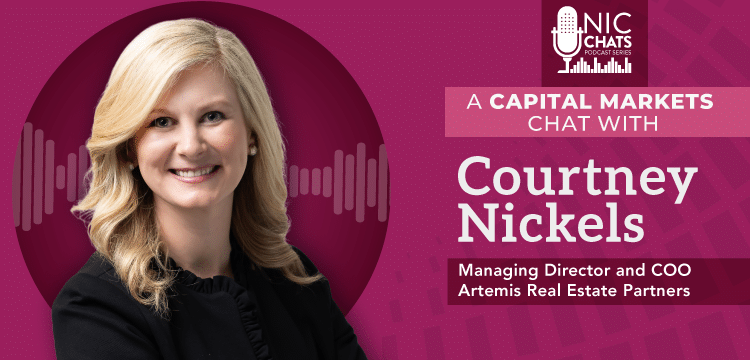
Host Lisa McCracken welcomes Courtney Nickels, managing director and COO of healthcare at Artemis Real Estate Partners, for a candid conversation about why senior housing is now center stage for investors heading into 2026. Drawing on her career-long focus in healthcare real estate, Nickels discusses how accelerating demand and historically low new supply are driving strong rent growth, occupancy above pre-COVID levels, and expectations for continued double-digit NOI growth—even as labor remains the top headwind to watch.
The discussion also explores the wave of new equity and debt capital coming into seniors housing, rising competition for deals, and what it takes to succeed in an operationally complex, local, and people-centric business. Nickels outlines Artemis’ disciplined, scalable strategy across the capital stack and care continuum—from active adult through assisted living and memory care—with an emphasis on private-pay, continuum of care communities, strong local and regional operator partnerships, selective development, and maintaining appropriate risk-adjusted returns in what she believes will be a defining year for the sector.
Want to join the conversation? Follow NIC on LinkedIn.
View transcript
Lisa McCracken: Welcome everyone to this episode of the NIC Chats podcast. My name is Lisa McCracken.
I'm the head of research with NIC, and I am joined here today by Courtney Nickels. She is the managing director and COO of healthcare with Artemis Real Estate Partners. Welcome, Courtney.
Courtney Nickels: Thank you. Good afternoon. I really appreciate you having me today, Lisa.
Lisa McCracken: Yeah. Super excited to have you here and we're gonna talk about a bunch of fun stuff, but I would love for you to give a little bit of background on Artemis so people know who you are and a little bit about the firm. And I think that'll give good background as we dive into our conversation.
Courtney Nickels: Okay, great. Absolutely. Again, my name is Courtney Nickels. I'm based in Atlanta, Georgia, where I live with my husband and my three children. I've been working in real estate on the private equity side for my entire career.
Early on in my career, I was introduced to the healthcare space and it was a space I was immediately drawn to and really, healthcare has been my focus ever since. Throughout my career, I've had the opportunity to invest across the healthcare space from senior housing and active adult, which we'll be talking about today, to skilled nursing medical office, as well as other niche healthcare property types and healthcare operating businesses.
I'm currently managing director and COO of healthcare at Artemis Real Estate Partners, where I oversee strategy, performance, and growth across our healthcare platform. We're one of the largest healthcare real estate investors in the country, and our focus is on building a disciplined, specialized, and scalable business that can invest thoughtfully across real estate cycles and across the capital stack.
Artemis is actively investing in senior housing and has been doing so since its inception.
Lisa McCracken: I love the broad-based background that you have across a number of the different healthcare verticals and so forth. So I think the senior housing and care space is such a niche sector so I love your perspective and we'll dive into some of that.
And I wanna thank you too. You've been a faithful NIC volunteer and been very engaged with NIC over the years. Appreciate your involvement. And I think you were an FLC-er and on some NIC committees and been on some NIC panels.
Courtney Nickels: That's right. Yes. I've had the pleasure of being very involved with NIC as a volunteer leader in several capacities.
And I have the fondest memories of my time on FLC. I was also on the DEI committee for a period. Now I'm on the fall conference planning committee and always enjoy the opportunity, whether it's a bootcamp or a panel or now a podcast to...
Lisa McCracken: yeah,
Courtney Nickels: ...be able to work with NIC and I'm excited to share some insights with you and your listeners today.
So thank you again for having me.
Lisa McCracken: Yeah. Again, thank you. For those of you who don't know, we put our volunteers to work. They are not seat warmers, so thank you. Okay, I wanna start off with I think what is collectively pretty positive momentum right now in our sector. And, some people use the term bullish just in terms of the outlook and, do you agree with this, disagree with this, or any caution with the current high level of optimism? How are you guys seeing the sector right now?
Courtney Nickels: You're right. I think this is certainly what everyone in the industry is talking about right now, and it's a great question.
I do believe that the optimism in the sector is well founded right now. The silver tsunami, which is something I remember talking about at the very beginning of my career in healthcare. It was always...
Lisa McCracken: I feel like we’ve talked about it forever.
Courtney Nickels: Yeah, it's here. Yeah, it's forever and now it's here. And that 80 plus population is accelerating and we're seeing that translate into real demand. And that's expected to only continue.
And then at the same time, supply growth is below 1% of inventory, which is historically very low. So you combine accelerating demand with constrained supply and I just think the magnitude of the opportunity set in senior housing is significant. And senior housing is undeniably one of the most attractive opportunities in real estate in the United States today.
And the data that NIC produces supports that, the performance of our portfolio supports that, and, we're seeing rent growth above historical norms. We have been for a couple of years now. We're expecting that to continue for a couple of years and with occupancy beyond pre-COVID levels, all of these things together are really a driving force behind projected double digit NOI growth over the next few years.
It's certainly optimistic. I think it's well founded and we're continuing to expand our investment portfolio in senior housing and generally in the healthcare sector in a disciplined manner, of course. But these supply demand dynamics and the long-term growth opportunities are exceptional.
Lisa McCracken: It's interesting for this, what I'll say, tinier niche sector for many years, which wasn't necessarily on the radar of a number of investors now. as our co-founder Bob Kramer likes to say, we're center stage in many respects. And I think certain things like the NCREIF returns and so forth have really gotten the attention of a lot of folks and there's been a lot of new capital coming into the sector. There's a lot of conversation around that, and we know that we need the capital investment really in our space again, to, meet that. We're gonna talk a little bit about development in a little bit. You already mentioned the data around some of the low, new inventory coming onto the market.
So we need that investment in our space to meet the growing demand. So the flow is good. There can be some downsides with the capital and then I know, so there's some folks that say it's a good thing, but there can be some cautionary elements to it. So I'd love your thoughts around that. Are there any sort of nuances or things that we need to think about related to that new capital?
Are there any missteps that they could take these days or things that they need to think about to set themselves up for? I think success moving forward in the years ahead as they think about their investments.
Courtney Nickels: Yes, there is definitely meaningful new capital entering the space, which I agree, is healthy and is a positive tailwind for the industry.
And you're exactly right, senior housing is nuanced. Historically, capital flows I've seen in healthcare have been cyclical and in senior housing because of the unique risks. And most recently because of COVID, which was a black swan event for the industry. And the trend I'm seeing right now is that capital is coming back into the industry in a big way.
The availability of debt capital has dramatically increased. And many equity investors are entering or are reentering the space post COVID and the senior housing industry is getting the attention of some of the largest real estate investment companies in the country. And meanwhile, the public REITs are extremely active, specifically in seniors housing.
So I think new entrants in the space, and of course longstanding investors as well, have to remain cognizant that seniors housing is a local business and it's operationally complex. That can't be underestimated. And it's certainly no secret either, but it's just an important thing to reinforce.
One of the things I'm proud of at our firm is our track record, the fact that we have a geographically diverse network of operating partners. We have over 120 operating partners across our firm
Lisa McCracken: Wow.
Courtney Nickels: Across all of our sectors of investment. And we invest across all major commercial real estate property types. But within senior housing we partner primarily with local or regional operators. And we believe those operators can attract and retain the best talent, staff the properties efficiently and effectively, which then results in consistent quality care for the residents.
It's just very much a leadership and people centric business, and we believe that directly translates to financial outcomes. And we think we're well positioned there. We have an in-house operational expertise and and that's part of our way of, we think properly assessing and managing that operational risk.
Lisa McCracken: I think we hear over and over again about the importance of that alignment between the capital partner and the operator. And, I think on your end, the ability to find quality operators and on the operator side the ability to find a capital partner that has similar goals as yours and, I think that it sounds like you, have a real clear philosophy in terms of where you see a success. You mentioned that, knowing operators that succeed in certain regions and certain markets is incredibly important to you in terms of how you select your operating partners.
Courtney Nickels: That's right. It's not a one size fits all business. We do spend a lot of time trying to appropriately match the right property or investment with the right operator.
Lisa McCracken: Okay, we've been talking about a lot of things that are pretty rosy right now and things are great and so forth. I think there are still some headwinds, I'm gonna say the whole labor thing, workforce.
And although we generally are seeing, and, the data supporting this, that I think the volatility is not what it was a couple years ago. Certainly not at the height of the pandemic or even coming out of it, but yet, are there as you monitor, obviously the performance of your portfolios and so forth.
So we're gonna talk about some sector headwinds labor expense pressures. So would love for you to talk a little bit about that. We know things are great in terms of, we got a lot of tailwinds and things are pretty rosy and so forth, but I think there's still some of those lingering things.
I would love for you to comment about what you're seeing in your portfolio.
Courtney Nickels: Sure. I think you, you really touched on it. If I had to say the one headwind that really is mostly on my radar right now, it would be labor. That to me is really the one to watch. In fact, just this week I got together in Atlanta with some colleagues in the industry and we were sharing thoughts on what's going on in the space. And labor was one of the biggest, if not the biggest topic of conversation. I think conditions for labor have really improved where wage growth in seniors housing has moderated, and right now it's at a good inflationary level. But we, I think it's important we remain disciplined in how we project labor costs and availability longer term.
So we're tracking the rising demand for healthcare services broadly just due to the continued aging population, outsized retirements, national policy impacts, so on and so forth, things that may affect labor availability in healthcare over more of the intermediate term. But one mitigant, I think, to the potential labor headwind, is the fact that affordability metrics have meaningfully improved for our sector over the past few years, and the data has shown it. When you compare the cost of senior housing to aging at home with full-time care, the value proposition of seniors housing is much stronger I think, than people often realize.
Lisa McCracken: Yeah. We've obviously done a lot of research on the middle market and so forth and even that, which, that can be a constrained group on the affordability. We've done some research that sometimes just the staying at home is not really a plan either. And it can be very costly, to stay at home and pay out of pocket for that care.
So it's, there can be some headwinds, but it sounds like things are a little bit more manageable but you gotta be smart with projecting out with some of that stuff too. Exactly. Okay. So one of the other things that we hear, it's very competitive out there right now for deals.
Are you feeling it? Are you observing that right now?
Courtney Nickels: We are, I'm observing that we are in an increasingly competitive environment for seniors housing deals right now, transaction volume is up, but with that increased capital in the space and the strong fundamentals we just talked about, so is competition.
And anecdotally, I've heard from the brokers that for most broadly marketed senior housing processes. They said bid counts are up 2x from last year. So while I think it's still a good time to be a buyer, it's also a good time to be a seller in senior housing, and I think we'll see high transaction volume in 2026.
I think for us, to differentiate ourselves, remain competitive we do have the ability to pivot across the capital stack with our investments.
And so for some things, maybe equity investment offers the best risk adjusted return. In other situations, maybe a structured investment or debt position may provide better downside protection. So right now I think it's just imperative that we stay diligent and measured in this increasingly competitive environment and make sure we're obviously achieving appropriate risk adjusted returns for each of our investments.
But overall, I think those with scale and experience and capital are definitely well poised in 2026 in the transaction market.
Lisa McCracken: Yeah, so can you talk a little bit about your investment profile and obviously every investors a little different here. You mentioned a wide range earlier in your introduction.
Everything from active adult to skilled nursing to, independent, assisted. And do you have a certain property type? Full continuum. Do you have a certain geographic region, primary markets? Do you do turnarounds? I would, do you have a typical profile that you'd like to just share with us?
Courtney Nickels: Sure. Broadly, Artemis’ healthcare strategy is to capitalize on the opportunities driven by that aging population and the increased healthcare spending and overall push to move care delivery to the lowest cost of care setting. So we do invest broadly across the healthcare spectrum and across the capital stack as I just mentioned. Within senior housing specifically, we invest across the continuum. Active adult, independent living, assisted living, and memory care, and we invest in the private pay portion of the sector. We generally avoid taking direct to government reimbursement risk. Right now I'd say we're focused heavily on continuum of care communities that provide multiple levels of care within the same property because they provide stability where a resident can age in place that increases length of stay and therefore occupancy durability.
But oftentimes there are opportunities to add value, whether it's through CapEx investment or expansion, other operational improvements, or even sometimes a manager change. So we do that, and our in-house operating team has added significant value at the asset level through hands-on asset management and also of course, collaborating with our operators.
Lisa McCracken: Kudos to you for venturing into the active adult space. There's a number that still haven't quite figured that out. We know that's definitely a growing and emerging property type and we think that there's a lot of momentum behind that. So that's exciting to hear that you're in that investment space as well.
Courtney Nickels: We are, yes, we view it as part of that spectrum of seniors housing that meets a certain meets a demand of a certain customer type.
Lisa McCracken: Yeah. Okay. We talked about it earlier. We are definitely in a development drought, so I didn't hear you mention that when you talked about your current investment profile and so forth, but, is it on your radar at all where, we feel like we know some development's happening of course, but and we feel like we're hearing people talk about it.
I think there's some intention there. There's always the question of when are we gonna turn the corner? I'd love your thoughts on that.
Courtney Nickels: Sure. Development has always been a minority portion of Artemis investment strategy. Prior to COVID, the senior housing market became oversupplied due to a high level of development.
But since then, as we've talked about, supply growth has declined dramatically and remained low. I think some in the industry definitely expected development to have picked up again, or at least more by now. Our view has been that it's just been more attractive to buy than to build in today's market.
But that said, we continue to monitor development opportunities and we will selectively pursue developments that are in strong markets with our preferred operators as we've historically done. Green Street projecting, and we tend to agreehat supply growth will ramp up over the near-to-intermediate term as development economics improve.
But I think while permits and starts may tick up, development takes time. So from groundbreaking to stabilization of a property, that's typically several years. And overall, I don't anticipate a meaningful near term or intermediate term impact on market supply or occupancy levels because of that.
Lisa McCracken: Yeah, no doubt.
Even if we start to turn the corner, it's been, it's gonna be a number of years till we really see any meaningful impact on the supply. So it's just fascinating times. As we said, earlier on, we've been talking forever about this, wave of the baby boomers and they're here. But it's just also interesting times with the supply demand dynamic that's going on.
Before we wrap up, I would love any final comments from you regarding just any of your predictions for senior housing capital and investment activity here in the year ahead. Any final insights that you'd love to share with us?
Courtney Nickels: I'm excited for 2026. I think it's going to be a defining year for our sector. I think this is both from a capital perspective, but also just from a perspective of the strength of the fundamentals. And looking back at 2025, I think there was definitely a rapid evolution on the capital markets side.
And as that capital accelerates into seniors housing, I think the landscape will continue to change and I think probably change more quickly than we've seen historically. So I think what's great is we're likely to see continued institutionalization of the space, which is wonderful for the industry. And for us, I think the focus remains the same.
We're going to remain disciplined in our deployment and our execution. And I just think 2026 is gonna be a big year.
Lisa McCracken: Yeah. I think we're excited to all be a part of the industry. These are exciting times for sure. Thank you Courtney, for your time. We appreciate it today and again for your ongoing support of NIC.
And thank you all for listening here. And we encourage you to check out, additional NIC Chats podcast at on the NIC website at nic.org. Wherever you tap into podcasts at Spotify or additional outlets. So thanks again, Courtney, for being with us today.
Courtney Nickels: Thanks for having me, Lisa.