Third Quarter 2023 Senior Housing Posts Negative Total Return

The senior housing sector posted a total return of -1.15% in the third quarter of 2023, down from a positive total return of 0.48% in the prior quarter. Short-term total returns for senior housing slightly outperformed the broader NPI, which posted a total return of -1.37% in the third quarter. Positive income returns for senior housing were outweighed by negative appreciation, driving negative total returns for the quarter. The broader NPI in the third quarter posted a similar performance, with negative appreciation more than offsetting positive income returns.

NCREIF Performance Report Q3 2023 

The senior housing sector posted a total return of -1.15% in the third quarter of 2023, down from a positive total return of 0.48% in the prior quarter. Short-term total returns for senior housing slightly outperformed the broader NPI, which posted a total return of -1.37% in the third quarter. Positive income returns for senior housing were outweighed by negative appreciation, driving negative total returns for the quarter. The broader NPI in the third quarter posted a similar performance, with negative appreciation more than offsetting positive income returns. 

The senior housing income return in the third quarter was 0.99%, in line with the apartment sector (0.99%) and stronger than the industrial sector (0.88%), but below the overall NPI (1.07%). The senior housing appreciation (capital/valuation) return was negative for the fifth consecutive quarter at -2.13%, the lowest appreciation return since the second quarter of 2020, but slightly better than the apartment sector’s appreciation return of -2.40%. Overall, current economic and capital market conditions drove negative appreciation returns in all sectors. Further, many investors have reduced their appreciation expectations for senior housing as the sector has not yet recovered to its pre-pandemic occupancy rate. The appreciation return is the change in value net of any capital expenditure incurred during the quarter.   

On a longer-term basis, the 8.70% annualized ten-year return for senior housing was the strongest of the main property types, except for industrial (14.80%), and outperformed the NPI ten-year annualized total return of 7.40%. Income returns for senior housing (5.03%) surpassed the NPI (4.58%), as did the appreciation return (3.56% vs 2.73%). 

The performance measurements cited above for senior housing reflect the returns of 214 senior housing properties valued at $11.39 billion in the third quarter. This was the highest property count in the NCREIF time series for senior housing, while market value was down slightly from a high of $11.47 billion in the prior quarter due to negative appreciation returns in the third quarter. It is notable that the number of properties tracked by this index has grown significantly since the beginning of the pandemic, up from 134 properties in the first quarter of 2020 that were valued at $6.3 billion. The additional properties may be influencing the overall performance returns of the index. 

Third quarter 2023 market fundamentals data for senior housing showed a continued recovery in senior housing occupancy rates in the 31 Primary Markets, according to NIC MAP® data powered by NIC MAP Vision, as demand for senior housing units outpaced new supply during the third quarter. As a result, the occupancy rate for senior housing stood at 84.4%, up 0.8 percentage points from the prior quarter and 6.6 percentage points from its low point, but still 2.7 percentage points below its pre-pandemic level of 87.1% in the first quarter of 2020. Overall, the relatively steady improvement in market fundamentals against a backdrop of significant volatility in other parts of the economy illustrates the needs-driven demand among older adults for housing and care that the senior housing industry continues to meet. 

tables-01

Picture1-Dec-13-2023-03-12-47-4562-PM

Source: Third Quarter 2023 NCREIF Performance Report, NIC Analytics

Senior Housing Stabilized Occupancy Will Soon Mark Tenth Quarter of Positive Growth

Senior housing stabilized occupancy will soon mark its tenth quarter of positive growth, the longest period of uninterrupted gains since NIC and NIC MAP Vision began reporting the data in 2005.

  • Senior housing stabilized occupancy will soon mark its tenth quarter of positive growth, the longest period of uninterrupted gains since NIC and NIC MAP Vision began reporting the data in 2005. 
  • Compared to pre-pandemic times, the year-over-year inventory growth has remained relatively modest, with rates for independent living hovering around 1.0% to 1.7% since October 2021 and for AL since June 2022. This subdued pace is partly due to fewer construction starts and extended durations of project deliveries in recent years.  

According to intra-quarterly NIC MAP® data released by NIC MAP Vision, the senior housing stabilized occupancy rate for the NIC MAP Primary Markets increased to 86.1% in the November 2023 reporting period, up 0.1 percentage points (pps) from October 2023 and 0.6pps from September 2023, on three-month rolling basis. From its pandemic record low of 80.2% in June 2021, senior housing stabilized occupancy increased by 5.9pps but remained 3.2pps below pre-pandemic March 2020 levels of 89.3%.  

By Majority Property Type. At 87.4%, the stabilized occupancy rate for majority independent living (IL) properties for the NIC MAP Primary Markets increased by 0.2pps from October 2023 and 0.5pps from September 2023, on a three-month rolling basis, but remained 3.7pps below March 2020 levels. For majority assisted living properties (AL), the stabilized occupancy rate for the NIC MAP Primary Markets was up 0.1pps to 84.8% from October 2023 and 0.7pps from September 2023 but still 2.5pps below March 2020 levels.   

Inventory Growth. From year-earlier levels, the inventory of IL in the NIC MAP Primary Markets increased by 1.4% or 5,023 units in the November 2023 reporting period, 0.3pps lower than that of AL (1.7%).  

Compared to pre-pandemic times, the year-over-year inventory growth has remained relatively modest, with rates for IL hovering around 1.0% to 1.7% since October 2021 and for AL since June 2022. This subdued pace is partly due to fewer construction starts and extended durations of project deliveries in recent years.  

Untitled

Stabilized Occupancy Recovery Across Select Metropolitan Markets.The stabilized occupancy rate for majority independent living properties increased or remained stable in 24 of the 31 Primary Markets in the November 2023 reporting period compared with October 2023. At 88.7%, Portland independent living stabilized occupancy saw the largest increase, up 0.9pps from October 2023. Cincinnati independent living stabilized occupancy fell by 1.2pps in November 2023 to 86.6%, marking the largest decline from October 2023.  

In November 2023, Boston, Baltimore, Minneapolis, Pittsburgh, San Jose, and Washington, DC reported relatively higher IL stabilized occupancy rates – at or exceeding the 90.0% mark.  

For majority assisted living properties, the stabilized occupancy rate increased or remained stable in 26 of the 31 Primary Markets in November 2023. At 84.2%, Seattle assisted living stabilized occupancy saw the largest increase, up 1.0pps from October 2023. The AL stabilized occupancy rate in Chicago had the largest decline and fell 1.3pps from October 2023 to 82.4%.  

Portland and Tampa reported the highest AL stabilized occupancy rates among the Primary Markets at 90.6% and 90.0%, respectively.  

Keep track of the timely review of the sector’s market fundamentals and trends. The NIC Intra-Quarterly Snapshot monthly publication, available for complimentary download on our website, continues to provide a powerful and closely watched means to stay ahead of industry trends.  

The December 2023 Intra-Quarterly Snapshot report will be released on our website on Thursday, January 4, 2024, at 4:30 pm.    

Interested in learning more about NIC MAP Intra-Quarterly data? To learn more about NIC MAP Vision data, schedule a meeting with a product expert today.   

Senior Housing & Care’s Middle Market: Key Takeaways From Housing for America’s Older Adults 2023

The Housing for America’s Older Adults 2023 report includes a special analysis on the middle-market older adult. See key takeaways.

This year’s Housing for America’s Older Adults report, produced by the Joint Center for Housing Studies of Harvard University and supported with funding from NIC, includes a special, independent analysis on the middle-market older adult. It underscores that the private and public sectors still have work to do to expand housing access and care choices for middle-income older adults as they age.

  • Harvard researchers revealed that only 14% of single-person households 75+ with moderate (middle) income can afford just four hours daily of in-home care, and only 13% can afford a move into an assisted living community relying on their monthly income only. Conventional wisdom that care at home is less costly than assisted living was questioned. In certain markets where homeownership and apartment rents are among the highest in the country (e.g. San Diego), assisted living is often less costly than staying in one’s home.
  • When looking at the three key accessibility features of single-floor living, no-step entries and wide hallways and doors, less than 4% of homes nationally fit the bill. The majority of older adults with middle-market incomes do not qualify for home modifications or maintenance because of program income limits. This speaks to a market opportunity for senior housing and care where settings are naturally designed for the older adult.
  • Two other takeaways include declining homeownership among 50-64 year-olds and rising mortgage debt among homeowners 65 and older. These findings reinforce the need for affordable housing and care options and options whereby home equity is not a requirement to cover costs.

While this study has important implications for the cost of in-home care compared to assisted living, the reality is that the aging demographic will necessitate a multitude of housing and care alternatives. The middle-market older adult cohort is severely underserved. This report can help providers, policymakers and other stakeholders better appreciate that continuing to live at home or pursuing many congregate residential care options are not financially within the reach of many. To advance choices and access for seniors, the private and public sectors must continue to work together.

CCRC Performance 3Q 2023: Strong Market Fundamentals

This analysis examines occupancy and year-over-year changes in inventory and asking rent growth within CCRCs and non-CCRCs in second quarter 2023.

The following analysis examines occupancy and year-over-year changes in inventory, and same-store asking rent growth—by care segment—within CCRCs and non-CCRCs in the 99 combined NIC MAP Primary and Secondary Markets. The analysis also explores the distribution of units in CCRCs and non-CCRCs by year of opening as well as regional occupancy rates by profit status (not-for-profit CCRCs vs. for-profit CCRCs) and payment type (entrance fee CCRCs vs. rental CCRCs) during the third quarter of 2023.

NIC MAP®, powered by NIC MAP Vision, collects primary data on occupancy, asking rents, demand, inventory, and construction for about 16,200 independent living, assisted living, memory care, skilled nursing, and continuing care retirement communities (CCRCs—also referred to as life plan communities) across 140 U.S. metropolitan markets. The dataset includes more than 1,164 not-for-profit and for-profit entrance fee and rental CCRCs in these 140 combined markets, including 1,086 in the 99 combined Primary and Secondary Markets.

3Q 2023 Market Fundamentals by Care Segment – CCRCs vs. non-CCRCs

The exhibit below illustrates the relative market performance of CCRCs vs. non-CCRCs by care segment in the third quarter of 2023 and includes year-over-year changes in occupancy, inventory, and asking rent growth.


Occupancy. Overall, the occupancy rate for CCRCs continued to outpace that of non-CCRCs across all care segments. The difference in the third quarter 2023 occupancy rates between CCRCs and non-CCRCs was largest for the independent living segment (6.3pps) and the assisted living segment (4.4pps), and smallest for the nursing care segment (1.4pps).

The CCRC independent living segment had the highest occupancy (90.5%) in the third quarter of 2023, followed by CCRC assisted living and memory care segments (87.5% and 86.5%, respectively).

In terms of occupancy improvements from one year ago, the largest occupancy gains for both CCRCs and non-CCRCs were seen across memory care and nursing care segments, while the smallest gains were seen across independent living segments.

E1-CCRC-1

Asking Rent. The monthly average asking rent (aka “monthly fees”) for CCRCs remained higher across all segments compared with non-CCRCS. Asking rent for CCRCs recorded the largest annual growth in the assisted living and memory care segments (5.3% to $6,633 and 5.8% to $8,341, respectively). Similarly, the highest year-over-year asking rent growth for non-CCRCs was seen in the assisted living and memory care segments (5.7% to $6,083 and 5.6% to $7,738, respectively). Note, these figures are for asking rates and do not consider any discounting that may be occurring.

Inventory. From year-earlier levels, nursing care inventory for both CCRCs and non-CCRCs experienced the largest declines (negative 1.7% and 1.1%, respectively). The highest year-over-year inventory growth was reported for the non-CCRC independent living segments (3.4%) and memory care segments (2.0%).

Negative inventory growth can occur when units/beds are temporarily or permanently taken offline or converted to another care segment, outweighing added inventory.

By Region – Not-for-Profit and Entrance Fee CCRCs Outperform For-Profit and Rental CCRCs Across All Regions 

Regional Occupancy Rates – By Profit Status 

Among the 1,086 CCRCs spread across the 99 Primary and Secondary Markets tracked by NIC MAP Vision, approximately 70% are operated as not-for-profit, and 30% are operated as for-profit.  

The exhibit below shows that in the third quarter of 2023, not-for-profit CCRCs had higher occupancy rates than for-profit CCRCs across all regions except in the Pacific. The largest differences in third quarter occupancy between not-for-profit CCRCs and for-profit CCRCs were in the Mid-Atlantic (5.4pps), followed by the Northeast (4.9pps), then the Southwest and West North Central (4.0pps).  

For Not-For-Profit CCRCs. The Mid-Atlantic (92.2%), Northeast (91.5%), and Pacific (89.1%) regions had the strongest occupancy rates in the third quarter of 2023. The Southwest region had the lowest occupancy at 86.1%.   

For-Profit CCRCs. The Pacific (90.9%), Mountain (86.9%), and Mid-Atlantic (86.8%) regions had the strongest occupancy rates in the third quarter of 2023. The Southwest region had the lowest occupancy at 82.1%.  

E2-CCRC-1

Regional Occupancy Rates – By Payment Type
Among the 1,086 CCRCs spread across the 99 Primary and Secondary Markets tracked by NIC MAP Vision, 53% are operated as entrance fee, and 47% are operated as rentals.

In the third quarter of 2023, entrance fee CCRCs had higher occupancy rates than rental CCRCs across all regions. The most significant difference between entrance fee and rental occupancy was reported for the West North Central region, where entrance fee CCRC occupancy was 5.4pps higher than rental, followed by the Mountain (4.9pps), and the Southeast (4.8pps).

Entrance Fee CCRCs. The Mid-Atlantic, Northeast, and Pacific regions had the strongest entrance fee CCRC occupancy rates – all above 90%. The lowest entrance fee CCRC occupancy was in the Southwest region at 86.0%.

Rental CCRCs. The Mid-Atlantic, Northeast, and Pacific regions had the highest occupancy rates, ranging from 87.4% to 88.7%, whereas the Southeast region had the lowest occupancy rate of 82.6%.

Looking ahead. The strong market fundamentals – characterized by strong demand and limited new supply – will likely continue through 2024. However, this must be viewed within the context of a “higher-for-longer” interest rate environment, which may present both challenges and opportunities for the sector. Operators who can effectively assess and embrace these changing trends, adapt with agility, and drive innovation will undoubtedly experience remarkable growth and success in the future.

Look for future blog posts from NIC to delve deep into the performance of CCRCs.  

Interested in learning more?  

To learn more about NIC MAP Vision data, and about accessing the data featured in this article, schedule a meeting with a product expert today.  


This article originally appeared in Ziegler’s Senior Living Finance Z-News

Would you Rather Solve Senior Housing or Health Care for Older Adults?

As of 2021, there were nearly 56 million seniors in the United States. By 2034, this population is expected to outnumber the 18-and-under population for the first time in U.S. history, indicating many millions will need to decide where to live as they age.

Munevar-Dianne_desktopProfileWell, what if you didn’t have to choose? For 40 years and counting, senior housing owners and operators have prepared for and responded to the housing needs of aging adults. This market, which includes assisted living and independent living as well as memory care and nursing homes, has seen immense growth. But two problems remain: affordability and integration with comprehensive health services. These issues will persist for future generations if we don’t start solving them today—to allow our grandparents, parents, and eventually ourselves to live in the settings we choose with the appropriate set of health care services we need to age with dignity. 

As of 2021, there were nearly 56 million seniors in the United States. By 2034, this population is expected to outnumber the 18-and-under population for the first time in U.S. history, indicating many millions will need to decide where to live as they age. Foreshadowing my own personal decision, I will have to consider which setting supports my holistic health needs including my physical, mental, and financial health, as well as my social support needs. 


Housing and health care shouldn’t be an either/or — it needs to be both. 


For the past few years, NORC’s Health Care Strategy team (HCS) has produced ground-breaking research supported by The National Investment Center for Seniors Housing & Care (NIC) and The SCAN Foundation. We are currently engaged in a multi-year research portfolio with NIC to understand the individual health events precipitating a move into congregate living. Our research will also highlight the potential value of senior housing as it relates to the longevity and health of older adults. What we’ve found thus far is that in the year prior to moving into a senior housing property, people experience an escalation of adverse events and conditions that increase their level of medical complexity, often referred to as “frailty,” as defined by the Harvard claims-based frailty index. Hospitalizations, trips to the ER, accelerated cognitive decline, exacerbations of chronic conditions like diabetes or kidney diseases, combined with the loss of a spouse or partner increase a person’s likelihood of experiencing further deterioration in health and independence. 

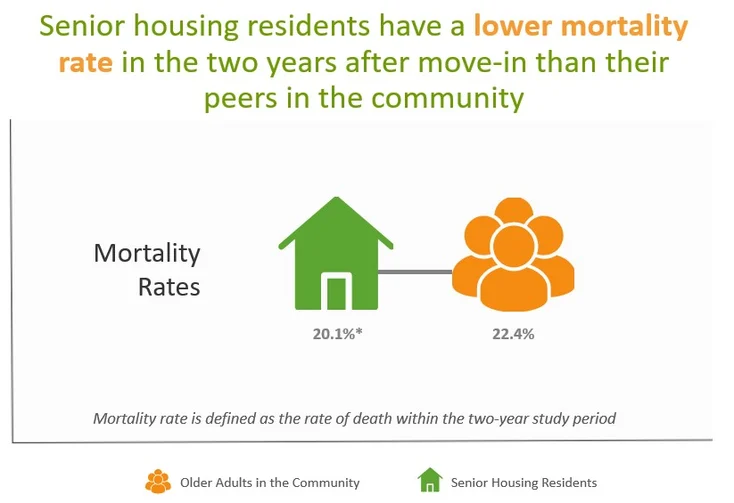
But we found improvement—even a potential reversal of sorts. In 2019, about 97,000 people moved into senior housing properties tracked in the NIC MAP Vision database. In the year after move-in, frailty levels of residents improved—there was a 10 percent decline in frailty relative to peak levels. While we might be inclined to attribute that health improvement to their move into a senior housing property, we know that correlation is not causation. Today, HCS is digging into the reasons for this marked improvement in a comprehensive health measure like frailty. Over the next few months and into 2024, HCS will produce research that analyzes longevity and health outcomes for residents of senior housing. We aim to better understand the correlation between senior housing and health outcomes. 


Dianne M picture

This research portfolio will provide invaluable insights for myriad audiences and stakeholders including our loved ones, and ourselves, who will soon make decisions about where to spend our golden years. Likewise, other stakeholders, like payers and health plans, and increasingly providers, will need a plethora of solutions to manage risk. Senior housing needs a seat at the health care table, aligned incentives, and payer/provider partnerships.

Housing and health care shouldn’t be an either/or—it needs to be both. A comprehensive solution allowing comfort, care, and dignity to seniors needs to be readily available and affordable so that more people aren’t forced to choose if they’d rather have housing or health care.

This commentary originally appeared in NORC Views, a health care strategy newsletter published by NORC at the University of Chicago.