Skilled Nursing Faces Opportunities and Challenges in 2025 

As we look ahead in 2025, the skilled nursing sector is poised for both opportunities and challenges. The year will likely be driven by many factors including evolving supply and demand fundamentals, workforce pressures, policy changes, and capital market trends. Below are the key trends to follow in 2025. 

Occupancy on the Rise 

Expect continued occupancy increases as the number of occupied units rise and operational bed inventory declines. The occupancy rate for nursing care rose 0.2 percentage points to 84.5% in the third quarter of 2024 for the 31 NIC MAP Primary Markets. This marked the fourteenth consecutive quarter of occupancy gains, driven by net absorption of nursing care beds outpacing the amount of new inventory. Inventory has been declining due to factors including closed properties and the migration toward more private than semi-private rooms. In addition, the total number of occupied nursing care beds continues to increase, rising to more than 467,000 beds for the 31 Primary Markets in the third quarter. 

Stable, but Uneven Reimbursement Rates 

Medicaid funding is expected to remain stable, with some states projecting rate increases of 3% to 4%. Supplemental payments tied to quality of care will continue to be a significant factor in reimbursement as states expand these programs throughout the country. The Centers for Medicare & Medicaid Services (CMS) finalized a 4.2% increase in Medicare payments to skilled nursing facilities (SNFs) for fiscal year 2025. This translates to approximately $1.4 billion in additional Medicare Part A payments. While this increase is welcome news for operators, it is important to note that it may be partially offset by other factors such as elevated operating costs. 

Active Acquisitions and Consolidation Cycle  

The industry is likely to see continued consolidation, with disciplined acquisition strategies presenting opportunities for growth in 2025. This trend is driven by the need for operational efficiencies and the potential for organic growth in newly acquired properties. Well-performing assets will command premiums, while distressed assets may see increased interest for turnaround opportunities or even sales for alternate uses. Much of the consolidation is expected to be driven by smaller and/or underperforming operators that need to exit the business. 

Expansion of Technology and Innovation 

The industry is likely to see continued adoption of technology solutions to address staffing challenges, improve care quality, and enhance operational efficiency. This may include increased use of telehealth, remote monitoring, and AI-assisted care planning. Many believe AI has the potential to reduce routine administrative burdens, guide clinicians to better outcomes, and improve the quality of care. 

More Favorable Regulatory Environment Possible 

The recent presidential election has led to expectations of a more favorable regulatory environment. The federal minimum staffing mandate was finalized in April of 2024. An analysis by KFF estimated that only 19% of nursing facilities would meet the minimum hours per resident day standards under full implementation of the final rule. Many in the industry are confident that the incoming administration, along with the Republican majority in the House and Senate, will likely reverse the mandate. However, workforce challenges including the availability of labor, especially direct care staff, will continue in 2025.   

Skilled nursing operators and investors must navigate a complex landscape in 2025 shaped by ongoing reimbursement changes, workforce shortages, and evolving care models. The winners will be those who prioritize operational efficiency, embrace technology, and strategically manage labor and regulatory challenges. The demographics provide long-term tailwinds, but success will hinge on adaptability and innovation in a constrained budget environment. 
Positive Momentum for Active Adult 

NIC’s 2025 outlook for active adult rental communities is positive, with robust demand expected to keep average occupancy rates in the mid-90% range. Like 2024, development is likely to remain somewhat subdued as access to capital and to land remain headwinds. As a result, the 0.5% average penetration rate for active adult is unlikely to increase significantly in 2025.  

Operationally, NIC expects active adult rental communities to continue to evolve to meet consumers’ changing lifestyle preferences, and organizations that can effectively differentiate their products and address the evolving needs of the 55+ demographic are well-positioned to succeed in this burgeoning market. Opportunities for customization, providing a la carte services, and increasing adoption of technology appear to be on the horizon for 2025. 

See NIC’s recently updated white paper for detailed insights on the active adult property type.

For a comprehensive understanding of the active adult property type, explore NIC’s Active Adult Communities course.

2025 Growth Outlook for Senior Housing & Care  

The senior housing and care sector is poised for a promising year in 2025, driven by strong demographic tailwinds, solid market conditions and improving operational performance.

The senior housing and care sector is poised for a promising year in 2025, driven by strong demographic tailwinds, solid market conditions and improving operational performance. While the general outlook is positive, there are uncertainties as the industry navigates a dynamic economic and political landscape. 

Guarded Optimism with Capital Flow 

Access to capital in the year ahead is anticipated to be rosier than the past 12 months, but how rosy remains to be seen. Interest rates have decreased from their peak, but remain above the lows from prior decades, and it does not appear we will return to those levels anytime soon. The Federal Reserve’s more conservative stance coming out of the December 2024 meeting suggests fewer rate reductions in 2025 than what was projected a mere six weeks ago. The sector faces approximately $10 billion in loan maturities in 2025, and borrowers will need to align their forecasts accordingly. Bank lending improved in 2024, and we anticipate that the debt markets will continue to migrate back to the playing field in 2025. Transaction activity is anticipated to be robust in 2025, building on the increased momentum seen in 2024.     

Measured Construction and Development Activity 

Despite strong demand driven by an aging population, new development activity remains constrained due to both limited access to development capital and elevated construction costs. While it is anticipated that more developers will explore projects in 2025, a flood of new construction is unlikely. There has been much talk about ‘thriving in ‘25,’ leading to ‘sticks in ’26.’ Projections from Fed officials now show only a half percentage point cut in the federal funds rate by year-end. This is likely to temper the flow of senior housing construction starts this year. The sector is in a better position to advance growth opportunities compared to one year ago, but we might be looking at more twigs than sticks in ’26.  

Solid Financial and Operational Performance 

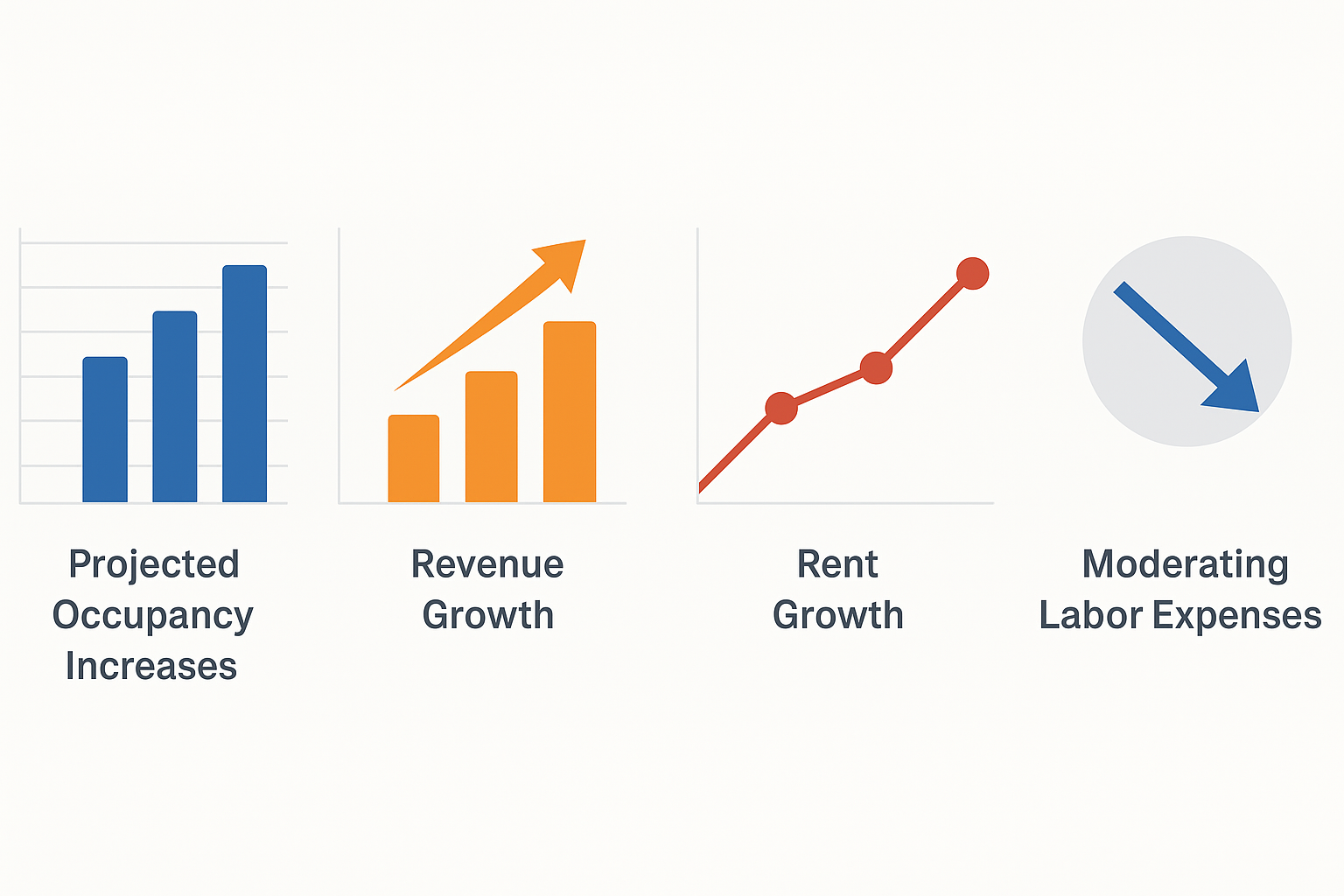
As a whole, senior housing financial performance is expected to continue to improve given projected occupancy increases, revenue growth, and the ability to implement rent growth above historic long-term averages. Labor-related expenses have been moderating, and cost of goods and utilities are more predictable. Rising insurance costs will remain a pressure point in 2025.  

Political Impact – A Wild Card 

The incoming administration has been vocal about their intent to tighten immigration policy and impose greater tariffs. It is unclear how actions at the federal level may shape the 2025 workforce landscape or decisions from the Federal Reserve, but it is clearly something to pay attention to. Proposed tariffs, coupled with potential workforce pressures could set up even greater headwinds for construction activity.  

Positive Outlook 

Overall, the outlook for the senior housing and care sector in 2025 is promising. Strong demographic growth, robust demand, and limited new supply are expected to boost operational and financial performance. These positive factors should help mitigate potential downsides, such as a slower pace of Federal Reserve easing and any adverse impacts from changing administration policies. While challenges persist for some communities that have struggled in recent years, the sector’s fundamentals remain strong, positioning it for continued growth and attracting increased investor interest in 2025. 

Spotlight on the NIC Spring Conference Agenda and Speakers

The NIC Spring Conference is just around the corner, and we’re excited to share a sneak peek at the agenda and speakers who will make this event truly exceptional. Here’s why you should mark your calendar and register today!

Agenda Highlights:

  • Emerging Senior Housing Trends: Explore how shifting demographics and market dynamics are shaping the future of senior housing.
  • Financing Strategies: Learn innovative approaches to funding and investments tailored to meet today’s challenges.
  • Leadership and Operations: Uncover actionable insights for operational excellence and leadership success.

Meet the Speakers: The lineup includes industry veterans, visionaries, and innovators who are driving change in senior housing. Expect actionable insights from their years of experience and their unique perspectives on navigating an evolving industry.

Key Topics:

  • Market trends and forecasting
  • Innovative solutions in senior care
  • Leadership strategies for success
  • The future of financing in senior housing

Why This Agenda Matters: The sessions are not only informative but also interactive, giving you the opportunity to engage with speakers and fellow attendees. Each topic is carefully selected to ensure relevance and provide maximum value to participants.

Don’t miss the chance to learn, grow, and connect at this game-changing event. Register now and be part of the conversation shaping the future of senior housing and care!

Industry Legacies: Parents Pass the Baton to the Next Generation: A Conversation with Jared and Barry Carr

A Conversation with Jared and Barry Carr

This article is the seventh in a series showcasing parent/child dynamics across the senior housing and care industry. My conversation with father and son duo, Barry Carr, Chairman and Co-founder, Ignite Medical Resorts and Jared Carr, President of Ignite Medical Resorts, explores how our industry has become a family affair.

Tell us about yourself and your work.

Barry Carr: In 1985 I started working for my father-in-law and his partner, who had three buildings in Chicago. My wife’s father was a silent-type partner who didn’t have a traditional education. He handled a lot of the maintenance duties while his partner ran the business. At the time, I was doing marketing for a big ad agency in Chicago. When one of their administrators quit, they asked me to come on as an assistant administrator. In 1989, they sold the company, and the new ownership didn’t have growth opportunities.

After about a year, my father-in-law’s old partner called me and asked if I wanted to operate a building he was planning to buy. It was 1991 when I went in as a partner and had my first ownership experience. In 1994, my partner asked me if we wanted to buy the old company back. My father-in-law went in a different direction, but I was all in. We grew NuCare into a large company and I eventually became the CEO. I bought my own building, Avanti, in 2001 and brought that into the fold. In 2012, I left and ran the one building on my own.

We now have 23 communities, all short-term rehab, straight down the center of the U.S. (Texas, Illinois, Missouri, Indiana, Kansas, and Oklahoma).

Jared Carr: Growing up around my father and grandfather in the industry didn’t sway my ambitions to do other things, but I really wasn’t sure what I wanted to do. For most of my life I pushed back on the idea of being in the industry because it’s time consuming and there are no holidays off. It’s not like a bank where nothing is going to happen at 11:00 at night or on Christmas Day.

During summer breaks at Indiana University, I worked in various facilities and started to look at health administration programs. It clicked once I enrolled in those classes. I was familiar with a lot of the regulations and standards of practice, which gave me confidence about heading in the same direction as my dad. Looking back, I understood it was a difficult business to be around, but I appreciated that it’s what enabled my happy childhood and gave us a fruitful life. Additionally, I was drawn to the fact that the industry is relatively recession proof and constantly growing. Ultimately, it made a lot of sense for me.

Once I decided on the path, I went all in majoring in health administration. My dad advised me not to work with him off the bat. At the time I was scared and resisted, but in hindsight it was fantastic advice. I’m really glad I got the opportunity to work for someone else and learn both what to do and what not to do. I ended up working at three of Symphony’s facilities. That was an important experience not only because I couldn’t run to daddy, but also because you get these buildings where you see people with significant, basic life challenges and different workplace norms. Then you come to buildings that we operate which are “resorts” and you get a family whose greatest concern is about matters that may seem more trivial like fresh linens or PT scheduling. It puts things in perspective.

Next, I did administration at Avanti as Ignite was forming. I’ve recently taken over as president to help run day-to-day activities while my dad and our co-founder Tim focus on the bigger picture.

Barry Carr: We made very clear from the start that Jared would report to Tim and not me. Tim helped mold him into what he needed for the company. I stood back and acted as the consiglieri, if you will.

How do you keep separation between church and state?

Barry Carr: When Jared was young, we’d go out for dinner, and I’d have to leave the table to take work calls. Recently, we were out to dinner and his phone rang. Next thing you know, the tables have turned and I’m looking at him out of the restaurant window taking a work call. That was a turning point. When we’re with the rest of the family, we try to avoid industry talk.

Jared Carr: Growing up, I never wanted Thanksgiving to be dominated by my father and grandfather talking about their building. It was frustrating as a little kid. Now that I’m older, I have that perspective and try to stay away from work topics when we’re in a group setting.

What advice do you have for the next generation or those thinking about joining the industry?

Barry Carr: It’s a great, never-boring field to be in. You can’t imagine what each new day will bring. Originally, I was trained to be an accountant, and I would think ‘I know what I’m going to be doing April 1, ten years from now.’ That’s not the case in this business.

It’s important to be humble. You need to be a strong leader and above it, but you also have to be able to get right down into it. That’s being able to speak in front of 200 staff members and being able to mop the floor. You need to have a “go with the flow” personality.

I always told Jared to be the first one there in the morning and the last one to leave at night. You have to earn respect especially when your last name is the same as the owner.

What advice do you have for the generation before us?

Jared Carr: Embrace change. This doesn’t go for my dad because he’s really good with change, but a lot of others say: ‘well this has been successful in the past.’ Be patient with the next generation who may decide they want to do things differently. 

Anything more to share?

Barry Carr: I will add—you have to want to do this. If you just want to make money, do something else, but if you care about people and want to be impactful in their lives this is a rewarding industry to be in.