Congressional Hearings and Confirmations Spotlight Seniors Housing & Care Sector

Over the last month, a series of congressional hearings and confirmations shined a spotlight on the seniors housing and care sector, and areas impacting the industry.

Over the last month, a series of congressional hearings and confirmations shined a spotlight on the seniors housing and care sector as a whole, as well as a number of areas impacting the industry. The hearings followed a tumultuous year of navigating the COVID-19 public health emergencies and subsequent media scrutiny, and covered a wide range of topics, including staffing necessities, private equity investment, quality metrics, home and community-based services (HCBS) funding, reimbursement pressures, telehealth flexibilities, and dual-eligible care coordination.

Below is a summary of key points from each hearing.

Senate Committee on Finance: A National Tragedy: COVID-19 in the Nation’s Nursing Homes

On March 17, the Senate Committee on Finance, chaired by Sen. Ron Wyden (D-OR), held the hearing “A National Tragedy: COVID-19 in the Nation’s Nursing Homes.” The hearing included testimonies from a nursing care certified nursing assistant (CNA), an AARP Director, a long-term care ombudsman, American Health Care Association’s (AHCA) Chief Medical Officer, Dr. David R. Gifford, and University of Chicago Public Health Sciences professor, Dr. Tamara Konetzka.

AHCA’s Dr. David R. Gifford shared testimony that sought to educate the committee on the needs of nursing home residents, the emotional and physical toll the pandemic had on residents and staff, as well as the multitude of challenges operators faced during the public health emergency. These challenges included the constantly evolving and sometimes conflicting guidance from local, state, and federal governments, the lack of reliable and timely testing, personal protective equipment (PPE) shortages, and the workforce crisis that was exacerbated by the pandemic.

With regards to the existing standard quality metrics, Dr. Konetzka of University of Chicago highlighted that “multiple rigorous studies” have found standard quality metrics do not have a meaningful association with COVID-19 outcomes for nursing homes and that even prior infection control citations were not associated with COVID-19 outcomes. Konetzka’s comments echo a 2019 GAO report that quality measures should better align with CMS’s strategic objectives at improving care quality rather than simply additional obligations of providers.

Gifford’s testimony also emphasized that COVID-19 didn’t cause problems that exist in the sector, but rather exacerbated or brought them to light. This is true on the staffing front as well – staffing challenges predate the pandemic. Thus, when the pandemic hit, tight staffing levels went from a strain to a crisis itself. Adelina Ramos, a Rhode Island Certified Nursing Assistant shared key points on this topic, including the often-low starting wages for skilled nursing workers, the prevalence of skilled nursing workers working multiple jobs, and that the often-low staffing ratios themselves tend to feed into the employee turnover challenge.

Konetzka highlighted that “Though community spread of COVID-19 and facility size have proven to be the top predictors of nursing home outbreaks in multiple studies, staffing does have an effect on how a COVID-19 outbreak plays out. More staff did not reduce the chance of outbreaks, but more staff hours meant fewer deaths and cases once an outbreak occurred.”

Dr. Gifford cited a November 2020 survey of skilled nursing providers that found 70 percent of nursing homes had hired additional staff and 9 out of 10 asked staff to work overtime and provided hero pay. Gifford summarized AHCA/NCAL’s actions relative to staffing through the pandemic – developing free online courses to train temporary caregivers, urging Congress to direct financial aid to long-term care properties, and sharing a strategy roadmap with governors to address the workforce shortage. Gifford summarized the sector’s needs by saying, “We need ongoing staff support as this pandemic continues, but we also need a more long-term solution. … We need a comprehensive strategy to recruit more health care heroes to serve in long term care.”

A National Bureau of Economic Research (NBER) study on private equity investment in healthcare made its way into the hearing multiple times. The study included data on 1,674 nursing homes that were acquired by private equity firms in 128 unique deals between 2000 and 2017. The study cited instances of bad outcomes for nursing homes that were acquired by private equity owners. These include elevated risk of death for short-term Medicare patients, higher rates of antipsychotic drug use, and increased taxpayer spending on episodes of care.

The American Investment Council has pushed back on the NBER findings, saying that “private equity firms make long-term investments in…nursing homes to help rescue, build, or grow businesses, often providing much-needed capital to strengthen struggling companies.” The council also said that the NBER research hasn’t been peer-reviewed and doesn’t include data on Medicaid patients, who comprise most long-term nursing home residents. The paper is “inconsistent with recent peer-reviewed academic research that shows that private equity-backed companies are delivering high-quality care to nursing home residents, particularly during the COVID-19 crisis,” it said.

One subcommittee member spoke in favor of the for-profit healthcare system. Rep. Tom Suozzi (D-NY 3rd District) said “I’m not against making money as long as you are taking care of your patients.”

Senate Special Committee on Aging: COVID-19 One Year Later: Addressing Health Care Needs for At-Risk Americans

On March 18, the Senate Special Committee on Aging, chaired by Sen. Bob Casey (D-PA), held the hearing “COVID-19 One Year Later: Addressing the Health Care Needs for At-Risk Americans.” Much of this hearing focused on the disparities in care during the pandemic. Speakers noted the virus had a disproportionate impact on the elderly, people with disabilities, minorities, and rural Americans. While this hearing was not focused on seniors housing or skilled nursing, private equity investment in long-term care was brought up and questions were posed regarding its suitability for the sector.

Comments highlighted the two different types of patients that are found in skilled nursing, and how they don’t necessarily align with each other. Anthony Jackson, senior vice president and chief operating officer of Roper Saint Francis Healthcare, and a former nursing home administrator said “When you look at the viability of a nursing home, they started to move away from the responsibility for which they exist, which is to take care of patients from a long-term perspective. They moved toward taking care of short-term types of disease which provides for quicker turnover and a better reimbursement.”

On HCBS services, Senator Elizabeth Warren (D-MA) said “…the coronavirus has also highlighted the critical importance of providing care safely in home and communities. Here’s the problem: Millions of Americans can’t access HCBS services at home. … We must make HCBS a mandatory benefit in Medicaid and expand Medicare to cover more at-home, long-term care services.” Following this hearing, the American Jobs Plan was announced, which includes $400 billion to expand access to Medicaid home and community-based services.

House Ways and Means Oversight Subcommittee: Examining Private Equity’s Expanded Role in the U.S. Health Care System

A week later, on March 25, the House Ways and Means Oversight subcommittee, chaired by Rep. Bill Pascrell (D-NJ 9th District) held the hearing “Examining Private Equity’s Expanded Role in the U.S. Health Care System.” Skilled nursing and private equity ownership were the central themes for this hearing, again citing the February 2021 National Bureau of Economic Research (NBER) study. Ernest Tosh, an attorney specializing in nursing home abuse and neglect highlighted what he considers to be a lack of transparency in for-profit skilled nursing chains’ use of taxpayer funds. Tosh said “We really have no idea what the financial position of these facilities is. They can be made to look bankrupt, but, in fact, may be making millions and millions of dollars each.” Tosh proposes requiring skilled nursing operators to file consolidated financial statements for entire chains, not just individual properties.

In anticipation of another congressional hearing scrutinizing the sector, AHCA/NCAL’s CEO and President Mark Parkinson proactively released a statement before the hearing highlighting both the shortcomings of government funding coverage and the limited role of private equity within the ownership of skilled nursing properties. Parkinson said “In the long-term care sector, private equity companies own less than 10 percent of nursing homes, and large investor acquisitions are decreasing. However, the small number of nursing homes that have turned to alternative revenue sources underscore the financial and staffing crisis that nursing homes are facing due to the fact that Medicaid does not cover the cost of care.”

Senate Finance Committee Confirmation Hearings: CMS Administrator Chiquita Brooks-LaSure and HHS Director Andrea Palm

On April 15, the Senate Committee on Finance held a confirmation hearing for both the CMS Administrator and the HHS Director, which covered applicable topics of Medicare and Medicaid funding and reform, telehealth, staffing, oversight, and penalty changes for skilled nursing properties.

Senator Mike Crapo’s (R-ID) opening statement on both Brooks-LaSure and Palm touched on the topic of telehealth. “Patients and providers have benefited from expanded access to telehealth and expedited approval of COVID-19 vaccines, diagnostics, and treatments. Going forward, Medicare and Medicaid patients must have the same access to innovative items and services as those with commercial insurance.” Several other senators highlighted the need to ensure that the telehealth boom that started during the pandemic continued. In response, Brooks-LaSure said that she wants to examine what CMS’s authority is to extend the flexibilities that are set to expire at the end of the public health emergency.

Senator Bill Cassidy (R-LA) also commented that “We both know we spend lots of money on duals, and we get miserable outcomes. … One of the issues is that it is difficult for aligning incentives for both state and federal governments.” Brooks-LaSure responded that there needs to be better coordination between long-term care, nursing homes, and hospitals.

The hearing did not highlight any major opposition to either nomination, and likely signals the confirmation of each to their respective roles at CMS and HHS.

 

Skilled Nursing Integration: Will COVID be the Catalyst for Tighter Hospital Partnerships?

Unlike home health and other post-acute sectors, skilled nursing operators and hospitals have not entered into many joint venture partnerships.

Unlike home health and other post-acute sectors, skilled nursing operators and hospitals have not entered into many joint venture partnerships. The COVID-19 pandemic, however, may be the wakeup call hospitals need to consider more integrated relationships that strengthen alignment. In the latest NIC Leadership Huddle, titled “Skilled Nursing Integration: Will COVID be the Catalyst for Tighter Hospital Partnerships?” health system executives got together to discuss joint ventures with skilled nursing partners.

april14_huddle_1024

Andre Maksimow, senior vice president, Kaufman Hall, began the discussion by illustrating how a Kaufman Hall client’s discharge pattern has changed over the pandemic. The Northeastern health system, which typically discharges 22,000 Medicare and Medicare Advantage patients annually, sent far fewer patients to skilled nursing facilities (SNFs) last year. “It’s a two-order effect, a compound issue,” he explained, pointing out that, on one hand, there was “less volume coming out of the hospital,” and on the other, “less going to skilled nursing versus home health.” Skilled nursing providers in the area are currently seeing a 25% reduction in overall discharges.

“I can tell you that we have fundamentally shifted as a provider organization in how we view our post-acute discharge process,” explained Dr. Mark Terpylak, D.O., FACOG, senior vice president, Population Health, Summa Health. His organization used to ask what kind of care they could qualify a patient for upon discharge. “We don’t do that anymore,” he said. Instead, his staff ask whether they can send a patient home. “If we can’t, then we work our way up the ladder in the other direction. That comes in large part with our movement into risk.” He explained that he looks to his network of providers to deliver lower-cost, value-based care, as his organization shifts their financial model.

Asked whether discharge volume to skilled nursing facilities would remain lower than pre-COVID rates, Dr. Terpylak responded that, “when possible, we’re not going to discharge to another facility…if it serves the patient and their family well, we’re going to try to get them discharged to the home.” Only if the patient fails to qualify for that course will the hospital send them to skilled nursing. He looks for skilled nursing partners who share the health system’s values and are, “committed to providing care for those folks in the most cost-effective fashion.” He also noted that for healthcare organizations and providers who bear risk, “we are not financially aligned with the typical skilled nursing operator.” He explained that this presents an opportunity to align in a different way, which he spoke to later in the discussion.

David Dafilou, CAO, CIN & vice president, Capital Health System, agreed that his organization would not revert to pre-COVID patterns. “Patients would much rather go home…they don’t want to be in the hospital at all. They don’t want to go to another facility. When possible, they want to go home.”

Maksimow asked why healthcare organizations are now interested in closer relationships and partnerships with skilled nursing facilities. In answer, Bryan Crum, director, Post-Acute Care Management, Summa Health, said, “We still have a big need for the right level of care at the right time…we want more patients that had been going to SNFs…going to home health. But we still want to utilize our SNF partnerships more.”

Addressing the same question, Dr. Terpylak explained that his system has historically been facility-based – and, as a result, was more comfortable sending discharges to another facility. “We had a very narrow-sighted view of what happened after folks left us. We didn’t really think much about it.” That is changing, and the healthcare organization is looking more closely at what happens when they discharge patients to a skilled nursing facility, and also at what happens once they leave that facility on the other end of a stay. “We need to find a different way to align ourselves with the skilled operators in our market that are open to partnering around a different methodology, different metrics, and a different level, frankly, of care integration.”

Given the new interest amongst healthcare organizations in forming partnerships and joint ventures with their post-acute providers, are SNF operators reaching out to upstream providers? Brian Cloch, principal, Innovative Health, LLC, pointed out that in years past his organization tried – but couldn’t get their calls answered. That, too, is rapidly changing, although in Cloch’s experience, many healthcare organizations, even when taking on risk, are still not fully embracing value-based care. When an organization understands the benefits of value-based care and takes an interest in working with a partner downstream, they are likely to find SNFs willing to work with them.

Cloch went on to explain that, in such a partnership, he hopes to gain referrals that might otherwise have gone to other facilities, such as ERFs or LTACs. Part of his strategy is to capture that portion of the market. “We scratch our heads and wonder ‘how does that happen?’ I get paid $600 a day, they get paid $3,000 a day or $2,800 a day. Why would somebody pay $1,800 a day more for the same care? That’s the target that we’re after.”

Not everyone on the panel is looking to partner in a joint venture. Dafilou pointed out that patients value choice, and that geographic considerations are important, and that in his area of the country, with a very high population density, there are many facilities nearby. He is looking at other ways to align with SNFs, such as putting healthcare providers within a facility, for example. In return for working with his organization, the SNF should be able to expect a greater volume of referrals. Capital Health recently reduced their preferred provider network down from 12 facilities to eight. He hopes that will enable a boost in referrals to each remaining SNF in his network.

Asked where he sees SNFs heading in the near future, Cloch said, “I think we’re going to be okay.” He pointed out that quality SNFs boast a very low hospital readmittance rate. When compared to higher readmittance rates in home health, in his view, SNFs may compare very favorably, in terms of total cost of care.

NIC MAP Vision Expands Ability to View Competition Across the Nation

NIC MAP Vision combines supply-side time series data for U.S. metropolitan markets and demand-side data for senior housing properties across the country.

NIC’s recent acquisition of VisionLTC and creation of NIC MAP Vision integrates the market-leading NIC MAP® Data Service with VisionLTC’s best-in-class data for investors, owners, and operators to provide significantly deeper and broader data for industry stakeholders.

Key Takeaway: NIC MAP has long been the industry leader in facilitating data transparency in the seniors housing and care sector. NIC MAP Vision combines both supply-side time series data for 140 U.S. metropolitan markets and demand-side data for properties all across the country, significantly increasing an analyst’s ability to identify all of the comparable and competitive properties in a market area.

Some Context: A few years before I joined NIC in 2016, I had a potential client who wanted a compilation of all the seniors housing and skilled nursing properties in the state of Virginia not covered by NIC, listed by address, ownership/management, number of units, unit mix, and monthly rent rates for each type of unit because they were planning to use the information to seek underserved areas for development. In scoping the project, it was determined that to accomplish the task, a researcher would at least need a map and good internet search skills—but they would also need a tremendous amount of tenacity and patience to locate and reach the right state and local licensing/regulatory agencies (for lists of those properties with licenses), the ability to search the internet for unlicensed properties, and to reach out to the right people “in the know” at local planning and zoning boards to discover properties in the development pipeline that may or may not be announced (often easier said than done). Additionally, adding to the analyst’s effort to compile all the salient information, some states only disclose that a property provides a specific service or level of care but does not identify how many beds are licensed for each type—or only licenses the whole property. In the end, many variables from disparate places needed to be gathered and judiciously classified, and it was deemed to be a very time-consuming project that would require resources beyond which was reasonable.

This affiliation is truly a game-changer. On one hand, NIC MAP® data, powered by NIC MAP Vision, continues to provide the same high-quality, supply-side data it has since 2005. The time series data of 140 metropolitan markets remains the gold standard for identifying historic patterns and trends and analyzing cycles in the seniors housing and care market fundamentals.

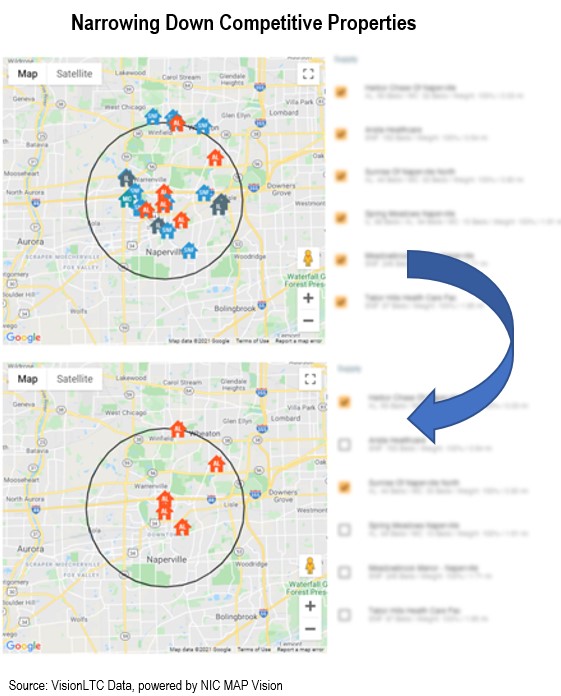
VisionLTC data, powered by NIC MAP Vision, goes beyond, and expands on the demand-side data with additional inventory including assisted living, memory care and nursing care licensed beds, and independent living units. With VisionLTC data and a few clicks of the mouse, an analyst now has the ability to go into any market area, no matter how small—or rural—and view details on local competitors to compile key property data.

Apples or oranges? It is of chief import when analyzing a market for senior living housing and services to designate properties as comparable or competitive.NMV 041321 Doing so increases the accuracy of demand analyses. In most market studies, before an analyst drills down into a competitive set of properties, they need to have broad knowledge of all of the comparable seniors housing and care properties in a market area that could capture any prospective resident from the total demand pool.

  • Properties that are designated “comparable” offer similar levels of care (e.g., independent living, assisted living, memory care, nursing care), and similar levels of programming and services included in the monthly fee (e.g., one meal a day, housekeeping twice a month, basic utilities, etc.).
  • Once a listing of all seniors housing and care properties is created for a specific market area of interest, the analyst then categorizes them into one or more competitive sets. Communities that are designated “competitive” are further defined as offering similar levels of care, programming and services included in the monthly fee—and have comparable unit size; pricing; amenities; quality of design, fit and finish; age of physical plant; and they target the same age- and income-qualified consumer.

Comparable and competitive properties (and their respective units within) are important to differentiate, especially when conducting a study of market depth for a particular property or development project. Comparable properties must be included in the mix because they are possible selections based on care level and services offered. Competitive properties, however, may require more thoughtful consideration from the analyst to identify features that appeal to households with a particular income, affinity group, or expectations for attractiveness and features.

NIC MAP Vision powers up the process. It’s a science…and an art. In developing a competitive set for a seniors housing market study, regardless of whether it entails review of an entire county or a small neighborhood, it requires objective data (the science part) and subjective observations (the art part). Through the VisionLTC client portal, a vast variety of objective seniors housing data can be accessed and compared to put a fine point on the big picture including, but not limited to:

    • PMA (site data): target market household demographics and associated growth rates, net worth, home values, home ownership rates, total and projected supply competitive supply
    • Competition data: owner/operator, property type, payment type, unit mix, assessed property value, property sale price, mortgage amount, lot acreage and total building square footage, average online consumer review star ratings, origin of resident data
    • Assisted living rate data: minimum and maximum rent data by unit type
    • Medicare data: total Medicare spend per beneficiary, 30 and 90-day readmission rates, percent attributed to a Medicare ACO
    • Development pipeline data: address, new or renovation, stage in development, hard costs, number of units, owner contact information and detailed notes about the project
    • Labor data: position, total employment, percent labor availability by position type, FTE per licensed bed, hourly wages
    • Survey performance data: number of surveys, total citations, quality of care ratings, complaints, fines
    • Construction cost data: various building components and total cost per square foot
  • Many additional factors can be considered to build the objective picture in a market study through the  VisionLTC client portal. The analyst can drill down in a marketplace to age of units, competitive and comparable care segment 5-year supply growth rates, senior disability rates including activities of daily living (ADLs), instrumental activities of daily living (IADLs), and cognitive impairment rates.

About NIC MAP Vision:

NIC MAP Vision, an affiliate of NIC, is a leading provider of comprehensive market data for the seniors housing and care sector. NIC MAP Vision brings together two strong, well-respected, and complementary teams and platforms – the market-leading NIC MAP® Data Service (NIC MAP) and VisionLTC’s best-in-class market research analysis platform. For more information, visit www.nicmapvision.com.

Learn More About VisionLTC Data

Schedule a meeting with a Product Expert to learn more about how our product offerings can help support your business and save you time in an increasingly competitive market.


Skilled Nursing Occupancy Continued to Be Challenged in January 2021

NIC MAP® Data, powered by NIC MAP Vision, released its latest Skilled Nursing Monthly Report on April 1, 2021, which includes key monthly data points from January 2012 through January 2021.

Managed Medicare RPPD hit a new low.

NIC MAP® Data Service, powered by NIC MAP Vision, released its latest Skilled Nursing Monthly Report on April 1, 2021, which includes key monthly data points from January 2012 through January 2021. Here are some key takeaways from the report.

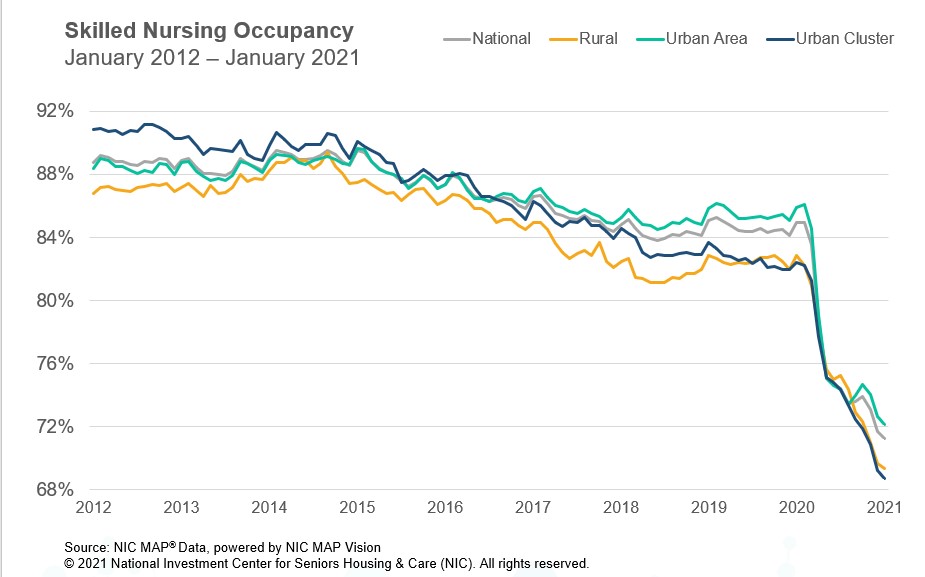
Occupancy continued to be challenged as the industry navigated the first month of 2021. Skilled nursing property occupancy fell to a new low of 71.2%, placing it 46 basis points below December 2020 (71.7%), 13.8 percentage points below pre-pandemic levels of February 2020 (85.0%), and 13.7 percentage points below year-earlier levels. The COVID-19 pandemic has significantly impacted census at skilled nursing properties due to many challenges including the vulnerable population living in the properties, local and state level regulatory restrictions, and a significant decrease in hospital referrals. The occupancy trend was consistent across geographies as both urban and rural occupancy rates declined from December (47 basis points to 72.2% in urban areas and 29 basis points to a record low of 69.4% in rural areas). While rural and urban areas continue to face very low occupancy levels, vaccination clinics in most skilled nursing properties and the recent relaxation of some CMS visitation guidelines may support some stability in occupancy in the coming months.

SNF Occupancy January 2021


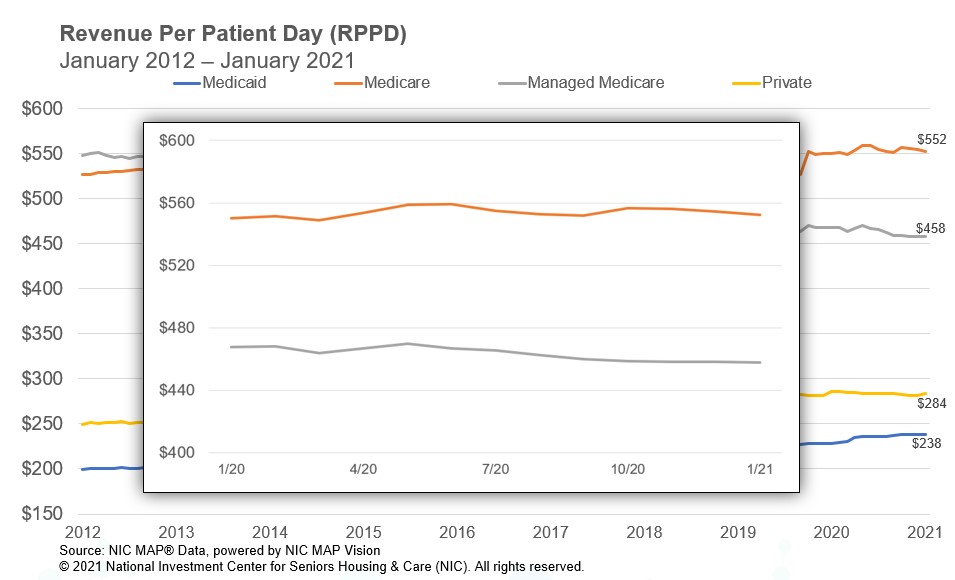
Medicare revenue per patient day (RPPD) declined from December 2020 to January 2021 ending the first month of the new year at $552. However, it is up since March 2020 when the RPPD was $549. There has been federal government support for Medicare fee-for-service reimbursement such as higher rates to help care for COVID-19 positive patients requiring isolation. However, that has been becoming less relevant as case counts have declined sharply at skilled nursing properties since the vaccine rollout in December. Medicare RPPD increased 0.3% compared to a year ago. Meanwhile, Medicare revenue mix continued to increase reaching its highest level since March of 2018. It increased 61 basis points from December to January, ending at 24.1%. Medicare revenue mix has held up relatively well since the pandemic began in March 2020, compared with other payor types. It is up 247 basis points since March compared to managed Medicare (down 16 basis points to 10.3%) and private (down 255 basis points to 5.8%).

RPPD January 2021


Managed Medicare RPPD hit a new low of $458 in January. Early in the pandemic managed Medicare RPPD increased from March to May 2020 but has since resumed the trend of monthly declines. It is down 2.1% since January 2020 and has declined 16% since January 2012. Managed Medicare patient day mix increased from December, up 81 basis points and stood at 7.7% in January after hitting a low during the pandemic of 5.4% in May. In addition, it was up 82 basis points from year-earlier levels. The increase since May of 2020, and the increase in the first month of 2021, suggests managed Medicare is playing an increasing role in overall operations but this is all in the context of a significant decline in occupancy. Managed Medicare admissions likely continue to be significantly below levels prior to the start of the pandemic.

Medicaid revenue per patient day increased slightly from December ending January 2021 at $238. However, that represents a 3.5% increase since March 2020 when the pandemic started, and it is up 4.2% from one year ago as many states embraced measures to increase reimbursement related to the number of COVID-19 cases. However, covering the cost of care for Medicaid patients is still a major concern as reimbursement does not cover the basic cost of patient care and services in many states. In addition, nursing home wage growth is elevated relative to inflation and staffing shortages are a significant challenge in many areas of the country. Expectations are that wage growth will remain elevated as staffing challenges remain an operational hurdle due to turnover and competition for labor in other industries.


To get more trends from the latest data you can download the Skilled Nursing Monthly Report here. There is no charge for this report.

The report provides aggregate data at the national level from a sampling of skilled nursing operators with multiple properties in the United States. NIC continues to grow its database of participating operators in order to provide data at localized levels in the future. Operators who are interested in participating can complete a participation form at https://www.nic.org/skilled-nursing-data-initiative. NIC maintains strict confidentiality of all data it receives.


U.S. Jobs Increase by A Very Strong 916,000 in March

The first Friday of the month at 8:30 ET is widely anticipated as the Labor Department presents a fresh gauge of the most recent economic performance in its release of the labor report for the prior month.

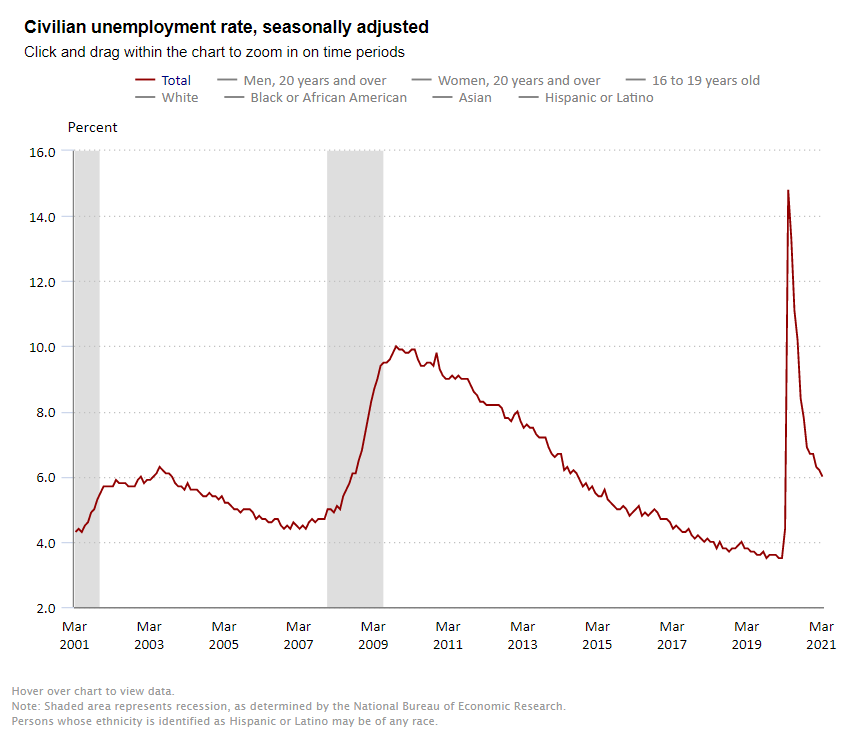
The first Friday of the month at 8:30 ET is widely anticipated as the Labor Department presents a fresh gauge of the most recent economic performance in its release of the labor report for the prior month. Today’s number was even more closely watched since it indicates how quickly the economy is bouncing back from the year-long pandemic. In its release, the Labor Department reported that nonfarm payrolls rose by 916,000 in March and that the unemployment rate edged lower to 6.0% from 6.2% in February. The jobless rate remains 2.5 percentage points above the pre-pandemic level of 3.5% seen in February 2020, but well below the 14.7% peak seen in April. Despite the February increase, job levels are 8.4 million (5.5%) below the pre-pandemic levels of February 2020. The consensus estimates for February had been for a gain of 660,000.

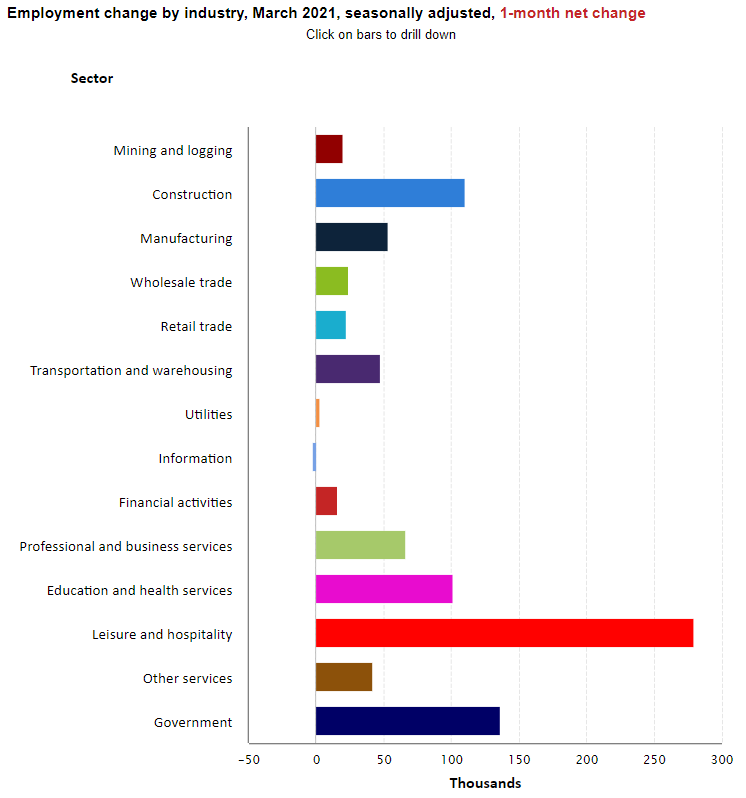
Private service-producing jobs increased by 780,000, led by a rise of 280,000 jobs in leisure and hospitality payrolls as pandemic-related restrictions began to be relaxed and restaurants re-openings occurred. The resumption of in-person learning translated into a combined 190,000 increase in state, local government, and private education employment. Health care added 11,500 jobs in March. Within healthcare, nursing care facilities gained 1,700 jobs in March.

The number of long-term unemployed (those jobless for 27 weeks or more) was little changed from February at 4.2 million but is 3.1 million higher than year-earlier levels, suggesting that this continues to be a very challenging time for many Americans. Long-term unemployed persons account for 43.4% of the total number of unemployed persons.

The underemployment rate or the U-6 jobless rate was 10.7% versus 11.1% in February. This figure includes those who have quit looking for a job because they are discouraged about their prospects and people working part-time but desiring a full work week.

Average hourly earnings for all employees on private nonfarm payrolls fell by $0.04 in March to $29.96, a gain of 4.2% from a year earlier. This was down from an annual gain of 5.2% in February.

The labor force participation rate, which is a measure of the share of working age people who are employed or looking for work was steady at 61.5% in March, up from 61.4% in February.

The change in total nonfarm payroll employment for January was revised up by 67,000 from a 166,000 to 233,000 and the change for February was revised up by 89,000 from 379,000 to 468,000. Combined, 156,000 jobs were added to the original estimates. Monthly revisions result from additional reports received from businesses and government agencies since the last published estimates and from the recalculation of seasonal factors.

The March data is promising and reflects a re-opening of the economy. The ongoing drop in COVID cases, the widespread distribution of vaccines, and a shift in consumer confidence will allow for a more complete re-opening of the economy and a fuller recovery in jobs in the coming months. The next round of fiscal stimulus will provide a further boost to economic activity and allow the second half of 2021 to be very strong.