“Terrific Environment” for Senior Housing and Care Investment

The educational programming topics at the recent 2022 NIC Spring Conference focused on the theme “A New Day” for the senior housing and care industry.

The educational programming topics at the recent 2022 NIC Spring Conference focused on the theme “A New Day” for the senior housing and care industry. Read below the opening remarks by Kurt Read, Chair of Board of Directors, NIC, and Principal, RSF Partners, in which he offered a glimpse into the new day, with opportunities awaiting in the sector.  

 

NICSpring-2022_0510


“Any time there’s a big moment of disruption, I think it’s really important to step back as an investor to look at the space that we’re in. Let’s set the stage a little bit here: We look like we’re at the end of a 12 plus year credit cycle, which in my 30 years in the industry, is the longest cycle that I’ve ever participated in.

Interest rates are rising. We have a war in Europe. Inflation is spiking. Market volatility is increasing. There is change everywhere, but capital is really interested in what we have to offer. We have a simple, easy to understand story around the drivers of growth in our space. And we have demonstrated good returns over the long run. Those are things that attract capital. However, the pandemic has accelerated the recognition that senior housing and care is an important part of the broader healthcare ecosystem. And many of the sessions here at NIC are going to talk about that.

So what does that mean to be part of the healthcare ecosystem? Let me give you a couple of fas just to set the stage on how we fit into this. As you know, healthcare spending is roughly 20% of GDP in the U.S. — that puts it at over $4.1 trillion a year. The health insurance industry has over $2 trillion a year in revenue. And just three of the larger companies in the health insurance space — United, Aetna CVS, and Humana — have more assets than our whole industry combined, about $480 billion. Why is that important? Because the health insurance industry is large, it’s healthy, and it’s well capitalized. And what are they looking at?

A growing number of their members live in our buildings and are more and more part of the equation of the increasing costs. And they require a lot of care. If you’re a health insurer or a risk taker in our space, they look at our space and say, “we’re not the senior living industry, we’re not the skilled nursing industry, we’re not the CCRC industry.” But, we have their members that are either pre-acute or post-acute. A pretty interesting distinction from the way we look at it.

And they have a business model that’s pretty easy to understand; sort of three things they’re looking at. One is they need to increase membership, particularly in their special needs plans, because those are the most expensive members they have. They need better, more integrated care delivery networks. Think about what that means. It’s all of you in this room (the care delivery network). And they need better, more integrated data. That’s why it’s so important for all of us to continue to contribute our data to NIC MAP Vision.

It’s pretty easy to see where this is going. Whether you’re a small operator, a developer, a large investor, we should all anticipate that this well-capitalized health insurance industry will be a force for change both in capital formation and in operations. At NIC and NIC MAP Vision, it’s clear that we need to remain at the forefront of creating more consistent, timely, useful data to engage with risk takers in the insurance industry at both the granular level (that means in your buildings) as well as at the industry level.

I’m a private equity investor. We’re raising our eighth fund. Am I bullish on investing in the senior living space? We are very bullish. We anticipate investing a lot of our next $500 million fund in the senior living business.

Why? Let me just remind you, other than the obviously wonderful demographic growth story, as we shift our focus to the baby boom generation, which is 62% larger than the silent generation we have been serving, let’s talk about the structural characteristics of our industry quickly that make it very favorable to invest in this space.

First, there’s an aging stock of supply in our industry. Second, rents are not correlated to the broader economy. Demand is inelastic; it’s driven by need. Our residents are not tied to the labor market (even though we’re having trouble with staffing) because they’re already retired. The industry is highly fragmented, which means there’s great opportunity for consolidation and growth. It’s notoriously difficult to scale. So those participants who can execute have a big advantage. Why is it hard to scale? Local markets matter. Customer demand, competition, land usage, and labor markets are all driven locally. Operations are a complex mix of real estate, wellness, healthcare, and hospitality. That’s hard to do. Branding has a limited effect. Families only make the decision to use our product once or twice in their entire lives. And regulations are a confusing mix of local, state and federal rules.

And lastly, one of my favorites is, you can’t offshore personal care.

All these factors favor dedicated, focused, expert participants and combine to create a terrific environment to earn a premium return on your effort.”
Three Days in Dallas Highlight “A New Day” for the Industry

More than 1,700 attendees gathered at the 2022 NIC Spring Conference in Dallas last month, surpassing turnout expectations.

More than 1,700 attendees gathered at the 2022 NIC Spring Conference in Dallas last month, surpassing turnout expectations as participants expressed a bullish outlook for the senior housing and skilled nursing sectors after a few challenging years.

A premiere industry event, the 2022 NIC Spring Conference engaged attendees in three days of results-oriented networking, information sharing, and educational sessions. The conference theme — “A New Day”— highlighted the shift from the challenges of the pandemic to the upcoming opportunities for senior housing and skilled nursing.


In opening remarks, NIC President and CEO Brian Jurutka reflected on the pandemic’s two-year impact on the industry. He noted the heroism of frontline workers and the resilience of owners and operators as everyone joined together to protect the most vulnerable Americans. “It’s too early to say the pandemic is behind us,” said Jurutka. “But we are finding ways to live with COVID, and it’s a new day.” He added that recent data show an industry rebound is underway.

The 2022 NIC Spring Conference welcomed the return of face-to-face receptions where industry stakeholders could socialize and strategize, and of the popular BraindatesTM that facilitated topic-focused small group conversations.

Timely educational session topics included rebuilding occupancy, boosting NOI, and how to recruit and retain workers, among other crucial issues. Plus, a new educational session format allowed for group discussions among attendees after hearing from expert panelists to tease out the important details of the timely topics.

See the April edition of the NIC Insider Newsletter for expanded details on the event.

Conference attendees may access high-quality video recordings and the corresponding graphic illustration boards of each session. In addition to the video recordings and illustrations, presentations are still available in the mobile app for download.

Mark your calendar for the 2022 NIC Fall Conference, coming to Washington, DC, September 14-16. If you’d like to be notified when registration opens in May, complete the form here.

Employment Continues to Grow at a Fast Clip, Increasing by 431,000 in March, While the Jobless Rate Falls Close to Its Pre-Pandemic Level

As the economy continues to move back toward normalcy and away from the pandemic, the Labor Department reported that nonfarm payrolls rose by 431,000 in March 2022.

As the economy continues to move back toward normalcy and away from the pandemic, the Labor Department reported that nonfarm payrolls rose by 431,000 in March 2022. The data suggest that the war in Ukraine and the surge in oil prices has not dampened hiring activity.

Overall job growth averaged 562,000 per month in the first quarter of 2022, the same as the average monthly gain for 2021. Revisions added 95,000 to total payrolls in the previous two months. Nevertheless, nonfarm payrolls were still down by 1.6 million or 1.0% from their pre-pandemic level in February 2020. The March increase in jobs was a bit weaker than market expectations of an increase of 490,000.


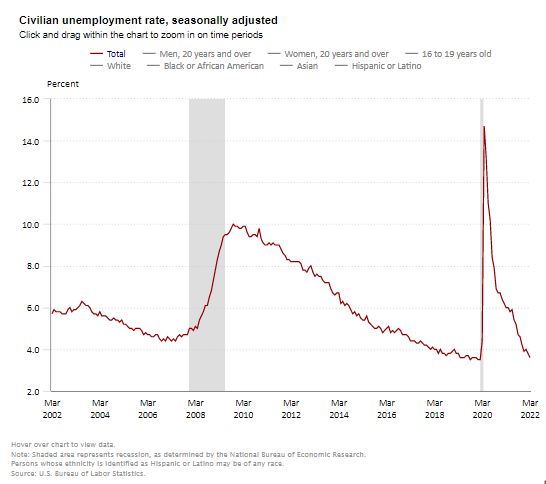
Civilian unemployment rate March 2022

Concerns about rising wage costs and inflation are further supported by this report. Average hourly earnings for all employees on private nonfarm payrolls rose by $0.13 in March to $31.73. This was a gain of 5.6% from year-earlier levels and more than the 5.2% rise seen in February. 

In a separate survey conducted by the BLS, the jobless rate fell by 0.2 percentage point to 3.6% in March 2022. The jobless rate is now only 0.1 percentage point above the pre-pandemic level of 3.5% seen in February 2020, and well below the 14.7% peak seen in April 2020. The number of persons unemployed declined by 318,000 to 6.0 million but was still above the 5.7-million-person level seen prior to the pandemic. 

Among the major worker groups, the unemployment rate for adult women (3.3%) declined in March. The jobless rates for adult men (3.4%), teenagers (10.0%), Whites (3.2%), Blacks (6.2%), Asians (2.8%), and Hispanics (4.2%) showed little change over the month. 

The labor force participation rate rose to its highest level since March 2020, increasing 0.1 percentage point to 62.4% in March from 62.3% in February. Nevertheless, this was still below the February 2020 level of 63.4%. The employment to population ratio increased by 0.2 percentage point to 60.1%, also below the February 2020 level of 61.2%.  


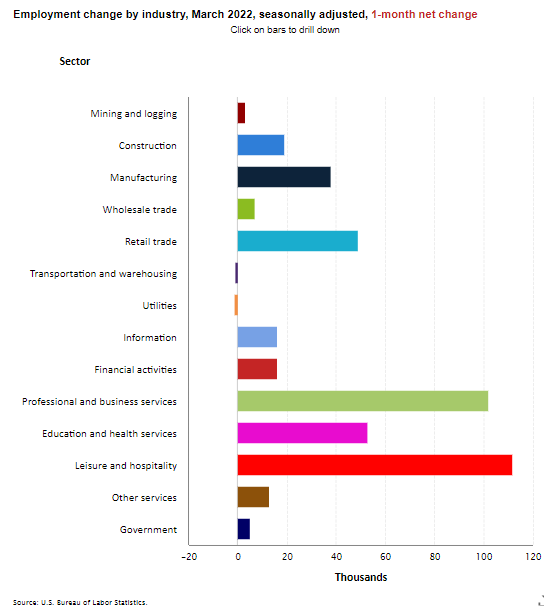
Employment change March 2022
The report also showed that workers are returning to their place of work. Roughly 10.0% of employed persons teleworked because of the pandemic, down from 13.0% in the prior month, 23% in February 2021 and more than one third at the height of the pandemic. 

The underemployment rate or the U-6 jobless rate was 6.9%, down from 7.2% in February 2022. This figure includes those who have quit looking for a job because they are discouraged about their prospects and people working part-time but desiring a full work week.

Employment in health care rose by 8,000 in March. Employment in health care was down by 298,000, or 1.8%, from its level in February 2020. Employment in leisure and hospitality continues to grow as well (up by 112,000 in March), but payrolls in this sector remain 1.5 million below their pre-pandemic level. 

The data shows that the labor market continues to gain strength and wage growth is accelerating. The report supports the Federal Reserve’s intention of raising interest rates further following the 0.25 percentage point hike in the fed funds rate at its recent March meeting.


Skilled Nursing Medicare Mix Increased Significantly Due to Omicron

After reaching a 19-month high level of 76.1% in December 2021, skilled nursing property occupancy fell 27 basis points to start 2022 at 75.8%.

“In periods when increased cases of COVID-19 occur at properties around the country, residents require isolation and higher skilled care, allowing operators to bill at the Medicare rate instead of Medicaid. As cases decline, you will see the mix revert back.”

– Bill Kauffman

NIC MAP® data, powered by NIC MAP Vision, released its latest Skilled Nursing Monthly Report on March 31, 2022. The report includes key monthly data points from January 2012 through January 2022.

Here are some key takeaways from the report:

Occupancy

After reaching a 19-month high level of 76.1% in December 2021, skilled nursing property occupancy fell 27 basis points to start the 2022 new year at 75.8%. The Omicron variant caused COVID-19 cases around the country to spike at the beginning of the year, which seemingly stalled the occupancy recovery. Occupancy had been relatively flat since July 2021 but the January reversal pushed occupancy to being only 383 basis points above the low point reached in January 2021 (72.0%) and it remains low compared to the February 2020 pre-pandemic level of 86.1%. The COVID-19 delta variant over the summer months and more recently the Omicron variant posed challenges to growing occupancy further. In many instances heightened absenteeism associated with sickness related to Omicron and restrictions on when staff could return to work safely caused many operators to limit patient admissions because they were unable to have sufficient numbers of staff to care for patients. With a national unemployment rate of 3.8% in February 2022 and the number of skilled nursing workers at the national level remaining 15% below pre-pandemic levels, the labor crisis is unlikely to abate anytime soon.

Blog Slides January 2022 - Draft 03282022_Page_15

Medicare

Medicare revenue per patient day (RPPD) increased slightly from December 2021 to end January 2022 at $585. This was an increase from $580 in December and its highest level since June 2020. The January increase was likely due to the need for more skilled care as some residents contracted the Omicron variant. The federal government implemented many initiatives to aid operators of properties for cases of COVID-19, including increases in Medicare fee-for-service reimbursements to help care for COVID-19 positive patients requiring additional care. Meanwhile, Medicare revenue mix also trended up in the month of January, increasing 411 basis points from 21.1% to reach a pandemic high of 25.2%. Given the elevated number of COVID-19 cases in January, this suggests there was a significant uptick in the utilization of the 3-Day Rule waiver as COVID-19 cases increased in the month of January. The 3-Day Rule waiver was implemented by Centers for Medicare and Medicaid Services (CMS) to eliminate the need to transfer positive COVID-19 patients back to the hospital to qualify for a Medicare paid skilled nursing stay, hence increasing the Medicare census at properties. As the cases decline, the Medicare revenue share is likely to decline as well.


Managed Care

Managed Medicare revenue mix increased 54 basis points from December to end January at 10.5%. This was up 258 basis points from pandemic low set in May 2020 of 8.0%, but 57 basis points below the most recent highwater mark of 11.1% prior to the pandemic. The increase is likely due to growth in elective surgeries from the early days of pandemic, which typically creates additional referrals to skilled nursing properties. Meanwhile, Managed Medicare revenue per patient day (RPPD) inched up from $453 to $454 in January and has fluctuated around this value since August. Compared to its year-earlier value of $468, it is down 2.9%, however and it is down $106 (19%) from January 2012. It continues to create pressure on operators’ revenue as managed Medicare enrollment continues to expand its reach and coverage around the country. The persistent decline in managed Medicare revenue per patient day continues to result in an expanded reimbursement differential between Medicare fee-for-service and managed Medicare, which has accelerated during the pandemic. Medicare fee-for-service RPPD ended January 2022 at $585, representing a $130 difference. Pre-pandemic, in February of 2020, the differential was $99.

Medicaid

As Omicron cases spiked in January, Medicaid patient day mix decreased 269 basis points to 63.7%. It has decreased 313 basis points from the most recent high set in in September 2021. In a similar trend, Medicaid revenue mix deceased in January, declining 258 basis points to 47.5%. As mentioned above, this was likely due to the spike in Omicron cases in January as operators moved residents from Medicaid to Medicare days as they required isolation and higher skilled care. Meanwhile, Medicaid revenue per patient day (RPPD) decreased 1.6% from December 2021 to end January 2022 at $245. After hitting a high of $249 in October 2021, it is now at a level last seen in May of 2021. However, Medicaid reimbursement has increased more than usual as many states embraced measures to increase reimbursement related to the number of COVID-19 cases. Medicaid has increased 3.4% since February 2020. On the other hand, covering the cost of care for Medicaid patients is still a major concern as reimbursement does not cover the cost of care in many states. In addition, nursing home wage growth is elevated along with overall inflation, and staffing shortages are a significant challenge in many areas of the country.

To get more trends from the latest data you can download the Skilled Nursing Monthly Report. There is no charge for this report.

The report provides aggregate data at the national level from a sampling of skilled nursing operators with multiple properties in the United States. NIC continues to grow its database of participating operators to provide data at localized levels in the future. Operators who are interested in participating can complete a participation form. NIC maintains strict confidentiality of all data it receives.

NIC Skilled Nursing Boot Camp: Evaluating the Investment Landscape

The Skilled Nursing Boot Camp: Evaluating the Investment Landscape offers participants an in-depth perspective on how value is created in skilled nursing.

New to NIC Academy’s professional development offerings, the Skilled Nursing Boot Camp: Evaluating the Investment Landscape course offers participants an in-depth perspective on how value is created in skilled nursing.

The course is designed for those new to the industry as well as those who wish to stay current on underwriting skilled nursing properties. It will orient participants to the nuances of skilled nursing. Participants will be able to understand the unique risks associated with skilled nursing and how they may be mitigated.

NIC will host a virtual Skilled Nursing Boot Camp: Evaluating the Investment Landscape course next month. The course will open on Thursday, April 28, with a live virtual class taking place on Thursday, May 5, from 3:00 pm to 5:00 pm EST.

Developed in conjunction with the NIC Future Leaders Council, the event is structured around a case study grounded in today’s reality that will expound on options from a property owner’s perspective. Participants will hear mock offers and pitches for consideration to determine if they should sell the property, hold the property, and/or retain a new operator.

Prior to and during the course, participants will receive an overview outlining skilled nursing industry trends, from both operators and investors, who will outline key factors for consideration. During the engaging 4-hour course itself, experts will detail approaches on how to analyze the decision.

Topics include:

    • Industry Overview
    • History of Growth in Skilled Nursing
    • Investment Considerations
    • Operational Considerations
    • Capital Market Structure

Course participants will work together in small virtual groups to discuss their prospective options and then collectively decide whether to sell, hold, and/or retain a new operator. Before the course concludes, the small groups will share their respective decisions and rationale with the other groups to gain additional perspectives.

The Skilled Nursing Boot Camp is currently open for registration.