Active Collaboration at the NIC Spring Conference

More than 1500 industry leaders gathered in San Diego in March for the 2020 NIC Spring Conference.

More than 1500 industry leaders gathered in San Diego last week for the 2020 NIC Spring Conference. Under calm blue skies, attendees engaged in three days of active networking, deal making, thought-leadership, and discussion of critical trends. A focus on disruption and new partnerships in senior care augmented the annual event’s established focus on real estate debt, equity capital flow, valuations, market trends, and investments.

Educational Program

Building on the conference theme of Investing in Seniors Housing and Healthcare Collaboration, speakers and sessions highlighted the increasing role of healthcare in the seniors housing value proposition.

The first of two general sessions, “Join the Disruption: Convergence of Healthcare and Seniors Housing,” provided real-world examples of healthcare and seniors housing disrupting current models in an increasingly value-based world. The presentation focused on the opportunities that now exist to break down old silos, adapt, and partner to improve outcomes. NIC’s Bob Kramer noted that “In the future, a system focused on prevention and wellness will keep people out of hospital and acute care settings. We are moving from a curative model to a preventative model.”

Spring 20 confGrowth strategist Andy Waldeck presented a thought-provoking luncheon keynote titled, “Positioning for the Long Term: The Opportunity for Integrating Senior Care.” Waldeck argued that the unsustainable cost of the U.S. healthcare system has left it ripe for disruption, and that the seniors housing and care industry has an opportunity to reframe its role in the healthcare continuum, saying, “We are in the early innings of the industry transitioning to a new vision.”

With educational programming organized along three tracks − Real Estate Strategies, Healthcare Strategies in Real Estate, and Senior Care Collaboration − attendees could easily find sessions aligned with their interests.

Real Estate Strategies

Sessions in the Real Estate Strategies track offered insights on deal structuring and what to look for in a partner, managing margin compression across property types, rising costs of labor, cap rate drivers, capital flow into the sector and more − with all discussions run by leading operators, debt providers, and investors in the field.

Healthcare Strategies in Real Estate

In the Healthcare Strategies in Real Estate track, attendees heard how PDPM is working five months in, learned about care integration models, explored real-world vertical integration strategies, and were updated on key drivers for valuation. One session featured newly released data by ATI Advisory indicating that integrating healthcare services, such as primary care and nurse practitioners, into seniors housing can reduce costly ER visits and hospital stays by as much as 50%.

Senior Care Collaboration

Kicking off the conference, a panel of experts weighed in on the unsustainable cost of healthcare and trends impacting the senior living industry. Sessions offered thought-provoking evidence of the looming changes in the way healthcare is accessed and delivered. Attendees walked away understanding that changes in healthcare delivery, from telehealth to new models of risk sharing and new partnerships with healthcare providers are likely to have a lasting impact on their industry.

Other News

During the conference, NIC announced the certification of its fourth Actual Rates Software Partner. Clients of Medtelligent, the maker of ALIS software for assisted living, memory care, and behavioral health communities, can now use the software for automated, efficient participation in NIC’s powerful Actual Rates Initiative.

Stay Tuned

2020 NIC Spring Conference highlights will be available on nic.org in the coming weeks. In addition, video and audio recordings for most of the sessions will be made available to conference attendees.

Join us for the 2020 NIC Fall Conference, October 7-9 in Washington, DC.  

Leading Innovations in Medicare Advantage

A No-Cost At-Home Pedicure for Mom? Imagine a world where your mom could have regularly scheduled pedicures in her own home. Now imagine that there is no out-of-pocket cost for this service, as it is in fact a benefit provided to her by her insurance plan. That doesn’t sound like the real world does it? […]

A No-Cost At-Home Pedicure for Mom?

Imagine a world where your mom could have regularly scheduled pedicures in her own home. Now imagine that there is no out-of-pocket cost for this service, as it is in fact a benefit provided to her by her insurance plan.

That doesn’t sound like the real world does it?

What I learned at The Third Annual Medicare Advantage Leadership Innovations conference last month is that this may not be such a fantastical idea. The insurance plan provides this special supplemental benefit because your mom is diabetic, and this regular check-in allows them to monitor and manage her diabetic foot pain in a way that they otherwise couldn’t. Medicare Advantage insurers are increasingly demonstrating their creativity as they continue to think about ways to establish touch points between their beneficiaries and their health providers.

Notice that I said health providers, and not healthcare providers. That’s because Medicare Advantage insurers are beginning to focus on population health, including social determinants of health like community environments and lifestyle behaviors. This is true now more than ever, with the rollout of of the CHRONIC Care Act’s Special Supplemental Benefits for the Chronically Ill. Because  population health is intrinsically a long-term strategy, these plan providers are beginning to think more like health managers than health insurers.

With the push for value-based care and a focus on preventing the need for expensive acute care settings, MA plan providers are deploying new tactics. These include strategic partnerships with home- and community based organizations, addressing food insecurity and social isolation, and cultivating a keen understanding of what supplemental benefits are desired and needed by their beneficiary populations.

The most recent CMS data indicates that approximately 24 million seniors and people with disabilities are enrolled in such MA plans. Savvy seniors housing operators may be wondering how they can affiliate themselves with these insurers to provide both better care and a better experience to their residents. Bolder seniors housing operators may even find themselves starting their own MA plans, considering the ways in which they could oversee care delivery to their own residents and get ­­­­­direct access to the healthcare premium dollars.

In-Home Care Improves Outcomes and Reduces Hospitalizations

It’s commonly thought that one of the most vulnerable times for any patient is the transition home from the hospital. Several challenges might lie ahead. In the hospital, patients are checked on every two hours, but that ends at discharge. Transportation challenges such as getting to followup appointments and being able to pick up new medications can appear. There may be nutrition challenges such as ensuring the food in the refrigerator hasn’t expired or having access to fresh food. Mobility challenges exist such as navigating steps or simply getting into the bathroom or shower safely. All these challenges greatly increase the risk of rehospitalization to the patient.

Medicare Advantage insurers are now deploying home health aides to member homes within 24 hours following discharge from the hospital. Frequent check-ins by aides, with immediate, real-time reporting has been shown to improve health outcomes.

Medication adherence following hospitalization can be problematic. New medications are often prescribed, while previous ones are discontinued. New routines must be established to ensure all medications are taken on a timely basis. This challenge creates an amazing opportunity for these home health aides. While they aren’t “hand to mouth” pill givers, they can report on whether the patient is taking their medications. They can tell if patients are taking too much or too little of their medications. They are also often told by patients why they aren’t taking a medication, perhaps because of an unwanted side effect.

All the insights obtained during this face time with patients can be reported back as actionable information. These aides are helping to mend a fragmented care system and allow for more timely deployment of interventions to patients.

Addressing Food Insecurity

If Medicare Advantage insurers are really interested in preventing ED utilization and hospitalizations, starting with food insecurity can be a big win. Food insecurity refers to a lack of access to enough food for an active, healthy life and uncertain access to or availability of nutritionally adequate foods. A review of Feeding America’s“Mind the Meal Gap” food insecurity map shows that this problem exists in every community, and food insecure patients are more likely to develop chronic conditions, such as diabetes, hypertension, and cardiovascular disease. A recent JAMA publication shows that nearly 1 in 10 Medicare enrollees age 65 and over experiences food insecurity and that food insecure individuals often report making trade-offs between food and medication.

Humana decided to address the food insecurity problem after identifying that it was the leading cause of their members’ unhealthy days. What Humana understands is that by addressing the needs of the whole person, they can avoid the much costlier alternatives. By piloting programs early, creating physician toolkits to screen for food insecurity, and developing food insecurity predictive models, Humana was able to effectively reduce the acute-care utilization of its members. For each one-day change in unhealthy days, they realize a reduction of ten hospital admissions per 1,000 patients.

Addressing Social Isolation and Loneliness

Social isolation is second only to food insecurity in creating unhealthy days for MA plan members. Social isolation and loneliness can lead to increased disease burden (particularly Alzheimer’s disease), higher risk of depression, greater chance of premature death, and an overall increase in ED and hospital utilization. Yet, 43% of adults report being lonely.

Enter organizations like Papa. Papa pairs motivated college students with older adults and families who need companionship and assistance with everyday tasks. Papa partners with health plans not only to address loneliness, but to provide transportation for appointments, medication pick up, and church or gym attendance.

Some Medicare Advantage insurers have even used a “two birds, one stone” tactic to address both food insecurity and loneliness. Partnerships with organizations like Meals on Wheels or Hunger Action Alliance rely on meal deliverers to do more than simply drop food off. They engage with members, reporting back on home conditions, medication adherence, and other concerns identified during their visit. Making the most out of existing resources again demonstrates the out-of-the-box thinking being highlighted by the conference.

Takeaways

The Medicare Advantage landscape includes both seasoned insurers and new startups. Whether you are an insurer covering several million lives or several thousand, the key takeaway from my attendance at MA Leadership Innovations is that if you want to foray into the value-based landscape of Medicare Advantage, you must be prepared to address all of the contributing factors to health, not just those deemed to fall within the “healthcare” slice. Tactics must include strategic partnerships with home- and community-based health organizations, ways to address food insecurity and social isolation, as well as a keen understanding of what supplementary benefits are needed by your beneficiary population.

For senior living providers, the possibilities to bring care coordination and care delivery directly to your residents where they live are exciting. You can choose to partner with major Medicare Advantage plans or with health provider organizations that focus on high need, high cost seniors. Or, you can form your own MA plan with other senior living organizations. Each is an opportunity to have your residents receive benefits paid for by their health insurance, enabling them to stay out of the ED and the hospital and live longer in your community. That is a game changer!


Private Buyers in 2019 Record Over $7 Billion in Transactions

Transaction pricing in seniors housing and nursing care saw a positive upswing in 2019. The number of closed transactions reached a high and should continue in 2020.

Average seniors housing price per unit reaches over $200,000 for first time.

There was no shortage of activity in the U.S. seniors housing and care transactions market in 2019. The story of abundant liquidity continued throughout the year with the number of closed transactions reaching a time-series high going back to 2008. Indeed, there was no sign of reduced interest from investors and the transaction market continued to show significant activity once again which, barring any economic or capital market shocks, is most likely to continue into 2020.

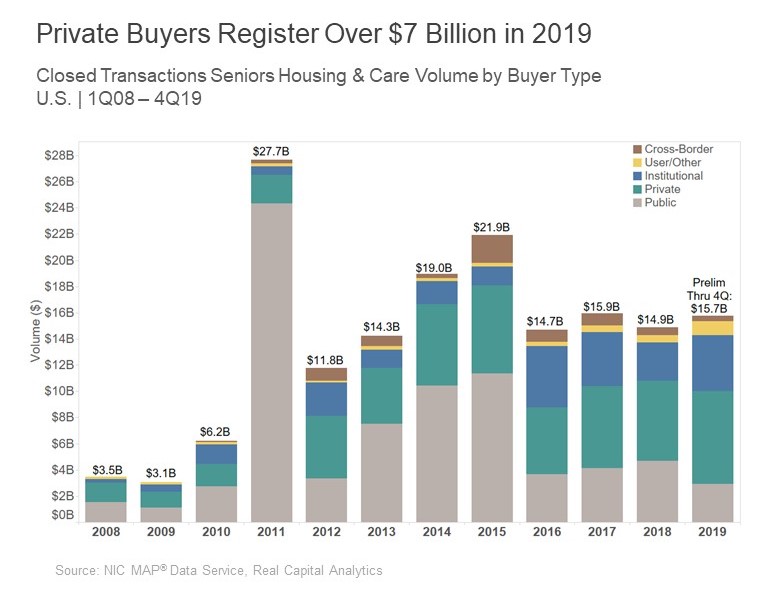
Seniors housing and care closed transactions volume in 2019 registered $15.7 billion, which includes $11.1 billion in seniors housing, and $4.7 billion in nursing care. The total volume was up nearly 6% compared with 2018 volume of $14.9 billion. However, the yearly comparison  differs when looking at the sectors separately as seniors housing dollar volume was up and nursing care volume was down compared to 2018. Seniors housing saw a 19% increase in volume from $9.3 billion in 2018, and nursing care volume was down 17% from $5.6 billion last year.

For closed transactions, the yearly count reached a time-series record going back to 2008. The number of deals closed in 2019 totaled 617, which was up 15% from the 535 closed in 2018, and up 22% from the 505 transactions closed in 2017. This new record of transactions closed is another indicator of the high level of interest from investors, especially the private buyers in the market.

In the bar chart below, note that the private buyer has been consistent in terms of closed transaction dollar volume over the past three years, ranging from $6.1 billion in 2018 to $7.1 billion closed in 2019. This buyer type registered a solid year in 2017 as well with $6.3 billion in closed transactions. The private buyer represented almost half of the dollar volume in 2019 with 45% of closed volume, up from the 41% share of volume in 2018. The 2019 private buyer volume was up 16% from 2018 and 13% from 2017.

Not many significant-sized transactions, for example over $500 million, were tallied. But many transactions closed for smaller portfolios and single properties within the private buyer category, which can include owner/operators, family offices, and other private partnerships whose primary focus is operating, developing, and/or investing in real estate.Transactions Feb 20 Private buyers-2

Seniors Housing and Care Pricing

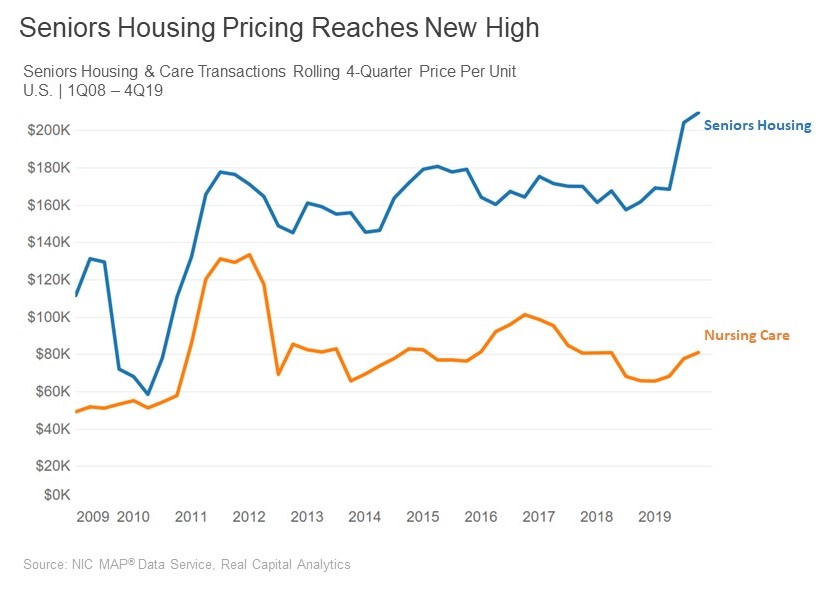
Seniors housing pricing had been trading in a range capped at the $180,000 mark since 2015.  But in the second half of 2019 that changed as the third quarter of 2019 saw a price per unit over $200,000 for the first time in the time-series since 2008. In the fourth quarter, price per unit increased 2.6% from $204,300 to finish 2019 at $209,600.

The blue colored line at the top of the graph below shows the uptick as 2019 closed. On a year-over-year comparison, seniors housing price per unit was up significantly as it increased 29.5% from $161,800 in the fourth quarter of 2018.  Also, worth noting is that from its low point, in 2010 of $58,500, price per unit is up over 250%.

In terms of nursing care pricing, represented by the orange line on the bottom, the story is much the same for increases in 2019. The price per bed is now back above $80,000 for the first time since the second quarter of 2018 when pricing took its latest downturn. Price per bed increased in the fourth quarter 2019 by 4.3% from $77,800 in the third quarter to end 2019 at $81,100. On a year-over-year comparison, nursing care price per bed was up 23% from $65,900 in the fourth quarter of 2018. From its low point in 2009 of $48,700, pricing per bed is up only 65%, which underscores the volatility in nursing care, as seen in the line graph below, especially in 2011.

Transactions Feb 20 Pricing Reaches High-2

In summary, pricing in both seniors housing and nursing care have seen a very positive upswing in 2019, based arguably on the stabilization of fundamentals for both, especially on the occupancy front. Labor continues to be a challenge for both, but absent a significant shock in 2020, for example a significant increase in interest rates or an economic downturn, we expect the fundamentals to continue to stabilize which should bode well for pricing. Of course, capital availability is a key driver as well, though that seems plentiful for now.

225,000 Jobs Created in January, Above Consensus View

225,000 Jobs Created in January, Above Consensus View

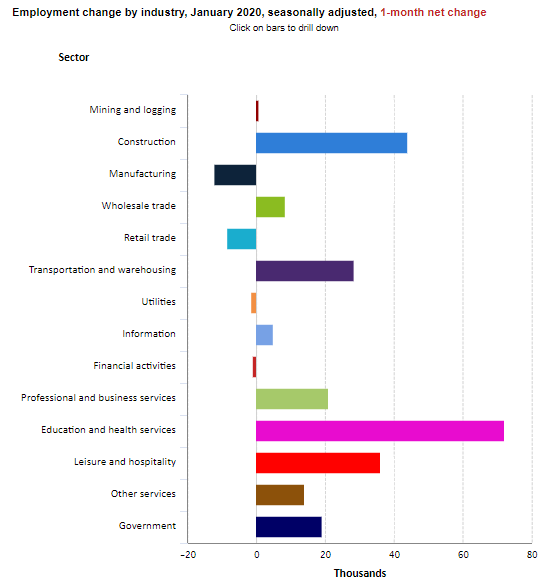
The Labor Department reported that there were 225,000 jobs added in January. This was more than the consensus estimate of 165,000 and marked the 112th consecutive month of job gains. For all of 2019, average monthly gains were less at 175,000. For 2018, monthly gains averaged 193,000 and for 2017, monthly gains averaged 176,000. The latter data points were revised from prior estimates.

Revisions also added several jobs to the prior two months. The change in total nonfarm payroll employment for November was revised up by 5,000 from 256,000 to 261,000 and the change for December was revised up by 2,000 from 145,000 to 147,000. Combined, 7,000 jobs were added to the original estimates. Monthly revisions result from additional reports received from businesses and government agencies since the last published estimates and from the recalculation of seasonal factors. After revisions, job gains have averaged 211,000 over the last three months.

Health care added 36,000 jobs in January and has added 361,000 jobs in the past twelve months. Ambulatory health care services added 23,000 jobs during the month and hospitals added 10,000.

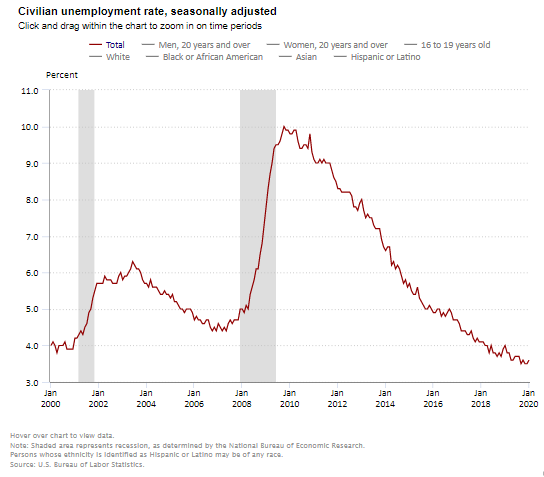
The January unemployment increased to 3.6% from 3.5% in December when it was at a 50-year low. The underemployment rate was 6.9% from 6.7%.

Average hourly earnings for all employees on private nonfarm payrolls rose in January by seven cents to $28.44. Over the past 12 months, average hourly earnings have increased by 3.1%. For 2018, the year over year pace was 3.0% and in 2017 it was 2.6%. Reasons why wages are not growing faster include the retirement of highly paid baby boomers and relatively weak productivity growth.

The labor force participation rate, which is a measure of the share of working age people who are employed or looking for work inched up to 63.4% in January from 63.2% in December, which had been the highest since August 2013.

The January employment report will support the Fed’s “on hold” stance, at least for the time being. In December, the Federal Reserve left interest rates unchanged and signaled it would stay on hold through 2020, keeping the Fed and its policies on the sidelines during the election year.

Your Chance to Join the Disruption

Healthcare delivery and payment models have entered a period of disruption. Industry leaders have begun to consider the effects these changes will have on seniors housing and care.

Recent changes demonstrate that healthcare delivery and payment models have entered a period of disruption. While this may not yet be a top concern for everyone, many industry leaders have already begun to consider, and even embrace, the effects these changes will have on seniors housing and care.  

Traditional players in the healthcare system are looking to provide better outcomes for lower cost and are rethinking their models — particularly as they relate to caring for an aging population. Healthcare players traditionally involved in creating networks to provide acute care are increasingly emphasizing wellness, care coordination, and management of chronic conditions in order to reduce and prevent acute care episodes.

This shift creates new opportunities for seniors housing and care providers who are willing to adapt. As new entrants and unusual partnerships continue to emerge, the walls separating healthcare and seniors housing are breaking down.

The 2020 NIC Spring Conference, held in San Diego next month, invites attendees to learn more about the disruption occurring as seniors housing and healthcare begin to converge.

During the conference morning general session: “Join the Disruption: Convergence of Healthcare and Seniors Housing,” a panel of experts will discuss why changes in healthcare delivery and payment models are occurring; how partnerships can slow the rising trajectory of healthcare costs and improve healthcare outcomes for high-need, high-cost frail elders; and how partnerships with healthcare providers and payors can generate revenue for seniors housing providers while improving resident quality of life and length of stay. NIC Founder & Strategic Advisor, Bob Kramer will be joined by keynote speakers David Nash, M.D., founding dean emeritus, College of Population Health at Thomas Jefferson University, Will Shrank, M.D., chief medical officer at Humana, Inc., and Dan Lindh, president & CEO, Presbyterian Homes & Services, for this highly enlightening discussion.

In addition to thought-provoking educational programming, the NIC Spring Conference offers a unique opportunity to make connections with other leaders in the field while gaining the latest data-driven industry insights. Bringing together more than 1,700 owners, operators, and capital providers, — plus numerous healthcare leaders — the upcoming NIC Spring Conference is a must-attend event for decision makers across the sector. Learn more about the conference.