Cautious Optimism Continued in 1H 2025 as Lending Stayed Active and Delinquencies Improved

NIC Analytics released the NIC Lending Trends Report for the first half (1H) of 2025. This complimentary report includes data trends over nine years for senior housing and nursing care construction loans, mini-perm/bridge loans, permanent loans, and delinquencies from third quarter 2016 through second quarter 2025. The report is based on survey contributions from 18 participating lenders.

In the first half of 2025, the Federal Reserve held the federal funds rate steady at 4.25% to 4.50%, following the three cuts made in late 2024. With inflation gradually easing and economic conditions stabilizing, policymakers emphasized patience and signaled that additional cuts would depend on sustained progress toward the Fed’s long-term inflation goal.

While treasury yields fluctuated with shifting expectations around future policy moves, they remained below prior-year highs, supporting a cautiously more constructive lending environment across senior housing and nursing care.

Survey Comments from the Field:

NIC’s lending survey gathers both data for inclusion in the Lending Trends report and commentary on what is driving those trends. A summary of that commentary is provided below.

In the first half of 2025, most lenders reported maintaining the same credit standards used in 2024, although several noted selective loosening for experienced sponsors, core-market properties, and stronger ownership profiles. A few indicated adjusting standards in response to volatility in the 10-year Treasury, while others emphasized that agency executions remained conservative despite renewed activity.

Lenders continued to prioritize existing client relationships but showed noticeably more openness to onboarding new borrowers, especially top-tier senior housing and nursing care operators. In the second half of 2025, banks in particular appeared increasingly aggressive, offering more competitive pricing and structures across both sectors. FHA remained active in nursing care, supported by Medicaid rate increases, however, production was affected by processing queues.

Importantly, some lenders signaled a shift in sentiment toward lease-up projects, exploring opportunities that previously received limited consideration, indicating a gradual broadening of credit appetite as the market stabilizes and confidence improves.

Permanent Lending Stayed Active as Senior Housing Slowed and Nursing Care Hit New Highs

Permanent lending activity remained steady in the first half of 2025, although trends diverged between senior housing and nursing care. Senior housing volumes totaled approximately $2.35 billion across the first two quarters, reflecting a modest pullback from the levels recorded in late 2024. Even with this decline, lending activity remained broadly consistent with post-2020 norms, supported by stable fundamentals and growing lender appetite for well-performing assets.

In contrast, nursing care permanent loan volume continued its upward trajectory, reaching nearly $2.95 billion in the first half of the year, surpassing timeseries benchmarks and extending the sector’s momentum from late 2024.

These dynamics point to a still-constructive permanent lending environment in early 2025. Rate stability and clearer deal economics have helped maintain activity levels, even as lenders remain disciplined and selective in their underwriting.

Bridge Financing Became More Active in 1H 2025 as Both Sectors Saw Their Strongest Volumes in Years

Mini-perm and bridge lending activity strengthened in the first half of 2025, with notable increases across both senior housing and nursing care. In senior housing, volumes totaled approximately $855 million, holding steady in Q1 relative to late 2024 before rising in Q2 to their highest level since 2023. This increase suggests growing confidence among lenders toward short-term financing structures, particularly for stronger operators and assets with clearer paths to stabilization.

Nursing care saw an even more notable acceleration, with $1.53 billion in bridge volume during the first half of the year, including a record $918 million in the second quarter. The sector reached its highest volume of bridge lending in the time series and exceeded senior housing volumes. This surge reflects lender interest in targeted skilled nursing opportunities, supported by ongoing operational stabilization.

Overall, short-term lending in 1H 2025 became more active and broad-based, benefiting from an increased appetite among both banks and alternative lenders. Even so, bridge capital remained concentrated among higher-quality sponsors, highlighting continued discipline despite the uptick in activity.

Construction Loan Activity Stayed Extremely Limited, Highlighting a Pipeline That is Thinning Just as Demand Strengthens

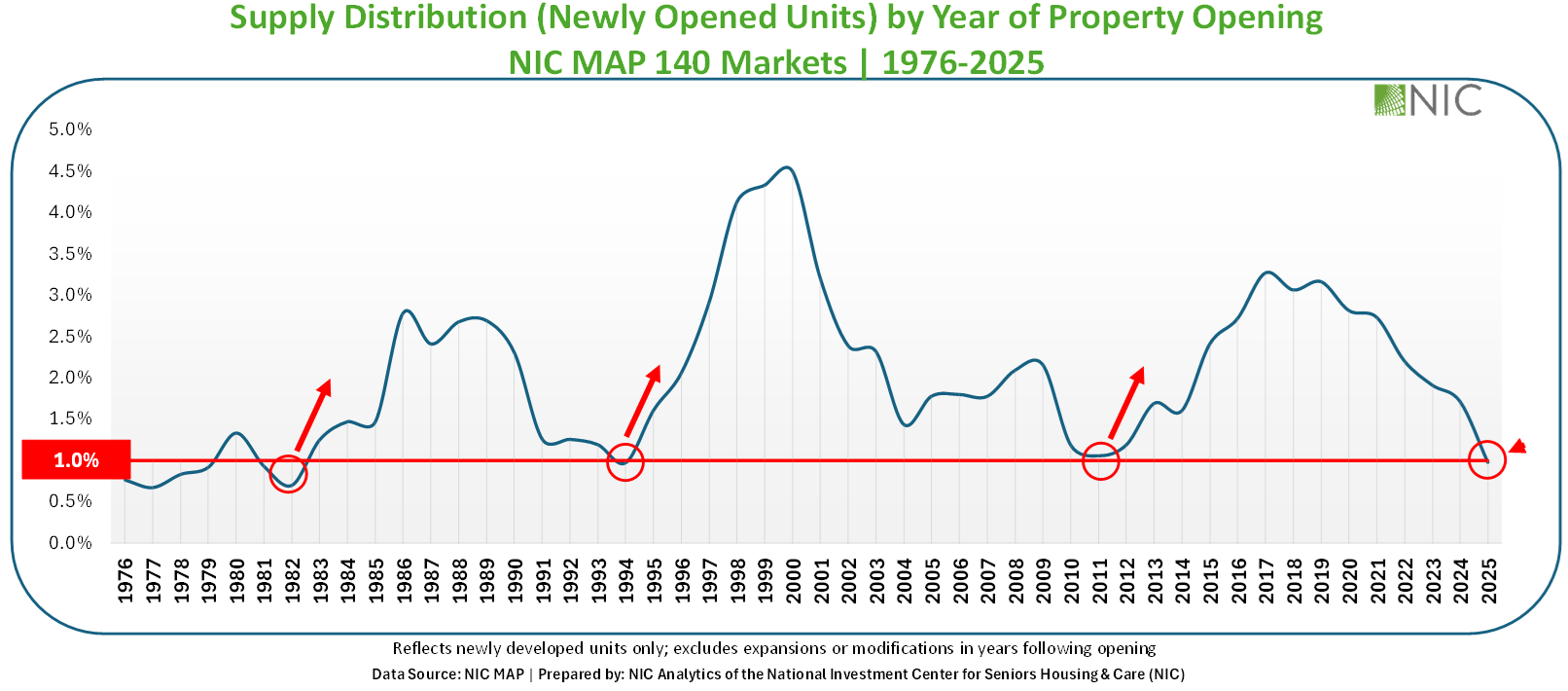
Construction lending remained extremely limited in the first half of 2025, with senior housing lending volumes holding near decade-low levels and nursing care construction lending remaining virtually nonexistent. Lenders and developers continued to take a cautious stance toward ground-up projects, directing capital primarily toward existing assets rather than new development. The number of senior housing units under construction remained near historic lows, extending a trend that now spans multiple years.

With the average construction cycle stretching to nearly 29 months, a project breaking ground today would not open until at least late 2027. As a result, some markets are beginning to experience actual inventory contraction rather than simply slower growth. This dynamic poses a longer-term risk: demand is recovering, but the industry is not replenishing supply fast enough, raising the possibility of mismatched demand with insufficient future product.

Overall, the first half of 2025 reinforced the same pattern seen in recent years, a muted construction lending environment, a pipeline that continues to thin, and a continued supply challenge.

Senior Housing Delinquencies Continued to Improve in 1H 2025, Well Below Recent Peaks

Delinquency rates continued to improve across both sectors in the first half of 2025. senior housing delinquencies fell to 2.4% in Q1 and 1.8% in Q2, extending the steady downward trajectory that began after peaking at 4.3% in 2023. This marks one of the notable improvements in the sector’s recovering financial footing. (Note that loans in forbearance are included in the delinquent loan data for some debt providers, slightly influencing these figures.)

Nursing care loan delinquencies also remained relatively stable, holding at 1.7% in Q1 and 1.6% in Q2, well below the peak of 2.7% recorded in 2024. While the sector continues to face higher operating and reimbursement pressures than senior housing, the leveling of delinquency rates suggests that the most acute phase of financial stress may have passed.

Overall, the first half of 2025 showed a continuation of the positive credit performance trends observed in late 2024, with both sectors benefitting from improved cash flow conditions and firmer occupancy levels.

Download the complimentary 1H 2025  NIC Lending Trends Report for full details on these and other trends in senior housing and skilled nursing lending. 

Note: This data is not to be interpreted as a census of all senior housing and skilled nursing lending activity in the U.S. but rather reflect lending activity from participants included in the survey sample only. 

The NIC Lending Trends Report for the second half of 2025 is scheduled for release in June 2026.

Interested in participating? The NIC Lending Trends Report helps NIC Analytics deliver on NIC’s mission to enable access and choice by further enhancing transparency of capital market trends in the senior housing and care sectors. We very much appreciate our data contributors. This report would not be possible without them. 

If you would like to participate and contribute your data to future lending trends surveys, please contact us at analytics@nic.org. As a courtesy for providing data, data contributors receive this report before publication on the website. The information provided as part of the survey will be kept strictly confidential. Individual answers will be combined with all other responses. Data acquired from this survey will only be reported in the aggregate, and therefore, the resulting aggregated data will not be attributed to you or your company upon distribution. 

Six Key Lessons Industry Leaders Have Learned: What Works, What Doesn’t 

Reflecting on 30 years of senior living evolution, a panel of veteran investors, developers, and operators shared their most valuable lessons learned to guide future decision making as the industry enters what could be a super-cycle of growth. The lively panel discussion took place at the 2025 NIC Fall Conference and drew a packed audience.

“We’re presenting six lessons learned of both the successes and the failures, so hopefully we can all be wiser in the next growth cycle,” said NIC Co-Founder and Strategic Advisor Bob Kramer, who moderated the session.

Kramer set the discussion in context by noting that today’s market conditions—high consumer demand, compelling demographics and historically low levels of new supply—echo earlier boom times.

Here are the six lessons learned from the leaders who’ve already experienced the industry’s highs and lows.

1- Develop your business model around the customer you plan to serve.

While that sounds simple, it’s more complicated than that, according to panelist Kurt Read of RSF Partners. He identifies three elements necessary to increase the probability of success. First is a laser-like focus on a particular type of customer.  Secondly, build a culture and operating model to serve that customer. Lastly, create an environment with a cost structure and margin of safety that supports scalable growth. 

Panelist Leigh Ann Barney of Trilogy Health Services said the company’s core operating principle is to create a hospitality type experience in a healthcare setting. Trilogy also offers a continuum of care and stays focused on properties in the Midwest. Lesson learned: Stick to what you’re good at.

2- Define your North Star.

“Engineer your business with the end in mind,” said John Rijos of Chicago Pacific Founders and CPF Living Communities. Too often, companies jump into senior living without a clear plan or vision of what kind of communities they want to own.

For Steven Vick of Signature Senior Living, his North Star is understanding his customer: a frail resident in need of assisted living or skilled care at a price point below that of the cost of a private room in a nursing home. That formula works for Signature which focuses on middle-market communities in Northeast Texas. Vick learned an important lesson when he worked at Alterra Healthcare during its go-go days in the late 1990s, opening a building every 32 hours. “Don’t do that,” he said.

3- Make sure your capital partner understands and supports your business model. 

Customer strategy must inform capital, not vice versa. Stephanie Harris of Arrow Senior Living entered the industry as a turnaround consultant in 1999 to help clean up some of the casualties of the overbuilding during that era. “It allowed me to think about what kind of capital partner I would want to work with,” she said. Harris eventually rebranded her business as Arrow Senior Living, managing 39 properties. “We found the right capital partner. We’re very fortunate,” she said. “We worked on getting it right from the very beginning.”

4- Avoid being overleveraged. Prepare for the unexpected.

“Being overleveraged is your Achilles’ heel,” warned Rijos. During the pandemic, he recalled that some developers built communities with only 15% equity and 85% debt. “That’s a disaster,” said Rijos. “Things will go wrong. There will be downturns.” He added that if you can’t put at least 35-40% of equity into the community then you shouldn’t do the deal.

During his time at Alterra, Vick also learned that debt is not your friend. “Be the owner of ‘no,’” he said. Signature has been successful because Vick has been able to say ‘no’ to extras, like swimming pools, that don’t support the frail customer at a middle-market price point. 

5- Maintain focus.  Understand the relationship between operational complexity and growth.

Trilogy offers a continuum of care. “Our business is very complex because of all the service lines we offer,” said Barney. “That’s why we’ve stayed focused in geographic areas that we know.”  This clustering strategy has helped Trilogy grow to 130 campuses in five states. 

6- Build an organizational culture and trust in your team.

“Always solve your people-problems first,” said Rijos. “Then a lot of the other problems will take care of themselves.”  Build trust in the organization. For example, give the executive director the ability to try a new approach without a penalty if it fails. He prefers flat organizational structures rather than those with multiple management layers.

Trilogy invests in its workforce with a robust apprenticeship program for every hourly position. “It’s not just wages or benefits, but how we invest in their retention,” said Barney. “We’ve chosen to do that through education and growth opportunities. Our employees drive our engine.”

Kramer wrapped up the session by encouraging attendees to create successful operating models and investment structures as the industry evolves over the next 30 years. “Take these six lessons learned back to your team and put them into practice,” he said.

Watch a replay of the full NIC Fall Conference session here: Understanding the Past of Senior Housing and Long-Term Care to Prepare for Our Future.

CCRC Performance 3Q 2025: Five-Year Trends in CCRC Entrance Fees

The following analysis examines broader occupancy trends, year-over-year changes in inventory, and same-store asking rent growth – by care segment – within 1,049 entrance fee and rental CCRCs in the 99 NIC MAP Primary and Secondary Markets.

3Q 2025 Market Fundamentals by Care Segment – Entrance Fee vs. Rental CCRCs

The exhibit below compares the market performance of entrance fee CCRCs and rental CCRCs by care segment for the third quarter of 2025, highlighting year-over-year (YOY) changes in occupancy, inventory, and asking rent growth.

Occupancy. Entrance fee CCRCs continued to report higher occupancy rates than rental CCRCs across all care segments. Among entrance fee CCRCs, the independent living segment achieved the highest occupancy at 93.6%. Similarly, within rental CCRCs, independent living reported the strongest performance with a 91.8% occupancy rate.

The difference in occupancy rates between entrance fee CCRCs and rental CCRCs was largest in the independent living segment (1.8pps), followed by nursing care (1.7pps) and assisted living (0.9pps), with the smallest gap seen in the memory care segment (0.1pps).

Rental CCRCs recorded the higher YOY occupancy growth in independent living (2.4pps), assisted living (2.1pps), and memory care (2.1pps) segments. While entrance fee CCRCs showed higher YOY occupancy growth in the nursing care (2.4pps) segment.

Asking Rent. The average monthly asking rent for entrance fee CCRCs remained higher than that of rental CCRCs across all care segments. Rental CCRCs showed higher YOY rent growth in assisted living (4.4% to $6,459) and memory care (4.3% to $8,238) segments. Entrance fee CCRCs experienced stronger YOY rent growth in independent living (4.5% to $4,325) and nursing care (4.9% to $479*) segments.

Note, these figures represent asking rates and do not reflect any discounts that may be applied. The nursing care average daily rent is the average private pay per diem rate.

Inventory. Compared to the level a year ago, rental CCRCs experienced inventory decline across all care segments except for memory care, which showed a modest gain (0.9%). The largest decline was observed in the assisted living segment (-2.0%), followed by nursing care (-1.5%) and independent living (-0.7%) segments.

In contrast, entrance fee CCRCs displayed a mixed trend: assisted living recorded the largest YOY inventory increase (0.7%), the nursing care segment experienced the largest decline (-0.9%), while independent living segment inventory remained unchanged from the prior year.

Negative inventory growth can occur when units or beds are temporarily or permanently taken offline or converted to another care segment, offsetting any newly added supply.

Steady Increases in CCRC Entrance Fees

The exhibit below explores the average entrance fees and YOY entrance fee growth across 99 NIC MAP primary and secondary markets from 2020 through 2025. The bar chart illustrates the average entrance fee in dollar amounts, while the line graph depicts the YOY entrance fee growth rate.

The average entrance fees in CCRCs have risen steadily over the past five years. In 2020, the average entrance fee was approximately $400,000, increasing to about $430,000 by 2022 and surpassing $480,000 by 2025. Overall, the average entrance fee in CCRCs has increased by $88,386 during this five-year period, representing a cumulative growth of 22.3%. As background, over the same five-year period, the median sales price of houses sold in the United States has risen cumulatively by 29.5%, according to data from FRED. This reflects continued demand for entrance fee-based CCRCs, as the cost to enter these communities gradually climbed year after year.

The YOY entrance fee growth rate in CCRCs fluctuated during the period. The orange line in the exhibit above highlights annual percentage growth rates, with the growth rate peaking at 6.3% in 2022, indicating a notable jump in costs that year. This was followed by a moderation in growth, with rates easing to 3.5% in 2023, rising slightly to 4.3% in 2024, and maintaining the growth at 4.3% in 2025. These changes suggest that the pace of growth has varied, potentially influenced by market dynamics, consumer demand, and broader economic conditions.

Look for future articles from NIC to delve into the performance of CCRCs.

Senior Housing Posts Highest NCREIF Property Type Return in Third Quarter and Year-to-Date 2025

Senior housing posted a positive total return of 2.88% in the third quarter of 2025, bringing year-to-date returns to 7.00%, the highest NCREIF property type return for both the third quarter and year-to-date performance. Senior housing in the third quarter outperformed the broader Expanded NCREIF Property Index (NPI) by 166 basis points, with the index posting a total return of 1.22%. Senior housing capital appreciation in the third quarter was positive with valuations increasing 1.50%. The capital appreciation return is the change in value net of any capital expenditures incurred during the quarter. Senior housing income return in the third quarter was also positive, yielding 1.38%. For the broader NPI in the third quarter, both capital appreciation (+0.06%) and income yield (+1.16%) were lower than senior housing but still positive.

By senior housing property subtype, independent living (+3.11%) outperformed assisted living (+2.66%) in the third quarter. In recent years, independent living has also outperformed assisted living over the one-, three-, and five-year periods. This outperformance may be driven by higher margins typically generated in lower acuity settings such as independent living, which require less staffing and labor expenses than higher acuity settings such as assisted living. Additionally, independent living has had higher occupancy rates over the five-year period, which surpassed 90% in the third quarter. Over the longer run, since NCREIF began tracking returns data for these subtypes roughly a decade ago, both assisted living and independent living posted similar average returns of more than 5.7% annually.

Annualized Total Returns by NCREIF Property Subtype
As of 9/30/2025; Unlevered

Annualized Total Returns Chart

Note: Since Inception is 2014 for Assisted Living and 2016 for Independent Living
Source: NCREIF, 3Q 2025, Unlevered Annualized Total Returns

Compared to other NCREIF property types over the one-year period, senior housing was also the strongest performer, returning 9.21% and outperforming the NPI by nearly 450 basis points. Over the 10-, 15-, and 20-year periods, senior housing was the third strongest property type behind industrial and self-storage, outperforming the NPI on an annualized basis by 66, 68, and 262 basis points, respectively. Since the 2003 inception of NCREIF’s senior housing historical series, income yield drove roughly 60% of senior housing total returns, while price appreciation contributed roughly 40%. These performance measures reflect the returns of 213 senior housing properties valued at $12.68 billion in the third quarter. Overall, the number of senior housing properties tracked within the NPI has grown significantly from the 56 properties initially tracked in 2003.

Annualized Total Returns by NCREIF Property Type

As of 9/30/2025; Unlevered

Annualized Total Returns by NCREIF Property Type

Source: NCREIF, 3Q 2025, Unlevered Annualized Total Returns

Senior Housing Total Returns by Income Yield versus Price Appreciation

As of 9/30/2025; Unlevered

Senior Housing Total Returns by Income Yield vs Price Appreciation

Source: NCREIF, 3Q 2025, Unlevered Annualized Total Returns

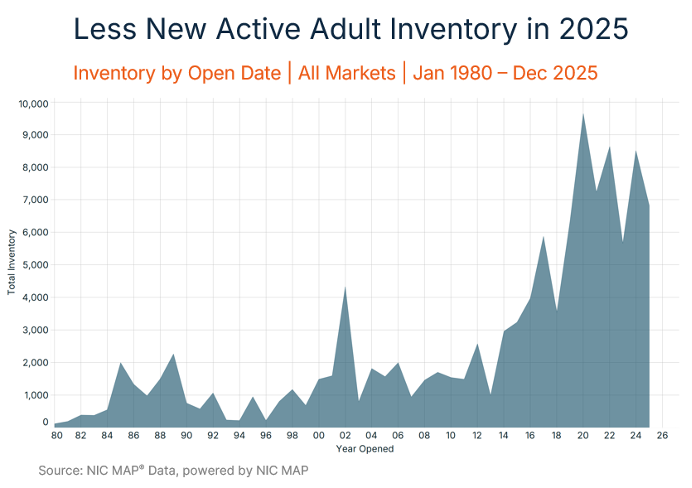
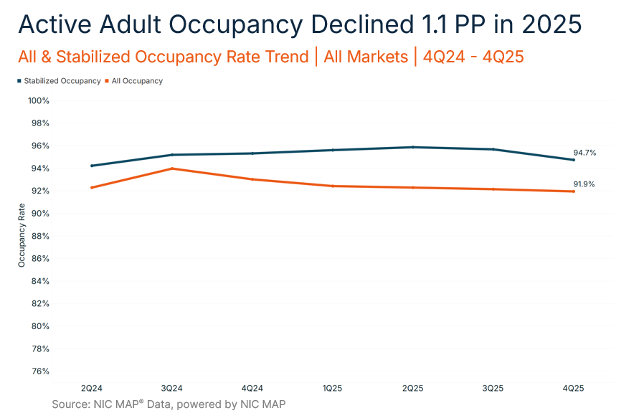
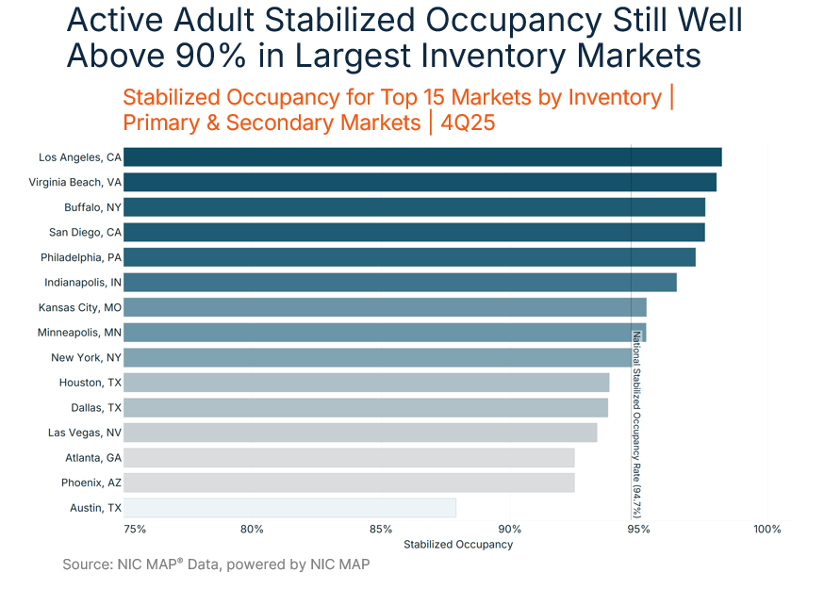
Senior housing occupancy rates in the third quarter continued climbing, with independent living surpassing 90% occupancy and assisted living jumping nearly one full percentage point to more than 87% occupied. Occupied senior housing units reached another record high, while year-over-year inventory growth fell to new record lows since NIC MAP began tracking this data in 2006. New supply is expected to remain moderate in the near term as the number of units under construction has fallen to levels last seen in 2012. Looking ahead, as a result of these robust market fundamentals, occupancy rates are on track to reach new record highs in 2026.

TOTAL RETURN
NCREIF Property Index (NPI) Senior Housing Assisted Living Independent Living
3Q 20251.222.882.663.11
YTD3.767.006.028.04
One Year4.729.217.6210.99
Three Years-2.312.200.634.07
Five Years3.922.831.554.37
Ten Years5.125.785.20N/A
Fifteen Years7.588.26N/AN/A
Twenty Years6.629.24N/AN/A
INCOME
NCREIF Property Index (NPI) Senior Housing Assisted Living Independent Living
3Q 20251.161.381.431.34
YTD3.574.144.214.10
One Year4.785.505.565.47
Three Years4.544.654.305.10
Five Years4.384.153.734.67
Ten Years4.504.804.62N/A
Fifteen Years4.905.46N/AN/A
Twenty Years5.175.91N/AN/A
APPRECIATION
NCREIF Property Index (NPI) Senior Housing Assisted Living Independent Living
3Q 20250.061.501.231.77
YTD0.192.781.763.84
One Year0.063.561.985.30
Three Years-6.62-2.37-3.55-0.99
Five Years-0.45-1.27-2.12-0.29
Ten Years0.600.950.57N/A
Fifteen Years2.592.70N/AN/A
Twenty Years1.393.20N/AN/A

Source: NCREIF, 3Q 2025, Unlevered Annualized Total Returns

Value-Based Care Update for Senior Housing & Care

Telehealth Updates. Telehealth has been an important flexibility enabling many senior living residents and communities to maintain better access to healthcare as well as reducing transportation and travel costs. Some senior housing residents have seen reduced telehealth access since broad waivers expired on September 30, 2025. This may require rescheduling visits to in-person until a federal budget is reached. It is important to note that telehealth coverage remains for residents who receive care under an Accountable Care Organization (ACO), for those receiving mental health services, for visits under commercial plans (including Medicare Advantage plans), and residents in nursing homes located in eligible rural or underserved areas. For further details, please review the CMS Telehealth website. To learn more about rural or underserved status, please see the Medicare Telehealth Eligibility Analyzer.

Medicare Advantage in 2026. During the Medicare Advantage annual open enrollment, running from October 15th to December 7th, senior housing residents can switch plans or adjust existing coverage. Overall, plans are expected to have stable costs even as the total number of plans available has been reduced. As open enrollment occurs, senior housing leaders considering how to support residents in navigating plan options can ensure they access benefits that are changing, like chronic care management, wellness programs, and in-home support, all of which can enhance resident satisfaction and improve health outcomes. Additionally, assessing marketplace updates and resident election changes can inform and better support healthcare referrals and extend resident stays. To explore 2026 Medicare Advantage Plan options, review the Plan Compare website.

Recent VBC Connections and Events. Strategic insights from leading organizations, innovators and teams were featured at both the 2nd Annual VBC Workshop in Atlanta, Georgia, and the Annual National Association of Accountable Care Organizations (NAACOS) Fall Conference in Washington, DC. Senior housing leaders, innovators, and ACO partners remain at the forefront of some of the most successful collaborations accomplishing the quadruple aim, building the future and bringing care home for seniors. Look out for new case studies and insights coming soon from NIC to advance planning, action and innovation. Also, if you have not yet accessed NIC’s newly updated web page devoted to these important topics, we encourage readers to visit NIC’s Healthcare and Wellness webpage to find podcasts and other important resources aimed at advancing the connections between senior housing and healthcare.

Upcoming Opportunities. Register now for an upcoming NIC webinar, Partnering with ACOs: Understanding the Business Case for Value-Based Care in Senior Housing. Speakers from Presbyterian Homes, LCS, and NIC will cover action steps and tools for senior housing leaders to gain insight, calculate value, and operationalize strategies to maximize partnerships with ACOs and MA plans.