Is There an Investment Case for Skilled Nursing in the Intra-and Post-Pandemic World?

How will the nursing home industry emerge from the pandemic? In the latest NIC Leadership Huddle event, expert panelists discuss the skilled nursing sector’s short-term and long-term impact on property valuations.

With all-too-frequent headlines of “nursing home deaths,” federal and state deficits, increased competition from home health agencies, and historic low occupancy levels while wage pressures continue – how will the nursing home industry emerge from the pandemic? In the latest NIC Leadership Huddle event, expert panelists, and then attendees in small groups, joined a spirited discussion on the skilled nursing sector’s short-term and long-term operational challenges and the impact on property valuations.
feb24_huddle_1200

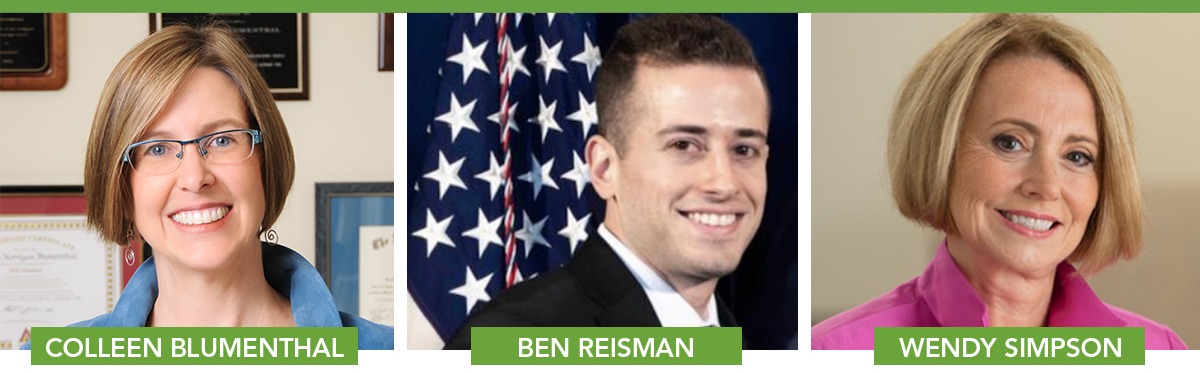
The event titled “Is There an Investment Case for Skilled Nursing in the Intra-and Post-Pandemic World?” began as always with expert commentary from experienced leaders in the space. In a short presentation, Colleen Blumenthal, MAI, chief operating officer/partner, HealthTrust pointed to some pre-pandemic slides indicating that demand was declining before COVID-19 hit the U.S. She also pointed out that a search in Google for “nursing home deaths” now yields over 150 million hits. She said, “It feels like there’s been a complete barrage of headlines, starting with Lifecare Center of Kirkland back in March, and it’s still continuing to this day.” She continued, “It’s a stigma that’s going to impact everyone in the nursing home sector, not just those that did not provide the standard of care that we expect.”

Blumenthal, explaining the impact of COVID-19 on the sector, pointed to CMS’s decision to limit visitations to nursing homes, among other factors. While likely saving lives, the policy negatively impacted many residents and their families, many of whom were left living in isolation for much of 2020. The policy also made it difficult for buyers and lenders to evaluate and transact on properties. Occupancy rates, which declined across the entire seniors housing and care industry, dropped more dramatically for nursing care than other sectors. Blumenthal observed that skilled nursing occupancy rates, which had been around 80% nationwide pre-pandemic, are now ranging from 55%-80%, with widely varying numbers across the fifty states.

Closing her self-described “Debbie Downer” introduction, Blumenthal pointed to pricing, which remained fairly steady, at around $100,000 per bed in 2020. That, she suggested, reflects sustained investor interest in the sector. With that, she asked panelists Wendy Simpson, chairman & CEO, LTC Properties, Inc., and Ben Reisman, senior vice president of Finance, TL Management, why they remain attracted to skilled nursing. They had similar responses. Both feel that the services provided by these businesses are needed and will continue to be supported by reliable government payers. In addition, according to Reisman, there are opportunities for investors to “stay ahead of the curve” by investing in new technologies, treatments, and other innovations.

2020 saw a pause in deal-making, as many investors focused on helping their operators weather the pandemic. This year, according to Reisman, deals are happening again. Simpson also is seeing an uptick in activity so far this year, saying, “We’re finding a relatively slow start to the year, but things are feeling a little bit better, as the spring comes along, than before.”

Both panelists pointed to difficulties finding lenders. Reisman said, “Lenders are going to look for very strong borrowers, which they always do, but will be more important now because they know, and we know that you can’t just say ‘there’s a vaccine’…to get back to pre-pandemic levels is going to take a long time.” That focus may result in fewer, and smaller, deals happening in the short term.
The deals that do get done may rest on the quality and reputation of the operator. “I think the industry is more interested in the operator now than necessarily the asset,” said Simpson. She continued, “You know, in real estate it’s ‘location, location, location,’ well, in investing it’s ‘operator, operator, operator.’” She indicated her company would like to help existing, trusted operators expand their portfolios.

Asked about the high numbers of prospective residents switching to home health care, neither panelist sees a long-term problem for skilled nursing. Rather, Reisman sees a temporary shift driven by the pandemic, followed by a return to congregate settings. Saying, “Isolation is a horrible thing,” he explained that current nursing home residents are isolated, but that, as group activities and visitation return, and people return to work and school, “that might flip.” He explained, “Even if people are reading the news and are scared today, in a few months or a couple of years, when they’re making a decision, talking to their doctor who’s recommending a nursing home as the best place for them to get better, I think a lot of that fear can easily go away, if we do a good job of communicating that.”

On the same question, Simpson pointed to skilled nursing’s investments in rehab facilities, as well as shortages of labor. She said, “Even before the pandemic, we didn’t have enough of an employee base, so if you take all of these people who are going to be able to see one or two patients a day, because of the travel between patients, and that person could see four to six people in a nursing home – I just don’t see how that math works.” She believes that home health will appeal to high income patients who can afford expensive round-the-clock nursing care at home, or strong families who can provide such care themselves. She argued, “that’s just not the United States.”

It should be noted here that in the follow-up discussion several attendees took a different view of the impact of home health care. Some small groups were unable to agree on whether the trend will be short term or have a lasting impact on long term care occupancy rates. If there was general agreement, it was on the fact that, for now, skilled nursing valuations are holding steady.

Another consideration for underwriters will be the relative health of state Medicaid systems, as well as the healthcare networks that refer patients. The panel discussed Texas, an example of a state with a rapidly growing population – but that has some of the lowest Medicaid reimbursement rates in the nation. In some smaller Texas markets hospitals have gone many months without referring rehab patients – a real concern for investors in an industry that often depends on those referrals for survival. Again, according to the panelists, they will be looking at the operator as they consider these and other investments.

Another potential source of trouble is rising insurance and liability costs driven by the pandemic. The panel suggested they will look at tort-reform laws and the litigation environment in any given state as part of their underwriting process.

The panel also discussed the trend towards reducing the numbers of beds in facilities, and the recent Ohio bed buy-back program. “Ohio may give up a thousand beds, but none of those beds were in service,” pointed out Simpson. She said, “I think there’s more value in the private room, if its available, but there’s always going to be need for at least double occupancy in properties.”

Immediately following the panel discussion, attendees hopped onto a group Zoom video meeting to discuss further. After a general discussion, attendees were divided into smaller breakout groups, and asked to address two questions: Has the pandemic inherently eroded skilled nursing values? And, where do occupancy/census levels stabilize, and how long will it take to get there? As noted above, discussion was frank and spirited – and not everyone in attendance was in agreement. However, when everyone returned to the larger group discussion and reported out their findings, the general sense was that, despite all the bad news of the past year, and despite disagreements on how deep and lasting the impact will be, there is still plenty of value in skilled nursing – and there will likely be more in coming months and years.
Takeaways and Highlights from Payments, Policy, & Capital Summit

Skilled Nursing News’ Payments, Policy, and Capital Summit brought together executives, policy professionals, and capital providers to share their thoughts on the skilled nursing industry.

Skilled Nursing News’ Payments, Policy, and Capital Summit brought together executives, policy professionals, and capital providers to share their thoughts on the recent past, present, and future of the skilled nursing industry. Highlights and key takeaways from the three-day virtual event are summarized here.

The summit included sessions on capital and one main topic of discussion was private equity and skilled nursing. In regard to investor interest in skilled nursing, private equity has been the bright spot in terms of buying skilled nursing properties even as the sector endured its most challenging year on record in 2020. One theme, however, has been the flight to quality as investors are interested in the best operators and properties in order to mitigate risk when allocating new capital. Private equity is still excited about the opportunity in the future as long-term care needs will remain given the fact that a very large population will be very sick with multiple illnesses and will not be able to afford private pay assisted living and unable to receive care in the home 24 hours a day.

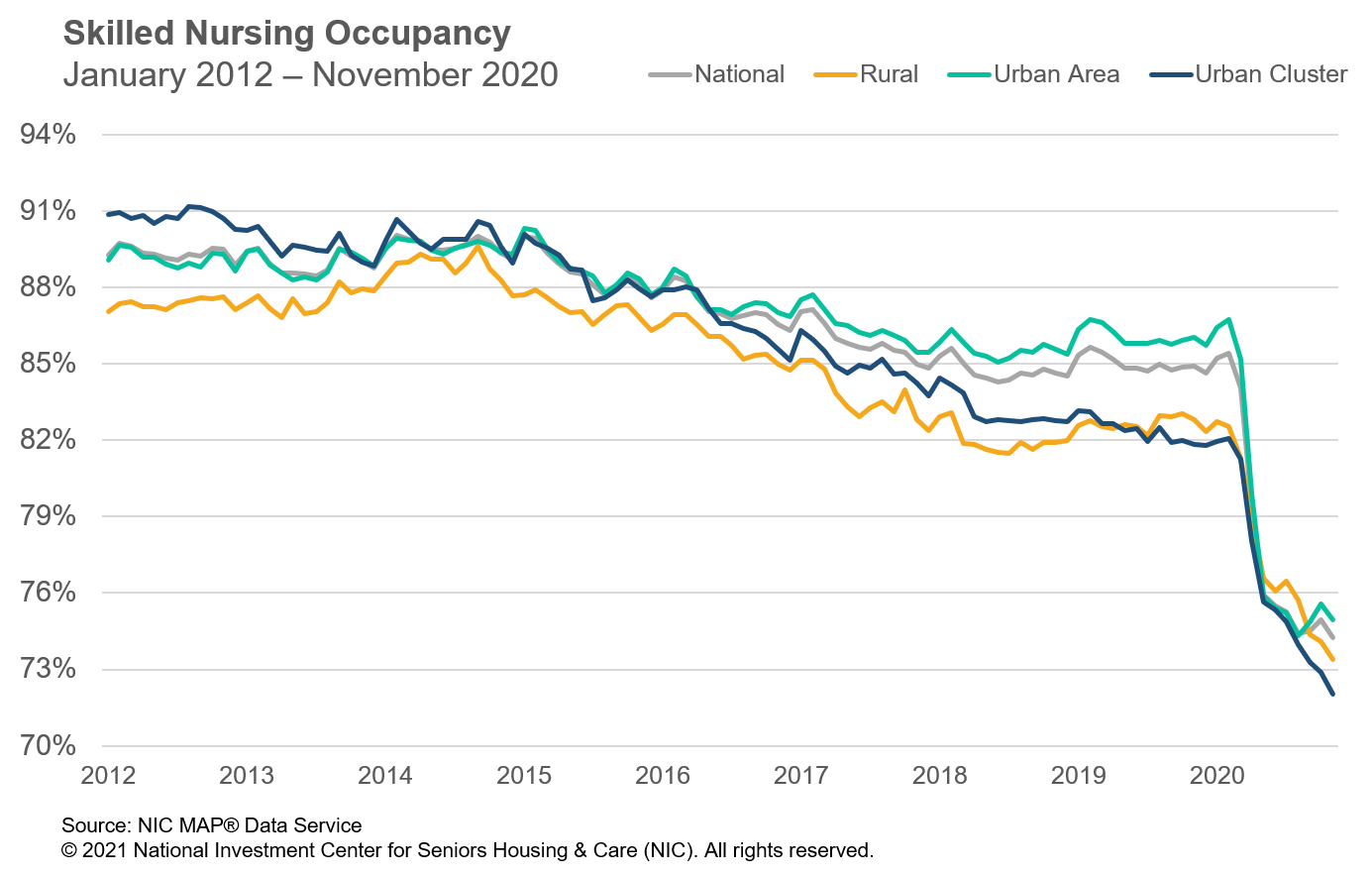
However, in the short-term private equity does have concerns given the challenges, hence the flight to quality operators and properties. Indeed, the difficulty in operations continues. Skilled nursing occupancy was at 74.2% as of November 2020 based on data from the recent NIC MAP Skilled Nursing Data Report, representing a 11.2 percentage point drop from February 2020.

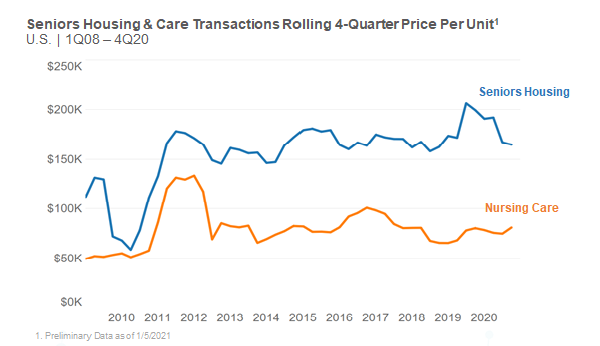
Despite the operational challenges, some owner/operators and families with plentiful capital have been the main buyers throughout the pandemic. In fact, according to preliminary fourth quarter 2020 data from NIC/RCA private buyers closed on $4.2 billion worth of seniors housing and care transactions for the year of 2020, which represented 57% of the volume. In addition, and perhaps an example of the flight to quality, skilled nursing (nursing care in the graph below) property price per bed has held firm according to NIC/RCA price per bed data (see graph below for details and sources). This pricing trend below is a national rolling four-quarter measure and it is not same-store; the mix of properties could impact the results. However, it does reflect what is trading in the market albeit with relatively lower transactions closed in 2020 due to the pandemic.

Seniors housing and care transactions price per unit

One of the comments made during the summit was that there were many transactions closed over $100,000 price per bed. So, what does this say as price per bed holds firm during this time of crisis? For one, the properties trading could be higher quality with good operators, as stated previously. In addition, there is still a very attractive expected spread in terms of the interest rates on debt and the expected long-term cash flow of a high-quality property, which may be supporting price levels.

Also, it was mentioned during the summit that government support has been a positive and private equity may be reassessing the “stroke-of-pen risk,” which is the risk that reimbursement rates are cut by the government. However, given the support of government funds during the pandemic investors may reassess the risk of government involvement as it has helped the sector stay afloat during this particular crisis. Lastly, there are some small private investors, owners and/or operators looking to expand regionally and have strong long-term views about the sector.

Much of the investor interest discussion, and the success of the sector, was certainly based on the quality operators but much of that quality is based on top talent and staff. It was mentioned that staff turnover was a top leading indicator of a successful operation before the pandemic and the belief is that is still the case. Staffing will continue to be a challenge now and after the pandemic and it should be a priority for both investors and operators alike to ensure the proper staffing is in place for all stakeholders.

As for what to expect on the policy and regulatory front, panelists covered labor and workforce topics such as the potential increase in minimum wage and mandatory staffing ratios, as well as what the future holds for PDPM, value-based purchasing, and risk-sharing models.

The Path to a $15 Minimum Wage

There are several states where a significant portion of the CNAs make less than $15 per hour – often starting at $9 or $10 per hour depending on market. With the new administration, there is certainly more discussion around a $15 minimum wage, which is a concern for many operators. As you might expect, states with the lowest CNA wages are the states that have really low Medicaid rates. As a result, providers simply do not have the resources to pay more than they are paying. Mark Parkinson, President & CEO, AHCA/NCAL emphasized that “if you do the minimum wage, you have to create a Medicaid mechanism that helps these states to pay for these wage increases.”

The upcoming stimulus bill will be passed with the reconciliation procedure, which requires only 51 votes. As a result of passing through reconciliation, there are only certain things that can be included in the bill, and currently, the prevailing view is that a minimum wage increase cannot legally be included. There is still a slim chance it’s ruled that the minimum wage increase can be included in the bill, but even if that is the case, it’s not clear that all Senate Democrats would vote for it. Additionally, the Biden proposal on minimum wage does increase the minimum wage to $15 per hour, but it is done with a gradual, phased approach, meaning the $15 wage would not be realized until 2025.

Other Regulatory Implications to Staffing

There’s good data available that indicates buildings with significant amounts of RN coverage, relative to buildings that didn’t, fared better with regards to COVID-19 cases and deaths. This may mean that there could be minimum staffing requirements established for the skilled nursing sector. Less likely, but still possible, could be including infection control experts within each of these sites as well. The caveat to successful implementation of these staffing minimums, however, is that these need to be funded under Medicaid for operators to be able to actually execute on these.

Enforcement – What Will be Scrutinized?

Given that nominated HHS Secretary Xavier Becerra is an Attorney General, it’s almost inevitable that oversight of skilled nursing will increase. One of the first things Seema Verma, former CMS Administrator, did was to issue a proposal that slowed down much of the requirements of participation that she felt had gone too far. The proposed rule was never finalized, and it is unlikely the Biden administration will finalize the rule.

There was a noticeable drop in civil monetary penalties (CMPs) under the Trump administration, but there may be pressure to get them back to where they were under the Obama administration. Right now, without an identified CMS Administrator and several important positions at CMS still open, there are a lot of unknowns, but that is likely to be on the table. The Biden administration is also going to take a close look at arbitration to see what can be done to decelerate its use.

There’s going to be a real push by the states to get rid of multi-resident rooms, specifically those that house 3 or 4 residents in a single room. This was brought to light as particularly problematic during the pandemic and private rooms are not only important for infection control, but also for quality of life and resident satisfaction as well.

Patient Driven Payment Model

The Patient Driven Payment Model – PDPM – has been one of the bright spots for the skilled nursing sector over the last year and a half. Despite concerns that the new payment system was not budget neutral, there were no substantive changes made to PDPM in 2020. This was in large part due to the COVID-19 pandemic overshadowing the concerns that some may have had about PDPM, and that may wind up being the case for 2021 as well. At some point the dust is going to settle and CMS will look again at the budget neutrality of PDPM.

There are some reasonable arguments to be made that could protect the gains that were realized under PDPM. First and foremost is that, as a whole, Medicare spending was down in 2020. Taking a step back and looking at the overall system puts PDPM in a better light.

Value-Based Purchasing

With the COVID-19 pandemic taking the full focus of the skilled nursing sector in 2020 and continuing into 2021, discussions about value-based purchasing and unified payments systems were not as prominent as they had been in the past. Once the pandemic is finally behind us, however, these conversations will once again become a more pressing topic.

As Scott Pilgrim, CEO, Diakonos Group points out, skilled nursing operators can secure additional Medicaid dollars, but must promise increased quality in return. Pilgrim notes that there are four mechanisms to increasing reimbursement rates under Medicaid and that policymakers see value in tying value-based purchasing to each of these four levers: base-rate increases, add-on rates, provider tax implementation, and inter-governmental transfer programs.

Risk-Sharing Arrangements – Medicare Advantage & Special Needs Plans

Medicare Advantage continues to grow, and that will continue to be the case. Market share for Medicare Advantage is approximately 35% and increasing each year by another 1%. I-SNPs provide an incredible incentive for operators to keep residents healthy. The COVID-19 situation was an incredibly difficult situation to navigate for I-SNPs, especially to those in the northeast. They were responsible for the entire risk of these residents, and in some cases were responsible for massive hospitalization bills. In other parts of the country, even with COVID, I-SNPs had done reasonably, as other medical expenses were down so much. All that being said, it’s clear that when the pandemic is finally behind us, risk-sharing type of arrangements are going to be an absolute must for providers that want to thrive.

Listening to all the potential policy and regulatory changes on the horizon made it clear: calls to reform post-acute and long-term care following the COVID-19 public health emergency, along with a new Presidential administration, mean the climate is ripe for potential regulatory changes to be implemented.

Skilled Nursing Occupancy Reached New Low In November 2020

NIC MAP® Data Service released its latest Skilled Nursing Monthly Report on February 4, 2021, which includes key monthly data points from January 2012 through November 2020.

Medicaid Revenue Per Patient Day Up But Cost of Care Still a Concern.

NIC MAP® Data Service released its latest Skilled Nursing Monthly Report on February 4, 2021, which includes key monthly data points from January 2012 through November 2020.

Here are some key takeaways from the report:

Occupancy

Occupancy continues to be challenged for skilled nursing properties, with the November 2020 occupancy rate falling to a new low of 74.2%. It was down 69 basis points from October (74.9%) and 11.2 percentage points from pre-pandemic levels in February 2020 (85.4%) and 10.7 percentage points from year-earlier levels. Since February 2020, COVID-19 has significantly impacted skilled nursing operations across the country due to high acuity levels of residents, pandemic-related deaths as well as fewer elective surgeries at hospitals which have resulted in less need for rehab services often provided by nursing care properties. As the country and the skilled nursing sector navigate through the Winter months and vaccine distributions, it is likely that occupancy will continue to face pressure.

skillednursing-chart1

Medicare

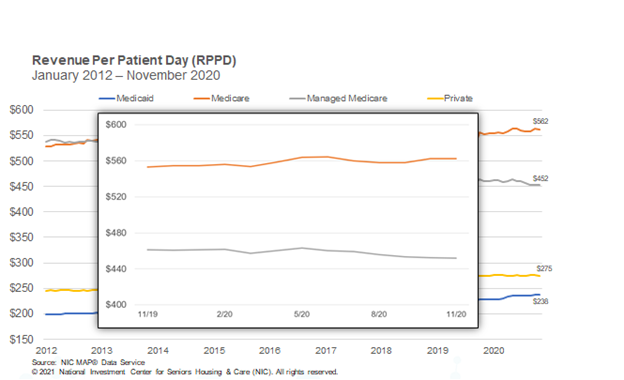
Medicare revenue per patient day (RPPD) was unchanged at $562 from October to November 2020. However, it is up by 1.6% since March. This increase is likely because of additional reimbursement by Medicare for COVID-19 positive patients requiring isolation, in addition to the temporary suspension of the 2.0% sequestration cuts by the Centers for Medicare and Medicaid Services (CMS). In addition, Medicare RPPD increased 1.7% compared to a year ago. Meanwhile, Medicare revenue mix increased 80 basis points from October to end November at 22.2%. It has increased 141 basis points since April.

skillednursing-chart2


Managed Medicare

Managed Medicare RPPD hit a time-series low (since 2012) as it decreased once again from the prior month. It ended November 2020 at $452. Early in the pandemic managed Medicare RPPD increased but has resumed the years-long trend of monthly declines. It is down 2.0% since November 2019 and has declined 16% ($86) since January 2012, Meanwhile, managed Medicare revenue mix decreased 36 basis points from October to November to 8.8%. However, it has declined 208 basis points since February, when it was 10.9% before the pandemic started.

Medicaid

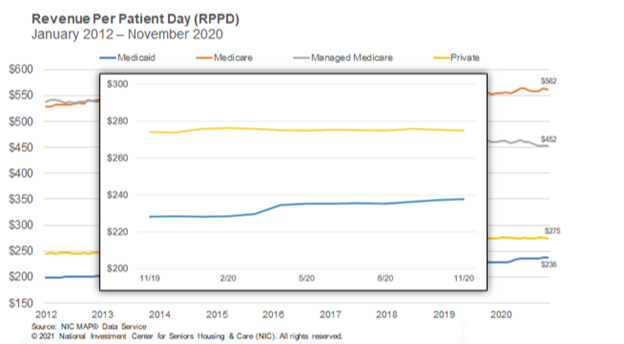
The relatively large increases in Medicaid RPPD seen at the onset of the pandemic have slowed, especially after the 2.1% increase experienced in April. Early in the pandemic, initial increases in reimbursement from some states helped skilled nursing properties related to the number of COVD-19 cases at properties. In November, RPPD increased 0.2% from October, ending at $238. On a slightly longer time frame, Medicaid RPPD is up 4.2% from the prior year. However, even with this increase, the concern continues to be that current Medicaid RPPD does not cover the actual cost of care in most states.

skillednursing-chart3-1


To get more trends from the latest data you can download the Skilled Nursing Monthly Report here. There is no charge for this report.

The report provides aggregate data at the national level from a sampling of skilled nursing operators with multiple properties in the United States. NIC continues to grow its database of participating operators in order to provide data at localized levels in the future. Operators who are interested in participating can complete a participation form here. NIC maintains strict confidentiality of all data it receives.

4Q 2020 CCRC Care Segment Performance Leads Non-CCRCs

Tracking occupancy, asking rents, demand, inventory, and construction data for independent living, assisted living, memory care, nursing care, and continuing care retirement communities (CCRCs), also referred to as life plan communities.

As the leading data provider for the seniors housing and care sector, the NIC MAP® Data Service (NIC MAP) tracks occupancy, asking rents, demand, inventory, and construction data for independent living, assisted living, memory care, nursing care, and continuing care retirement communities (CCRCs), also referred to as life plan communities. This data is collected for more than 15,000 properties across 140 metropolitan areas. NIC MAP currently tracks 1,208 not-for-profit and for-profit entrance fee and rental CCRCs in these 140 combined markets (1,137 in the 99 combined Primary and Secondary Markets).

The following analysis examines current conditions and year-over-year changes in inventory, occupancy, and same store asking rent growth—by care segments within CCRCs (CCRC segments) compared to non-CCRC segments in freestanding or combined communities to focus a lens on the relative performance of care segments within CCRCs.

Current CCRC Occupancy by Payment Type and Profit Status

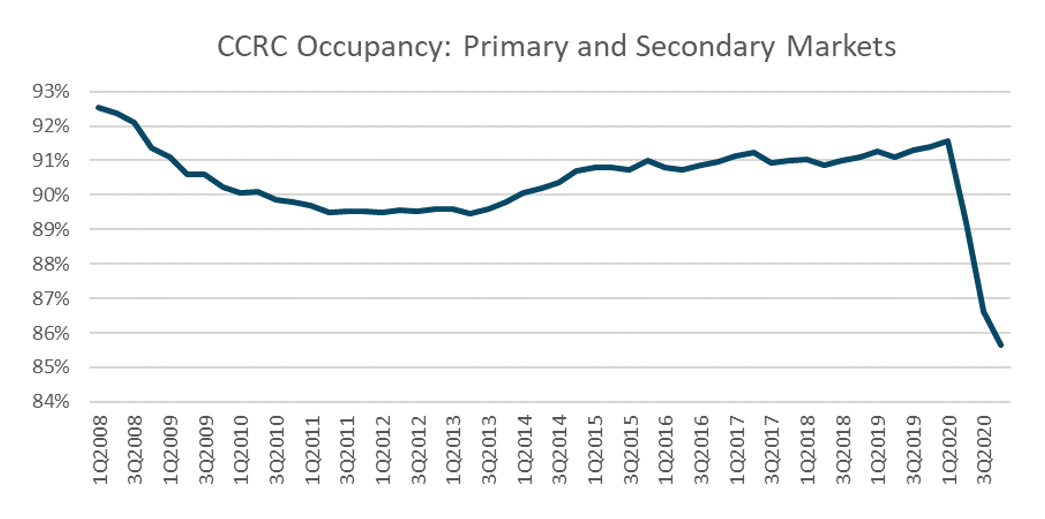
In the fourth quarter of 2020, CCRC occupancy fell 90 basis points from the third quarter to 85.7%, its lowest level since NIC MAP began reporting the data in 2006. The cumulative drop in occupancy was 350 basis points since the pandemic began to have an impact on occupancy rates. Prior to 2Q 2020, CCRC occupancy oscillated around 91% for 22 consecutive quarters.

ccrcchart1 

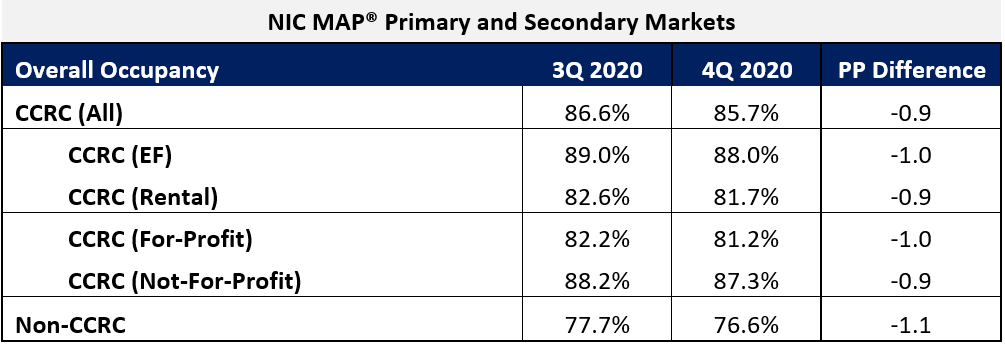
Non-CCRC occupancy averaged 76.6% in 4Q 2020—a very wide 9.1 percentage points lower than CCRC occupancy (85.7%). Entrance fee CCRC occupancy was 6.3 percentage points higher (88.0%) than rental CCRCs (81.7%), and not-for-profit CCRC occupancy was 6.1 percentage points higher (87.3%) than for-profit CCRCs (81.2%).

ccrcchart2


CCRCs vs. Non-CCRCs: Care Segment Detail

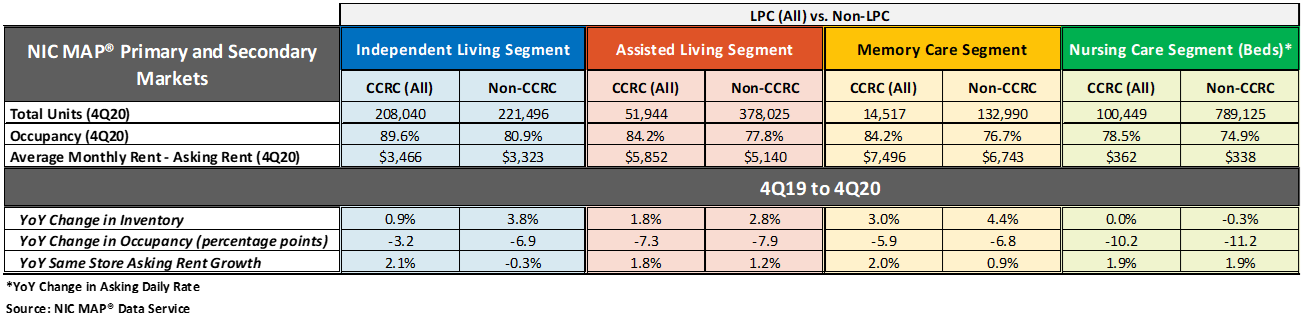
The table below compares each of the care segments—independent living, assisted living, memory care, and nursing care—in the Primary and Secondary Markets. The table shows the 4Q 2020 total open units, occupancy and average monthly asking rent—and year-over-year changes for CCRCs and non-CCRCs.

The CCRC independent living care segment (which represents 55.5% of CCRC units) garnered the highest occupancy in the fourth quarter of 2020 (89.6%), as well as the least year-over-year drop in occupancy falling 3.2 percentage points. The current nursing care segment occupancy rate in non-CCRCs, which represents 51.9% of non-CCRC units, was much lower at 74.9%, and fell 11.2 percentage points year-over-year.

 ccrcchart3


Higher occupancy at CCRCs

The CCRC independent living care segment had the highest 4Q 2020 occupancy (89.6%), followed by CCRC assisted living and memory care (84.2%, respectively), and CCRC nursing care (78.5%). Among non-CCRCs, the independent living care segment had the highest 4Q 2020 occupancy (80.9%), followed non-CCRC assisted living (77.8%), memory care (76.7%) and nursing care (74.9%).

The difference in 4Q 2020 occupancy between CCRCs and non-CCRCs was the highest for the independent living segment (8.7 percentage points), followed by the memory care segment (7.5 percentage points), the assisted living care segment (6.5 percentage points), and the nursing care segment (3.6 percentage points).

Occupancy declined from year-earlier levels for each of the care segments. However, CCRCs had lesser declines in occupancy than non-CCRCs. Among CCRCs, independent living care segment occupancy declined the least (-3.2 percentage points), followed by memory care (-5.9 percentage points), assisted living (-7.3 percentage points), and the nursing care segment (-10.2 percentage points). Among non-CCRCs, memory care and independent living segment occupancy declined the least (-6.8 and -6.9 percentage points, respectively), followed by assisted living (-7.9 percentage points), and the nursing care segment (-11.2 percentage points).

Higher annual, same store asking rent growth at CCRCs

Overall, CCRC same store year-over-year asking rent growth in the fourth quarter of 2020 was 2.4%, down from the time series high of 4.7% reached in the first quarter of 2019, but slightly higher than the time series low of 2.1% at the end of 2010, the end of 2013 and beginning of 2014. Year-over-year asking rent growth did not vary significantly across the CCRC care segments unlike the non-CCRC care segments; the variation was only 30 basis points for CCRCs but 220 basis points for non-CCRCs. Among CCRCs, the highest year-over-year asking rent growth was 2.1% in the independent living segment; among non-CCRCs it was highest in the nursing care segment (1.9%). The lowest year-over-year asking rent growth was noted for CCRCs in the assisted living care segment (1.8%); in non-CCRCs it was noted for the independent living care segment (-0.3%).

Significantly weaker inventory growth at CCRCs

Non-CCRCs had higher rates of inventory growth (year-over-year change in inventory) by segment than CCRCs, with the exception of the nursing care segment. The highest rates of inventory growth were reported for non-CCRCs in the memory care and independent living care segments (4.4% and 3.8%); the lowest were reported for both CCRCs and non-CCRCs in the nursing care segment (0.0% and -0.3%, respectively). Negative inventory growth can occur when units/beds that are temporarily or permanently taken offline, or converted to another care segment, outweigh added inventory.

Occupancy rates vary by region and payment type

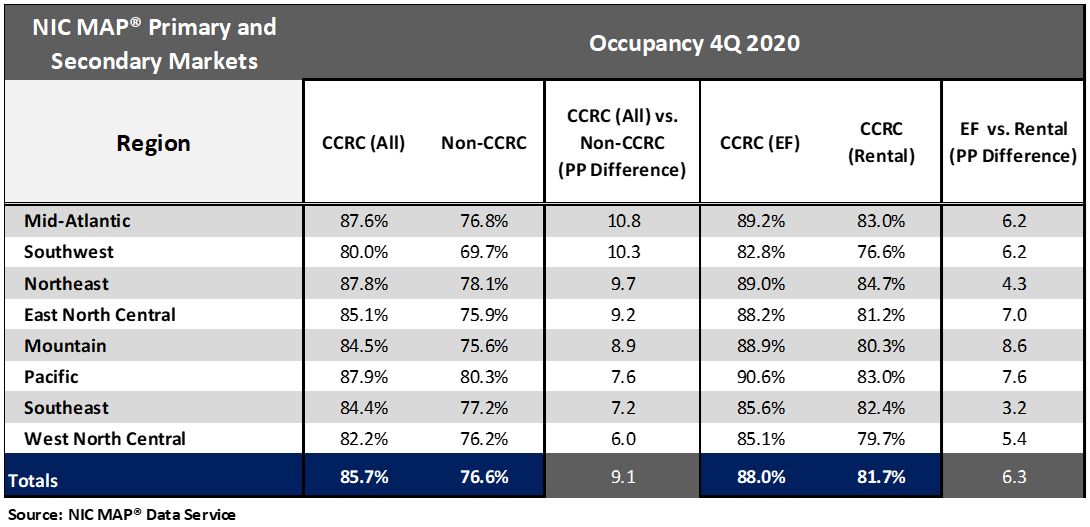
Seniors housing and care communities in the Pacific, Northeast, and Mid-Atlantic regions, which were more significantly impacted earlier in the pandemic than other regions, currently have the strongest CCRC occupancy rates ranging from 87.9% to 87.6%. The weakest CCRC and non-CCRC occupancy is in the Southwest region at 80.0% and 69.7%, respectively. That said, the greatest difference in CCRC and non-CCRC occupancy was in the Mid-Atlantic region—a 10.8 percentage point difference.

The difference in fourth quarter occupancy rates between entrance fee and rental CCRCs was the greatest in the Mountain region (8.6 percentage points), followed by the Pacific (7.6 percentage points), and the East North Central region (7.0 percentage points).

ccrcchart4

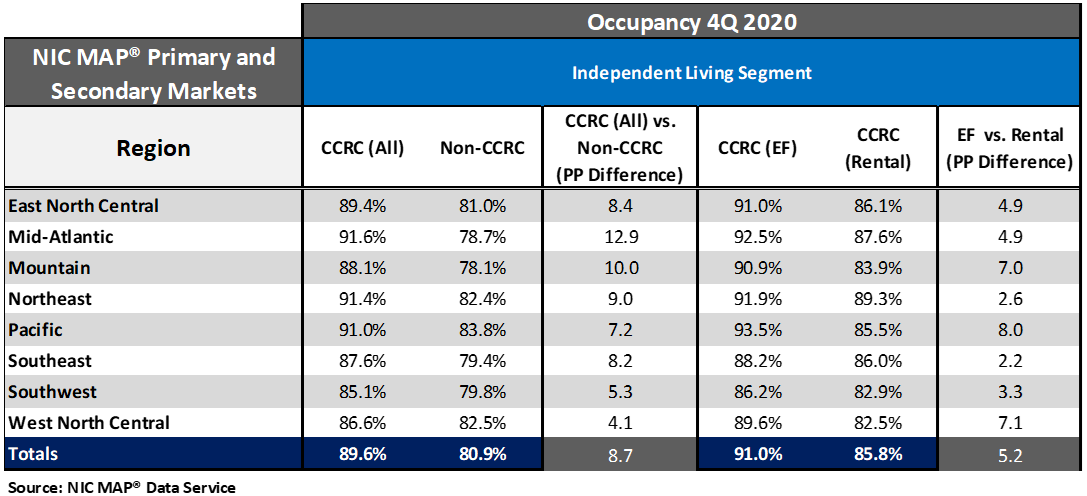
Looking specifically at the independent living care segment by payment type, the difference in fourth quarter occupancy rates between entrance fee and rental CCRCs was the greatest in the Pacific region (8.0 percentage points), followed by the West North Central region (7.1percentage points), and the Mountain region (7.0 percentage points).

ccrcchart5

Look for future blog posts from NIC to delve deep into the performance of CCRCs.

To learn more about NIC MAP® Data Service, and the latest metro-level data they can provide to support your organization through their various product offerings, schedule a meeting with a product expert today.

{{cta(‘bcaafbdc-4095-4a32-bab0-45f0ce50ac2e’)}}

Middle-Market Model Requires Creative Approaches

Alternative housing models for middle-income seniors were explored at the 2020 NIC Fall Conference in a session titled Senior Housing’s New Reality: Impacts and Ideas for the Forgotten Middle.

The senior living market faces a new reality. The economic fallout of the pandemic has put pressure on the affordability of many communities. Elders who previously had the resources to move into a community may no longer be able to do so, expanding the already large group of seniors with modest incomes in need of housing. At the same time, more middle-income seniors are drifting into the low-cost end of the market.

Alternative housing models for middle-income seniors were explored at the 2020 NIC Fall Conference. The session, “Senior Housing’s New Reality: Impacts and Ideas for the Forgotten Middle,” was led by Torey Riso, an investor and independent consultant. He was joined by John Cochrane, CEO, HumanGood; James Lydiard, staff vice president, CareMore Health; and Bill Pettit, president, R.D. Merrill Company.

Riso kicked off the discussion noting that a NIC-funded study in 2019 highlighted the need for middle-market housing. The study showed that 54% of seniors could not afford much of the seniors housing product on the market. “The pandemic focused attention on the already challenging reality to serve this middle market,” said Riso. He added that there is an opportunity to change the rules and reconsider all elements of the seniors housing model: the building, financing, services, staffing and payment sources.

The panelists discussed three different approaches to help reduce the cost of housing for middle-income seniors.

Create a Mixed-Use Community

HumanGood operates life plan communities and affordable housing for low-income seniors. The challenge is to meet the needs of the 80% of seniors who fall between those two extremes, noted Cochrane. “We have a unique opportunity to bridge the gap.”

Cochrane pointed to the successful example of Plaza Roberto Maestas, a transit-oriented community in Seattle’s Beacon Hill neighborhood, financed with public and private funding sources. The development is more than housing, creating a true community. Elements include affordable apartments for seniors and families, along with retail and commercial space, an early childhood facility and a community center. The project is situated around a central plaza, allowing all age groups to interact. “The project connects to the larger community,” said Cochrane.

Middle market communities will increasingly rely on complex financing structures, such as those used at Plaza Roberto. “That is the future,” said Cochrane. “No one size fits all.” He added that the size and stability of the affordable seniors housing market will attract investors that will enjoy reliable returns over a long period as well as a social benefit.

Rethink the Full-Service Model

Owner /operator Merrill Gardens primarily serves seniors in the upper 25% income category. But management felt the company was losing touch with its traditional middle-income base. So, Merrill Gardens partnered with ReNew REIT and purchased a portfolio of older seniors housing properties. The cost of the properties was lower than that of new developments which could help lower rents for residents.

The properties will be rolled out as a new brand for middle-income seniors. But despite the lower cost basis of the properties, Pettit noted that much of the rent is still driven by operations. “We need to think about how to deliver a valuable product for middle-income seniors,” he said.

The new brand will not be a full-service model. Instead, it will be designed around what typical seniors might do for themselves living at home. “We think middle-income seniors are more open to participating in their own needs,” said Pettit. For example, instead of a restaurant-style dining program with multiple menu items, the new model might offer food options more like those available at an extended stay hotel. The new model also will take a close look at alternative service delivery models to cut personnel expenses. “Take off your full-service hat,” Pettit advised.

Merrill is exploring partnerships with local providers, such as home health services. The family will also be a key partner to provide some care needs.

Pettit believes that through partnerships on the care side, and dining changes, that the buildings can operate at rents of $1,000 to $2,000 less a month than at higher-end properties. That provides a lower profit margin than that of the expensive projects. But when the real estate is acquired at a 40-45% discount to new development, the yield on cost is superior, according to Pettit.

Reduce Healthcare Costs

The pandemic has shown that housing and healthcare are intrinsically linked. Making healthcare accessible and affordable helps reduce care costs and increase the residents’ length of stay. CareMore offers a Medicare Advantage plan for seniors housing properties that can help offset care costs. When enough residents sign up for the plan, CareMore can provide medical personnel on-site. Also, working with one health plan can save the community staff time spent coordinating care among different providers. “Government funded dollars should be part of the equation,” said Lydiard. He added that the Medicare program is seeking novel approaches to reduce costs. Seniors housing, where care can be delivered efficiently to a growing number of elders, will be part of the solution.


The panelists agreed that more than one solution will emerge to meet the challenge to house middle and lower-income seniors. “This is a huge market, and its needs are varied,” said Cochrane. “There will be different models and we will need every one of them.”