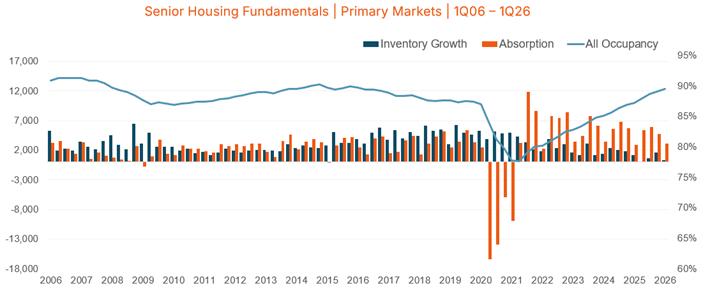
Senior housing occupancy increased 0.4 percentage points in the first quarter, with the number of occupied senior housing units once again reaching record levels. Year-over-year inventory growth continued to decline, hitting new record lows while average annual asking rent growth accelerated for both independent living and assisted living. These and other findings on first quarter 2026 senior housing data trends were presented by NIC’s Research & Analytics team during a recent webinar with NIC MAP clients. Additionally, Arick Morton, CEO at NIC MAP, presented details on the expanded number of markets in NIC MAP’s coverage, increasing from 140 markets historically to 214 beginning in 2026.
Key takeaways from first quarter 2026 data included the following:
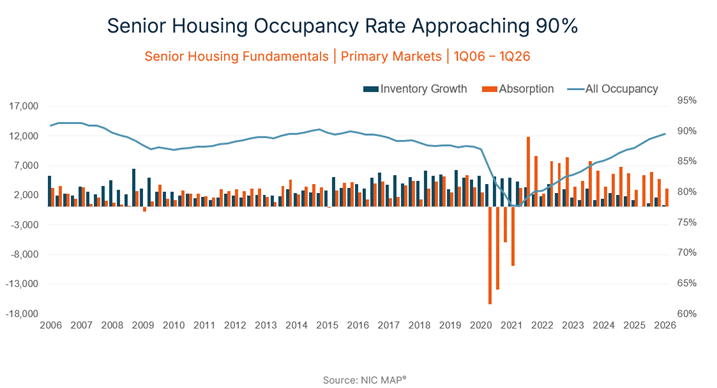
Takeaway #1: Senior Housing Occupancy Rate Approaching 90%
- The senior housing occupancy rate increased 0.4 percentage points in the first quarter for the 31 NIC MAP Primary Markets to reach 89.5%, driven by positive net absorption outpacing a low number of new units arriving online.
- At the current pace, occupancy rates remain on track to surpass 90% before the end of 2026.
- The NIC MAP Secondary Markets have already surpassed the 90% threshold after increasing 0.3 percentage points to reach 90.2% in the first quarter.
Takeaway #2: Independent Living Exceeds 91% Occupancy
- Breaking out occupancies by property type, both independent living and assisted living occupancy rates for the 31 Primary Markets rose 0.4 percentage points in the first quarter.
- Independent living surpassed 91% occupancy for the first time since 2016 in both the Primary and Secondary Markets.
- Overall, solid gains for both property types illustrate the choice-driven demand from the younger or healthier older adults moving into independent living, as well as the need-driven demand from those seeking assisted living services and care.
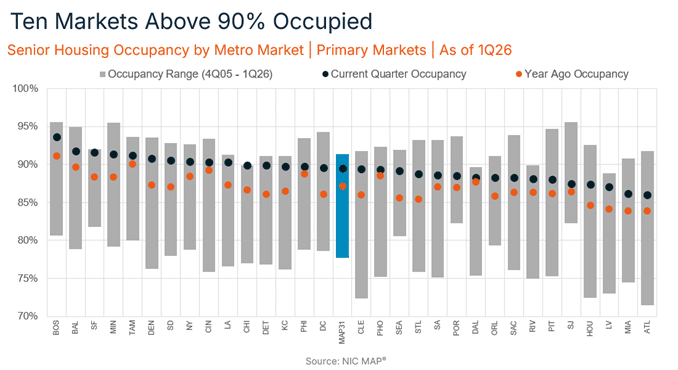
Takeaway #3: Ten Markets Above 90% Occupied
- Ten of the primary markets had occupancy rates above 90% in the first quarter, up from seven markets in the fourth quarter of 2025 and five markets in the third quarter of 2025.
- There are several markets where occupancy rates today are near or even slightly above their all-time highs, such as San Francisco (91.6%), Los Angeles (90.3%), Dallas (88.3%), and Chicago (89.9%).
Takeaway #4: Inventory Growth Hit New Record Low
- Turning to inventory growth, a continued decline in new supply arriving online in the 31 NIC MAP Primary Markets has helped drive occupancy rates higher.
- By property type, year-over-year inventory growth hit a new record low, increasing by only 0.4% and 0.3% for assisted living and independent living, respectively.
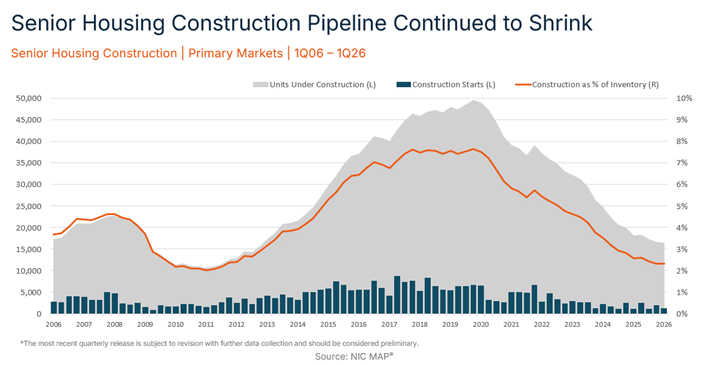
Takeaway #5: Senior Housing Construction Pipeline Continued to Shrink
- Drilling down into construction activity, despite increasing occupancy rates, the development response remains notably slow.
- Total units under construction fell to roughly 16,400 in the first quarter, levels last seen in 2012.
- On a percentage basis, construction underway totals only 2.3% of existing senior housing inventory, among the lowest levels in the time series.
- This shrinking construction pipeline indicates that the pace of new supply is unlikely to accelerate in the near term.