Senior Housing Unit Mix: An Important Factor for Better Performance

Many factors play a role in determining the performance of an individual senior housing property. One of these considerations is unit mix.

Omar Zahraoui cropped

INTRODUCTION 

Many factors play a role in determining the performance of an individual senior housing property. One of these considerations is unit mix, i.e., the share of studios, one-bedroom, or two-bedroom units within a single property. The unit mix of a senior housing property is a critical aspect of a property that must be carefully planned, managed, and executed upon. Senior housing constituents, both upstream and downstream, understand that the proper unit mix of a property is a vitally important component of maximizing occupancy and minimizing resident turnover as a resident moves through the continuum of care. 

In this article, NIC Analytics examines market fundamentals by unit mix across the senior housing care segments (i.e., independent living, assisted living, and memory care segments) in the 31 NIC MAP® Primary Markets. The exhibit below provides a detailed view of the unit mix distribution, occupancy recovery, supply and demand dynamics, as well asking rate growth across different unit types and care segments.1  

ACTIONABLE INSIGHT 

When planning the unit mix for a senior housing property, it is important to conduct a market analysis to understand the demand and supply factors in the area. Also, it’s a good idea to keep in mind that trends and preferences can change over time. Ultimately, the unit mix should be designed to meet the current and future needs of the aging residents as well as the personal preferences and lifestyle of the target population, while also considering the local market conditions and trends. The unit mix of a property also depends on how large it sizes each care segment, and partly on the sizing of the units within each care segment. 

KEY FINDINGS 

Unit Mix 

The exhibit below shows that unit mixes vary significantly among senior housing care segments and tend to skew toward smaller-sized units (i.e., units with fewer rooms) as acuity increases and residents move through the continuum of care. This trend of older adults in senior housing downsizing from larger units to smaller units is driven by a number of factors, including a desire for less maintenance and upkeep, an opportunity to increase efficiency for residents with mobility impairments, and the affordability aspect associated with meeting higher care expenses.  

Studios are most prevalent among assisted living and memory care segments. Within the NIC MAP Primary Markets, studios account for about 56% of total units within the assisted living segments and 85% for the memory care segments. Studios are typically the most affordable unit type in senior housing, making them a popular choice for single-person households.  

The independent living segment—frequently more of a lifestyle choice than need-driven—generally offers more one- and two-bedroom units but fewer studio units than assisted living and memory care segments. Notably, independent living segments in the NIC MAP Primary Markets have the most diverse mix: 49% are one-bedroom units, 33% are two-bedroom units, and 11% are studios, with an occasional three-bedroom unit or cottage.  

Occupancy Recovery 

In the last decade, independent living segments have generally experienced stronger occupancy rates compared with assisted living and memory care segments. This is mainly due to more restrained supply and development pipelines, more affordable monthly rates, as well as longer length of stay as residents of independent living generally prefer to age self-sufficiently for as long as possible.  

At 85.4%, occupancy for the independent living segment continued to be relatively higher than other segment types in the fourth quarter of 2022 but has the most room left to fully recover and return to its pre-pandemic level (90.0%). By comparison, occupancy for assisted living segments was lower at 81.4%, while occupancy for memory care segments was lowest at 80.7% but has the least room left to fully recover to its pre-pandemic level of 82.6%. 

The exhibit shows that in independent living, as unit room count increases, occupancy rates tend to be higher. However, in assisted living and memory care segments, smaller units tend to have relatively higher occupancy rates compared with larger units. 

In the fourth quarter of 2022, three-bedroom and two-bedroom units in independent living segments had the highest occupancy rates (90.5% and 88.1%, respectively), followed by one-bedroom units (84.3%), and then studios (83.8%). By contrast, in assisted living and memory care segments, one-bedroom and studio units had relatively higher occupancy rates compared with two-bedrooms. At 83.0%, one-bedroom occupancy was the highest in assisted living segments, while occupancy for studio units in memory care segments ranked first at 81.6%.  

These most occupied unit types – larger units in independent living and smaller units in assisted living and memory care segments –  experienced relatively smaller occupancy declines during the height of the pandemic, have maintained higher occupancy rates compared with average occupancy for each respective care segment, and now are closest to full recovery and a return to pre-pandemic first quarter 2020 levels; except for the memory care segment where two-bedroom occupancy is well-above pre-pandemic levels. (As background, occupancy for two-bedroom units in memory care segments has generally been more volatile due the relatively small number of units, but it’s worth nothing that since the pandemic began, supply and demand dynamics showed increasing interest in this type of memory care unit.) 

Demand Dynamics 

In the fourth quarter of 2022, the difference between the occupied stock for independent living segment and that of assisted living segment was the smallest in the timeseries. In other words, the occupied stock for the assisted living segment has been growing at a relatively faster pace than for independent living segment. The same high acuity trend applies when comparing occupied stock for memory care segment with assisted living or independent living segments. 

In independent living, occupied stock across larger units has recovered most of the units placed back in the market. Three-plus bedroom units have recovered 100% of the units vacated during the height of the pandemic, and in fact, exceeded first quarter 2020 occupied stock by 4.0%, followed by 2-bedroom units (71% of units have been reoccupied but occupied stock remained negative 1.4% relative to pre-pandemic levels). Across assisted living, one-bedroom and two-bedroom units have recovered 100% of the units vacated during the pandemic and surpassed pre-pandemic level. This was also the case for studios and two-bedroom units in the memory care segment.  

Supply Dynamics 

Over the period from first quarter 2020 through fourth quarter 2022, the stock of units within the independent living segment increased in all unit types but studios. Three+ bedroom units had the highest pace of inventory growth at 5.8% or 999 units, but one- and two-bedroom units added the largest number of units on a net basis (2,531 and 2,119 units, respectively). Similarly, across assisted living segments and memory care segments, larger units had the highest percentage increase, but on a net basis, smaller units had the largest number of units added to the market. 

Largely due to impact of higher interest rates and capital market dynamics, a slowdown in the growth in senior housing inventory and development activity is helping to bring supply and demand into better balance. In the fourth quarter of 2022, all unit types across senior housing care segments showed a slowdown in construction as percent of inventory, in many cases below 1% and in all cases far below pre-pandemic first quarter 2020 levels. 

While new inventory compounded the downward pressure on occupancy during the height of the pandemic, this trend of construction starts slowing down will serve as a tailwind for the occupancy recovery. In fact, occupancy across the three senior housing care segments recorded six quarters of positive momentum and consistency, suggesting that senior housing is now on a trajectory of rising occupancy rates and better supply/demand patterns broadly. Notably, this is not the case, however, in all geographic markets. 

Year-over-year Asking Rent Growth 

The effects of inflation and rising costs are reflecting on asking rate growth across all senior housing care segments and unit types. From year-earlier levels, asking rates rose to the highest levels in the timeseries across all care segments and unit types in the fourth quarter of 2022. Memory care segments recorded the largest year-over-year increases, ranging from 6.5% for one-bedroom units to 11.7% for two-bedroom units, followed by assisted living segments (ranging from 5.3% for one-bedroom units to 7.3% for two-bedroom units). Growth in asking rates was less for independent living but was still high compared with pre-pandemic year-over-year increases across all unit types. Note these figures are for asking rates and do not consider any discounting that may be occurring.  

In conclusion, the layout and unit mix of a property is an important consideration in occupancy patterns and should be considered in developing or evaluating a senior housing property. The unit mix in turn is driven by market dynamics, including location, demographics, and resident income profile, as well as the vision of the senior housing property owner. While smaller units are currently more prevalent among assisted living and memory care segments, larger units may appeal to a different resident profile in the foreseeable future i.e., middle income residents seeking to share with other residents a larger unit with multiple bedrooms to reduce monthly rates and increase efficiency and socialization. In fact, larger units are relatively affordable (even when compared with studio units) if they house more than one resident, despite the relatively large increases in monthly rates across all care segments.
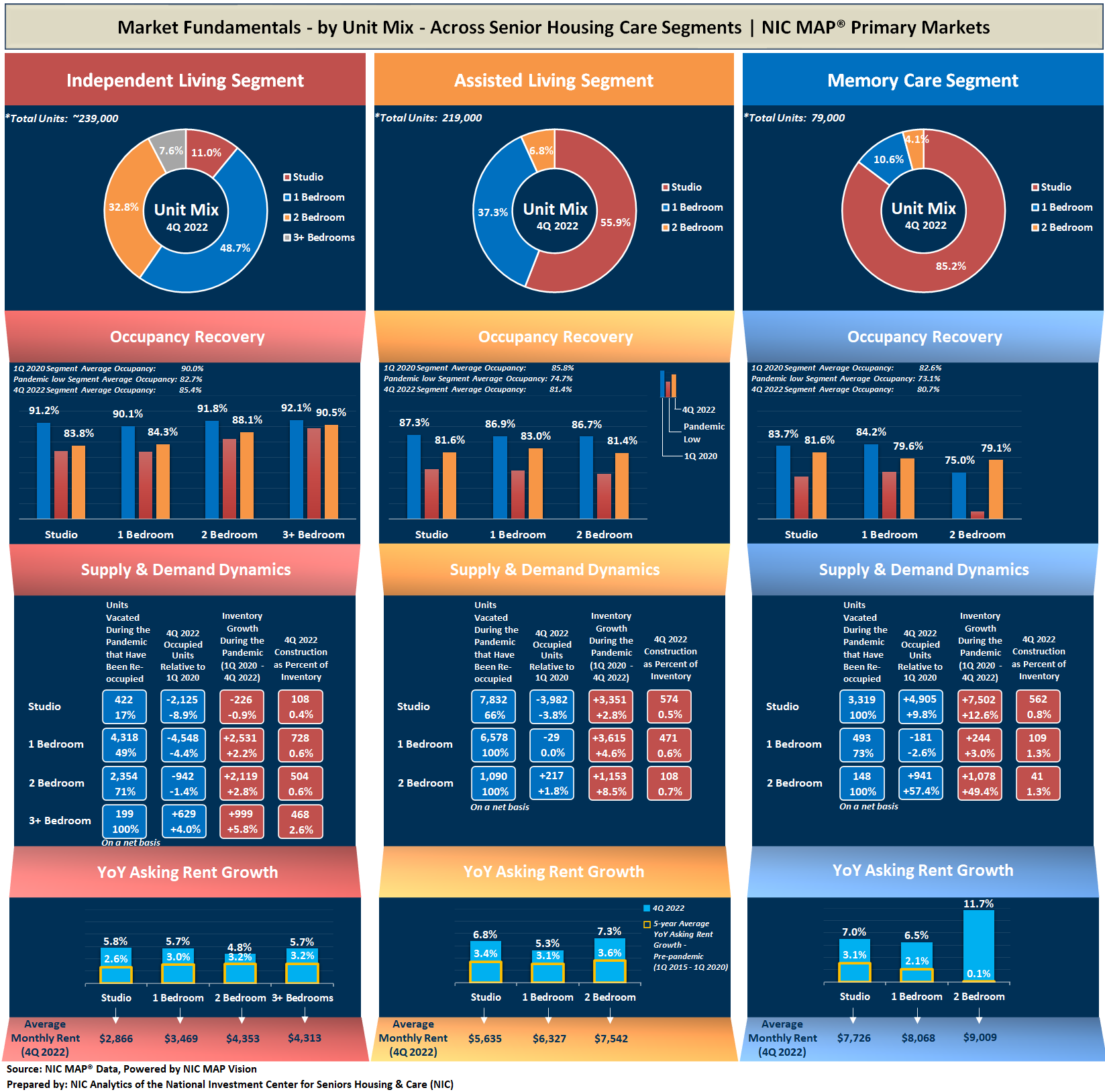
Exhibit V5

— 

1 Note this analysis only includes properties reporting the unit mixes within the senior housing care segments. This means that properties and segments with unknown unit mixes were excluded from the analysis. This article also uses the segment type designation from NIC MAP, meaning that the data used in this analysis are units that can be located at any type of senior housing property, with respect to segment type. 
Take Action with 2023 NIC Spring Conference Innovation Labs

NIC takes pride in creating conferences that equip attendees with expert-tested tools, concrete connections, and actionable insights they need.

“The topics that are explored and discussed at great length have been very relevant. They allow me to think deeper, pose more questions, but also find other like-mind people who are in the same situations.”

– Katie Perry, Knute Nelson –2022 NIC Spring Conference Attendee 

NIC takes pride in creating conferences that equip attendees with expert-tested tools, concrete connections, and actionable insights they need to increase access and choice for America’s older adults. Unlike trade shows, which can become an endless maze of booths, exhibits, and competing events, NIC Conferences are expertly curated to ensure attendees benefit from a variety of opportunities for efficient networking and learning.

To further achieve this goal, NIC is introducing Innovation Labs at the 2023 NIC Spring Conference—hands-on workshops designed to facilitate collaboration and idea sharing between attendees and the innovators already steeped in the topic. These up-close-and-personal sessions will give attendees the opportunity to learn from early adopters and innovators who are already making healthcare and housing integration a reality.  

Here’s a breakdown of the five Innovation Labs at the 2023 NIC Spring Conference—and why you need be in the room. 

Launching Value-Based Care

How to Begin Your Journey in Value-Based Care will piggyback off of the main stage sessions devoted to value-based care. It’s the answer to your question, “But how do I get started?” The session’s five subject matter experts will give attendees more individualized attention and make it easier to ask questions through polling. The subject matter experts will discuss primary care models that benefit residents’ health and operators’ business models, how you find the right partner, and more. 

A second Innovation Lab on value-based care will walk attendees through the creation of an implementation plan. The seven subject matter experts in Customizing a Value-Based Care Strategy for Operators will split the room into small groups, each with an experienced operator, primary care partner, special needs plan, and/or a value-based care consultant. This gives attendees direct, hands-on support from the subject matter experts as they co-create a plan for implementation and tackle lingering questions. 


Getting Active in Active Adult
 

There has been a lot of talk about Active Adult—the newest red-hot housing segment for older adults—but how do you get started? This session, Active Adult Tools for Success: Market, Product, and Lifestyle, subject matter experts will highlight the top three things operators need to know to become active in the space. First, operators must consider the state of the economy and how supply metrics and construction starts should impact Active Adult considerations. Second, what defines an Active Adult property, what market characteristics to look for, and what makes the product feasible overall. Finally, subject matter experts will outline the lifestyle and healthcare offerings that customers will expect. 

Confronting Operational Challenges & Opportunities 

Economic changes continue to impact the industry. Keepin’ It Real – Let’s Talk Margin will be a frank discussion on the macro impacts of the economy on senior housing and related industries. From the senior housing perspective, speakers will discuss near- and long-term trends related to inflation and unemployment and their effects on supply chains and operating costs. These challenges will be compared and contrasted to the experience of the hospitality industry, and the strategies those leaders have used to overcome occupancy and workforce challenges. 

In keeping with the theme of the conference, What Capital Sources Need to Know About Operators will offer capital providers insights on how to form successful partnerships with operators: the questions they should ask, the qualities to identify, and the top five metrics they should look for in a potential partner. The subject matter experts, divided into Family Feud-style teams, will reveal the top five metrics capital sources should assess in a potential partner. Is it operator to capital relationship, HR community levels, sales and marketing data, or something else? You’ll have to be in the room to find out. 

Over the course of the three-day conference, there will be abundant opportunities for all attendees to leave with concrete, actionable strategies to improve access and choice for America’s older adults. Join us.

Moving Healthcare Upstream: Opportunities for Senior Living

Dr. Shah will share his expertise in health and healthcare as a keynote speaker at the 2023 NIC Spring conference (March 1-3).

2023 NIC Spring Conference Preview  

Nirav R. ShahNirav R. Shah, MD, MPH, a Senior Scholar at Stanford University’s School of Medicine and Chief Medical Officer of American Health Associates, is a leader in care innovation for older adults.  Dr. Shah will share his expertise in health and healthcare as a keynote speaker at the 2023 NIC Spring Conference (March 1-3). Shah’s research focus areas include improving care for family caregivers, expanding the reach of PACE programs, and improving outcomes in nursing homes. Board-certified in Internal Medicine, Dr. Shah is a graduate of Harvard College and Yale School of Medicine, and is an elected member of the National Academy of Medicine. 

In advance of the upcoming NIC Spring Conference session, I recently spoke with Dr. Shah about how changing healthcare landscape and payment models can mean opportunities for senior living operators.  

Marcet: Dr. Shah, tell us about your experience in healthcare and how that has shaped your beliefs about the future of healthcare payment and delivery. 

Shah: I’ve been a practicing physician, regulator, operator, payer, and public health leader. Collectively, these experiences have convinced me that we need to move upstream and keep people as healthy and active as possible. By focusing on prevention rather than only taking heroic measures when it’s often too late, we can do good and do well. That is, I think the healthcare system is finally starting to align incentives so that we can consistently have that upstream focus. With more systems taking on risk and learning about value-based care, the only way to make margin is to keep people healthy and out of the hospital, to know an individual’s health needs, and help deliver health at home. In fact, this is what people want, and is perhaps a good “side effect” of what Amazon and COVID-19 taught us, that consumerism when it comes to healthcare demands high quality, safe, reliable, and timely care that’s personalized and on your schedule at home — not just when it’s convenient or how it’s been done by traditional healthcare delivery systems for decades. 

Marcet: What is driving the changes in how we think about health and how and where healthcare is delivered and paid for? Does this shift change the value of senior housing and care to our healthcare system? 

Shah: For years, seniors housing focused on the residential aspects of an individual or couple’s needs, and stayed away from healthcare because of regulatory concerns. Now, with the shift in how healthcare is paid, the many opportunities to keep people healthy are most apparent in the home. So there is a big move away from focusing on hospitality alone, to delivering healthcare as well. For some, this means renting space to a PT practice onsite, or affiliating with a physician group. For others, “frontier” operators are even running their own insurance plans. While that model may not make sense for most operators today, there is lot of value to be captured by thinking outside the box, and partnering with healthcare providers and insurers in ways that keep people healthy and thereby in your environment longer. This is especially urgent given the changing demographics — with older residents who have multiple health conditions the ‘new normal’ in seniors housing. 

Marcet: Specifically, what are the implications of hospitals coming to be viewed as cost centers rather than revenue centers? Why does this shift matter to the senior housing and care industry? 

Shah: Today a hospital in a value-based contract will be paid the same regardless of a one-day stay or a five-day stay for a given procedure. So hospitals want to shift care — and cost — outside their four walls to other sites. For a traditional nursing home operator, becoming a “super SNF” that combines medically complex care with high-end hospitality (and resulting higher reimbursement) might make sense. So, the hospital of tomorrow is an Emergency Room with an ICU on the second floor — most elective surgery and procedures such as colonoscopies have already moved out of hospitals to ambulatory sites. The nursing home of the future is today’s hospital ward. And home is where people want to stay and get care, and this becomes the main site for almost all care supported by telehealth, remote patient monitoring, visiting clinical staff, and even hospital-at-home care models. 

Marcet: Value-based care (VBC) is an acronym we hear a lot these days — along with talk of risk-based models of care and payment, social determinants of health (SDOH), Medicare Advantage (MA) plans, and ACOs (Accountable Care Organizations). Is this just the latest fad or buzz in healthcare similar to the push to managed care in the 80s and 90s that then faded away with negative press and consumer reaction (there has been a lot of negative press about MA plans lately, for instance) or is this a movement that will fundamentally reshape healthcare delivery and payment in the U.S.? Put another way, as a senior housing and care operator, owner, or investor, should I be paying close attention to this movement and anticipating NOW what it means for me and what opportunities/challenges it offers, OR should I sit back and wait till the dust settles to see what meaningful long-term changes result?  

Shah: There is a component of hype with today’s level of interest in Medicare Advantage plans and the many other new programs. But their fundamental premise of paying for value is built on decades of previous work. So while MA may see reimbursement cuts in the coming years, for example, the promise of paying for value remains, and learning how to function in a world where upside and downside risk is shared, where personalized health is prioritized, where the “consumer” is king, and where dollars flow to whomever can best keep people healthy — these are foundational elements that won’t change, even if another acronym is the primary vehicle of value-based care. 

Marcet: Does the current push “moving health home” provide opportunities for senior living providers and, if so, what are necessary steps to take advantage of those opportunities?  

Shah: First, providers have the opportunity to understand their residents better than almost anyone else. Who best than someone with 24/7 access to a patient to understand her unique wants, needs, and preferences for care? Invest in those skills.  

Second, as a trusted partner to a resident, senior living providers can best guide an individual to the right mix of services to keep her healthy. That means providers need to be able to discern among healthcare options, and not just go with whomever has the best marketing or revenue opportunity — but serve as an advocate for the resident. It’s incumbent on providers to take on the stewardship role, as they know the geographic region with its unique mix of clinical providers better than any single family, and can take a long-term perspective for the resident’s benefit. 

Third, in the near future, every provider will need a good answer for in-person or “last mile care” in the home, which includes diagnostics such as radiology and laboratory, triage with home-based assessments, and post-acute care monitoring and management. Already family members ask about such healthcare options before they ask about a facility’s dining options — and this emphasis on high quality healthcare in the home will only accelerate. 

Back to 2000 With Eyes on Future Change

I recently had the opportunity to attend the ASHA Annual Meeting in Scottsdale, and the mood was both reflective and forward-looking.

I recently had the opportunity to attend the ASHA Annual Meeting in Scottsdale, and the mood was both reflective and forward-looking.  

Looking back. Current economic conditions were compared to 2000 and 2001 when tech spending dropped off a cliff following a run-up in tech purchases in preparation for “Y2K.” The tech industry today is undergoing a similar reckoning as the world reopens and pandemic restrictions are eased. Business and consumer spending have been redirected to other sectors. Predictions were made for a slowdown in 2023 that mirrors the 2000-2001 slowdown – rather than an outright recession – although interest rate sensitive sectors such as real estate will be impacted to a greater extent. 

What hasn’t changed. Higher expenses and competition for labor continue to be top of mind. On a positive note, occupancies have rebounded from the depths of the pandemic – improving revenues – and many operators have been able to push through rate increases. These positive tailwinds, however, have not been enough to offset the rise in labor, debt, and other expenses. Interestingly, it was noted that, while necessary, rate increases are unfortunate as the industry is vying to make housing for older adults more affordable.  

Looking ahead. Capital providers and developers are hitting the pause button on new projects due to high construction costs and erosion in operating margins. A positive note was that construction was an issue of concern before the pandemic, but the lower level of development in 2022 and 2023 is helpful for occupancy recovery. Also positive is that concessions are beginning to abate. Given the increase in the cost of capital, however, there may be greater investment opportunities on higher quality assets that have the ability to push through rent increases. If the Fed keeps rates at an elevated level, the buyer pool will shrink due to the lower availability of debt, and regulators are pushing banks to get loans paid down. 

On valuations, cap rate estimates are up roughly 75 basis points from a year earlier to around 6%. Almost all appraisal activity is for current assets – not acquisitions – and there is concern that a pick-up in distressed sales could impact valuations for well-performing assets.  

Value-based care drew great interest and excitement about senior housing’s ability to improve health, lower costs, and provide better care for older adults with the support of a trusted health care partner. Longer stays and value-based revenue, coupled with lower expenses, can improve NOI, and one case presented showed an increase of 5-15%. Attendees throughout the conference agreed that senior housing deserves a seat at the policymaking table to get the best results in value-based care. 

Other efforts on the affordability and margin front include engaging residents in volunteerism and ensuring that services are priced correctly, which also helps to reduce acuity creep. Labor availability should normalize due to higher wages and less competition from other sectors. Diversity efforts are expanding with training programs at the less experienced levels, while also casting a wider net for Board of Director openings. Sustainability also drew great interest as the industry continues to implement day-to-day improvements such as utilizing Energy Star technology and earning a WELL certification. 

Technology is being carefully adopted, but it needs to be interoperable from Day 1, seamlessly jibing with a community’s existing technology, and it needs to prove useful. For example: 

  • Digital menus are cool but do our residents need or want them?  
  • Can the technology provide day-to-day efficiencies to free up staff for resident interaction and care?  
  • Can CRM improve our sales process? 
  • Can technology help manage data in a value-based setting? 

On the opposite side of the table, age tech vendors want to know operators’ long-term IT strategies so that technology can best drive those plans forward.  

The senior housing industry has endured much in recent years, and the ASHA Annual Meeting showed that our sector continues to work hard and to persevere in improving housing and care on the behalf of older adults. 

Stop Talking, Start Doing: Expert Speaks on Medicare Trends, Opportunities

Now’s the time to stop talking and start doing, according to Dr. Sachin Jain, CEO of SCAN Group and SCAN Health Plan.

2023 NIC Spring Conference Preview

Sachin JainForget trying to design the perfect healthcare partnership. Now’s the time to stop talking and start doing, according to Dr. Sachin Jain, CEO of SCAN Group and SCAN Health Plan, one of the nation’s largest and fastest growing not-for-profit Medicare Advantage plans.

With a BA, MBA, and MD from Harvard University, Dr. Jain will offer his provocative take on Medicare trends as a keynote speaker at the 2023 NIC Spring Conference (March 1-3). The Friday session will include a panel of experts who will discuss how private pay senior housing operators can tap into Medicare payment models, including Medicare Advantage (MA) plans which are experiencing exponential growth.

As a teaser for the upcoming Spring Conference audience, NIC Chief Economist Beth Mace recently talked to Dr. Jain about the future of MA plans and the partnership opportunities for senior housing providers.

Mace: Can you tell us about a few trends you see in Medicare and how those may impact operators of senior housing?

Jain: There is more scrutiny of the Medicare Advantage (MA) program and that is a good thing. More than 50% of Medicare beneficiaries receive their healthcare services through MA plans. So, I think it’s worth pausing to look at the program and identify some of the opportunities. The areas for improvement fit into three categories. First is risk adjustment, which is a controversial topic. We want to get risk adjustment right because we want to create incentives for healthcare organizations to want to take care of sicker MA beneficiaries, but we don’t want to go so far as to create an arbitrage situation wherein plans are selectively enrolling certain populations because the cost of their medical care is less than what the government will pay for them. We do see evidence of that behavior.

The second major trend is the growth of specialized plans for particular populations. Operators are familiar with Institutional Special Needs Plans (I-SNPs). These plans focus on home, and institution-bound older adults. But there are opportunities to look at specialized plans for other groups, such as those with dementia. For example, SCAN recently launched a product for LGBTQ+ seniors called Affirm. Twenty years ago, it would have been unimaginable to have a specialized plan for that population. But with the consumerization of healthcare, there will be more need for specialized products and programs for patients of a particular kind.

The third trend, more broadly, is the increasing clinical push of MA programs around care in the home. We must be careful and thoughtful about this. A lot of home healthcare is well delivered, and a lot is not well delivered. Senior housing operators need to answer the question around which types individuals are best managed in their buildings. There is an opportunity for operators to clearly articulate the value they deliver to patients and their families. One of greatest challenges is acknowledging the difference between what we say we do and what we do in practice. Every healthcare organization should have a struggle between the words in their mission statements and what they’re actually doing in practice.  Too often we don’t leave space for that self-skepticism. You cannot improve until you acknowledge you’re not perfect.

Mace: As one of the nation’s largest not-for-profit Medicare Advantage plans, SCAN’s mission is to keep seniors healthy and independent. Can you tell us about your organization and its mission? Why was SCAN established and when? And how large is it today?

Jain: SCAN was founded in 1977 by a group of racially and gender diverse community activists in Long Beach, California, who believed the future of aging should be oriented around aging in place. They created a coalition of community-based organizations and called themselves the Senior Care Action Network (SCAN). The primary work of the network in the 1980s and ‘90s, was to operate a social HMO, a major CMS demonstration project focused on integrating the social determinants of health to improve healthcare outcomes. SCAN operated the longest running and most successful of all the social HMO demonstration projects. When CMS phased out the project, we turned our sights into operating as a Medicare Advantage plan. And we have been an MA plan for more than 20 years. Over that time, we have grown to serve more than 285,000 Medicare beneficiaries in four states: California, Nevada, Texas and Arizona. We also operate four diversified care delivery divisions: Welcome Health, focused on home-based geriatric care; Homebase Medical for home-based chronic disease management and palliative care; Healthcare in Action, focused on homeless medical care; and myPlace Health, a PACE program in collaboration with Commonwealth Care Alliance. The unifying theme among our divisions is all the different ways to keep seniors healthy and independent.

Mace: SCAN has a specific focus on “reinventing aging.”  What does that mean?

Jain: From a clinical strategy perspective one of the most important things that health organizations that serve older adults can do is to take a look at what I call the inflection points in their lives. One point is turning 65 and becoming Medicare and Social Security eligible. Another inflection point is the diagnosis of a chronic disease or the significant progression of a chronic disease, such as diabetes. The third point is a new diagnosis of cancer. And the fourth is the first fall or fracture from a fall. The goal is to look at each inflection point and do more for people at the point of inflection as they transition from curative care and eventually to hospice care. Every organization should be thinking about how to wrap services around the patient and family to prevent or delay those inflection points, or to support people through those points. That’s how we think about our work at SCAN.

Mace: How can senior housing operators partner with value-based care and Medicare Advantage plans?

Jain: We have lived in the space of strategic possibility for a long time. I’ve been around the Medicare Advantage space for many years and there’s always this perfect partnership just within reach with building operators. Then we get stuck on economics, clinical models, organizational charts, and leadership questions. The answer is some version of the Nike saying, “Just Do It.” We need to do something and learn from it. We are not going to get the perfect partnerships on day one. But there is a clear strategic alignment between Medicare Advantage plans and what senior housing operators do. We are both trying to keep our members and residents healthy and independent to age in place. The question we struggle with is how to unlock shared value and achieve regulatory compliance. There are ways to do it. We have seen successful partnerships. But there is a disconnect between day-to-day building operations and the desire at the corporate level to adopt a more strategic approach. The goal is to close the gap between the high-level intent of the corporation and the ground game played at the individual building level.

Mace: You also focus a lot of effort on social determinants of health. Why is this important, what does this mean, and how do you do this?

Jain: The ‘social determinants of health,’ I believe, is a fancy term for poverty. What happens when you’re poor? You cannot get the food you need, pay rent, or keep the lights on. Our model supports patients through specialized programs for their needs in each area.

Mace: Our operators have eyes 24/7 on residents and have the opportunity to shape people’s choices, influence activity levels and socialization, and yet not many senior living properties are doing that with Medicare Advantage plans. How does senior housing fit into the MA paradigm?

Jain: Senior housing fits in from the perspective that it is the coordinator of the lives of building residents. Also, senior housing can play a role to coordinate access to MA benefits that residents may not know how to obtain.

Mace: Recently, there has been criticism of Medicare Advantage plans. Is that criticism likely to slow the growth of movement by seniors to MA plans?

Jain: I think people have spoken. The criticism is at a macro level. Older people are choosing MA plans because they provide distinctive value. I have a Forbes column that takes a critical look at the fee-for-service model. It is not a panacea. There are huge coverage gaps. Some major expenses are not covered. Categories of benefits are not covered, such as vision, dental and hearing. We have an opportunity to continue to fine-tune MA programs. We cannot ignore the fact that 50% of older adults are MA beneficiaries. Much of the federal regulatory system missed the boat on this. I wrote another Forbes article on the idea that government agencies should focus on innovations in the MA program.

Mace: Should senior housing operators be cautious about working with Medicare Advantage plans?

Jain: Caution is one word. Another word is experiment. Create a partnership of whatever variety. You don’t know what you don’t know until you get started. There is so much latent potential around MA plans and senior housing operators. We’re leaving a lot of opportunity to improve healthcare on the table.

Mace: Is there anything else you would like to add?

Jain: We recently announced the creation of the HealthRight Group, the combination of SCAN and CareOregon. Nonprofit community-based health plans need scale to drive sustainability. When we receive regulatory approval, SCAN and CareOregon will come together under the HealthRight Group umbrella. I’d like to emphasize that senior housing operators have the opportunity to partner with community-based health plans. One of our goals is to create partnerships with operators to improve care for Medicare and Medicaid eligible beneficiaries.

Note: Dr. Jain will be the keynote speaker at the 2023 NIC Spring Conference main stage session, “The Trends and Opportunities in Medicare All Operators Should Be Tracking” on Friday, March 3, 8:30-9:30am.

NSC-2023-General-Site-Banners-Partnering-overview