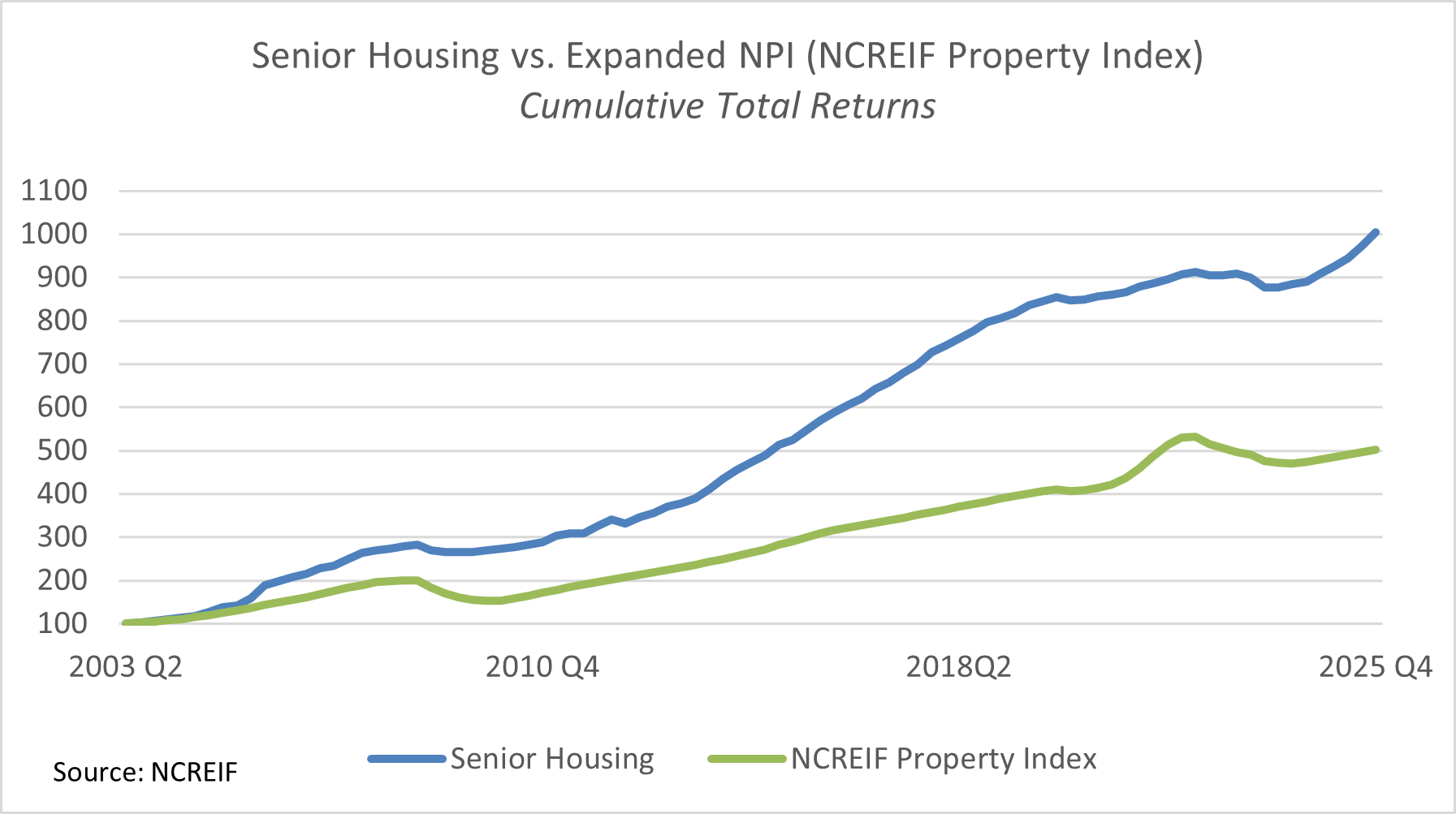
NIC’s Research & Analytics team presented findings during a webinar with NIC MAP clients on January 22, reviewing key senior housing data trends during the fourth quarter and full year 2025. Additionally, Traci Bild, CEO at Bild & Co, presented and analyzed sales and occupancy trends.
Key takeaways included the following:
Takeaway #1: Occupancy Rates Climbed Higher
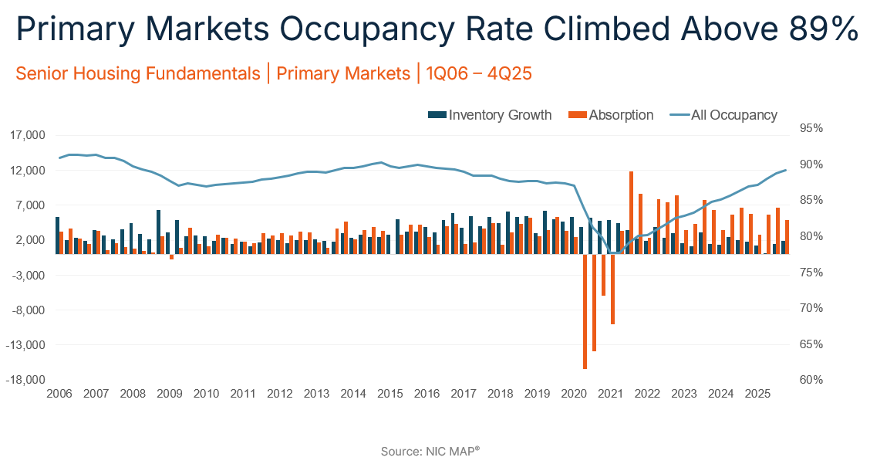
The occupancy rate for senior housing rose 0.4 percentage points in the fourth quarter for the 31 NIC MAP Primary Markets, reaching 89.1%.
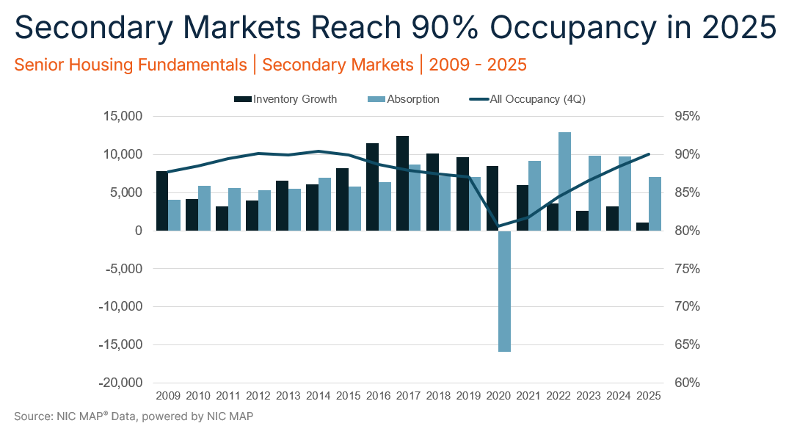
Meanwhile, the occupancy rate for the 68 Secondary Markets tracked by NIC MAP rose 0.3 percentage points in the fourth quarter to end the year slightly ahead of the Primary Markets at 90.0%.
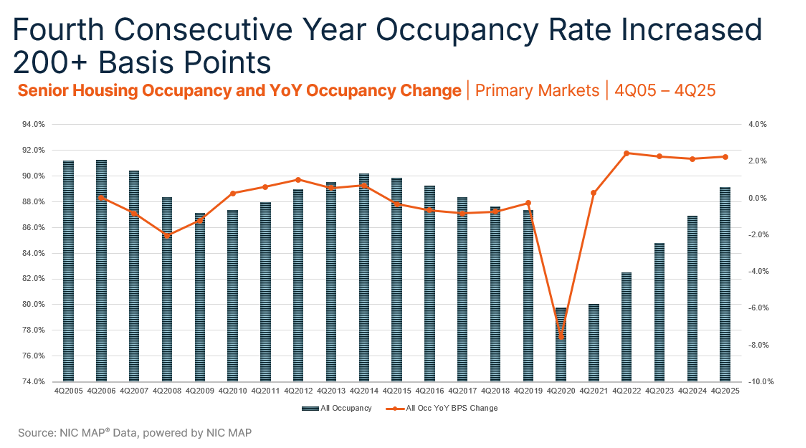
The occupancy rate for senior housing rose 2.2 percentage points in 2025 for the 31 NIC MAP Primary Markets, marking the fourth consecutive year in which occupancy gained more than 200 basis points.
Meanwhile, the occupancy rate for the Secondary Markets gained 1.6 percentage points in 2025.
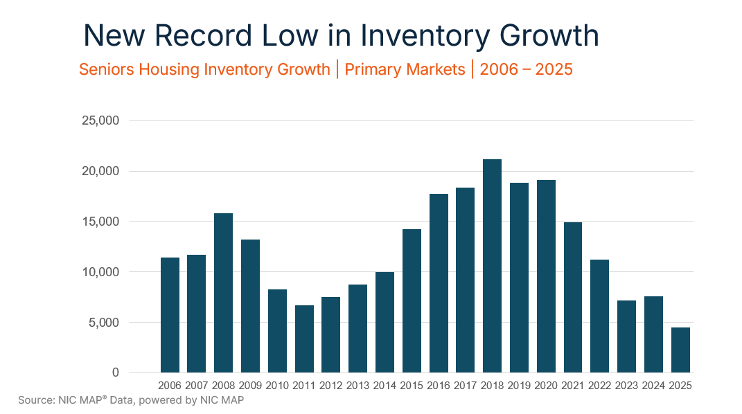
Takeaway #3: New Record Low in Inventory Growth
Turning to inventory growth, a continued decline in new supply arriving online also helped drive occupancy rates higher.
The year 2025 was the lowest on record for both the Primary and Secondary Markets since NIC MAP began tracking this data.
Looking ahead, the limited number of new units under construction today indicates new supply growth is unlikely to pick up in the near term.
Takeaway #4: Seven Markets Above 90% Occupied
Seven of the 31 Primary Markets had occupancy rates above 90% in the fourth quarter, compared to five in the previous quarter, led by Boston (93.1%), San Francisco (91.9%), and Baltimore (91.9%).
Only five markets had occupancy rates below 87%, with the lowest being Miami (85.4%), Atlanta (85.5%), and San Jose (86.1%).
There are several notable markets where occupancy rates today are near or slightly above their all-time highs, such as San Francisco (91.9%), Los Angeles (90.5%), Dallas (89.1%), and Chicago (89.0%).
Active Adult 4Q25 Key Takeaways
On January 15th, NIC MAP released fourth quarter data for the more than 850 active adult rental communities they track across the U.S. These communities cater to mostly healthy adults age 55+ who want to live in a community designed for active lifestyles and interaction with peers and who do not yet need or want on-site healthcare services.
Key takeaways included the following:
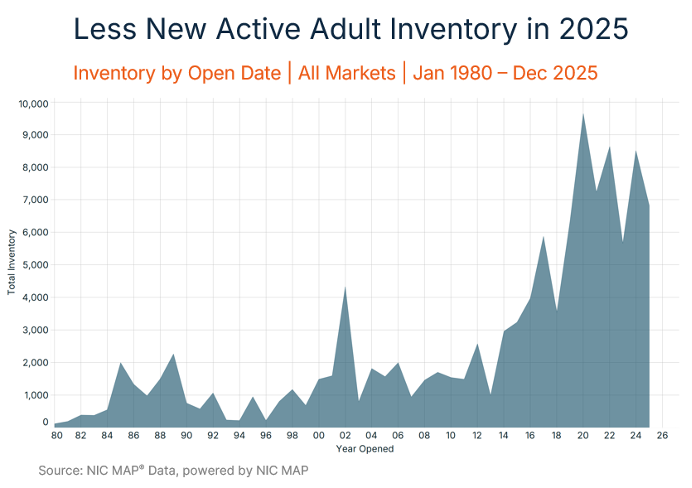
Takeaway #1: Less New Active Adult Inventory in 2025
In 2025, roughly 6,800 new units opened, a decline from the 8,500 new units delivered in 2024.
Although inventory is tracked back to 1980, older inventory is likely driven by naturally occurring retirement communities or conventional age-restricted apartments rather than active adult communities.
Roughly half of today’s inventory opened in the past 10 years, which is the more modern lifestyle-focused product we see being developed today, with one-third developed since 2019.
If you are interested in diving further into these active adult property type nuances, check out a recent episode of the NIC Chats Podcast with Cushman & Wakefield where we discuss market trends and valuation insights for active adult rental communities.
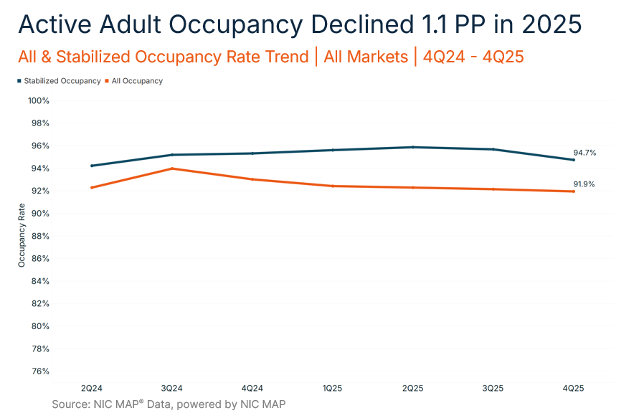
Takeaway #2: Active Adult Occupancy Declined 1.1 Percentage Points in 2025
Although new supply was lower in 2025 than 2024, this new inventory may have had a moderate impact on occupancy rates.
The active adult occupancy rate stood at 91.9% in the fourth quarter, edging down 0.2 percentage points from the prior quarter and declining 1.1 percentage points for the full year 2025.
The active adult occupancy rate includes all properties, including those still in lease-up. As a result, the dip may have been driven from new units arriving online that are still being absorbed.
Overall, occupancy rates have ranged from 92% to 94% over the past seven quarters since NIC MAP began tracking this data.
For stabilized properties open at least two years, occupancy rates are near 95%.
Takeaway #3: Active Adult Stabilized Occupancy Still Well Above 90% in Largest Inventory Markets
Across the Primary and Secondary Markets, 14 of the 15 largest inventory markets have occupancy rates above 90%, with only Austin falling below 90%.
Anecdotally, we are hearing from industry experts that the bottom six markets in the chart have had a lot of new supply over the past few years and, as a result, are seeing signs of slower lease up and lower rent growth.
Stay tuned in 2026 as NIC MAP continues to roll out active adult data within its platform and across markets, including inventory, occupancy, and rents.
Senior Housing Development Cycles: When is the Next One?
Mark Twain famously said that history doesn’t repeat itself, but it often rhymes. That framing feels especially relevant for senior housing today.
For years, the industry debated demand: Is it here yet? Is it strong enough? Is it sustainable? The current demographic momentum has tempered that debate. Senior housing is no longer defined by questions of demand; it is now constrained by the availability of supply. And that shift changes everything.
An Interesting Pattern Beneath the Surface
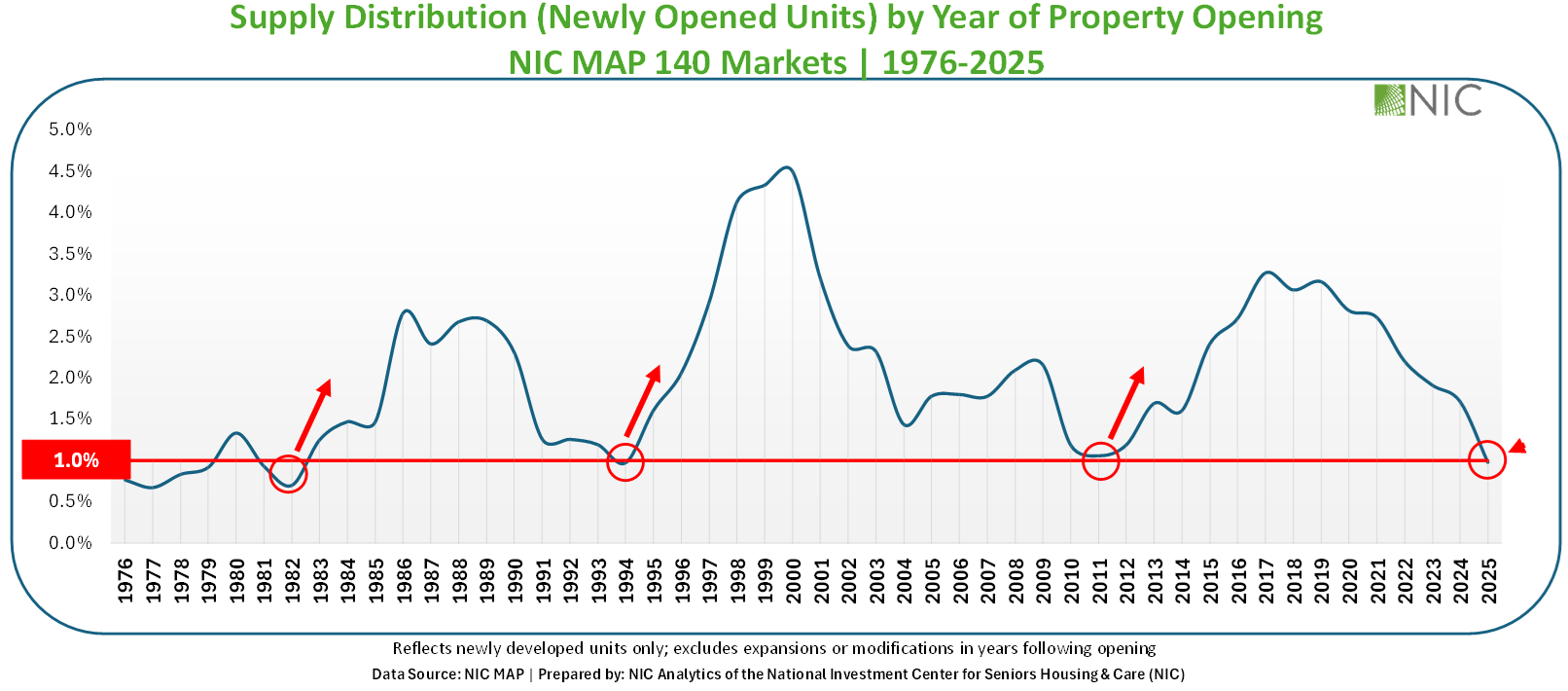
The chart below shows historic senior housing supply cycles over multiple decades. What stands out is not volatility, it’s consistency.
Each time new supply activity re-accelerated, it followed the same signal: new inventory dipped to roughly 1% of total stock. That was true in the early 1980s, the 1990s, and again around 2011.
In each case, development activity did not peak immediately. Instead, supply continued to build for five to six years before reaching cycle highs.
Today, senior housing finds itself once again at that same one-percent threshold (support level). This suggests we are in the early innings of the next supply cycle. But unlike prior cycles, the context has fundamentally changed.
Why the Next Cycle Will Be Different
In short, the next cycle will not be about getting ahead of demand. It will be about trying to catch up to it. But that catch-up will not happen quickly. Senior housing units under construction have been declining for several years, falling from about 50,000 units in 2019 to roughly 16,200 units in 2025. (For context, at the start of the last supply cycle in 2011, units under construction were below 13,000, lower than today’s level.) As a result, the next supply cycle will likely build more slowly, peak further out, and last longer than previous cycles.
Additionally, one of the most underappreciated challenges in senior housing development today is not just capital, it is time. This is not a snap-back environment, it is a long-duration build environment.
The average senior housing construction cycle has stretched to approximately 29 months. That means any project breaking ground today is unlikely to open before 2027 or 2028. Most importantly, every development decision today determines market position two to three years from now. This changes how development risks are evaluated; a 29-month cycle means market assumptions must hold longer and cost overruns compound faster.
Furthermore, new development today is constrained by three costs that can’t be engineered away: labor, materials, and money. Labor shortages, higher material costs, and higher interest rates are tightening project math. Some developers are not short on ideas; they are short on margin. That is why construction efficiency and design innovation are starting to matter as much as financing.
When is the Next One? Will History at Least Rhyme?
Looking ahead, supply growth is likely to remain low to moderate through 2026. If history does rhyme, the answer is not ‘now,’ but it is not far off either. The signals point to an upcoming cycle formation.
What is different this time is where development will restart. Most markets today are not even in the construction race. New development will begin in a much narrower set of markets, specifically where demand is strong and the development math pencils out. In other words, the old mantra of “location, location, location” is evolving into “location, economics, and execution.”
Development risk has been repriced upward. In many cases, return profiles no longer fully compensate for the risk, particularly when you factor in construction costs, lease-up timelines, and capital structure uncertainty.
That said, senior housing construction lending conditions have improved modestly. It is no longer an automatic ‘no.’ Lenders are backing proven sponsors, markets with clear demand visibility, and projects supported by pre-leasing and partnerships. Capital has become more selective and more disciplined.
Stepping back, capital engagement in senior housing continues to deepen ahead of the next supply cycle. Rising deal counts alongside rising pricing is typically a signal of healthier market confidence, not distressed selling. However, that capital is flowing primarily into existing assets, not new development. Historically, this is consistent with an early-cycle environment, where capital prioritizes stabilized assets before development activity returns.
For senior housing stakeholders, this is a moment to be forward-looking, to underwrite future demand growth, long-term pricing power, and to price the story early. Ultimately, development decisions today are about confidence in tomorrow’s growth.
And importantly, unlike the last supply cycle, which ran into oversupply in select markets, the next cycle will arrive in an environment of robust and accelerating demand, but it will not be broad-based, it will favor the right markets and the right projects.
2026 Outlook for U.S. Continuing Care Retirement Communities (CCRCs)
As we look forward in 2026, the U.S. Continuing Care Retirement Community (CCRC) sector appears poised for another year of strong performance, marked by continued demand, tight supply, and demographic tailwinds. These trends are consistent with broader gains observed across senior housing throughout 2025 and are expected to continue going into 2026.
Sustained Occupancy Momentum Expected in 2026
In 2025, CCRCs experienced strong absorption with notable performance in independent living, assisted living, and memory care segments. As the oldest Baby Boomers start to move into senior living communities, and the first Boomers turn 80 in 2026, demand is expected to remain robust.
At the same time, CCRC inventory growth is expected to remain constrained. Lengthy development timelines and pivots toward organizational growth through acquisitions and affiliations rather than new development continue to limit new supply. This combination of high demand and limited inventory growth is likely to drive occupancy up. As a result, we expect CCRC occupancy rates to maintain positive momentum going into 2026, with growth rates at similar levels seen in 2025.
Historically, entrance fee CCRCs have maintained higher overall occupancy rates than rental CCRCs. However, entrance fee communities have also experienced slower occupancy growth compared to rental properties. Looking ahead into 2026, we expect entrance fee CCRCs to see incremental occupancy gains, but not as rapid as gains in rental CCRC occupancy.
Supply Outlook: Limited Supply Growth Driven by Expansions
Inventory growth in 2026 is expected to come primarily through campus expansions, as ground-up development remains muted. Units under construction are still well below 2020 levels, particularly for the independent living care segment indicating that new supply will remain tight for the foreseeable future.
Regional Dynamics: High Demand Meets Limited Supply
High-demand markets, especially in the Northeast and Mid-Atlantic regions where occupancy levels are already elevated, are likely to see persistent supply constraints. With little near-term inventory growth and strong demographic demand, these markets may experience more limited options for prospective residents. This dynamic is particularly acute in the independent living segment, where desirable units are increasingly generating waitlists.
Care Segment Performance Outlook
The strongest performance for CCRCs in 2026 is expected across independent living, assisted living, and memory care segments. Demand in these care segments continues to be steady, and many communities are operating near or above long-term averages. Despite several changes, nursing care remains the area that presents the most difficulties to most operators. Most communities have been operating with occupancies in the upper 80s but are still affected by the skilled nursing labor pressures. The years to come may see this trend gradually diminishing.
The industry appears to have moved beyond the most significant reductions in skilled nursing inventory, though modest rightsizing may continue, particularly among communities where nursing units still outweigh independent living offerings.
Rate Growth Stays Elevated Amid Strong Demand
Average monthly rate (AMR) growth for CCRCs has moderated from 2023 peaks but remains elevated. For independent living, assisted living, and memory care segments, the annual rate growth continues to hover around 4-4.5%, and this is likely to hold relatively steady going into 2026. While below recent highs, these increases remain well above the pre-pandemic norm of roughly 3%, suggesting continued cost pressures and pricing power supported by strong demand and limited supply.
Emerging Opportunities and Anticipated Challenges
The National Association of Realtors’ outlook for 2026 projects a 14% increase in existing home sales compared to 2025. Many CCRC residents rely on proceeds from the sale of their home to pay for CCRC entry fees; a strong housing market could serve to help shorten decision timelines and further bolster demand, particularly for entrance fee CCRCs.
Potential challenges in 2026 include headline exposure stemming from any additional high-profile CCRC bankruptcies. While such events tend to attract national media attention, their impact is often more localized. Existing residents may seek better financial transparency and communication from communities, while prospective residents may delay or hesitate in making move-in decisions. Even when market fundamentals remain strong, such a headline risk can temporarily weigh on demand and lengthen closing cycles for CCRCs.
Active Adult Demand Expected to Grow in 2026
NIC expects demand for active adult rental communities to continue to grow in 2026. The property type appeals to younger or healthier older adults who are ready to downsize into maintenance-free communities with resort-like amenities but who do not yet need or want the care and services provided in traditional senior housing.
Inflation pressures will continue to be headwinds to new development as well as to consumers. Active adult rental communities’ median average monthly rent of roughly $2,000 may help serve middle income older adults along with luxury options for more affluent residents.
Demand for “wellness” is not yet waning and will likely continue to be the focus of lifestyle and engagement programming in 2026. The evolution of aging, longevity, and disease prevention technology – combined with resident-led programming – will differentiate active adult communities from conventional multifamily properties.
With stabilized occupancy rates near 96%, active adult communities are poised for another year of positive performance in 2026.
We use cookies on our website to give you the most relevant experience by remembering your preferences and repeat visits. NIC's privacy policy can be viewed here. By clicking “Accept”, you consent to the use of ALL the cookies.
This website uses cookies to improve your experience while you navigate through the website. Out of these cookies, the cookies that are categorized as necessary are stored on your browser as they are essential for the working of basic functionalities of the website. We also use third-party cookies that help us analyze and understand how you use this website. These cookies will be stored in your browser only with your consent. You also have the option to opt-out of these cookies. But opting out of some of these cookies may have an effect on your browsing experience.
Necessary cookies are absolutely essential for the website to function properly. This category only includes cookies that ensures basic functionalities and security features of the website. These cookies do not store any personal information.
Functional cookies help to perform certain functionalities like sharing the content of the website on social media platforms, collect feedbacks, and other third-party features.
Performance cookies are used to understand and analyze the key performance indexes of the website which helps in delivering a better user experience for the visitors.
Analytical cookies are used to understand how visitors interact with the website. These cookies help provide information on metrics the number of visitors, bounce rate, traffic source, etc.
Advertisement cookies are used to provide visitors with relevant ads and marketing campaigns. These cookies track visitors across websites and collect information to provide customized ads.