NIC Shares Credit & Investment Outlook

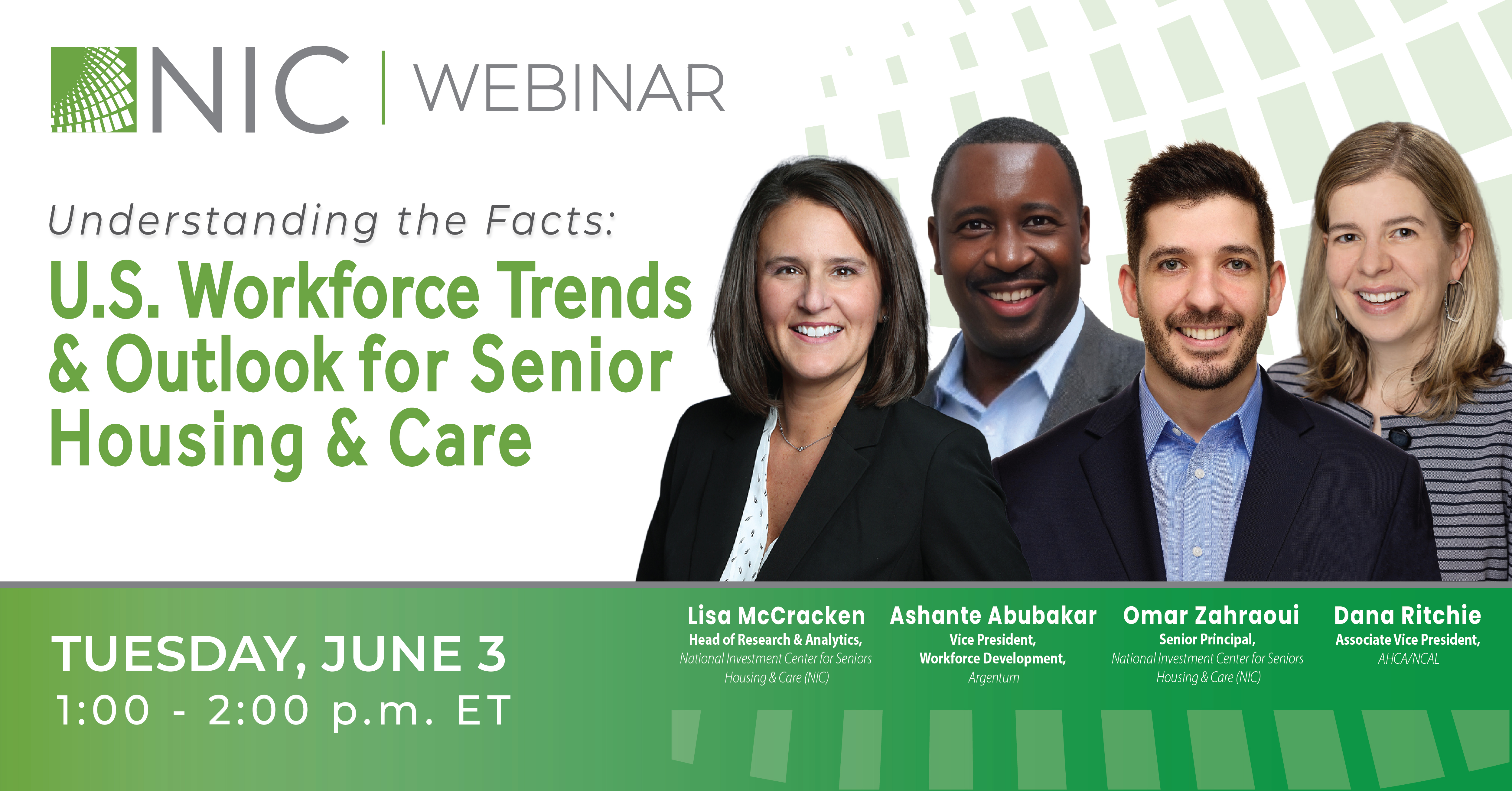
More than 630 professionals registered for a recent NIC Senior Housing Credit & Investment Outlook webinar held on March 26th. Attendees received updates on the latest sector market fundamentals supporting a positive outlook along with insights on loan maturities, delinquency rates, and investment performance. NIC staff shared the latest data points and guest panelist, Aaron Becker, Senior Managing Director, Head of Seniors Housing & Healthcare Production with Lument, provided perspective on the momentum their firm is seeing with transaction activity and new investors entering the space.

Key takeaways from the webinar include:

  • Short Term Outlook: Positive
    • The senior housing sector can anticipate rising occupancy throughout the year with limited new competition coming onto the market. These tailwinds will continue to boost NOI margins.
  • Medium-Term Outlook: Positive, but Guarded
    • Beyond this year, forecasts are for continued rising occupancy and strong demand as development activity will likely remain muted. Both of these support ongoing boosts to NOI margins.
    • The guarded sentiment reflects uncertainty related to economic unknowns, many related to changes related to actions of the current administration (e.g. tariffs).
  • Long-Term Outlook: Positive
    • The strong demand for senior housing and care will be sustained by significant growth in the aging population. This outlook is positive, assuming supply and demand remain balanced. Undisciplined, rapid growth following the current period of record-low construction could be disruptive. 
  • Active Adult, while currently much smaller in inventory than senior housing overall, has the opportunity to expand penetration rates for senior housing options.
  • NIC forecasts occupancy across the primary and secondary markets to be roughly 91% by the end of 2026.
  • There is an estimated $10.94 billion in senior living loan maturities in 2025.
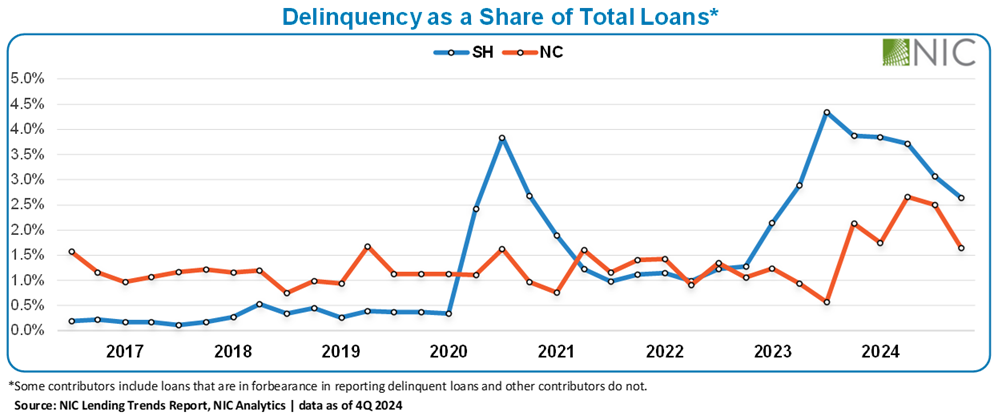
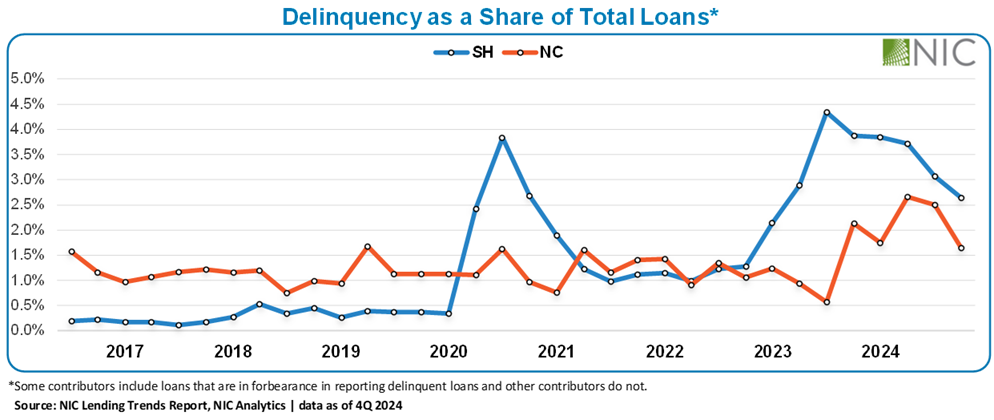
  • The delinquency rate on senior housing CMBS loans was 2.1% in February, below multifamily overall, but higher than the 1.66% delinquency rate in September 2024.
  • Senior housing investments outperformed the broader NCREIF Property Index in the fourth quarter of 2024.

Visit NIC.org to watch a replay of the webinar.

Introducing the Financial Benchmarking Initiative: Elevating Asset and Deal Management

We are excited to introduce the NIC MAP Financial Benchmarking Initiative, originally launched by NIC in 2018 to establish transparent financial benchmarks for the senior housing sector.

Now redesigned, the initiative leverages NIC MAP’s cutting-edge AI technology and the newly standardized Seniors Housing Industry Chart of Accounts. This program empowers NIC MAP clients to gain deeper insights into their financial performance, comparing their properties against a market cohort to make more informed decisions.

Participation is simple. Contributors submit detailed income statements on a quarterly basis, and they can submit in their own chart of accounts – NIC MAP’s unique AI technology maps the submitted statement to a standard chart of accounts. Furthermore, to protect submitter confidentiality, NIC MAP anonymizes the statements before ingesting them. Once benchmarking is complete, NIC MAP’s reports provide insights into key metrics like revenue, expenses, and profitability, allowing stakeholders to identify areas for operational improvement and strategic growth. By distinguishing between market-driven performance changes and property-specific issues, the NIC MAP Financial Benchmarking Initiative enables operators, owners, and investors to optimize portfolio performance, reduce costs, and drive stronger financial outcomes in an increasingly competitive landscape.

Learn more.

Senior Housing Occupancy Continues Climbing in First Quarter 2025

The NIC Analytics team presented findings during a webinar with NIC MAP clients on April 10 to review key senior housing data trends during the first quarter of 2025. Steve Proffer, Director at Harrison Street, joined the webinar to share an update on the outlook for the year ahead and perspectives from one of the leading investment management firms in senior housing.

Key takeaways included the following: 

Takeaway #1: Occupancy Rate Continued Climbing 

  • The occupancy rate for the 31 NIC MAP Primary Markets rose 0.3 percentage points to 87.4% in the first quarter, driven by net absorption of senior housing units outpacing the number of new units arriving online.

Takeaway #2: Independent Living Occupancy Gains Outpacing Assisted Living in Recent Quarters

  • By property type, occupancy rates for independent living have made slightly higher gains in recent quarters than assisted living, which is a reversal of trends in 2022 and 2023.
  • In the first quarter, independent living increased to an average occupancy rate of 89.0%, while assisted living increased to 85.8%.

Takeaway #3: Assisted Living Inventory Growth Was Up Slightly, While Independent Living Growth Continued to Edge Downward 

  • Turning to supply, assisted living inventory growth has ticked up slightly the past two quarters, while independent living inventory growth has declined, which may be driving some of the changes in occupancy rate gains for the two property types.
  • Overall, however, inventory growth for both assisted living and independent living remained low historically.

Takeaway #4: Inventory is Shrinking in Five Markets 

  • Senior housing inventory is shrinking in several markets where property closures or units being converted to other uses outweigh the number of new communities or units replacing them.
  • San Antonio, TX has nearly 4% fewer units today than it did three years ago, while inventory has declined by nearly 2% in Riverside, CA, Pittsburgh, PA, and Sacramento, CA.

Takeaway #5: Secondary Market Construction Starts Fell to Historic Lows

  • The current trend of low or negative inventory growth is unlikely to reverse in the near term as construction starts in the first quarter continued to decline, with the fewest units breaking ground in the 31 Primary Markets since 2009 during the Global Financial Crisis, and the fewest units ever breaking ground in the Secondary Markets since NIC MAP began tracking this data in 2007.

Takeaway #6: Construction Starts Remain Below Inventory Growth

  • The number of new units breaking ground has been less than the number of new units being delivered for four consecutive quarters, a trend that last occurred in 2021 and, before that, in 2009 during the Global Financial Crisis.

What’s the Difference Between an Operator and a Manager?

Adding Clarity to Attract Capital Sources

Unlike many other commercial real estate sectors, senior housing requires access to capital that goes beyond funding the real estate investment in order to grow and sustain quality operations. This need for operational funding necessitates attracting new sources of capital to the sector.

In a previous article, we highlighted the critical importance of having a flow of capital investments for growing operations as a cornerstone for quality and sustainable growth in the senior housing sector. Recognizing that clarity and consistency in terminology are foundational to attracting new sources of operational capital, NIC’s Capital for Operations (CFO) Definitions Subcommittee has finalized key definitions central to this conversation. This article highlights the work of this subcommittee and the unveiling of these foundational definitions.

Why Clear Definitions Matter

Clear and commonly agreed-upon terminology is essential to effectively communicate with external investors who may not fully understand the core stakeholder groups in senior housing. By establishing precise definitions, the sector can more easily attract diverse capital sources—especially those focused on operational excellence and enterprise growth rather than solely real estate-backed investments. This clarity helps investors better understand the distinct roles and responsibilities within the senior housing ecosystem, ultimately facilitating more informed investment decisions.

Defining the Landscape: Key Terms Established

To facilitate clear communication among stakeholders—including lenders, investors, operators, and managers—the Definitions Subcommittee has adopted the following definitions.

Looking Ahead: Defining “Integrated Enterprise”

While significant progress has been made to establish these key terms, important work remains. The Definitions Subcommittee is now turning its attention to defining more complex concepts as it relates to enterprise.

For instance, consider a fully integrated company in senior housing that includes multiple entities:

  • Real Estate Owner (either fully owned or joint venture)
  • Operator (fully owned or joint venture)
  • Manager (fully owned)

Does this integrated structure that has established brand identity equate to greater enterprise value? Clearly defining these terms will help stakeholders better understand how integration, brand strength, and operational excellence contribute to overall valuation.

Conclusion: Building on Clarity for Sustainable Growth

As the sector continues to navigate a rapidly evolving landscape shaped by demographic shifts and increasing demand for high-quality senior housing services, clarity around key terms is not merely academic—it is foundational. Standard definitions lead to better communication; better communication leads to increased investor confidence; increased investor confidence unlocks broader access to operational capital.

Ultimately, the sector’s future success will depend upon our collective ability to clearly articulate value—not only through physical assets but also through exceptional operations that enhance resident experiences and drive sustainable growth.

Special thanks to members of NIC’s Capital for Operations Definitions Subcommittee, Michelle Kelly of National Health Investors, Madisen Medley of Merrill Gardens, Leigh Ann Barney of Trilogy Health Services, Dan Ogus of HumanGood, and Bill Kauffman of NIC.

Definitions:

Capital for Operations: Any capital (debt or equity) used in senior housing and nursing care that invests in or lends to a real estate owner, operator, or manager, and is not secured by real estate.

Manager: Entity responsible for oversight and management of day-to-day business as outlined in a management agreement.

Operator: Entity (often called an OpCo) that assumes business risks and benefits.

Real Estate Owner: Entity (often called a PropCo) that owns the fee simple real estate.

Value-Based Care: What’s Different Now and What Does It Mean for Senior Living?

The notion that senior living communities aren’t part of the healthcare continuum was dramatically undercut by the pandemic.

The notion that senior living communities aren’t part of the healthcare continuum was dramatically undercut by the pandemic. Operators now know their role is critical to the health of their residents, and to the long-term success of their business.  

This realization comes at a time when the healthcare system itself is undergoing a substantial change. The fee-for-service paradigm is being replaced by value-based care. The goal is to create better health outcomes at a lower cost.

“What does value-based care mean now for senior living?” asked NIC Co-Founder and Strategic Advisor Bob Kramer introducing a main stage session on the current state of value-based care at the 2025 NIC Spring Conference. “Value-based care represents an incredible opportunity and an incredible challenge for senior living.”

The session was led by Stephanie Boreale, Watermark Retirement Communities. She was joined by Larry Leisure, Chicago Pacific Founders; Andy Eby, Bickford Senior Living; and Brian Fuller, ATI Advisory.

Setting the discussion in context, Fuller explained that value-based payments shift responsibility for costs and quality to the entity delivering care. Reimbursement is no longer a payment based on the delivery of a service — the traditional fee-for-service arrangement.

Fuller noted that different value-based care models are emerging and highlighted these key data points:

  • Growth in healthcare spending accelerated in 2023, topping $4.9 trillion.
  • Healthcare spending represents a 17.4% share of the economy, which is set to eclipse 20% by 2032.
  • Medicare enrollment will increase by almost 50% by 2030.
  • About 54% of Medicare beneficiaries are enrolled in Medicare Advantage plans, a value-based care model.
  • About 14 million Medicare beneficiaries are covered by ACOs or other value-based care arrangements.  
  • The value-based healthcare market is projected to grow at a compound annual growth rate of 17.2% from 2024 to 2031, reaching $43.39 billion by 2031.

Value-based care remains the primary solution to slow rising healthcare costs, Fuller said, but he cautioned that adoption of the model must accelerate. The government’s goal is to have every Medicare beneficiary in a value-based care arrangement by 2030. “We need to double down on value-based care to overcome demographic and political realities,” he said. But, he added, “Culture change is a significant lift.”

Unlock the Potential

The upside is that value-based care payments represent a revenue growth opportunity for senior living owners and operators. Medicare premium dollars can potentially be tapped for items such as transportation, wellness programs and support services. Enhanced value-based care services can improve resident health, satisfaction, retention, and length of stay.

“There is an opportunity here,” said Leisure. “Senior living operators are in a unique position.”  Many of the services already provided by senior living communities are part of the value-based care model. “We touch lives every day,” said Leisure, adding that investors are looking for successful models of how value-based care can boost the operator’s bottom line.

One example is Bickford Senior Living, which improved net operating income by 17% year-over-year by implementing a healthcare integration strategy. “Operators have a responsibility to prove to payors and insurers what we can do and how we can drive outcomes,” said Eby, who belongs to several industry initiates on value-based care. “We’ve leaned into value-based care to differentiate our properties by making them more attractive to residents.” 

Watermark’s Boreale asked: How do payors view senior living?

Payors want to contract with medical groups and shift the risk to those parties. Leisure suggested that owners and operators consider on-site health care, Medicare Advantage plans that wrap around medical teams, and virtual care.

Fuller said that payors focus on three factors: Enrolling beneficiaries and keeping them; CMS star ratings of quality, service and member experience; and the management of their loss ratio. “Figure out how to play in one or several of those areas,” he advised. “Take ownership.”

There’s another way to think about value-based care, said Fuller. “It’s the right thing to do.” His grandmother died while living in a memory care community. But the last 12 months of her life were horrific for her and Fuller’s family. She cycled in and out of the emergency room and the hospital.

Fuller would have loved to have had an interdisciplinary care team to discuss what the family wanted for her and what she wanted. That could have avoided the turnstile of care, not to mention the huge cost to the Medicare system. “Let’s not lose the resident’s story,” said Fuller. “That is the anchor of value-based care.”

Leverage Technology

Technology also plays a major role in value-based care strategies.

Senior living providers have a wealth of resident data that healthcare providers and payors are eager to access. The challenge is how to aggregate that data, analyze it, integrate care, and demonstrate that senior living improves health outcomes.

New and emerging technologies will help reach that goal, according to the panelists. For example, Bickford joined the Senior Living Transformation Company to develop a tech-enabled model that integrates with value-based care frameworks.

New fall detection technologies can help reduce hospitalizations and emergency room visits.  Technologies that monitor biomarkers can help to anticipate issues related to chronic illnesses. Development is underway of $9-an-hour artificial intelligence nurses to consult with patients in real time.

Where to start? Senior living owners and operators need a strategy and a roadmap. “Get started,” said Fuller. “Look for successful models and potential partnerships,” added Leisure.

Eby said implementing a value-based care strategy isn’t as complicated as it seems. There is no path to follow. “Make the path by walking,” he said. “Get moving.”

Learn how to implement value-based care in your properties. NIC Academy’s ValueBased Care specialty course offers tools and strategies for navigating the complexities of value-based care to help you realize its potential benefits.