Lease-Up Trends Show First Year Critical: NIC SHARK Second Segment Report 

The NIC SHARK report series is designed to deliver actionable, data-informed insights and forward-looking perspectives to help senior housing capital providers, operators, and developers prepare for the future and better serve America’s older adults. 

This second segment of the NIC SHARK series reviews senior housing lease-up trends over two key periods in the past decade and provides projections for the next three years. The analysis examines how these trends can shape senior housing lease-up strategies, highlighting the importance of the first year in setting the trajectory for success. These SHARK insights aim to drive a renewed growth cycle in the senior housing sector. 

To learn more, download the second segment of the NIC SHARK Report.  
Key Takeaways: 

  • Constant S-Shaped Lease-Up Curve: Lease-up trends over the past decade consistently followed a similar S-shaped curve, with occupancy starting low, accelerating in the second year, and stabilizing by the third and fourth years after opening. However, the steepness of the curve varied between periods. 
  • Importance of an Early Leasing Push: The first year is decisive in setting the trajectory for a property’s future performance. After the first year, all percentile curves tend to follow similar paths, with properties exhibiting stronger lease-up momentum in their initial year being better positioned to capitalize on accelerating demand in subsequent years. The first-year momentum makes a notable difference and impacts long-term stabilization outcomes and overall success.  
  • Renewed Growth Cycle with Faster Stabilization and Higher Lows: While properties opened in 2022 and 2023 experienced a relatively slower start due to some stabilized properties still recovering occupancy from the pandemic, they are projected to stabilize faster, with a steeper lease-up curve than in past cycles and new occupancy records. Half are on track to reach or exceed 97% occupancy by the fourth year, while another quarter is expected to reach between 87% and 97%, reflecting a higher low at 25th percentile (87%). 

What does this mean for the senior housing sector? It means that a strategic focus on marketing, pricing, and outreach during the initial lease-up phase is vital. The first-year push isn’t just about filling units quickly; it’s about establishing a trajectory that sets the stage for long-term success. The data shows that properties with limited lease-up success in the first year often struggle to accelerate the pace of lease-ups in a meaningful way in the second year and beyond.  

While market supply and demand dynamics play a role in shaping lease-up trends, the S-shaped curve and the importance of the first-year lease-up push remain constant in our industry. These dynamics offer actionable insights for adapting our strategies, whether we’re operating in a balanced market, navigating a period of supply surge, or preparing for anticipated population growth for older adults, increased demand, and moderate new supply. 

However, it’s important to remember that it’s not just the market dynamics are changing – operators are actively shaping them. The collective efforts put into that first year have the potential to propel the industry forward, allowing senior housing operators to reach more potential residents. By leveraging the first-year lease-up push, marketing and sales professionals have the power to change the dynamics of the future and redefine success for senior housing. 

We would love to hear your feedback! For questions or feedback, please contact  analytics@nic.org  

Stay tuned for upcoming segments of the NIC SHARK series.  

Download the second segment of the NIC SHARK Report

Senior Housing Occupancy Increases for 13th Consecutive Quarter in Third Quarter 2024

During a recent webinar with NIC MAP Vision clients, the NIC Analytics Team presented findings on key third quarter 2024 senior housing data trends. Morgin Morris, Senior Vice President with KeyBank Real Estate Capital and Jim Dooley, Director with JLL Capital Markets joined Lisa McCracken, NIC’s Head of Research for a conversation on the capital markets, debt lending, and transaction activity.

Key takeaways from the third quarter data included the following: 

Takeaway #1: Occupancy Increased for the 13th Consecutive Quarter 

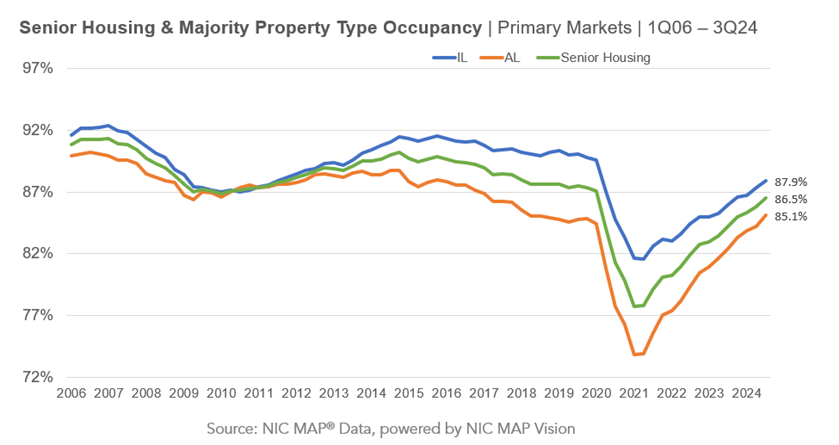
  • The occupancy rate for the 31 NIC MAP Primary Markets rose 0.7 percentage points to 86.5% in the third quarter.
  • This marked the thirteenth consecutive quarter of occupancy gains, driven by resident demand for senior housing units outpacing the amount of new inventory arriving online.    

Takeaway #2: Occupancy Gap Between Assisted Living and Independent Living Continued to Narrow

  • In the third quarter of 2024, there was a 0.5 percentage point increase in the independent living occupancy rate and a 0.9 percentage point increase in the assisted living occupancy rate.
  • Though the independent living occupancy rate still exceeded the assisted living occupancy rate (87.9% vs 85.1%), assisted living occupancy gains have outpaced those of independent living in recent years. 

Takeaway #3: Senior Housing Occupancy Growth Across All Markets

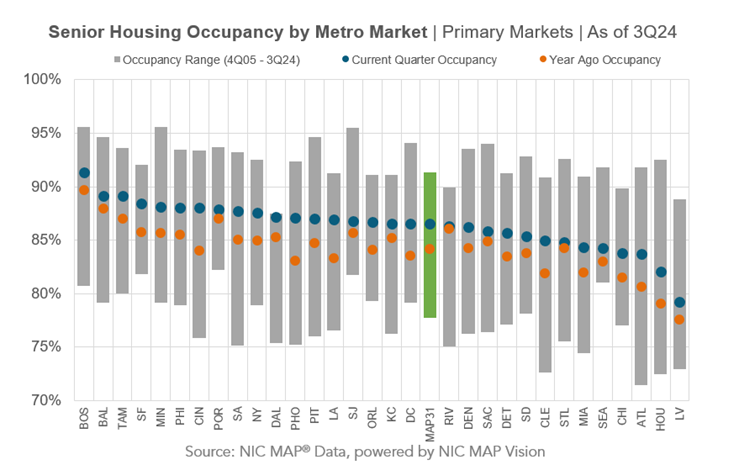
  • We have seen positive occupancy rate movement in each of the 31 Primary Markets over the year ending in the third quarter of 2024.
  • The strongest gains were in Cincinnati and Phoenix, which each increased by 4.0 percentage points over the past year.
  • The smallest gains were in Riverside, CA, where occupancy rates are roughly in line with the NIC MAP average, and St. Louis, which has an occupancy rate below the NIC MAP average.

Takeaway #4: Senior Housing Units Under Construction Least Since 2014  

  • Turning to construction trends, for both Majority Independent Living and Majority Assisted Living properties, we continue to observe an ongoing decline in the number of units under construction, which today are back to levels last seen in 2014.
  • This decline may reflect ongoing headwinds to development such as access to capital, cost of capital, and construction costs.

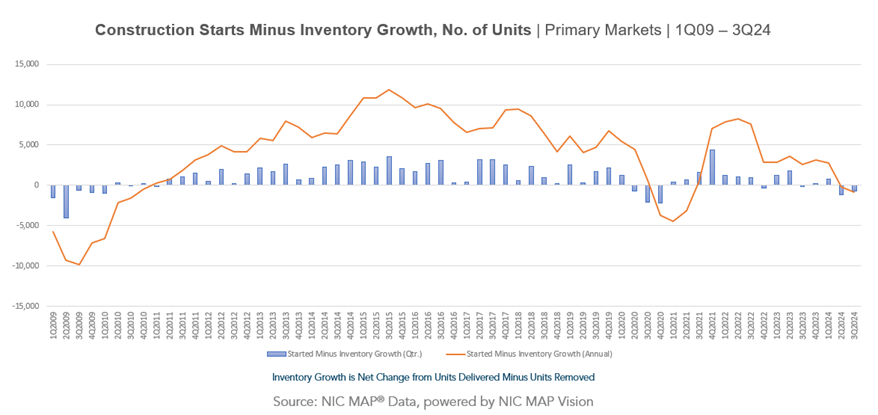
Takeaway #5: Construction Starts Below Inventory Growth 

  • Construction starts have continued to decline, and we have now reached a point where the number of new units breaking ground annually has fallen below the number of new units being delivered.
  • This trend last occurred in 2021 – and before that – in 2009 during the Global Financial Crisis.

Guest panelists Morgin Morris and Jim Dooley both indicated that there is an increase in optimism within the industry and that they are seeing increased activity with transactions, competitive bidding, lending and even some minor movement with new development inquiries. 

Catching the Wave: Why REIT Investing is on the Rise 

In 2024, improving senior living industry fundamentals and evolving market dynamics are building momentum in the senior housing real estate market, and well-capitalized REITs have found themselves in a unique position to take advantage of the current buying environment.  

Many healthcare REITs have primarily been net sellers throughout the pandemic recovery period, shedding underperforming assets and portfolio outliers to focus on stabilizing their own portfolios, but are now touting robust investment pipelines of actionable deals. In contrast, bank debt continues to be in relatively short supply, with fewer lenders allocating funds in the sector, and higher interest rates limiting the rate of return investors can achieve when they can line up debt. So how have REITs been able to invest while much other capital has remained sidelined? To answer that, we will examine the series of events that led to the current, favorable position well-capitalized REITs find themselves in today.  

Pandemic: As we all know, the devastating impact of the pandemic disrupted senior living operations, as well as many other industries including commercial real estate, with the office and retail segments hit particularly hard.  

Rising rates: Inflation accelerated rapidly, marked by the sharp jump in the CPI-U in April 2021 and peaking at 9.1% in June 2022. The Federal Reserve (the Fed) was in hindsight, perhaps slow to respond, attributing the early spike in inflation to supply chain disruptions that would eventually normalize, waiting nearly a year after the first spike in the CPI-U to raise the Federal Funds rate in March 2022, steadily increasing it to 5.33% in July 2023. 

Market dislocation: Perhaps taking a cue from the Fed that the inflationary environment was temporary, coupled with the promise of recovering operations, the senior housing real estate market rebounded quickly in 2021 and 2022, pushing cap rates to pre-pandemic levels and at times even lower. Given interest rates were still relatively low at this time, financial institutions were still active in supplying capital.  With fewer favorable buying opportunities given the low cap rate environment and lack of stabilized senior living deals, many healthcare REITs instead focused on selling underperforming assets at low cap rates, using sale proceeds to improve their balance sheets by reducing debt and/or improving equity through stock buybacks, shrinking their companies in the near-term but positioning themselves to take advantage of future opportunities as markets normalized. 

Regional banking crisis: The failure of Silicon Valley Bank (SVB) in March 2023, while fairly contained, sent ripple effects across the regional banking industry, which is a major real estate capital source, accounting for 80% of commercial real estate loans. With $2.2 trillion in commercial loans coming due over the next 3 years, smaller and regional banks may continue to be limited in their ability to lend to our industry at levels prior to this crisis. As the regional banks had to more aggressively manage their own loan portfolios and financials sponsors, which rely heavily on leverage, and began pulling back on capital allocation, the result was a significant slowdown in commercial real estate transactions, including the senior housing industry.  

Higher for Longer: Following the onset of the regional banking crisis, capital dried up, forcing sellers and borrowers to reassess. With the Fed not being quick to reduce rates, in early 2024, market expectations began to shift to acceptance that rates would be higher for longer, and the market became much more favorable for well-capitalized financial intermediaries, including REITS.  

Rates are now starting to adjust to slowing inflation and employment data, and the Federal Reserve cut the federal funds rate at its September meeting. Even with this movement, the cost of debt remains elevated by recent historical standards, and we are seeing transaction spreads that adequately compensate for this reality.  More recently, the publicly traded healthcare REITs with a focus on senior housing and skilled nursing have experienced a significant improvement in their cost of equity, and investors are showing optimism that they are in a unique position to deploy accretive capital while their competition has remained sidelined. 

Many REITs are now actively engaged as buyers, and some are expecting to meet or exceed pre-pandemic investment volume in 2024. In addition to acquisitions, with fewer lending options in the market from traditional banks, some REITs are increasingly stepping into the lender position, capitalizing on high-yielding debt and ideally striving to create a pipeline for future growth through purchase options on properties at stabilization.  

In closing, given current market conditions and what is anticipated in the short-term, we envision an active role for REITs in senior housing throughout the end of 2024 and into 2025. 

Capital for Operations: A Key to Quality and Growth

The senior housing and care sector is evolving, and ensuring adequate capital for operations is essential to driving quality services and long-term success. Recognizing this critical need, NIC has established a dedicated Capital for Operations Focus Area Committee focused on understanding and growing the role of operational capital in senior housing. Organized into three subcommittees, this group is actively working to define key terms related to this topic, to explore financing opportunities, and to draw lessons from other industries which may help senior housing providers access capital for their operations for the long-term. Select committee members met recently at the NIC Fall Conference to solicit feedback from key industry leaders on these very topics.

Why Capital for Operations Matters

For decades, the senior housing sector has heavily relied on real estate-backed financing to support growth. However, the focus must shift as the sector looks toward a future where the demand for high-quality services continues to expand, a demand that relies on operating companies to execute. Real estate connected capital cannot alone sustain this growth. While real estate assets are foundational to senior housing and care offerings, they are optimized when paired with exceptional operations that drive customer engagement and satisfaction. Simply put, without quality operations, there can be no quality returns.

Even the largest senior housing capital providers cannot thrive solely through the ownership of real estate that is not paired with high-performing operations. This underscores the importance of ensuring that capital sources are available and structured to support not only the real estate, but also the day-to-day operations of senior housing.

Defining the Landscape

One of the committee’s key objectives is to bring clarity and consistency to the concept of “Capital for Operations.” To achieve this, the Definitions Subcommittee is developing a comprehensive glossary that will provide clear definitions for key stakeholders related to this topic, including “operator,” “manager,” “real estate owner,” and “enterprise.” Having agreed-upon terminology will be essential for attracting new sources of capital to the sector and providing external investors with a deeper understanding of senior housing constituent groups.

Expanding Financing Opportunities

The Finance Subcommittee is tasked with broadening the range of financing options available to operators in the senior housing ecosystem. A major hurdle in this area is the need for increased education and understanding about how to best structure deals for cash flow-based financing. While healthcare lenders often lend on cash flow, this practice is not widespread in the senior housing sector, especially for managers and operators who typically do not hold real estate assets.

The Finance Subcommittee is focusing on identifying capital sources and supporting educational efforts that effectively outline the unique dynamics of senior housing operations. The goal is to bring thoughtful operational capital into the sector. In addition, dialogue with lenders will be enhanced to better educate existing senior housing stakeholders about the qualifications needed to obtain operational capital.

Learning from Other Industries

The Research Subcommittee will initially examine the lodging (hospitality) sector to understand what learnings may be helpful for senior housing in terms of capital and operations. While perhaps not as operationally complex as senior housing, in that elements of longer-term ‘housing’ and ‘care’ are notably absent, the lodging industry has a number of nuances and complexities within its business that could provide important takeaways for the sector. Ultimately, the goal is to provoke thoughtful discussion and stimulate the development of potentially innovative solutions.

Conclusion

The senior housing sector is at a crossroads, where societal and economic forces are converging to create both challenges and opportunities. With the aging population set to grow exponentially over the next few decades, the demand for high-quality, personalized care will only intensify. As shared by Pete Stavros, Founder of Ownership Works, at the NIC Fall Conference, we need to look at alternative models to structure and capitalize our businesses. Better capitalization is going to be a key component of success for the industry moving forward.

Beyond the need for financing operations, this very dialogue reflects a broader strategic shift. Forward-thinking stakeholders will recognize that future success hinges not solely on real estate investments, but also on the ability to deliver healthcare-integrated services, personalized experiences, and operational efficiency. As value-based care models gain traction, senior housing will increasingly intersect with healthcare delivery, pushing operational capital to the forefront of investment strategies. To best respond to the increasing operational complexity, those who can secure and deploy growth capital effectively will be best positioned to lead the sector into a future where the quality of resident life is as valuable as the physical assets that house it.

Industry Sentiment Rising: NIC Poll  

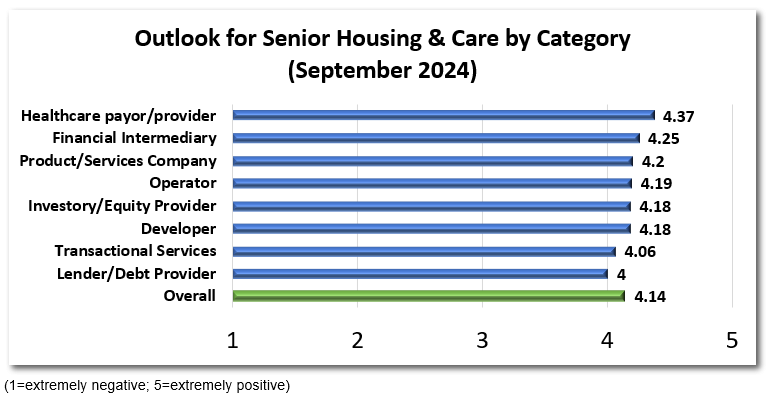
More than 2,800 owners, operators, and related industry professionals attended the 2024 NIC Fall Conference in Washington, D.C. The conference provided the ideal opportunity to ‘take the temperature’ on the general outlook and industry sentiment among those working in and investing in the senior housing and care sector. Beginning with a poll at the 2024 NIC Spring Conference, and replicated at this year’s Fall Conference, all attendees were asked to respond to the question, “What is your overall outlook for senior housing and care across the next year?” Roughly 2,600 individuals provided their feedback.  

Poll results showed the average overall outlook is positive, coming in at 4.14 (1=extremely negative; 5-extremely positive). This is slightly above the NIC Spring Conference average rating of 4.11. Not surprisingly, the ratings varied depending on the respondent type. The lowest ratings came from lenders and debt providers, similar to the pattern that emerged at the spring conference. Despite this lowest ranking across all groups, the 4.0 translates into a “positive” outlook for the months ahead. In March, the lenders and debt provider responses averaged 3.8.   

These ratings support the general sentiment shared by conference attendees anecdotally as well as by speakers across various sessions. It has been a difficult environment over the past few years with the pandemic followed by inflationary pressures and capital challenges. With the recent rate cut by the Federal Reserve, projected future rate reductions, and significant demand dynamics driven by the aging demographic, many continue to see brighter days ahead. These NIC poll results support this sentiment.

Many thanks to everyone who attended the 2024 NIC Fall Conference and who took the time to respond to the poll.