Resources for Understanding Family Offices  

In September 2024, NIC published an article on the potential for growing family office participation in the senior housing sector, particularly given the notable increase in family offices globally and their common allocations for real estate investments. While the value proposition for both senior housing and family offices exists, it is helpful to fully understand the family office investor, how they might think about senior housing as an alternative investment and how unique dynamics of the family office structure can best be navigated by those looking to connect. This article outlines valuable resources that provide useful data points, tools and insights for senior housing operators, developers and fund managers.  

For background, there are several helpful reports and articles that outline common family office characteristics, investment allocations, and general structural considerations.  

  1. The Family Office Real Estate Trends You Need to Know  
  1. Family Offices are About to Surpass Hedge Funds with $5.4 trillion in Assets by 2030 
  1. More Family Offices are Hiring CIO-led Investment Teams 
  1. 2024 Global Family Office Report 
  1. Family Barometer 2024 
  1. Family Office & RIA/Broker Dealer Monthly Data Report 
  1. Understanding Investment Decisions in the Family Office 

For those looking to subscribe to recurring newsletters and publications from experts who understand family offices and related topics, the list below provides a variety of options for the reader to consider.  

  1. Mr. Family Office Newsletter: This free newsletter provides insightful articles on hot topics related to family offices. Mr. Family Office is also active on social media, another way to stay on top of these interesting reads.  
  1. FINTRX: They are a family office and registered investment advisor intelligence platform. FINTRIX offers a variety of blog articles and reports on the investing trends of family offices. One interesting component of their weekly roundup newsletter is the ‘Private Funding Pulse Check,’ which shows recent family office investments.    
  1. Family Business Magazine: This outlet provides a combination of resources that are free to readers along with more in-depth articles and reports that are behind a paid firewall. As an aside, the subscription fees are relatively nominal given the amount of material included. Family Business Magazine also hosts several key industry conferences each year.  
  1. Family Office Exchange: FOX, as it is called, has a number of resources for family offices and their advisors, including well-respected events, robust thought leadership and newsletters accessible to non-members.  
  1. Family Office Insider: The resources from FOI are a combination of paid subscriptions and more limited access for the public via newsletters and reports on their website. They cater to a global audience and often share resources on family office investments. 

There are several family office conferences as well, all of which vary in terms of size, audience and focus. Some events are limited to family members and their office staff, but others are open to external attendees. It is also important to check the geographic focus of the events, whether geared toward U.S. family offices or to a global audience. There are several conferences that focus on investments and some even on real estate, but many others are geared towards the unique aspects of family offices such as succession planning, governance best practices and family office structures. If looking to attend a family office conference, it is probably best to view it as an educational event and not an opportunity to directly target unknown family office representatives for investments. Family office members can be guarded for obvious reasons, and they attend conferences to learn and share, so investment conversations need to be respectful of any unspoken boundaries.    

NIC will continue to track family offices as a potential capital partner and educate both those family offices about senior housing investments as well as share insights with developers and operators on the best way to align with family office dollars.    

ULI Raising the Visibility of Senior Housing

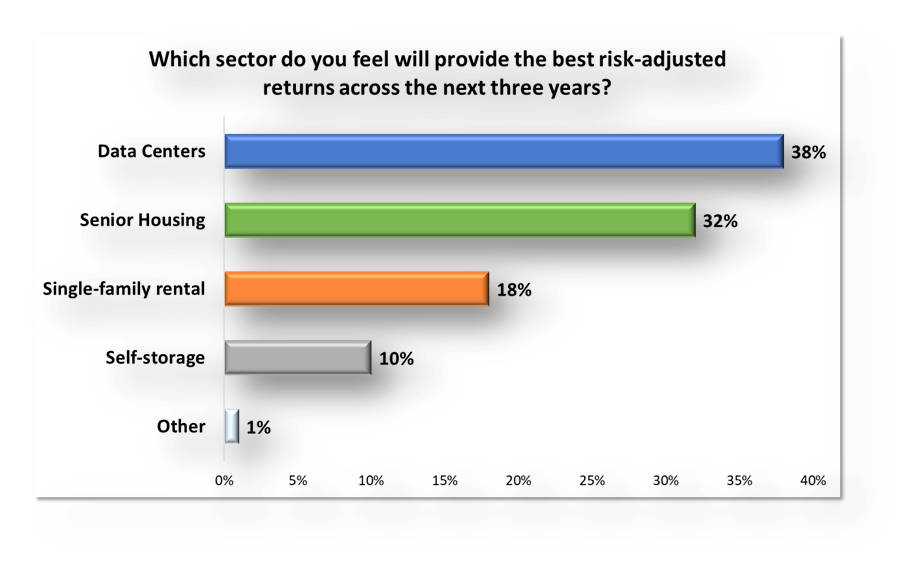
On October 16th, NIC’s Head of Research and Analytics, Lisa McCracken, participated in the Urban Land Institute (ULI) Real Estate Economic Forecast webinar. This biannual webinar accompanies the release of a similar economic forecast report, which shares survey results from leading real estate economists and analysts, and highlights market fundamentals from key real estate property types. For the first time, senior housing was included in the report and was highlighted in this member-exclusive webinar. As part of this webinar, the nearly 1,000 attendees (largely non-senior housing) responded to the polling question, “Which sector do you feel will provide the best risk-adjusted returns across the next three years?” The graph below details the results of that poll, which shows senior housing rated the second highest behind data centers.

Source: Poll results, ULI Economic Forecast Webinar, 10/16/14

Additionally, senior housing was included in the 2025 Emerging Trends in Real Estate publication, compiled by ULI and PwC. The goal of the 2025 trends publication is to provide forward-thinking views on the future of various real estate sectors in the U.S. In addition to calling out the prior success of the senior housing sector, this article outlined the need to think differently and adopt a fresh lens on the future of housing and services for older adults. While highlighting the significant tailwinds driving demand (aging population), the article noted the need for additional housing and care options for middle-income seniors. By 2033, middle-income seniors are projected to represent 44% of all older adult households in the U.S. Affordability will continue to be top-of-mind for senior housing.

With an additional 2.2 million adults aged 65 and older expected to enter the rental market over the next decade, the Active Adult rental market was noted as an emerging model attracting greater interest among both senior housing and multifamily developers. Active Adult communities vary with some developers targeting the middle-market consumer, with others offering higher-apportioned amenities.

The final emerging trend featured in the ULI article related to repurposing existing retail real estate for mixed-use senior housing developments. These projects highlight a growing trend of redeveloping retail spaces into mixed-used developments that include age-restricted housing, addressing both the demand for senior living options and the need to revitalize vacant mall properties. These projects also have the potential to align well with the expectations of baby boomers and provide integrated access to amenities and services as part of an overall redevelopment plan. Each redevelopment has a unique history and future potential, allowing for creative and innovative uses moving forward. As we approach 2025, we are optimistic about the momentum behind senior housing and the interest from both current and new investors and developers. NIC associates Ray Braun, Caroline Clapp, and Lisa McCracken are members of ULI and associated product councils and will continue to call attention to the sector at a national level among real estate professionals and economists. 

Federal Study: Medicaid Reimbursement Falls Short

In addition to being a safety net for low-income seniors in need of skilled nursing services, Medicaid is a key funding stream for financial stability and operational viability for nursing homes throughout the United States. As the primary payer for long-term care services, Medicaid funds a significant portion of the care provided to older Americans and is vital to the nation’s healthcare system, especially as the population rapidly ages.

Given this vital role and the criticism among many operators around Medicaid not covering the actual cost of care, the Office of the Assistant Secretary for Planning and Evaluation (ASPE) at the U.S. Department of Health and Human Services launched a study aimed to understand the relationship between state Medicaid payment rates to nursing homes and the costs these facilities incur while caring for Medicaid residents. Medicaid data was collected from individual states and Medicare Cost Reports for freestanding nursing homes in 44 states.

The following are key takeaways from the study:

  • On average, Medicaid payments covered about 82 cents for every dollar of reported costs for caring for Medicaid residents in nursing homes.
  • The mean Medicaid payment rate was $198 per resident per day, while the mean cost was $253 per day.
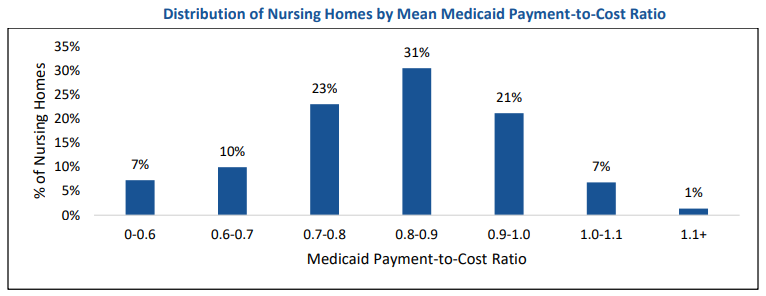
  • About forty percent of nursing homes had Medicaid payments covering 80% or less of their reported Medicaid costs. Fifty-two percent had 80-100% of costs covered, and eight percent had payments exceeding costs.
  • Nursing homes with lower nursing staff levels had higher payment-to-cost ratios than those with higher staffing levels. For example, nursing homes with total nursing staff levels below 3.00 hours per resident day had a ratio of 0.85, while those staffing above 4.00 hours had a ratio of 0.77.
  • Nursing homes with higher proportions of Medicaid residents had higher payment-to-cost ratios. The report mentioned this is consistent with nursing homes with less reliance on Medicaid having expenditures that exceed those of nursing homes more reliant on Medicaid.
Source: “Assessing Medicaid Payment Rates and Costs of Caring for the Medicaid Population Residing in Nursing Homes”, Final Report 2024.

Readers should note the study does have limitations as mentioned within the release, including the fact that the data used was from 2019 and the Medicaid rates used were the states’ statutory Medicaid payment rates, which may not capture all payments made to nursing homes via Medicaid. Many states have increased Medicaid reimbursement, and nursing home operators have experienced higher operating costs since 2019. Hence, there is a need for further analysis with more recent data.

This study provides critical insights into the challenges facing Medicaid-funded nursing homes, highlighting significant disparities between payment rates and the costs incurred for resident care. Addressing these gaps is essential not only to sustain the nursing home industry but also to improve care quality for older Medicaid beneficiaries. Given the vital importance of this topic, all stakeholders—policymakers, healthcare providers, and industry leaders—should be deeply invested in the outcomes of discussions stemming from this report. As stakeholders explore Medicaid payment reforms, these findings underscore the need for payment systems that promote both financial sustainability and high care quality standards. This report serves as a valuable resource for furthering the conversation that will shape future Medicaid policies and ensuring the long-term viability of America’s healthcare system.

The full report is available here.

Updated White Paper Provides New Insights on Active Adult Property Type

The performance and growth of active adult rental properties continue to garner interest from real estate developers, investors, and operators as this property type evolves in response to demand from the Baby Boomer population and increasingly, the oldest cohort of the Generation X population.

In addition to the numeric growth of these key renter cohorts, demand drivers include:

  • Longer life expectancy combined with an increased focus on wellness by these “younger” seniors is delaying the need for higher acuity communities.
  • Increased solo aging is driving a desire to downsize or “right-size” into smaller residences.
  • Changing lifestyle preferences are driving interest in maintenance-free communities with resort-style amenities and social engagement including significant interest in “affinity” communities.

Today, active adult rental properties bridge the gap between conventional multifamily housing and traditional senior housing with communities that offer amenities, activities, and social programming that support active lifestyles. This paper updates the definition of the active adult rental property segment from the original definition launched by NIC in 2022 and provides new data and insights related to this burgeoning property type.

Learn more and download the Active Adult White Paper: Update on the Emerging Property Type here.

CCRC Performance 3Q 2024: Elevated Demand for Memory Care

The following analysis examines the occupancy and year-over-year changes in inventory and same-store asking rent growth—by care segment—within 1,062 Continuing Care Retirement Communities (CCRCs) and 13,796 non-CCRCs in the 99 NIC MAP Primary and Secondary Markets. The analysis also explores supply and demand dynamics in the memory care segment over recent years.

3Q 2024 Market Fundamentals by Care Segment – CCRCs vs. non-CCRCs

The exhibit below compares the market performance of CCRCs and non-CCRCs by care segment for the third quarter of 2024, highlighting year-over-year changes in occupancy, inventory, and asking rent growth.

Occupancy. CCRCs continued to outpace non-CCRCs in occupancy rates across all care segments. The largest occupancy difference in the third quarter of 2024 was in the independent living segment (5.2pps), followed by the assisted living segment (4.2pps), with the smallest gap in the nursing care segment (1.0pps).

Asking Rent. The highest year-over-year rent growth for non-CCRCs was seen in the independent living (4.3% to $4,098) and assisted living segments (4.3% to $6,410), while CCRCs recorded the largest asking rent growth in the memory care segment (4.3% to $8,749).

Note, these figures denote asking rates and do not consider any potential discounting.

Inventory. Nursing care inventory saw the largest declines for both CCRCs (-1.5%) and non-CCRCs (-0.4%) from the prior year. Among CCRCs, memory care was the only care segment to report positive inventory growth, up by 1.2% from year-earlier level. For non-CCRCs, independent living and memory care segments saw the largest year-over-year inventory growth, at 1.8% and 1.7%, respectively.

Negative inventory growth can occur when units/beds are temporarily or permanently taken offline or converted to another care segment, outweighing added inventory.

3Q 2024 Memory Care Segment Performance

The exhibit below shows the annual absorption rates, defined as the change in the occupied units from the previous year, across all care segments within CCRCs. In the third quarter of 2024, the year-over-year absorption rates for memory care segments led with 5.3%, outperforming assisted living (2.4%), independent living (0.9%), and nursing care (0.5%), and showcasing relatively strong market fundamentals. Memory care segments within CCRCs continued to demonstrate notable growth in demand in recent quarters. The segment has consistently led in absorption rates over the past three years and doubled its absorption growth from levels the year before.

Since the third quarter of 2019, inventory for memory care segments within CCRCs has grown at a relatively faster pace than assisted living and nursing care segments. While independent living has taken the lead in growth over recent quarters, memory care segments within CCRCs continue to demonstrate steady expansion.

In the third quarter of 2024, the occupancy rate for CCRC memory care segments increased for the 10th consecutive quarter, reaching 89.9%. This rate places memory care ahead of nursing care, which has an occupancy rate of 85.3%, and assisted living at 89.8%, while independent living remains the highest at 91.6%.

In conclusion, the memory care segment in CCRCs has shown notable strength, with the highest absorption rates and positive inventory growth. This sustained momentum underscores the importance of memory care offerings in CCRCs, positioning it as a resilient and expanding care segment within senior housing.

Want to learn more about the drivers of memory care growth in CCRCs? Check out Growing Prevalence of Memory Care in Life Plan Communities.