701,000 Jobs Lost in March, Presaging Further Losses Ahead

701,000 Jobs Lost in March, Presaging Further Losses Ahead

The Labor Department reported that there were 701,000 jobs lost in March. This was the first decline in jobs after 113 consecutive months of job gains and heralds more losses in the months ahead as businesses shed jobs due to the COVID-19 pandemic.

Yesterday, the Department of Labor reported that 6.6 million Americans filed for unemployment insurance benefits in the week ending March 28, 2020. In the past two weeks, 6.5% of employed people or nearly 10 million people have filed claims according to Bloomberg analysis.

Analysts had anticipated that there would be a loss of 100,000 jobs in March. The reason for the discrepancy between jobless claims and the loss in jobs reflects the timing of today’s survey, which took place in mid-March before stay-at-home orders began to be implemented.
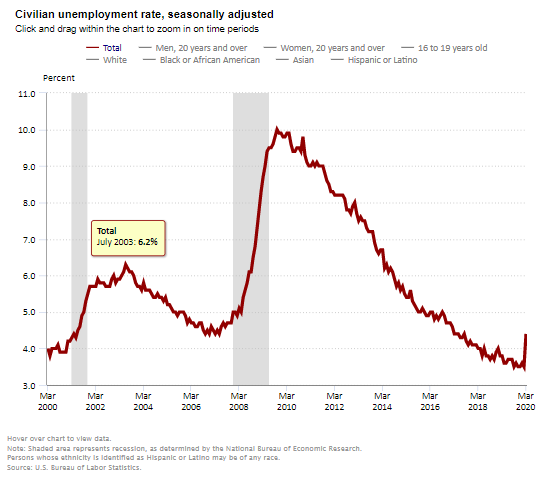
Separately, the March unemployment rate increased by 0.9 percentage point to 4.4% from a 50-year low of 3.5% in February.This was the largest over-the-month increase in the rate since January 1975 when the increase was also 0.9 percentage point. The underemployment rate rose to 8.7% from 7.0%. The number of unemployed persons rose by 1.4 million to 7.1 million in March.

The Congressional Budget Office earlier this week indicated that its projections have the unemployment rate rising to 10% for the second quarter of 2020 and to remain at 9% at the end of 2021. Other analysts project even higher rates. In the last recession, the unemployment rate peaked at 10%. The highest monthly unemployment rate on record, going back to 1948, is 10.8% set in late 1982.
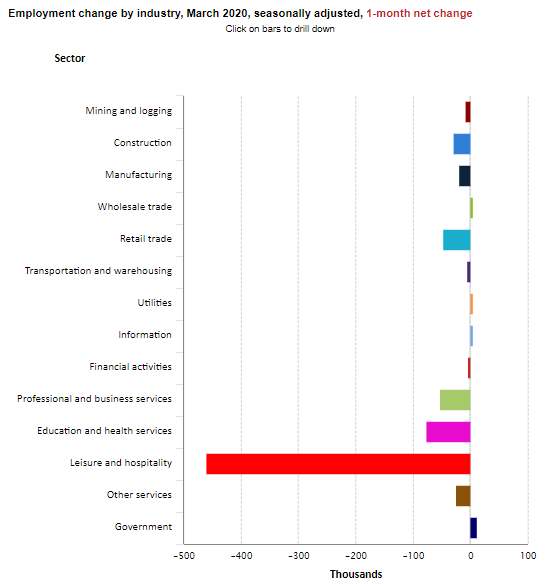
Revisions also subtracted thousands of jobs in the prior two months. The change in total nonfarm payroll employment for January was revised down by 59,000 from 273,000 to 214,000 and the change for February was revised up by 2,000 from 273,000 to 275,000. Combined, 57,000 jobs were subtracted to the original estimates. Monthly revisions result from additional reports received from businesses and government agencies since the last published estimates and from the recalculation of seasonal factors. After revisions, job gains averaged 245,000 per month for January and February.

Employment in health care fell by 43,000 in March. In the prior 12 months, health care employment had grown by 374,000.

Average hourly earnings for all employees on private nonfarm payrolls rose in March by eleven cents to $28.62. Over the past 12 months, average hourly earnings have increased by 3.1%. Over the past 12 months, average hourly earnings increase by 3.1%.

The labor force participation rate, which is a measure of the share of working age people who are employed or looking for work fell 0.7 percentage point to 62.7%. Total employment, as measured by the household survey fell by 3.0 million to 155.8 million.

Today’s report is a precursor of future weak employment reports as the effects of the coronavirus reverberates through the economy. Most economic forecasters are projecting a significant contraction in GDP in the second quarter as the economy shuts down in response to social distancing and the pandemic even with the $2 trillion fiscal stimulus package signed into law by President Trump
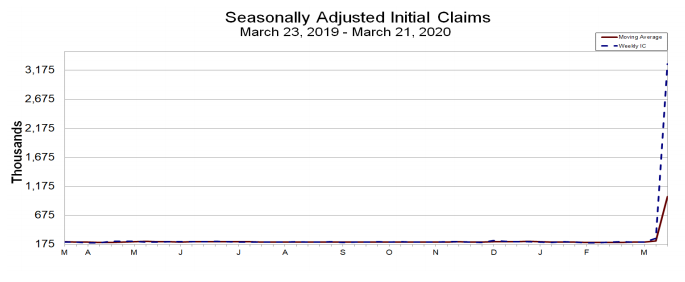
Jobless Claims Doubled to Historic High of 6.6 million in the Week Ending March 28

Jobless Claims Surge to Historic High of 6.6 million in the Week Ending March 28.

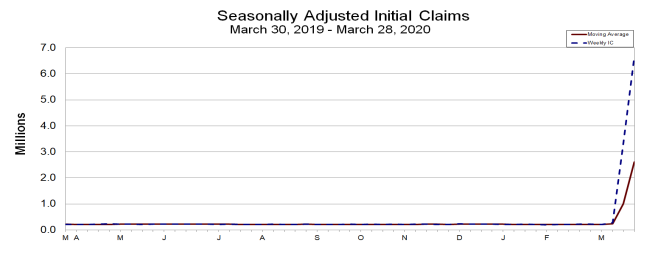
The Department of Labor reported that 6,648,000 Americans filed for unemployment insurance benefits in the week ending March 28, 2020 as the COVID-19 pandemic continues to shut down many businesses and much of the economy.  This was an increase of 3,341,000 from the previous week’s upwardly revised level of 3,307,000.  While last week’s report shattered records, this week’s report was even more shocking due to the magnitude of the increase.  The speed and scale of the job losses is unprecedented.  In the past two weeks, 6.5% of employed people or nearly 10 million people have filed claims according to Bloomberg analysis.  It was the highest level of initial claims in the history of the series.  At its worse during the Great Recession, there were 665,000 first-time claims filed in the week ended March 28, 2009.  That was second only to the week ended October 2, 1982, when 695,000 first-time claims were filed. 

Unemployment claims at 6mil

Continuing claims for regular benefits, which are reported with an extra week’s lag, rose 1,245,000 to 3,029,000. 

The largest increases in initial claims for the week ending March 21 were in Pennsylvania, Ohio, Massachusetts, Texas and California. Many states reported increased layoffs in service-related industries broadly and in the accommodation and food services industries specifically, as well as in health care and social assistance, and the travel and transportation industries.

The increase in unemployment claims is a preview of the March unemployment rate to be announced by the BLS tomorrow, on April 3rd.  Most analysts expect it to rise from its February 2020 50-year low of 3.5%, but the larger impact will likely show up in the figures in the April employment situation report due to the timing of the surveys. The majority of the reported layoffs occurred after the Labor Department’s reference week in the March report.   In response to the expected sharp slowdown in the economy, the President signed into law a $2 trillion economic stimulus rescue package that broadly expands unemployment benefits. 

Jobless Claims Surge to Historic High of 3.3 million in the Week Ending March 21

Jobless Claims Surge to Historic High of 3.3 million in the Week Ending March 21.

The Department of Labor reported that 3,283,000 Americans filed for unemployment insurance benefits in the week ending March 21, 2020 as the COVID-19 pandemic shut down much of the economy.  The weekly report is among the first economic indicators to show the effects of the virus on the economy.   This was an increase of 3,001,000 from the previous week’s level of 282,000.  This shattered records and was the highest level of initial claims in the history of the series.  At its worse during the Great Recession, there were 665,000 first-time claims filed in the week ended March 28, 2009.  That was second only to the week ended October 2, 1982, when 695,000 first-time claims were filed.  This report compares poorly with the average 225,000 claims filed by people during each week during the past six months. 

The total number of people claiming benefits in all programs for the week ending March 7 was 2,006,363, a slight decrease from the previous week. There were 2,039,322 persons claiming benefits in all programs in the comparable week in 2019. 

The largest increases in initial claims for the week ending March 14 were in California, Washington, Nevada, Pennsylvania and Massachusetts.

The sharp increase in claims is attributable to impacts form the COVID-19 virus.  Many states reported increased layoffs in service-related industries broadly and in the accommodation and food services industries specifically, as well as in health care and social assistance, and the travel and transportation industries. States that depend heavily on tourism, were especially hard hit.

The increase in unemployment claims is a preview of the March unemployment rate to be announced by the BLS on April 3rd.  Most analysts expect it to rise sharply from its February 2020 50-year low of 3.5%.  In response to the expected sharp slowdown in the economy, the Senate approved a $2 trillion economic stimulus rescue package that broadly expands unemployment benefits.  The deal will go to the House for a vote on Friday, March 27th.

Survey: Overwhelming Majority of Senior Housing Properties Continue to Maintain Occupancy

A new survey reports that 79 percent of seniors housing and care operators saw no significant changes in move-outs last week and no significant changes in occupancy.

Residents and Their Families Are Not Abandoning These Communities


Contrary to speculation that families are removing their elderly loved ones from senior housing and care properties, a new survey reports that 79 percent of operators saw no significant changes in move-outs last week and no significant changes in occupancy. Activated Insights, the senior care group of Great Place to Work, conducted this survey of private pay senior housing operators representing 1,078 buildings and 100,899 units.


Several U.S. operators noted that sales and marketing activities including all move-ins have been halted completely in this COVID-19 pandemic. Other operators continued to allow pre-scheduled move-ins to occur, though with extra steps and screening. 


Moreover, 21 percent of operators reported increased occupancy. Some operators attributed this increase to how families often realize they are not in a position to take care of an elderly or disabled loved one at home. Moreover, as one CEO commented, “they are much safer with us since we are cleaning and screening like mad.” Many of these move-ins are from pre-scheduled moves or families who have toured and were in sales consideration. Nearly all are heavily screened.


“The data reflect how quickly senior housing operators have adapted lessons learned in Washington state to protect our nation’s vulnerable elders and frontline staff by upholding the highest standards of care,” said Robert Kramer, Founder and Strategic Advisor at the National Investment Center for Seniors Housing and Care. “The results from this survey are especially timely since the investment community has been starved for data in this time of uncertainty.” 


The methodology for this study was based on phone surveys conducted on Wednesday, March 18 and Thursday, March 19 by Activated Insights. The 100,899 units represent close to 8 percent of the overall senior housing and care inventory. Moreover, the majority of the 19 operators are companies that have applied for Great Place to Work certification, an indication that they strive to be leaders in their field. Wharton and London Business Schools have published longitudinal, peer-reviewed studies concluding that Great Place to Work companies across a variety of industries perform better on key business indicators.


When asked why this survey was undertaken, Dr. Jacquelyn Kung, CEO of Activated Insights replied, “We were seeing new reports of families and their elderly loved ones fleeing senior housing and care properties but had not heard the same – so we thought it was strange. We conducted this survey to check the facts of what is actually occurring.”


While the COVID-19 pandemic is developing quickly and occupancy could change, this survey of senior housing operators by Activated Insights indicates that senior housing continues to serve an essential role in meeting the housing and care needs of frail older adults who are most at-risk in this pandemic.

 ### 

Telehealth Discussed at NIC Spring Conference

Medicare just announced that it will − temporarily − reimburse for telehealth-provided services, opening an opportunity for seniors housing providers to provide residents with access to vital health services without exposing them to pathogens circulating at hospitals and clinics as a result of the coronavirus outbreak. A very timely panel discussion at the NIC Spring […]

Medicare just announced that it will − temporarily − reimburse for telehealth-provided services, opening an opportunity for seniors housing providers to provide residents with access to vital health services without exposing them to pathogens circulating at hospitals and clinics as a result of the coronavirus outbreak.

A very timely panel discussion at the NIC Spring Conference on “Telehealth: Boon or Threat to Senior Care?” offered an overview of telehealth options, as well as concrete suggestions for seniors housing companies wanting to get started.

Panel moderator Kelsey Mellard, CEO of Sitka, laid the groundwork by clarifying that the general concept of “Telehealth” includes very different services.  Many people assume that telehealth describes remote monitoring of patient vitals, with smart devices transmitting health data to providers automatically and securely for analysis. The NIC panel, however, focused on another service category getting a lot of attention recently: virtual consultations by medical professionals, whether RNs, primary care doctors, or specialists; via phone, secure messaging, and/or video conferencing. Sitka and Doctor On Demand, whose president and chief commercial officer Robin Glass was also represented on the panel, both fall into this category.

Panelist Michael Kurliand, director of telehealth and process improvement at West Health, a non-profit focused on lowering health care costs for seniors, pointed out that telehealth is not new – it has been around since the 1960s – and that peer-reviewed and anecdotal evidence show up to a 40% reduction in hospital admissions with the deployment of telehealth practices in post-acute care settings.

Glass described the services of Doctor On Demand, where people consult via video and online chat with their care team. They can develop a relationship with a specific doctor, scheduling appointments in advance with him or her, or get help at any time from any doctor available. Doctor On Demand also supports multi-party calls so family members can join the conversation.

Sitka facilitates secure consultations with specialists, if the primary care physician needs a second opinion from an expert, and creates video messages from the specialist with specific instructions for patients, said Mellard.

Seniors housing staff members can assist residents with appointment scheduling online, or with using conference calling or messaging technology, keeping frail seniors from being exposed to dangerous viruses in doctors’ waiting rooms. Plus, as Kurliand points out, virtual visits can reduce the chance of a staff member getting infected.

During the question period, several operators asked about using telehealth for remote patient monitoring. Kurliand said this can be problematic because as soon as you get involved, you incur responsibility and liability.

For seniors housing operators wanting to explore telehealth, Kurliand said his team at West Health offers a free guide to getting started, available on the West Health website. Kurliand also suggests engaging with your regional Telehealth Resource Center. These government-funded centers offer connections and state-specific advice to organizations wanting to explore telehealth. You can find your local center at telehealthresourcecenter.org.

While the current CMS ruling applies only until the end of the healthcare emergency that the U.S. Department of Health declared on January 31, legislation pending in Congress could extend some or all of the provisions of the bill into the future. For more information, see the Medicare Telemedicine Health Care Provider Fact Sheet available on CMS.gov.

“There are a lot of good things in this ruling, and I commend Seema Verma and her team. It will give people a running start in implementing telehealth services, but it doesn’t really go far enough and will probably get revised,” Kurliand commented after the CMS ruling was announced.