It’s Not Science Fiction Any More

Will technology really help provide care solutions for the seniors housing and care sector? According to the 2018 NIC Fall Conference lunch speaker, new technology will have a huge impact on care—and sooner than you may think. Global tech entrepreneur Vivek Wadhwa is well-known for his ability to predict and describe revolutionary technological advances long before they transform our lives. His book, The Driver in the Driverless Car: How Our Technology Choices Will Create the Future, details emerging innovations and makes a strong case for embracing them. We talked to him about his upcoming presentation and how seniors housing and care stakeholders may benefit from his insights. What we can expect is this—the next few years will bring profound changes to the seniors housing and care sector, as a host of breakthrough products and services simultaneously enter the market.

NIC: What’s your message for the seniors housing and care industry?

Wadhwa: Within five years, our smart phones will have the same computing power as our brains. Then they’ll continue getting smarter. Because of advances in computing, artificial intelligence (AI) and sensors, the robots we imagined from pop culture and Sci-Fi are now becoming a reality. The sensors in our rooms, working with AI and the devices we carry in our pockets, will deliver personalized healthcare. We’ll literally have AI talking to us, telling us how we should live healthier lives. The advances we might have imagined growing up are now becoming a reality. It’s not science fiction any more.

NIC: Do you have a key takeaway for this audience?

Wadhwa: The strongest use of this technology is for serving and caring for the elderly. To the extent that operators and investors learn about these technologies, they can provide better care to the elderly, and can enhance the services they offer, all while improving operational efficiencies. They can make lives better.

Also, the largest growth market in the next five to ten years will be caring for the elderly.

NIC: Will this technology address major issues, such as staffing shortages, wage growth, and adapting to the value-based payment system?

Wadhwa: With intelligent devices such as Alexa actively monitoring and assisting individuals, you need less human labor. For example, imagine within every property, a diagnostics device that can perform many of the same tests as a hospital. It then connects directly to a doctor on a smart phone, providing all the necessary information for prescribing medications and delivering instant advice. This type of technology, which is already available in other countries, will reduce costs, improve efficiencies, and take care of the human element, improving outcomes.

NIC: Will you have specific examples?

Wadhwa: I will walk my audience through a variety of technologies—from AI and robotics to sensors, digital medicine, even self-driving cars. I’m going to give a timeline for what this means to them and when they can expect to see these in the market. Forget Uber. The biggest opportunity for self-driving cars will be transportation for the elderly—they will be the biggest beneficiaries of that technology, because they need it the most.

NIC: What piqued your interest in this topic?

Wadhwa: We’re all getting older. I’ve had many debates about what we’re going to do about caring for the elderly—particularly when they’re the majority of the population. There won’t be enough young people to care for them, therefore you will need technology.

NIC: How will new technology address labor issues?

Wadhwa: We’ve seen nothing yet. In the next five to ten years, we’ll see things get harder. Current labor issues are a small taste of what’s coming. Investors need to double their investments and not back off. In the long term, this sector is where the money will be made.

NIC: What’s the most significant innovation coming?

Wadhwa: If there was just one, this would be a very simple talk. The advances in computing are driving a host of technological breakthroughs, at an exponential pace, all at the same time.

NIC: If you had to pick one new technology, to have the most impact on the seniors housing and care industry, which would you select?

Wadhwa: For the elderly, I’d pick AI/robotics. These will be basically the same technology—devices that can do the work of a human being. They’ll have a huge impact on this industry. This category will include cars, drones, and a host of other intelligent devices.

NIC: What should investors, developers, owners, and operators do to prepare for these changes?

Wadhwa: They have to learn about these emerging technologies. Look at the demographics and the market opportunity. They need to think about how they can provide better services and efficiencies with what’s coming.

Are there resources you would point these stakeholders to?

Wadhwa: Well, here’s where my book, The Driver in the Driverless Car: How Our Technology Choices Will Create the Future, comes in. For this sector, it’s a must-read. It walks them through all of these things and tells them what it means for their lives.

NIC: How will all this technology change the experience of a senior resident, say in an assisted living facility?

Wadhwa: Seniors will live healthier, more engaged lives. Virtual reality advances will take them into new experiences, and new parts of the world. Life-like experiences will enable seniors to virtually travel. This technology is currently flimsy—it’s just for techies right now, but in five years, it will be like accessing a new reality. Five years is not that far away. In so many ways, the lives of seniors will improve.

How do you think your message will resonate with this audience?

Wadhwa: By the time I’m done, their heads will be spinning. They’ll be blown away and should feel very excited—and a little bit scared.

NIC Expands Scope of Boot Camp for New Dealmakers

Registration now open

Back by popular demand, the 2018 NIC Seniors Housing Boot Camp, The Art of Assessing a Deal, will be held Wednesday, October 17 from 10:00 am – 2:00 pm at the Hyatt Centric Chicago. Boot Camp is an interactive workshop for professionals looking to familiarize themselves with the unique aspects of investing in seniors housing real estate.

This year, Boot Camp has been expanded to allow thought-provoking discussions from experienced industry experts who will review essential tools they use for successful deal making. The expanded half-day workshop has been designed to provide participants the opportunity to join the conversation and take part in comprehensive discussions reviewing current market conditions and trends, critical analyses that assess opportunities, and other important operational considerations.

Using recent NIC Map® data, participants will be immersed in a discussion on current seniors housing market fundamentals and trends, transactions volumes and valuations. Building upon this groundwork, boot campers will then actively participate in a discussion of a seniors housing property acquisition opportunity using a real-life offering memorandum (OM) that focuses on the operation of a property.

Expert facilitators will share perspectives on important topics such as analyzing market supply and demand, determining the investment thesis and strategy, and learning how buyers can access capital to finance the acquisition. After the deep dive discussion on the elements of assessing an opportunity, the workshop will focus on how operational strategies such as labor, staffing, sales and marketing can affect the property’s occupancy, net operating income, and valuation. These discussions will focus on current challenges facing seniors housing operators and provide tips for success.

The session culminates in an opportunity for boot campers to apply the knowledge gained in the workshop to develop a bid and compete to purchase the property.

Boot camp participants will leave with a better understanding of what to look for, how to assess an opportunity and then decide if they should bid, sell or walk away from a hypothetical opportunity.

New to the workshop this year, industry icon Bob Kramer will share current industry insights.  His presentation will provide his thoughts on the future of seniors housing and care and offer insights on the opportunities as well as the challenges facing investors today.

Join us. The 2018 NIC Senior Housing Boot Camp will provide participants tools for deal assessment as well as a great opportunity to network with colleagues and experienced industry thought leaders.  We hope to see you and your colleagues there!

Learn more about the specialized senior housing investment expertise and the NIC Academy programs available online year-round.

Five Key Takeaways from NIC MAP’s Second-Quarter Seniors Housing Data Release

NIC MAP® Data Service clients attended a webinar in mid-July on the key seniors housing data trends during the second quarter of 2018. Key takeaways included the following:

Takeaway #1: Seniors housing occupancy fell to 87.9%

  • The all occupancy rate for seniors housing, which includes properties still in lease up was 87.9% in the second quarter, down 40 basis points from 88.3% in the first quarter of 2018, and down 80 basis points from the second quarter of 2017. This was the lowest occupancy rate in seven years or since 2Q 2011. Meanwhile, assisted living occupancy fell to a record low rate of 85.2% in the second quarter.
  • The quarterly decline in the occupancy rate stemmed from a significant increase in inventory in the second quarter—6,492 units. This was the largest unit increase in inventory since NIC began reporting the data in 2006. This in turn can be traced to gains in assisted living inventory which also registered the largest increase in unit inventory in the time series. Independent living inventory also increased, but it did not set a record.


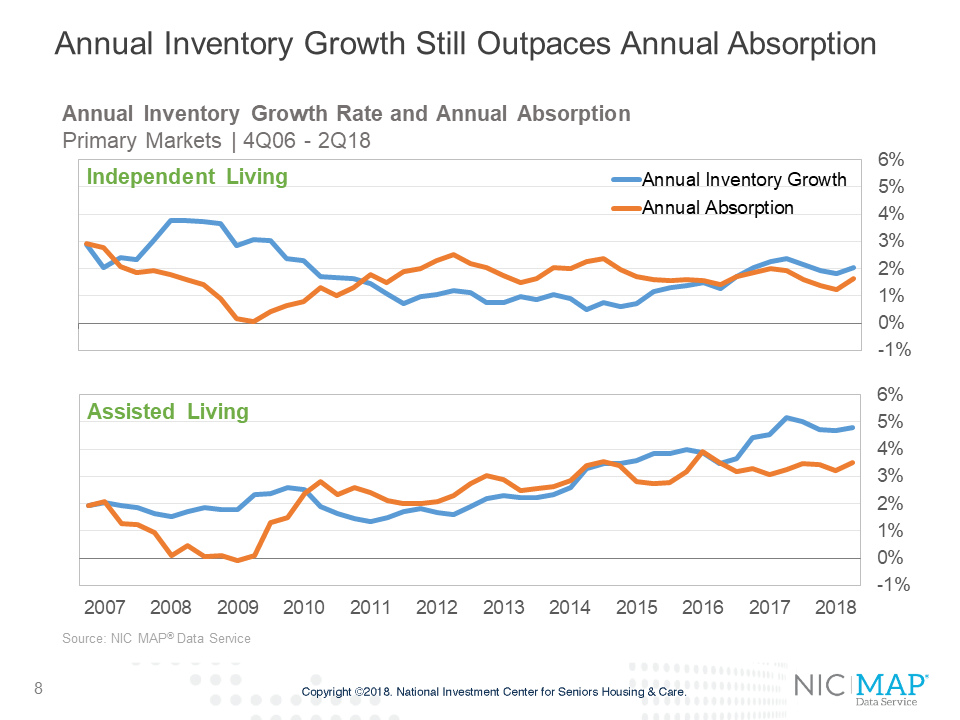
Takeaway #2: Annual inventory growth outpaced annual absorption for both assisted living and independent living

  • Assisted living inventory growth has been ramping up for a longer period than independent living in the Primary Markets. In mid-2012, the occupancy rate of independent living was the same as for assisted living at 88.8%. Since that time, there has been a clear divergence in occupancy performance reflecting the differences in supply growth and demand for the two property types.
  • As of the second quarter, annual inventory growth for assisted living was 4.8%, up from 4.7% in the first quarter, but below the record high 5.2% pace seen in the middle of 2017. Annual absorption accelerated to 3.5% from 3.2% and was the strongest since the second quarter of 2016.
  • For majority independent living properties, annual inventory growth was 2.1%, above the growth in absorption of 1.7%. In contrast, annual absorption outpaced annual inventory growth from the first quarter of 2011 through the second quarter of 2016.

Key Takeaway #3: Six Markets Account for Nearly Half the Inventory growth in Past Year

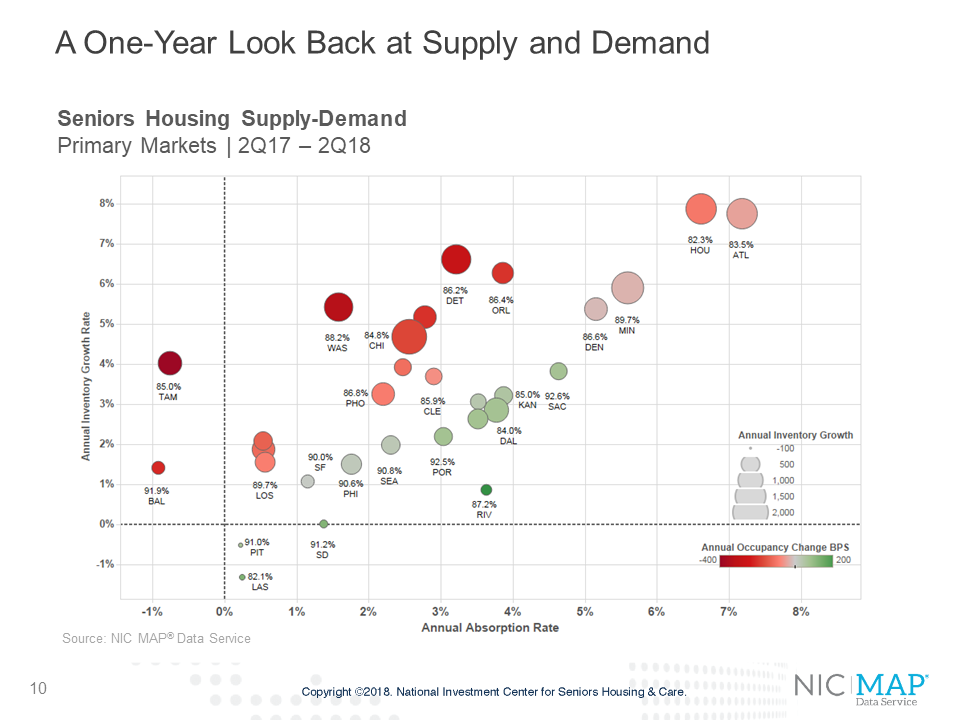
  • The most absolute unit growth in seniors housing in the past year occurred in Chicago, followed by Minneapolis, Atlanta, Houston, Detroit, and Washington D.C. These six markets each had more than 1,000 units of new inventory brought on line in the past year, with Chicago leading the pack with nearly 1,900 units. These six markets accounted for 46% of all new inventory in the Primary Markets in the past year.
  • In terms of percentage growth in inventory, the largest gains took place in Houston, Atlanta, Detroit, Orlando and Minneapolis. The strongest net absorption also occurred in many of these markets as seen by the markets. This includes Atlanta, Houston, Minneapolis and Denver.


Key Takeaway #4: Same-store rent growth decelerated

  • Same-store year-over-year asking rent growth for assisted living was 2.8% for the second quarter, down 20 basis points from the first quarter. For independent living, rent growth accelerated to 2.6% from 1.9% in the first quarter.
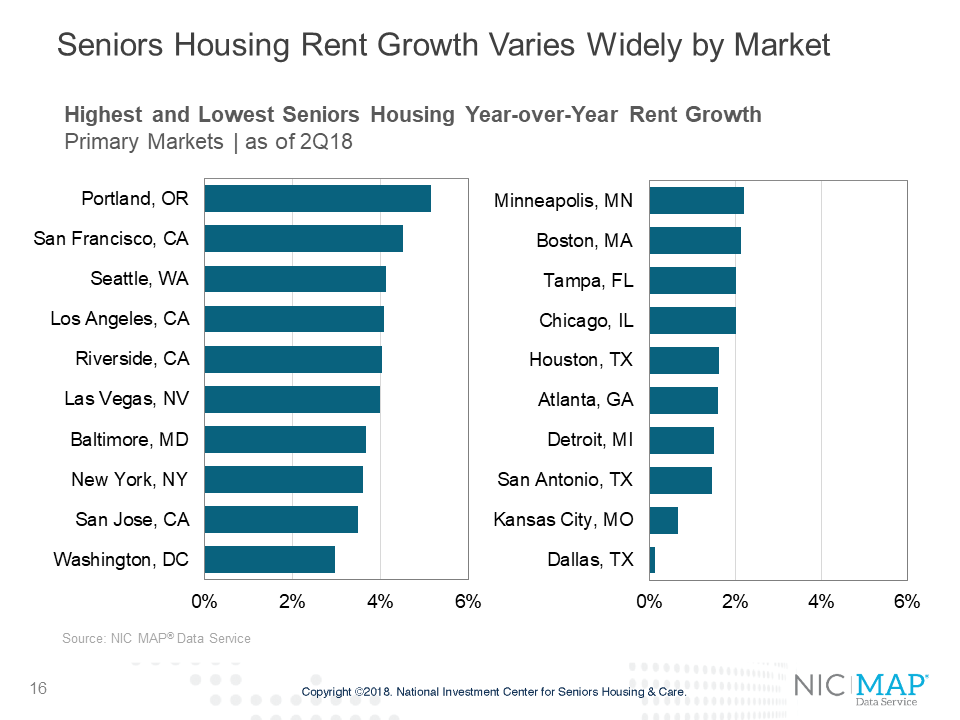
  • There is wide variation in rent growth, however. Among the Primary markets, the top ranked metropolitan areas for year-over-year rent growth in overall seniors housing were Portland Oregon, San Francisco, Seattle and Los Angeles. Poorest rent growth was in Dallas, Kansas City, San Antonio, Detroit and Atlanta. Many of these same markets have some of the lowest occupancy rates in the nation as shown in earlier slides (Dallas, San Antonio, Atlanta, Houston and Chicago).

Key Takeaway #5: Closed Seniors Housing & Care Dollar Volume: $2.3bn for 1Q18

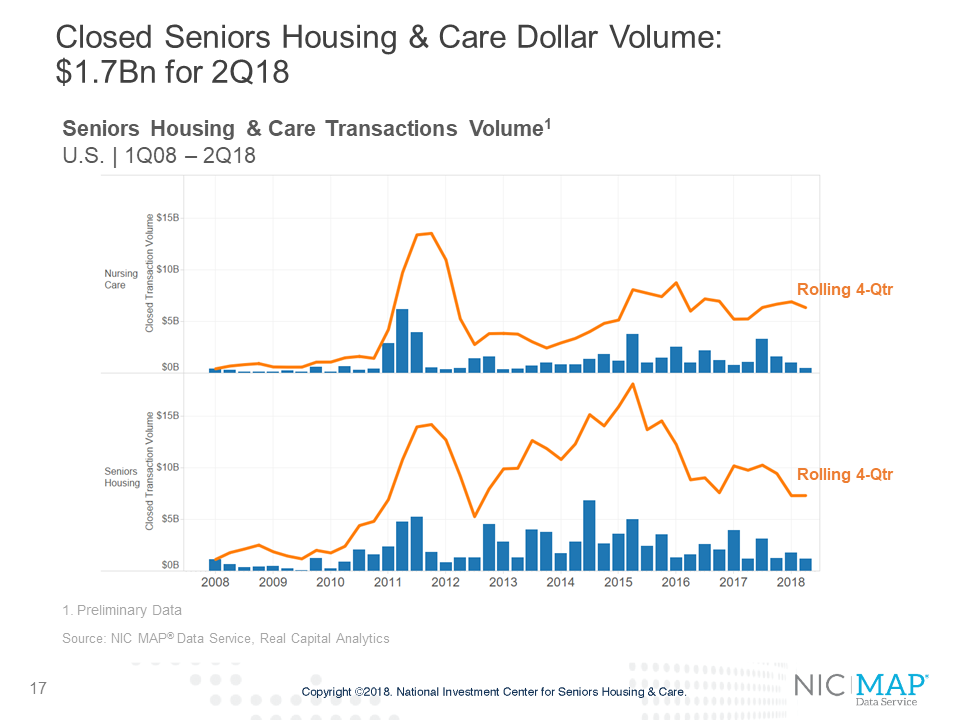
  • Preliminary estimates of seniors housing and care transactions volume totaled $1.7 billion in the second quarter. That includes $1.2 billion for seniors housing and $500 million in nursing care transactions. The total volume was down 40% from the previous quarter’s $2.8 billion and down 25% from the second quarter of 2017 when volume came in at $2.2billion.
  • Current figures show a 42% drop in single-property deals from 110 closed in the first quarter to 64 closed in the second quarter. Portfolio deals also decreased 42% from 19 closing in the first quarter of 2018 to only 11 in the second quarter.

Seniors Housing Annual Total Investment Returns Equal 12.79% in Q1 2018

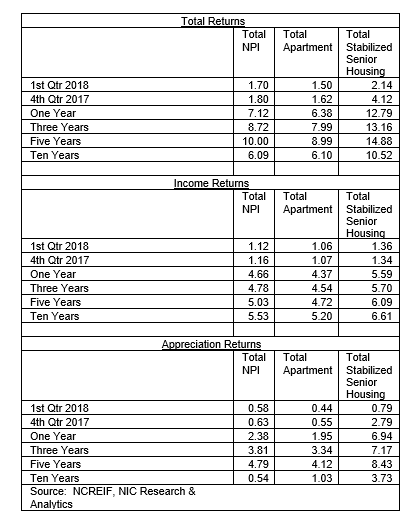
First-quarter investment return data for the NCREIF-reported seniors housing properties equaled 2.14%, composed of a 0.79% capital return and a 1.36% income return. The annual total return through the first quarter of 2018 was 12.79%, overshadowing the NCREIF Property Index (NPI) result of 7.12% and the apartment result of 6.38%. However, at 13.53% industrial total returns outpaced seniors housing.

Despite the relatively strong showing, the total annual return for seniors housing has been trending down since mid-2014 when it peaked at 20.37%.   This pattern can also be seen in the broader NPI index and is due to the appreciation return which tends to slow at this point in the real estate cycle.

Looking more closely at the components of total returns, appreciation returns for seniors housing exceeded all major property types on a 10-year basis.  Hotel and office both experienced negative capital returns over this period, while seniors housing had a 3.73% capital return.   More recently, the capital return was 6.94% on a one-year basis, dwarfing all other property types except for industrial, which has benefited from e-commerce which has increased demand for last-mile warehouse space.

With the exception of the hotel sector, seniors housing income returns have also exceeded the NPI as well as the other main property types on both a one-year and a ten-year basis.

These performance measurements reflect the returns of 104 seniors housing properties, valued at $5.3 billion in the first quarter.  This is the first quarter that the market value of the NCREIF universe of seniors housing has exceeded $5 billion.

Announcing Gary Cohn as NIC Fall Conference 2018 General Session Speaker

Newt Gingrich, Larry Summers, Ben Bernanke, and Timothy Geithner have all presented at the NIC Fall Conference in recent years with the sharp observations and timely insights that can only come from top government officials. These speakers provided their unique perspectives to NIC’s seniors housing and care executive audiences.

This year’s upcoming conference continues NIC’s tradition of featuring nationally prominent speakers. NIC has announced that the opening general session of the 2018 NIC Fall Conference will feature a conversation with the former Director of the National Economic Council and the former President and COO of Goldman Sachs, Gary Cohn.

As seniors housing and care navigates a shifting market and evolving economy, its leading decision makers face a number of potential business challenges, such as the impact of a tight labor market, increasing wages, and rising interest rates.

Cohn will share his insights and observations on the U.S. economy and where it is headed as the influences of a changing global economy, more restrictive monetary policy, and tax reform take root. He will also speak to his views on the potential impact of tariffs on trade, the economy, and inflation; today’s very tight labor market, including staffing challenges for business expansions; regulatory, healthcare, and immigration reform; and the direction of interest rates.

Cohn’s insights on where today’s economy is taking us promise to be highly relevant to our conference attendees, while effectively highlighting the 2018 NIC Fall Conference theme: “Navigating the Present Market and Anticipating the Future.”

The 2018 NIC Fall Conference will be held October 17-19 at the Sheraton Grand Chicago. Click below to register.