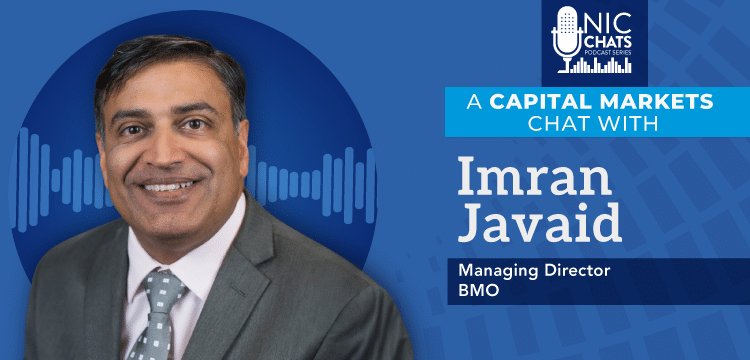
Senior housing lending may be experiencing significant momentum, but seasoned lender and NIC Board member, Imran Javaid, brings a disciplined perspective to today’s capital markets. In this episode, Head of Research & Analytics, Lisa McCracken, talks with Javaid, Managing Director for BMO’s U.S. for-profit healthcare team, about the sector’s sharp turnaround from the COVID doldrums, why robust debt availability has not translated into a construction boom, and how cautious assumptions around cap rates, exit strategies, and rent levels are shaping both senior housing and skilled nursing finance.
They also discuss the influx of new capital, including family offices, and why aligning with the right operator and product in each market remains critical in a still-fragmented industry where most operators manage 10 or fewer communities. Along the way, Javaid offers practical advice for emerging operators on building credibility with lenders and equity partners, reflects on lessons from COVID, and explains what needs to change before construction lending meaningfully loosens and new development accelerates.
Want to join the conversation? Follow NIC on LinkedIn.
View transcript
Lisa McCracken: Welcome everyone to this issue of the NIC Chats podcast. This is Lisa McCracken, the head of research with NIC.
Very excited to have Imran Javaid with BMO Commercial. He's a managing director and also a NIC Board member. Thank you, Imran. I'm gonna let you say hello, give a little bit about your background and BMO and your role, and just say hi for a few minutes.
Imran Javaid: Thanks, Lisa, and I would say that was a perfect pronunciation of my name, so I appreciate that.
As Lisa said, Imran Javaid, I'm the managing director for BMO's for-profit healthcare team in the U.S. I've been a lender in this space for over 25 years at this point. I'd like to not tell you before that what I used to do because that would just start dating me. But it's been a, it's been a lot of changes in the past 25 years, so it's been an interesting run.
Lisa McCracken: Yeah, well I think we'll probably come back to that because I, this is a interesting time in our sector. So I think when you reflect about where we are now, where we're going, it's always interesting to look back clearly about where we've been. So that probably gets to the first thing I wanna talk about.
There's a lot of energy right now. Positive momentum. I think mostly everybody agrees that we've got strong momentum, mostly tailwinds. Some people say, you know, we're on fire right now. Some of that maybe scares me a little bit, you know? I think that's all good. The tailwinds are generally good. Would you agree with the positive momentum?
I mean, what's your general, you know, sentiment from BMO and then, you know, I'd love some of your personal thoughts and just turn to momentum and where we are as a sector.
Imran Javaid: Yeah, I think that's correct. It's, as you know, it's a big turnaround from 12 to 15 months ago.
Lisa McCracken: I know.
Imran Javaid: When people were still stuck or coming out of the COVID doldrums.
So, you know, it's great. The sector I think, is doing well. The lending activity is you know, fabulous. Right? I think you can really get pretty much you know, most of your transactions financed right now. Anything that's stabilized though in particular, or a portfolio of properties, that's where I think BMO really has gravitated towards and really been doing a great job of some of these larger portfolios that are out there.
They've become very, very competitive. I would say the one exception, and I, you know, maybe we'll discuss it a little bit later, but like, is construction lending? That really has not picked up. And, and you know, to answer your second part of the question, that actually, that lack of pickup in construction lending is why I am not super nervous about the sector.
As a lender you know, some of the things that I see on the equity side, it's hard for me to say, but I wonder like what the exit strategy of some of these things are. You know, I used to work for a PE firm a long time ago.
Lisa McCracken: Mm-hmm.
Imran Javaid: And I wonder what they're using in their exit cap rate. So I'm a little cautious about from, if I was thinking of it from the equity perspective, but from a debt perspective on the cautious basis that we lend on, or a discipline basis that we lend on, I think is fine. And I think for the lending part, it's great. You know, I will say the other thing that as a lender, you're always a little bit extra cautious, right? That's why I'm not on the equity side clearly.
The one thing I worry about, Lisa, to answer part of the question or be mindful of is, well, there's two things.
One is really about the fact that, no matter what, the sector still only captures a, you know, a minority of seniors.
Imran Javaid: Most people still prefer to age in a different environment than a senior housing facility. So that's one thing. And you know, the other part is you still have to be mindful of the quality of the operator and the right product for the right market.
You can have, the wrong product set in a particular market, and it's just not going to sell no matter what happens because it's just not the right product. Right? So it's, I think those two still matter. So quality of your real estate and the quality of your operator are still paramount and important, so you can't really neglect those and brush those under the rug.
Lisa McCracken: Right. Well, and I think that that's one of the things that's come up in a lot of conversations around, you know, a lot of this focus on our sector and the energies attracting a lot of new capital, which we need capital to grow the sector, and that's great, but, you know, there's a lot of conversation around, you know, the education of that new capital.
And one of the challenges is how do they align with the right operator? And selecting the right operator can be a challenge. Are you, you know, do you encounter any of that new capital and are you seeing and observing that?
Imran Javaid: Yeah, I mean, I can't give away too many. We're financing some of those things for some of that new capital coming in
Imran Javaid: And you know, that's where like a little bit of that strict, you know, head scratching comes like, what is your exit strategy on what you're paying for, you know, as a lender. I am doing, you know, 65% lending, right? So I feel pretty secure, even if I think cap rates move in a different direction.
But I see the cap rates people are paying, they're paying for the value that they still have to create. So obviously that's not how I'm lending, you know, but they are confident in their lending on that basis. And, and like I said, I think quality of the operator and the product matters but. You know, especially when you have a portfolio as a lender, again, like my risk is very diffused.
I do wonder when it's a single deal, an individual deal, like, are they going to be okay? And are they gonna, the plan's gonna work out? You know, I don't think it's a case of if you build it, it will always, they'll always come because there are wrong products for particular markets. And they may not do well no matter what is going on in the overall sector.
Lisa McCracken: It just speaks to the complexities of our sector. So I know, you know, NIC, we're trying to do a lot of that education with some of that, that new capital. So, you know, I was gonna ask you about general comments on the availability of debt. So you've spoken to that.
Any comments on availability, senior housing versus on the nursing front? I'm not sure of your breakdown of your activity between the two of them.
Imran Javaid: We do a lot more right now on our portfolio that's on the senior housing side versus skilled side. But we like the skilled sector and we're looking for ways to be more competitive in this space.
You know, one of the things that's always been a challenge is we are a conservative lender. Right? Like, or a disciplined lender, I would like to say, as opposed to conservative, right? Like, and, you know, we don't that sector sort of like on it's almost like the flip of what you would normally expect on a sector that has more volatility.
It always has a higher lending expectation, right? Like the expectation for most people is that they're trying to bridge to HUD and they're looking for 80 to 85% lending. And that's just not what we do. But, you know, I think we're looking for ways to partner up they're with folks that are comfortable with the secondary yeah.
You know, second piece and the risk so that we are still secured in our piece and, and what we are comfortable with. So we are looking for that as a avenue of growth. But it is not the only place would be growing.
Lisa McCracken: Right.
Imran Javaid: So you know, to answer your question, it's as skilled as a smaller component, but I think it might be growing a little bit more than it is right now.
Lisa McCracken: Right, right.
Imran Javaid: Yeah.
Lisa McCracken: I do wanna do a sidebar quickly on some of the new capital because you put out a white paper on the family office stuff, which was awesome. And I say that because you know, we've spent some time exposing ourselves to that growing segment of obviously capital, you know, in terms of the high net worth individuals, and you've got some perspective just in terms of the potential opportunity there.
For our sector, it's a different kind of capital and, you know, where they can be potential partners. If you don't mind just commenting a little bit on the family offices and I know, you know, BMOs, you know, serves those groups in some different departments and some of your partners internally within the organization.
Imran Javaid: Yeah. You know, the interesting thing about that sector is they are very much they're talking about our space. Right? Which is great. And I think you'd know this because you have gone to speak at them. You can't just go to their conferences or whatever. You have to be invited to go there. So our wealth management partners who actually take care of that family office and have a robust practice in that space they sort of like, tell us as to what they're looking for, and that's how we get to know some of them and figure out, what I find is a lot of them are interested in the space, but depending on the size, there's a lot of variability on what a family office is, first of all. Right? Like, and there's a lot of variability on like, how they want to be involved, right?
Like a lot of them want to be indirectly involved. So for them, exposure to REITs or exposure to, you know different investment vehicles that let them invest indirectly in the sector is much more appropriate depending on their size. And then there are a few that you, you probably know well that are actually looking to either buy platforms or are in platforms already that they're looking for growth and they are in the, you know, I think that's where like the most exciting part is, in my opinion, right? Not that the smaller folks indirectly you know, investing through REITs and others are not important, but I think they're focused on, and I think this is part of what you guys have done as a great education from the NIC side is for whatever reason, they understand the fact that they really need to focus on the operator. So they're investing in the operator as the platform. And they also understand that the real growth in equity comes in our sector on the real estate side.
So they are enabling the operator. To really grow, not just as an operator, but also own their own properties, right? So I think that's where it's kind of exciting as I look at sort of like these operator structures and what they come across. And I think that's really good for our sector, honestly.
And that's what I was right about. But I think that's what your education through honestly, the sector has also helped because they're really smart. I see them investing in platforms, which I think is great for us.
Lisa McCracken: And I mean, you know, one of the things that NIC is as you know, looking at is this whole capital for operations and it's, you know, so much of the capital in our sector's tied up in real estate and that's okay, but it's how do we you know enable the operators and managers to grow with different types of capital and maybe capital that hasn't entered our space. And different healthcare verticals have that very much so. And you know, the family offices are different, just different in often you know, they have their own rules. And, so can just be more flexible and often in that regard. That brings me to another question. I'm gonna quote a stat and this is gonna be a new one to you. And this circulated internally at NIC and it speaks to some of the fragmentation in our sector, but also, some of the opportunity and it's fascinating.
So we ran a data point just to try to understand the number of operators in our space recently. So we took out and this is senior housing, so this excludes the nursing space. We took out all the single sites, so we wanted to know, okay, how many operators are there now this just reflects the, you know, the what NIC Map tracks.
Now this was several hundred markets, so it's not just the 99 markets or 140 markets. Across the database, so it was like 300 some markets. So for the number of operators that manage two or more communities, 84% of the operators have 10 or fewer communities. So we, a lot of operators that have that are smaller. So what, and I share that because we also have a lot of emerging operators, so groups that may, with a bigger organization, maybe with a Brookdale or with the centers that are splintering off and creating their own operating companies. So this brings me to a question, you know, for you. So if, if I am.
Imran Javaid: just, can I ask a question? I just wanna clarify. So 10 or operators that do 10 or less properties are 84% of the entire sector, you mean?
Imran Javaid: Is that right?
Lisa McCracken: 85% of the operating companies manage 10 or fewer. That's between two to 10 that's taking out the single sites? Yes.
Imran Javaid: Okay.
Lisa McCracken: To 10. Isn't that crazy? 84% of senior housing? Yeah.
Imran Javaid: Yeah, that's quite a stat. I mean, sorry, go ahead. I asked your question.
Lisa McCracken: So here's my question for you. Okay. As a lender, so when we, if I'm an operating or management company looking to grow and access capital, w hat advice do you have for me? So when we think about, you know, the growing demand and the need for more operators and, and so that's a little different type of question for you, but I have less of maybe a track record.
Maybe I personally know our team maybe has a track record. Collectively, we're not new to the industry, but as a company, you know, we're now, operators are us, we, we started in the past year and, and we we're seeing those. Yeah, we know we're seeing those emerge. I mean I'd be curious what advice as a lender you have for us to sort of establish that track record for you as a lender that's gonna give you faith, to you know, establish that, that credibility.
Imran Javaid: So, I'll give you my answer, not as BMO, right? Like, so keep that in mind, right? Like, I think 'cause. It is not BMO's wheelhouse, that type of lender. And I, you know, for a wholesale of reasons, I don't think that that's BMO's wheelhouse, but we can get into that if you want. But I will say, if I was one, if I were one of those operators, right?
The first thing I want to do is make sure I have a, you know, strong or a well-known relationship on the equity side, right? Like, so that's really. The key factor, like, and maybe it's like whatever access to capital you have, just have it be, it can't always be like, you did this with like this friends and family raise.
That's maybe fine for the first, or. Second property, but if you're managing eight, that's not a good strategy, right? Like each time be talking about like a big syndicator that you go out to. So, and it becomes challenging, right? Because then, you know, each time you're going and asking that syndicator or raising money potentially.
That's challenging. So have the equity partner security. The reason I say that is twofold, one is the equity partners, especially if they're significant, will then often bring in their debt relationships into the mix. And really that ends up driving the, you know, which rightfully it should.
Because if your equity partner is 60% of the cap stack therefore is going to want a bigger say in who the debt partner provider is. Right?
Imran Javaid: But they bring on, you know, the other key part is they bring on their own relationships. And I will add a little bit of color, which is again, not as BMO, but as Imran over time kind of thing.
You know, I used to be at companies that did that financing, right? Like when I was at Capital Source, we would do the smaller operator and they were great loans, honestly. I honestly think that is something that's missing in the sector right now. Like there's, there's private capital and you know, they're leveraging up or whatnot else, but they're not, they're, the private capitals is again, looking for like big deals.
They're looking for whales, they're hunting for whales. They're not looking for the smaller operators and really taking care of them. So it ends up being like regional banks and your regional operators. But I wish, I really wish this is a missing piece in this, in our cap, just in our debt stack right now, at least in my opinion.
And no offense to some of the commercial finance companies that are operating, not denigrating them in any way, but I think they don't necessarily go after these smaller operators. So really the smaller operators, their options are regional. You know, or there's some lenders that are good actually healthcare provider lenders as well that come from the sector that are also SBA lenders, SBA type loans and stuff. But really nail down the equity source and then you can come up with the debt capital and the debt stack. Your best bet right now, at least as regional banks that are understand and get, get to know you, but in my opinion, that gets to the whole basic underlying premise of relationships, right?
And if it was not true at any time, then COVID really showed it. Like, if people were like, oh, you know, giving it lip service, COVID really showed like your relationships with your banks, your equity providers, really, really matter, right? And it's, you know, and I think it's true for the lending side as well, right?
Like we saw folks who did really, really, you know, did all the right things by us. We will do a ton of stuff for those operators and those equity providers that we wouldn't have done otherwise, right? Because they did all the right things for us. Same thing for them. Like they saw us step in right, and help in ways that they would not expect.
So I think it's like mutually, like the real importance of building a strong relationship really matters. So for the smaller operators, focus on your regional banks. Don't go around trying to call the big banks, and I'm not disrespecting anybody, including ourselves. Right. I think they're just different strategies for different institutions. And so focus on the regional operators and focus on your equity partners.
Lisa McCracken: That was great. Thank you. You mentioned COVID. Nobody wants to go back there, but I just wanted to reflect. Sorry. You know, the data we're showing is showing, we definitely seem to be past the peak of a lot of the distress and so forth.
You guys observe that you've mostly worked through a lot of that, and I guess that's one part one, part two, you still seeing any pressure points? I guess labor comes to mind mostly, you know, with any of your borrowers, but I think that's always gonna be there, but the volatility seems to be less now.
Any comments on any of those topics?
Imran Javaid: We’ve always been disciplined, right? So we actually did really, really well through COVID, especially when I heard of what other folks at other institutions were going through. We only had a handful of challenges through COVID. Which is honestly amazing, right? Like, that's all I could say. So it really is. So we didn't really have the kind of stresses. I feel like the stressors we had was either the operator was not the right operator for the market, or the product was not the right product for the market.
Like the first one, the equity really solved for us in a, in a couple of instances because even though the operator was actually a great national operator, they were just not the right operator for that particular market. So they brought in a new operator and those properties turned around.
The ones that I think were challenged in terms of, you know, maybe not the right product, you know, like mix of kind of rooms or whatever else that were there. Those were a little bit tougher to solve, but I feel like we have worked through those as well at this point. So I think we've kind of gone past that stressor, the stress of like, it's always been a people business. So for how long I've been in the industry, yes, COVID was like an extreme case. It is always a challenge hiring people and retention.
That's no different right now. In fact in the, you know, strain or, you know, of sort of like, I think perception anyway of people in terms of how the labor market looks.
That's always been better for our industry, honestly, right? And I think that's continues to be the case. I think some of those stressors have either diminished to more normalized, if I say it's through cycle, like I always look at through cycle things. Like, it's like, gone through the cycle and it's more normalized back to a normal turnover and craziness, which in our industry is just high, right? Like, it's just a higher point. And that's just the way it goes. Unfortunately, constant. And I don't see any particular stressors for operators beyond those.
Lisa McCracken: Okay. Okay. Before we wrap up here, I do wanna revisit the development.
So early on you say about construction, obviously that's the one sort of Debbie Downer right now on our industry. I mean, you know, I feel like you and obviously some's happening, you know, we do know that. But yep. You know, a few months ago somebody said, you know, this was a bank, a lender that said, within their organization the, you know, construction lending's, like a dirty word.
That's obviously maybe an extreme statement, but yeah, just doing any of it. And, are you getting inquiries? But, and, is there light at the end of the tunnel? Because we hear, I think there's interest in people chatting about it, What are your thoughts now? Where do you think we're gonna be a year from now?
Imran Javaid: So, I hate to give you a long-winded answer, but I'll give you a long-winded answer. And there's a couple of components to it. One is, I would say there's definitely a lot of chatter, right? So let's just get that out there. I think there's a lot of interest from developers 'cause what else would they be doing?
Quite frankly, they want to develop, no offense to developers you know. So there's a lot of interest and inbound that we see, and that has definitely picked up. There are forces outside of anyone's control that just have made construction lending, as you know, a more expensive proposition than was out there.
There was expectation that maybe has diminished in terms of what rate relief would be because one of the big components from a bank lending standpoint is really that interest rate reserve that was required was huge. And I think it's, you know, relative to what it used to be, I shouldn't say it was huge, it was just bigger than it used to be five years ago, whatever. Right? So that's just an obvious statement, but the reason I bring that up is like, I think the general expectation, or I was looking, looking at consensus forecast for economists. It's like, I think you can correct me if I'm wrong, but it's like two rate cuts. Well, that's seriously diminished from where it was, but you know, there's a lot that can happen and, and whatnot, but I'm just saying in general, that's the expectation. So I don't think that's gonna provide a major relief anytime soon to have construction lending change. And then I'm gonna tell you a dirty little secret. I apologize if I say this, but I, you know, hopefully nobody gets any…
Lisa McCracken: Just stay between you and I.
Imran Javaid: The thing is, banks don't make much money on construction lending. That's just the truth, right? Like it's just you take a lot of risk for it as a bank, right? But you don't get a lot of return for it because when things are stabilizing, you're getting paid off, right? You deploy your capital towards the end of the gap stack, right?
And sometimes not even all of it gets deployed, right? Which is again, like good problems, but so your best properties that just manage correctly and all this sort of good stuff, they get paid off and you're done. In the meantime, you actually didn't make much return for it. So you know, the flip side is the ones that you stick around are the ones that didn't do well.
Right. So that's the challenging part. So they are, they're not like, even though banks do a good job of construction lending in general you do it for other reasons, you don't do it for, you know, the construction lending aspect, right? Like you do it because it's leading to other business, deepening relationship with somebody, etcetera.
So banks don't make much, much money and you know. It's hard, right? Like, it's like when you have so many options. When we have, well there's only so much capital one can deploy, right? So when you have so many options of all these new entrants coming into place, buying up properties, and you can lend stable on stabilized or near stabilized properties, why would I necessarily be doing construction lending?
So something else would need to change in the dynamics of the market to actually make that, make that click. I'll say one last thing and I'll stop talking. I apologize if I'm harping on this, but you know, the other thing I worry about in general about just construction lending is demographics are not destiny.
And I feel like a lot of developers right now just like put the case, like, oh, look at all these numbers from NIC and you know, it's gonna be great because there is so much demand. It's like, okay, but you're talking in general terms, I'm talking about this specific thing. So like show me all of the reasons why it's compelling here and more importantly, why or does the seniors in that place have the capacity to actually make those rent payments?
And a lot of people believe they do, but they are rents that are unprecedented. When you look at historical, you know, things, they're unprecedented on what they need to do to make that pencil out. And that's really, I think, what, what is the I don't know the, the source of tension really between the developers and the banks or the lending institutions anyway, that I know of, which is, just because there are demographics, that does not mean it's going to work out guys, you know?
Imran Javaid: And really, when you're talking about rents that were sort of like middle here and you're talking about the top of the market, which is not born anywhere. And I have to underwrite to that rent to make it work.
That's really challenging to do.
Lisa McCracken: Yeah. Yeah. Well, thanks for letting us get and peel back the layers of the psyche of the construction line. That was very educational, insightful. So well, I think we're at time here, Imran. This was really great. I appreciate the conversation. I know the, the listeners appreciate this as well.
So thank you for your time. Thank you all for listening and you can always access additional NIC Chat's podcast on the NIC website, Spotify however you access your podcast. So that does it for myself and Imran and we will see you all again soon. Thank you.