NIC expects demand for active adult rental communities to continue to grow in 2026. The property type appeals to younger or healthier older adults who are ready to downsize into maintenance-free communities with resort-like amenities but who do not yet need or want the care and services provided in traditional senior housing.
Inflation pressures will continue to be headwinds to new development as well as to consumers. Active adult rental communities’ median average monthly rent of roughly $2,000 may help serve middle income older adults along with luxury options for more affluent residents.
Demand for “wellness” is not yet waning and will likely continue to be the focus of lifestyle and engagement programming in 2026. The evolution of aging, longevity, and disease prevention technology – combined with resident-led programming – will differentiate active adult communities from conventional multifamily properties.
With stabilized occupancy rates near 96%, active adult communities are poised for another year of positive performance in 2026.
Healthcare Drivers and Outlook for Senior Housing and Care in 2026
Programs • Place • Precision • Performance
Senior living enters 2026 at an important transition point. This is the year the first baby boomers turn 80 years old, and many will begin entering into the senior living continuum. At the same time, many communities are experiencing high occupancy, markets are constrained by limited new growth and population demand dynamics are accelerating. Together, these drivers create steady momentum that will present opportunities for senior housing leaders to take practical, measurable, and actionable steps with proactive health strategies in 2026. This article examines four factors—programs, place, precision and performance from a healthcare lens to provide a look at what’s ahead.
Programs — Wellness as a Scalable Operating Engine
Wellness programs are becoming more than amenity-driven offerings and are beginning to shape core operating principles. Residents, in general, are arriving older and with greater medical needs and functional complexity, narrowing the window for effective intervention. As a result, in 2026 more reactive care models may begin to give way to structured, preventive approaches.
Leading communities are scaling prevention and customized wellness programs and technologies that integrate mobility and fall prevention, cognitive health, nutrition and hydration, behavioral health, social connection, and preventive clinical services. Increasingly, these programs are standardized, data-informed, and designed to be replicated to then further become tailored to the resident, rather than preset for one community at a time.
2026 Impact: Programs enabling senior housing with holistic wellness approaches will increasingly provide visibility as a product in the marketplace and a reliable engine that empowers residents and supports activities of daily living (ADLs) with stability, social and emotional engagement, and extended independence. The best programs in the best communities may further be seen as portable and be provided outside the community to engage partners and attract future residents.
Place — Architecture as a Platform for Health and Growth
Sustained high occupancy and demographic growth are placing pressure on existing supply and will make new construction and expansion unavoidable in many markets. This creates a meaningful opportunity to design future environments that directly support health, wellness, and care delivery.
Next-generation community design is emphasizing biophilic factors—intentionally strengthening connection to nature to support health, wellbeing, and performance—while also incorporating natural, small-household layouts, walkable environments, circadian lighting, and clinical-adjacent wellness spaces. Increasingly, communities will likely launch as infrastructure-ready to accommodate future diagnostics, sensors, and care models without major retrofits and modifications.
2026 Impact: Place, as a setting, will be envisioned and designed to better meet the growing needs coming in 2026 and beyond by providing a welcoming, health-planned environment and a long-term place to grow in a community lifestyle. Creating durable assets that support resident desires and anticipate health functional needs will set the stage to begin sunsetting aging properties and dated designs.
Precision — Science and Artificial Intelligence (AI) That Enable Earlier Action
Advances in diagnostics and AI are bringing precision medicine into everyday senior care. Multi-organ biomarker panels, dementia blood tests—such as the Alzheimer’s screening blood test that launched in primary care in 2025—will continue to bring precision medicine forward, alongside digital biomarkers for gait, sleep, and hydration. Coupled with more AI-based early warning systems it will be increasingly possible to identify risk earlier and with greater confidence in senior living.
These tools can accelerate, and advance longevity even as the science will increasingly begin to better connect organ health directly to functional decline. Senior housing is a natural environment for these efforts to combine. Innovators and AgeTech solution providers will be increasingly drawn into the sector, providing more capabilities for a growing population with high health needs.
2026 Impact: Precision science will further shift care from reactive to predictive, enabling earlier, more targeted support that stabilizes function, allowing care teams to intervene before ADLs deteriorate rather than after a crisis occurs. While this shift may be more gradual, preparing short, applied programs – “science for caregivers” – and developing tech partner strategies and AI community guidelines will better enable senior housing residents, staff and leaders to embrace the benefits of precision with advanced diagnostics and AI connected care plans.
Performance — Outcomes and Policy Alignment
When Programs, Place, and Precision are successfully combined, the result can be measurable Performance: extended length of stay, fewer hospitalizations, improved functional stability, higher resident and family satisfaction, and more efficient staffing. These are all factors that national and state health programs and health payors are also focused on leveraging and testing. The drive to move healthcare (even hospital care) at home is a national movement that will continue in 2026 and beyond. Demographic shifts across the nation, expectations of residents, their families, and financial drivers in the broader healthcare insurance marketplace will increasingly integrate Performance through value-based and accountable care relationships.
This integration also aligns with recent CMS Innovation Center models such as TEAM, ACCESS and MAHA ELEVATE, which all emphasize prevention, functional support, and accountability across community-based settings. Senior living communities that operate or seek to better operate as coordinated wellness and prevention partners will be well positioned to partner with Accountable Care Organizations, hospitals and health systems. Further, the best communities may be increasingly seen as desirable for advanced utilization management and care coordination with some health payor strategies and pilots.
2026 Impact: Performance requires senior housing leaders to recognize that access to and excessive dependency on the hospital emergency room should become a legacy. It may have created performance enhancement in the past as a relief valve, but it will be increasingly scrutinized in 2026 and the future. Senior housing leaders should develop a roadmap to advance in the healthcare ecosystem to leverage their strengths, develop unparalleled relationships with residents, and find healthcare partnerships that suit their goals and resident needs. More advanced senior housing organizations may also begin taking further control over Performance by designing, customizing and launching their own health insurance plans and contracted services.
What’s Next?
In 2026 NIC will provide data, insights, and analytics to empower senior housing leaders to succeed on their healthcare journey. Roadmaps, tools, playbooks and insightful training and education sessions are coming across these four factors that will help leaders continue to succeed in bringing healthcare home for seniors.
Senior Housing: A Sector Moving at Two Speeds Entering 2026

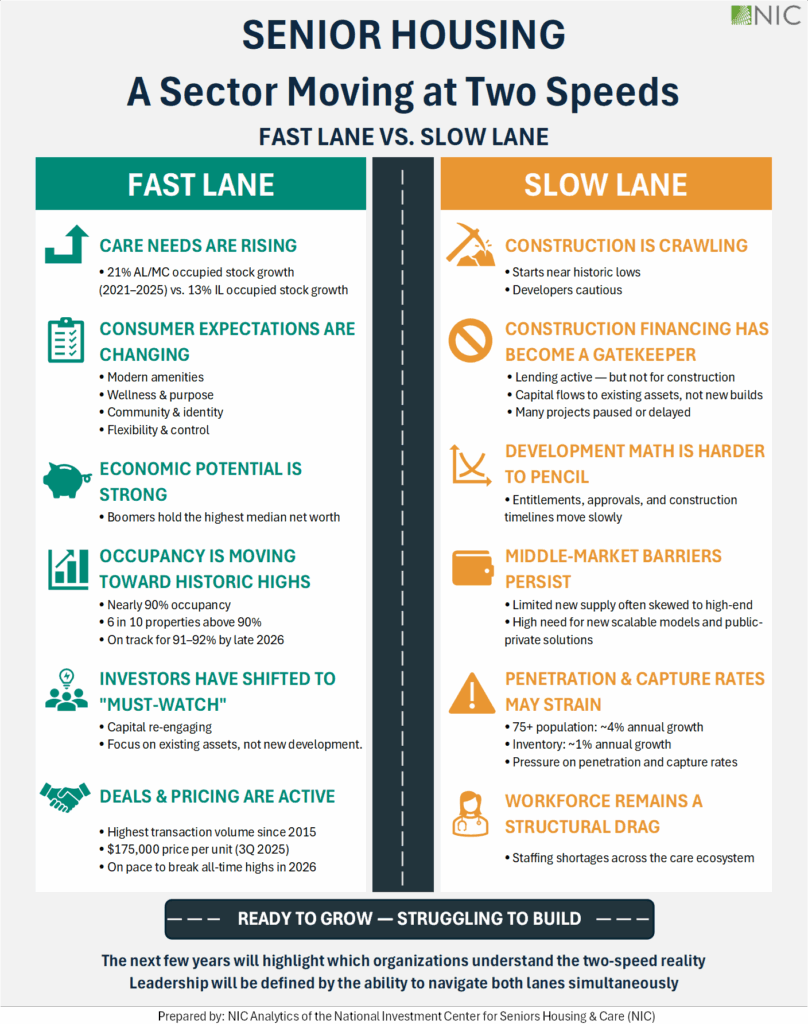
The senior housing sector is moving at two speeds, fast and slow, and leadership in the years ahead will be defined by who can navigate both lanes simultaneously. The industry is positioning for unprecedented growth, but construction financing, labor challenges, and development caution are stifling the speed of that growth.
The Fast Lane: Demand Momentum Is Outpacing Expectations
The senior housing sector isn’t just waking up, many trends within it are accelerating, with several key forces defining this fast-moving lane.
Care Needs Are Changing: The growing prevalence of care needs, cognitive decline that often accompanies an aging population, and increasing functional limitations within our population makes senior housing a necessary component of the nation’s aging infrastructure. This is evident in the data. Occupied assisted living and memory care inventory in the 99 NIC MAP Primary & Secondary Markets grew 21% from 3Q 2021 to 3Q 2025, while independent living grew 13% over the same period.
Consumer Expectations Are Changing: Consumers are not quietly slipping into senior housing, they’re arriving with different expectations than before, including expectations for modern amenities, purpose, identity, community, wellness, flexibility, and control over care. Today’s consumer expects all of it, and that reality is raising the bar for operators across every senior housing segment.
The Economic Potential Is Powerful, But Uneven: Baby Boomers hold the highest median net worth of any generation. Yet beneath that strength lies an affordability challenge. Middle-income adults aged 75 and better are aging into care needs faster than capital or policy solutions are adapting.
Occupancy Is Moving Toward Historic Highs: Senior housing occupancy for the 99 NIC MAP Primary & Secondary Markets has climbed back to nearly 90%, and the momentum isn’t slowing. In fact, six in ten properties are already operating above 90% occupancy. Based on NIC SHARK projections, occupancy is expected to set new record highs by late 2026, pushing into the 91–92% range for the first time in industry history.
Investors Have Noticed and the Narrative Has Shifted: Capital that once stood on the sidelines has re-entered the conversation. The senior housing sector has officially moved from “wait-and-see” to “must-watch.” But many investors aren’t just observing the improved occupancy and fundamentals, they are moving toward a “must-act” mentality. The strong NCREIF returns in 2025 have helped build this momentum and are anticipated to remain strong in 2026. This renewed investment activity is positive, but is being directed primarily toward existing assets, not new development.
Deals and Pricing Tell the Same Story: As lenders and capital providers continue prioritizing existing assets, senior housing 4-qtr transaction volume has marched upward, reaching its highest level since 2015. Pricing reinforces the trend. Notably, 4-qtr per-unit pricing climbed to $175,000 in 3Q 2025, just 16% shy of its all-time peak. If current growth trends hold, pricing is on track to surpass that high in 2026.
The fast lane is being powered by a demographic arc that will represent the largest care-eligibility expansion in U.S. history, by a consumer who expects more and engages more, by an asset class that continues to demonstrate resilience, relevance, and results, and by a momentum written into occupancy, priced into transactions, and reflected in the way investors are talking about, and betting on, senior housing.
The Slow Lane: Supply and Development Capital Are Lagging
If the Fast Lane shows what is possible, the Slow Lane shows what is hindering forward progress within the sector. Several challenges define this slow-moving lane.
Construction Is Crawling: Even with record-high occupancy on the horizon, the supply response remains stubbornly slow. Construction is hovering near historic lows and has yet to catch up, restrained by financing challenges, high interest rates, construction costs, and a cautious posture from developers who have endured a challenging construction cycle.
Lending Remains Active, but Not for Construction: Construction financing has become a gatekeeper. Banks and debt providers are optimistic about the sector’s fundamentals yet remain conservative with new development capital. Many lenders continued to take a cautious stance toward ground-up projects, directing capital primarily toward existing assets rather than new construction. As a result, construction loans have become harder to secure, and many projects are being paused, re-evaluated, or delayed.
Development Math Is Harder to Pencil: Developers are facing unpredictable budgets and rising expenses. Labor shortages, materials and labor costs, regulatory layers, and zoning barriers all contribute to feasibility challenges. Even when financing is available, the economics often break, and the timeline doesn’t help: entitlements, approvals, and construction timelines move slowly, far slower than the pace of demographic aging.
Middle-Market Barriers Persist: Limited new development often concentrates in higher-end segments, leaving middle-income adults with too few options. Without new scalable models, alongside public-private partnerships and policy innovation, affordability gaps will widen and care challenges will ripple across the entire care ecosystem. Eventually, a share of future demand will struggle to translate into realized occupancy.
Penetration and Capture Rates Will Eventually Feel the Strain: While the 75+ population is growing nearly 4% per year, senior housing inventory is expanding by only about 1% annually. As this gap widens, penetration rates will begin to flatten or even decline, maximum occupancy levels will limit further absorption, and capture rates will eventually plateau.
Workforce Remains a Structural Drag: As occupancy increases, the need for more workers grows just as quickly. But this is not only a senior housing challenge, it is a challenge facing the entire care economy. If senior housing can mitigate its workforce issues, it will relieve pressure on adjacent care sectors as well. With its staffing intensity and staff-to-resident ratios, senior housing has the potential to absorb and stabilize part of the broader care-economy workforce strain. Solving it here would help solve it everywhere.
It doesn’t matter how fast demand is growing, if capital isn’t flowing, supply isn’t growing. The Slow Lane is driven in part by continued capital hesitancy toward new construction financing, combined with labor shortages, and development economics that continue to hold the speed limit down.
Encouragingly, the recent NIC lender survey captured early signs of shifting sentiment. A number of lenders in the second half of 2025 began to revisit lease-up projects and explore opportunities that previously received limited consideration.
History also tells us that by the time construction finally ramps up, the best sites, teams, and partnerships are already spoken for.
Finally, the next few years will highlight the leaders who recognize that the sector is moving at two speeds, and who take thoughtful, decisive steps to close the divide.
Your Role in Making 2026 a Successful Year for Senior Housing and Care
Every January at NIC, we start off the new year by thinking about the months ahead. We make forecasts about what will unfold and how to strategically prepare for those events. In this special edition of the NIC Insider newsletter, our team has shared their outlook for 2026 within their respective areas of senior housing expertise. In this particular article, however, rather than speaking to what we see unfolding across the next 12 months, we share insight and feedback directly to a handful of key stakeholder groups. What do we need from each of these partners for the sector to succeed and advance in 2026?
Capital and Equity Investors: You are the enabler for growth in this sector. Will this be the year when we will see more dollars being allocated from acquisition activity towards new development? The first Baby Boomers turn 80 in 2026, and with this growing demand and record-low supply growth, the projected gap in available senior housing is widening. We are going to need capital to fuel inventory growth. We also need to ensure that senior housing operators have the tools and specialized talent that they need to manage the increased complexity of the business. Capital and operator alignment will continue to be increasingly important. For the veteran investors in the space, we will need your help to make sure that the new capital entering senior housing for the first time is educated and understands the nuances of the sector.
Debt Lenders: Thank you for your increasing lending activity in 2025. We are hoping for continued growth in debt availability in 2026. Specifically, if senior housing construction lending could be viewed as less of a credit risk and more as an opportunity for banks in the year ahead, that would be notable progress. The sector needs both equity partners and debt lending to bring the sector back to the table on new development. Developers and operators can execute on creating new senior housing communities, and we are hopeful that we will see a softening among banks on construction lending risks.
Operators: You will benefit from strong demand and rising occupancy levels, but you are also navigating a changing customer and a constant battle for talent and operational complexities. You need to continue to be nimble. The playbook likely needs updating: healthspan versus lifespan; technology; workplace culture; affordability; value-based care; performance benchmarks. For our sector to meet the growing demand, we know that we will need more high-performing operators. We will need to continue to give operators the tools they need to grow in scale and sophistication in 2026 (note, the 2026 NIC Growth Conference can help!).
Healthcare Partners: The CMS Center for Innovation has recently launched new models (ELEVATE and ACCESS) that indicate more attention is being given to senior housing and care. There is a very clear focus within the administration on prevention, wellness, and keeping older adults healthier for longer. This is our time! And the good news is that we don’t have to do it alone. We need our healthcare partners to help educate us on the opportunities to engage in potential risk-bearing arrangements and to help raise the visibility of senior housing and care within the broader healthcare ecosystem.
Technology Partners and Innovators: Technology and data are at the core of so much of what we do, and you are an integral part of our future. For 2026, we will look to you to help us better understand practical applications for AI because we want to move beyond the hype and look for real-world solutions. Your role in helping our sector proactively manage residents’ chronic conditions, and your help enabling us to be more efficient in the face of workforce headwinds, will be invaluable. We will need you to bring to us proven, cost-efficient, integrated solutions in 2026.
Developers and Construction Firms: You have been patient during a difficult several years. As a reminder, roughly half of senior housing inventory is over 25 years of age. Yes, we need new development to meet the growing demand, but we also need to be reinvesting in what we already have. Your limited activity is a function of the current capital environment, which will turn the corner soon. What we need from you in 2026 is ongoing efforts to innovate and find more efficient and cost-effective ways to bring the product to market. How can we reduce timelines and mitigate the labor challenges facing today’s senior living projects? We are hopeful that we will start to see some increased activity later in 2026.
Brokers and Transaction Agents: You are going to be busy in 2026 with increased competition for properties. You are often the frontline of many of the new players entering the sector. You too play a significant role in ensuring that these individuals and groups are educated investors and understand the unique operating characteristics of seniors housing versus other real estate property types.
There are countless other industry professionals and groups that will play key roles in the year ahead. For NIC, you can expect a fierce commitment to bringing you the thought leadership, research, and education to help you succeed throughout 2026. We look forward to seeing you at our 2026 NIC Spring Conference in Nashville where all of these important stakeholders will come together and play their unique part in this unprecedented time in the history of our sector. Best wishes for a productive 2026!
NIC’s 2025 Research Review
Trends Show a Changing Sector Evolving to Meet Consumer and Business Needs
Thought leadership is at the core of NIC’s mission—empowering the sector with data and analytics that support informed decisions and move the industry forward.
This past year underscored why that mission matters. New capital sources and entities are entering the market. Shifting regulation, touching everything from staffing to healthcare coverage and eligibility, is influencing workforce retention and shaping efforts to expand affordable options and middle market supply. Technology is transforming operations and the resident experience. Active adult communities are accelerating in popularity. And the demographic wave that will require the specialized care and services that senior housing provides will continues to build.
Sitting at the precipice of change, the industry sentiment conveys a very optimistic tone. At the 2025 NIC Fall Conference, 92% of leaders reported feeling positive—or extremely positive—about the year ahead.
To provide evidence and insight that helps leaders navigate those trends, NIC’s Research and Analytics team continually analyzes various data sources and publishes timely insights year-round. The team’s Year in Review report compiles significant analyses, including dozens of reports, case studies, data releases, and expert commentaries.
Below are a few highlights of research shaping senior housing and care.
Today’s older adults are aging differently than previous generations. More are living alone, placing a greater emphasis on their preventive health and wellness, and seeking communities that offer meaningful social connection with peers. These preferences are fueling the growth of the relatively young Active Adult rental segment, bringing occupancy to an average of 96%, which far outpaces all other types of senior living communities. NIC’s Investment Thesis for Active Adult Communities outlines the market dynamics, operating economics, valuations and long-term potential of this segment.
Increasingly, the link between senior housing and better care can be quantified. One of the cornerstones of NIC’s research portfolio has been a multi-year initiative to measure how senior living settings have the potential to improve resident outcomes and quality of life. In 2025, researchers found that older adults who remain in senior housing for longer periods of time utilize fewer acute care services and see their health stabilize for several years after moving in. For older adults with neurodegenerative diseases, researchers found that senior housing can reduce the number of hospitalizations and readmissions, provide relief for family caregivers, and enable timely access to care in a supportive environment, ultimately leading to greater longevity. These outcomes reinforce the pivotal role that senior housing can play in living well, longer. Senior housing can be a critical partner in reducing strain on families and the broader healthcare system while promoting older adults’ health and well-being. We must continue to advance the value that senior housing plays in promoting better quality of life and health outcomes as more stakeholders seek solutions for the aging population.
Workforce needs and other operational pressures require ever-changing strategies. Labor shortages, changing regulations across care settings, and projected demand for hundreds of thousands of additional direct-care workers continue to shape operators’ strategies. NIC analyzed these trends through a workforce webinar and companion blog that use the data to tell a powerful story—and highlight where solutions are emerging.
Capital is flowing through the sector. Overall, the first half of 2025 showed a continuation of the positive credit performance trends observed in late 2024, with both the senior housing and skilled nursing sectors benefitting from improved cash flow conditions and firmer occupancy levels. NIC’s annual Lending Trends Report offers a spotlight on capital market conditions, reflecting lending activity of senior housing and care debt providers across the U.S.
AgeTech is permeating all facets of senior housing and care—from care coordination to operations. But not every new piece of technology will be a viable solution for your organization. Everything needs to flow with your particular business model, whereas things like scalability and manageability are paramount. In this NIC Chats Podcast, guest Abby Miller Levy talks about how AgeTech can be used to improve workflows, reduce workloads so staff can focus on caring for residents; areas of opportunity, and advice for entrepreneurs seeking to enter the sector.
The 2025 trends of rising demand, new care and investment models, workforce pressures, and a growing recognition of senior housing as a critical health partner all reinforce the need for clear, reliable analytics. Throughout the year, NIC’s Research and Analytics team helped the industry interpret these shifts through data-driven reports, trend analyses, and thought leadership that informed strategy across the sector. Building on that momentum, the team will expand the industry’s knowledge base in 2026, producing new research, engaging emerging audiences, and continuing to serve as ambassadors who equip both leaders and new entrants with the insights needed to navigate a rapidly evolving landscape and advance the future of senior housing and care.
We look forward to more partnerships and progress in 2026, and as always, we welcome your inquiries and feedback on how the research team can help power your mission.
We use cookies on our website to give you the most relevant experience by remembering your preferences and repeat visits. NIC's privacy policy can be viewed here. By clicking “Accept”, you consent to the use of ALL the cookies.
This website uses cookies to improve your experience while you navigate through the website. Out of these cookies, the cookies that are categorized as necessary are stored on your browser as they are essential for the working of basic functionalities of the website. We also use third-party cookies that help us analyze and understand how you use this website. These cookies will be stored in your browser only with your consent. You also have the option to opt-out of these cookies. But opting out of some of these cookies may have an effect on your browsing experience.
Necessary cookies are absolutely essential for the website to function properly. This category only includes cookies that ensures basic functionalities and security features of the website. These cookies do not store any personal information.
Functional cookies help to perform certain functionalities like sharing the content of the website on social media platforms, collect feedbacks, and other third-party features.
Performance cookies are used to understand and analyze the key performance indexes of the website which helps in delivering a better user experience for the visitors.
Analytical cookies are used to understand how visitors interact with the website. These cookies help provide information on metrics the number of visitors, bounce rate, traffic source, etc.
Advertisement cookies are used to provide visitors with relevant ads and marketing campaigns. These cookies track visitors across websites and collect information to provide customized ads.