Effective Management Contract Transitions 

With the recent increase in M&A activity and asset transaction volume comes one of the industry’s most difficult tasks: management transitions.  

Management transitions are complex, time consuming, and typically disruptive to existing community operations. What makes them particularly difficult is all the various stakeholders to consider and involve: residents, families, existing staff, new staff, investment partners/owners, legal counsel, lenders, consultants, etc.  

Amongst a litany of checklist items to consider during transition, there are two paramount themes that keep management transitions on track: Constant, effective communication and robust, front-ended planning

Below you will find a thorough (but likely not exhaustive) list of key considerations during transitions.  

Pre-Planning 

Effective planning pre-transition is a key to success. Devising a roadmap for the months ahead will help avoid future issues, forgotten tasks, or unforeseen circumstances. With a multi-layered project such as this, utilizing a Gantt chart or similar project management tool can be extremely valuable to lay out a timeline, tasks, responsible parties, and track progress. If resources allow, setting a dedicated transition team to spearhead the project will produce better results.  

Communication 

Transition calls between the existing operator and new operator should start as early as possible and continue regularly during the process. Post-call action items should be clearly defined and assigned to help avoid tasks falling through the cracks.  

Regular town halls held at the community with residents/families and both the former and new operator have been very effective in many transitions. The existing operator should notify residents, families, and staff of this transition early on and be available to field questions and concerns. Early and often communication will go a long way with naturally concerned residents and families.  

Legal / Licensing / Regulatory 

Arguably the most critical step in a management transition is securing the change of ownership approval – often referred to as the “CHOW.” Every state is different, so it’s important to have a handle on the state’s process, requirements, and timeline – a delay in licensing approval could add weeks or even months to a transition. Consultation with expert licensing counsel/consultants is typically recommended to avoid any missteps with the CHOW process.  

Rules vary by state, but most management transitions will require new resident agreements and some will require property inspections. Knowing this ahead of time and building it into your timeline will help avoid delays.  

It is important to clearly decide on the future name of the community to avoid any conflicts down the line and delays with the license transfer. 

Community Operations 

  • Financial Diligence –  The new operator should perform a thorough review of current and historical financials, current year budget vs actuals, capital expenditure history, insurance loss/claim history, etc. Make sure expectations are clear with regard to go-forward budget, occupancy goals, leasing plan, etc.  
  • Physical Diligence – If necessary, engage third party consultants to perform third party reports or receive and review existing reports (Phase 1 environmental, Property Condition Report, Structural, if necessary, etc). 
  • Care Assessments – The new operator will need to re-assess all resident’s care levels under their care model. The new model and applicable pricing will need to be effectively documented and communicated with residents/families as it relates to billing. In some cases, the care plan will immediately transition to the new care model, but in other cases residents are grandfathered into the old model.  
  • Staffing & Benefits – Transitioning staffing and payroll benefits will take time and careful consideration. Many times, managers will seek to retain existing staff members and incentivize them with stay on bonuses. The new operator will need to clearly communicate new benefits (401k, medical, vacation time, etc) to new staff.  
  • Technology, CRM, Financial and Other Systems – It will take time and coordination to transition all technology, financial, and other systems. Any new staff will need to be properly trained on new systems.  
  • Emergency Systems and Protocols  The new operator should ensure all emergency systems are working, current on inspections, and that proper protocols and emergency preparedness plans are in place.  
  • Marketing and Reputation Management – Plan for necessary branding/marketing costs during the transition, especially if the name is changing. Also be clear on what new operator owns and does not own in terms of marketing collateral, pictures, etc. Be sure to scrub online reviews and online presence to be aware of any outstanding reputational issues in the market. Post transition, the new operator will inherit the online reputation of the community. 

Even under a “successful” transition, operations will likely go backwards. This should be planned for and underwritten appropriately with regard to leasing and financial performance during the first 6-12 months. Unforeseen items will likely arise, but with the two most important pillars of effective communication and front-ended planning, the team can minimize the likelihood of major issues and delays during transition.   

Independent Living Initial Rate Growth Moderates, While Assisted Living Accelerates 

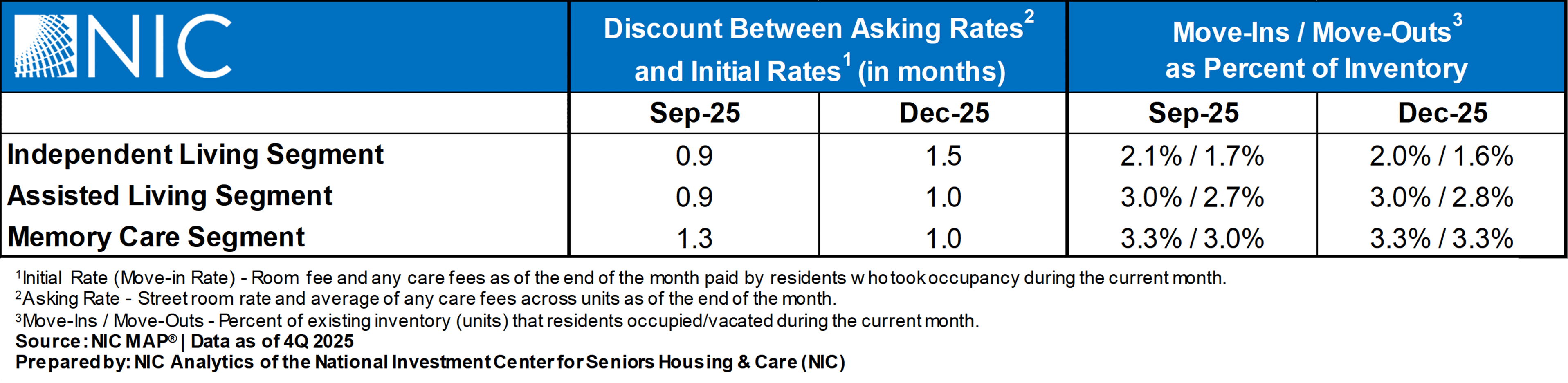
Data from the recently released 3Q 2025 NIC MAP Actual Rate Report showed that:  

  • For independent living properties, the year-over-year growth in initial rates slowed to 7.6% in September 2025, down from 17.5% in June 2025. Meanwhile, the year-over-year growth in asking rates rose by 0.5 percentage points to 8.2% in September 2025. 
  • For assisted living properties, year-over-year rate growth accelerated across all rate categories in September 2025. Initial rates increased by 6.3%, the highest growth rate since the third quarter of 2023. In-place rates and asking rates rose by 6.1% and 6.6% from year-earlier levels, respectively. 

In the third quarter, discounts between asking rates and initial rates widened for independent living properties compared to the previous quarter. In contrast, assisted living properties saw discounts narrowing from the previous quarter. 

  • Average initial rates for independent living properties were 8.6% ($403) below asking rates in September 2025, equivalent to a 1.0-month discount on an annualized basis, up from the 0.8-month discount recorded in June 2025. 
  • For assisted living properties, average initial rates were 8.1% ($549) below asking rates in September 2025, which translates to a 1.0-month discount on an annualized basis, down from the 1.3-month discount recorded in June 2025. 

Additional key takeaways are available to NIC MAP subscribers in the full report.    

About the Report: The NIC MAP Seniors Housing Actual Rates Report provides aggregate national data from approximately 300,000 units within more than 2,500 properties across the U.S. operated by over 50 senior housing providers. The operators included in the current sample tend to be larger, professionally managed, and investment-grade operators as a requirement for participation is restricted to operators who manage 5 or more properties. Visit the NIC MAP website for more information. 

Cautious Optimism Continued in 1H 2025 as Lending Stayed Active and Delinquencies Improved

NIC Analytics released the NIC Lending Trends Report for the first half (1H) of 2025. This complimentary report includes data trends over nine years for senior housing and nursing care construction loans, mini-perm/bridge loans, permanent loans, and delinquencies from third quarter 2016 through second quarter 2025. The report is based on survey contributions from 18 participating lenders.

In the first half of 2025, the Federal Reserve held the federal funds rate steady at 4.25% to 4.50%, following the three cuts made in late 2024. With inflation gradually easing and economic conditions stabilizing, policymakers emphasized patience and signaled that additional cuts would depend on sustained progress toward the Fed’s long-term inflation goal.

While treasury yields fluctuated with shifting expectations around future policy moves, they remained below prior-year highs, supporting a cautiously more constructive lending environment across senior housing and nursing care.

Survey Comments from the Field:

NIC’s lending survey gathers both data for inclusion in the Lending Trends report and commentary on what is driving those trends. A summary of that commentary is provided below.

In the first half of 2025, most lenders reported maintaining the same credit standards used in 2024, although several noted selective loosening for experienced sponsors, core-market properties, and stronger ownership profiles. A few indicated adjusting standards in response to volatility in the 10-year Treasury, while others emphasized that agency executions remained conservative despite renewed activity.

Lenders continued to prioritize existing client relationships but showed noticeably more openness to onboarding new borrowers, especially top-tier senior housing and nursing care operators. In the second half of 2025, banks in particular appeared increasingly aggressive, offering more competitive pricing and structures across both sectors. FHA remained active in nursing care, supported by Medicaid rate increases, however, production was affected by processing queues.

Importantly, some lenders signaled a shift in sentiment toward lease-up projects, exploring opportunities that previously received limited consideration, indicating a gradual broadening of credit appetite as the market stabilizes and confidence improves.

Permanent Lending Stayed Active as Senior Housing Slowed and Nursing Care Hit New Highs

Permanent lending activity remained steady in the first half of 2025, although trends diverged between senior housing and nursing care. Senior housing volumes totaled approximately $2.35 billion across the first two quarters, reflecting a modest pullback from the levels recorded in late 2024. Even with this decline, lending activity remained broadly consistent with post-2020 norms, supported by stable fundamentals and growing lender appetite for well-performing assets.

In contrast, nursing care permanent loan volume continued its upward trajectory, reaching nearly $2.95 billion in the first half of the year, surpassing timeseries benchmarks and extending the sector’s momentum from late 2024.

These dynamics point to a still-constructive permanent lending environment in early 2025. Rate stability and clearer deal economics have helped maintain activity levels, even as lenders remain disciplined and selective in their underwriting.

Bridge Financing Became More Active in 1H 2025 as Both Sectors Saw Their Strongest Volumes in Years

Mini-perm and bridge lending activity strengthened in the first half of 2025, with notable increases across both senior housing and nursing care. In senior housing, volumes totaled approximately $855 million, holding steady in Q1 relative to late 2024 before rising in Q2 to their highest level since 2023. This increase suggests growing confidence among lenders toward short-term financing structures, particularly for stronger operators and assets with clearer paths to stabilization.

Nursing care saw an even more notable acceleration, with $1.53 billion in bridge volume during the first half of the year, including a record $918 million in the second quarter. The sector reached its highest volume of bridge lending in the time series and exceeded senior housing volumes. This surge reflects lender interest in targeted skilled nursing opportunities, supported by ongoing operational stabilization.

Overall, short-term lending in 1H 2025 became more active and broad-based, benefiting from an increased appetite among both banks and alternative lenders. Even so, bridge capital remained concentrated among higher-quality sponsors, highlighting continued discipline despite the uptick in activity.

Construction Loan Activity Stayed Extremely Limited, Highlighting a Pipeline That is Thinning Just as Demand Strengthens

Construction lending remained extremely limited in the first half of 2025, with senior housing lending volumes holding near decade-low levels and nursing care construction lending remaining virtually nonexistent. Lenders and developers continued to take a cautious stance toward ground-up projects, directing capital primarily toward existing assets rather than new development. The number of senior housing units under construction remained near historic lows, extending a trend that now spans multiple years.

With the average construction cycle stretching to nearly 29 months, a project breaking ground today would not open until at least late 2027. As a result, some markets are beginning to experience actual inventory contraction rather than simply slower growth. This dynamic poses a longer-term risk: demand is recovering, but the industry is not replenishing supply fast enough, raising the possibility of mismatched demand with insufficient future product.

Overall, the first half of 2025 reinforced the same pattern seen in recent years, a muted construction lending environment, a pipeline that continues to thin, and a continued supply challenge.

Senior Housing Delinquencies Continued to Improve in 1H 2025, Well Below Recent Peaks

Delinquency rates continued to improve across both sectors in the first half of 2025. senior housing delinquencies fell to 2.4% in Q1 and 1.8% in Q2, extending the steady downward trajectory that began after peaking at 4.3% in 2023. This marks one of the notable improvements in the sector’s recovering financial footing. (Note that loans in forbearance are included in the delinquent loan data for some debt providers, slightly influencing these figures.)

Nursing care loan delinquencies also remained relatively stable, holding at 1.7% in Q1 and 1.6% in Q2, well below the peak of 2.7% recorded in 2024. While the sector continues to face higher operating and reimbursement pressures than senior housing, the leveling of delinquency rates suggests that the most acute phase of financial stress may have passed.

Overall, the first half of 2025 showed a continuation of the positive credit performance trends observed in late 2024, with both sectors benefitting from improved cash flow conditions and firmer occupancy levels.

Download the complimentary 1H 2025  NIC Lending Trends Report for full details on these and other trends in senior housing and skilled nursing lending. 

Note: This data is not to be interpreted as a census of all senior housing and skilled nursing lending activity in the U.S. but rather reflect lending activity from participants included in the survey sample only. 

The NIC Lending Trends Report for the second half of 2025 is scheduled for release in June 2026.

Interested in participating? The NIC Lending Trends Report helps NIC Analytics deliver on NIC’s mission to enable access and choice by further enhancing transparency of capital market trends in the senior housing and care sectors. We very much appreciate our data contributors. This report would not be possible without them. 

If you would like to participate and contribute your data to future lending trends surveys, please contact us at analytics@nic.org. As a courtesy for providing data, data contributors receive this report before publication on the website. The information provided as part of the survey will be kept strictly confidential. Individual answers will be combined with all other responses. Data acquired from this survey will only be reported in the aggregate, and therefore, the resulting aggregated data will not be attributed to you or your company upon distribution. 

Six Key Lessons Industry Leaders Have Learned: What Works, What Doesn’t 

Reflecting on 30 years of senior living evolution, a panel of veteran investors, developers, and operators shared their most valuable lessons learned to guide future decision making as the industry enters what could be a super-cycle of growth. The lively panel discussion took place at the 2025 NIC Fall Conference and drew a packed audience.

“We’re presenting six lessons learned of both the successes and the failures, so hopefully we can all be wiser in the next growth cycle,” said NIC Co-Founder and Strategic Advisor Bob Kramer, who moderated the session.

Kramer set the discussion in context by noting that today’s market conditions—high consumer demand, compelling demographics and historically low levels of new supply—echo earlier boom times.

Here are the six lessons learned from the leaders who’ve already experienced the industry’s highs and lows.

1- Develop your business model around the customer you plan to serve.

While that sounds simple, it’s more complicated than that, according to panelist Kurt Read of RSF Partners. He identifies three elements necessary to increase the probability of success. First is a laser-like focus on a particular type of customer.  Secondly, build a culture and operating model to serve that customer. Lastly, create an environment with a cost structure and margin of safety that supports scalable growth. 

Panelist Leigh Ann Barney of Trilogy Health Services said the company’s core operating principle is to create a hospitality type experience in a healthcare setting. Trilogy also offers a continuum of care and stays focused on properties in the Midwest. Lesson learned: Stick to what you’re good at.

2- Define your North Star.

“Engineer your business with the end in mind,” said John Rijos of Chicago Pacific Founders and CPF Living Communities. Too often, companies jump into senior living without a clear plan or vision of what kind of communities they want to own.

For Steven Vick of Signature Senior Living, his North Star is understanding his customer: a frail resident in need of assisted living or skilled care at a price point below that of the cost of a private room in a nursing home. That formula works for Signature which focuses on middle-market communities in Northeast Texas. Vick learned an important lesson when he worked at Alterra Healthcare during its go-go days in the late 1990s, opening a building every 32 hours. “Don’t do that,” he said.

3- Make sure your capital partner understands and supports your business model. 

Customer strategy must inform capital, not vice versa. Stephanie Harris of Arrow Senior Living entered the industry as a turnaround consultant in 1999 to help clean up some of the casualties of the overbuilding during that era. “It allowed me to think about what kind of capital partner I would want to work with,” she said. Harris eventually rebranded her business as Arrow Senior Living, managing 39 properties. “We found the right capital partner. We’re very fortunate,” she said. “We worked on getting it right from the very beginning.”

4- Avoid being overleveraged. Prepare for the unexpected.

“Being overleveraged is your Achilles’ heel,” warned Rijos. During the pandemic, he recalled that some developers built communities with only 15% equity and 85% debt. “That’s a disaster,” said Rijos. “Things will go wrong. There will be downturns.” He added that if you can’t put at least 35-40% of equity into the community then you shouldn’t do the deal.

During his time at Alterra, Vick also learned that debt is not your friend. “Be the owner of ‘no,’” he said. Signature has been successful because Vick has been able to say ‘no’ to extras, like swimming pools, that don’t support the frail customer at a middle-market price point. 

5- Maintain focus.  Understand the relationship between operational complexity and growth.

Trilogy offers a continuum of care. “Our business is very complex because of all the service lines we offer,” said Barney. “That’s why we’ve stayed focused in geographic areas that we know.”  This clustering strategy has helped Trilogy grow to 130 campuses in five states. 

6- Build an organizational culture and trust in your team.

“Always solve your people-problems first,” said Rijos. “Then a lot of the other problems will take care of themselves.”  Build trust in the organization. For example, give the executive director the ability to try a new approach without a penalty if it fails. He prefers flat organizational structures rather than those with multiple management layers.

Trilogy invests in its workforce with a robust apprenticeship program for every hourly position. “It’s not just wages or benefits, but how we invest in their retention,” said Barney. “We’ve chosen to do that through education and growth opportunities. Our employees drive our engine.”

Kramer wrapped up the session by encouraging attendees to create successful operating models and investment structures as the industry evolves over the next 30 years. “Take these six lessons learned back to your team and put them into practice,” he said.

Watch a replay of the full NIC Fall Conference session here: Understanding the Past of Senior Housing and Long-Term Care to Prepare for Our Future.

CCRC Performance 3Q 2025: Five-Year Trends in CCRC Entrance Fees

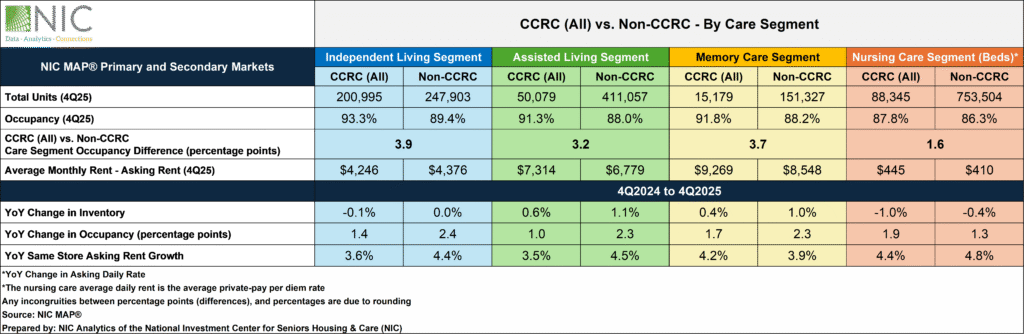
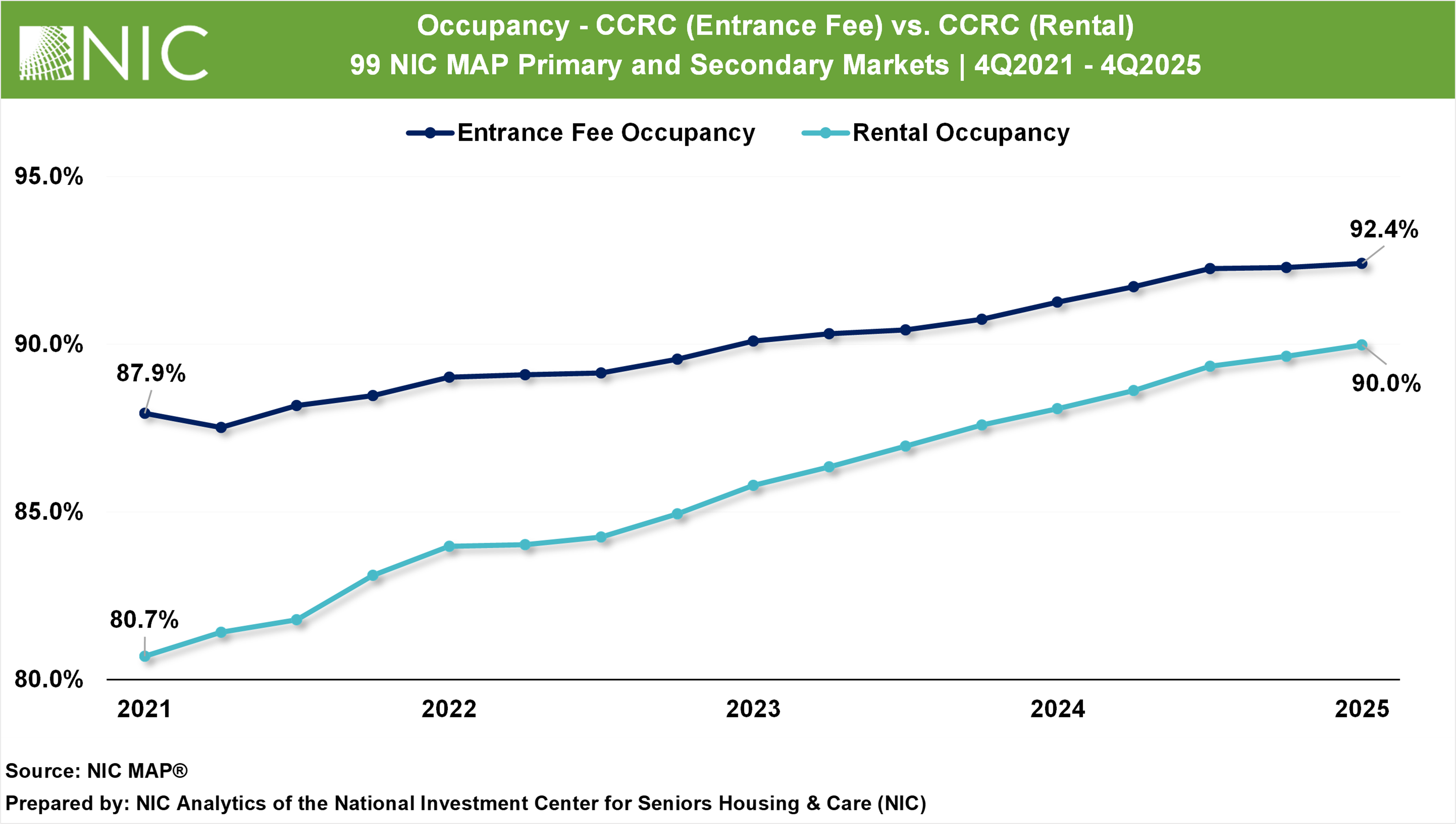
The following analysis examines broader occupancy trends, year-over-year changes in inventory, and same-store asking rent growth – by care segment – within 1,049 entrance fee and rental CCRCs in the 99 NIC MAP Primary and Secondary Markets.

3Q 2025 Market Fundamentals by Care Segment – Entrance Fee vs. Rental CCRCs

The exhibit below compares the market performance of entrance fee CCRCs and rental CCRCs by care segment for the third quarter of 2025, highlighting year-over-year (YOY) changes in occupancy, inventory, and asking rent growth.

Occupancy. Entrance fee CCRCs continued to report higher occupancy rates than rental CCRCs across all care segments. Among entrance fee CCRCs, the independent living segment achieved the highest occupancy at 93.6%. Similarly, within rental CCRCs, independent living reported the strongest performance with a 91.8% occupancy rate.

The difference in occupancy rates between entrance fee CCRCs and rental CCRCs was largest in the independent living segment (1.8pps), followed by nursing care (1.7pps) and assisted living (0.9pps), with the smallest gap seen in the memory care segment (0.1pps).

Rental CCRCs recorded the higher YOY occupancy growth in independent living (2.4pps), assisted living (2.1pps), and memory care (2.1pps) segments. While entrance fee CCRCs showed higher YOY occupancy growth in the nursing care (2.4pps) segment.

Asking Rent. The average monthly asking rent for entrance fee CCRCs remained higher than that of rental CCRCs across all care segments. Rental CCRCs showed higher YOY rent growth in assisted living (4.4% to $6,459) and memory care (4.3% to $8,238) segments. Entrance fee CCRCs experienced stronger YOY rent growth in independent living (4.5% to $4,325) and nursing care (4.9% to $479*) segments.

Note, these figures represent asking rates and do not reflect any discounts that may be applied. The nursing care average daily rent is the average private pay per diem rate.

Inventory. Compared to the level a year ago, rental CCRCs experienced inventory decline across all care segments except for memory care, which showed a modest gain (0.9%). The largest decline was observed in the assisted living segment (-2.0%), followed by nursing care (-1.5%) and independent living (-0.7%) segments.

In contrast, entrance fee CCRCs displayed a mixed trend: assisted living recorded the largest YOY inventory increase (0.7%), the nursing care segment experienced the largest decline (-0.9%), while independent living segment inventory remained unchanged from the prior year.

Negative inventory growth can occur when units or beds are temporarily or permanently taken offline or converted to another care segment, offsetting any newly added supply.

Steady Increases in CCRC Entrance Fees

The exhibit below explores the average entrance fees and YOY entrance fee growth across 99 NIC MAP primary and secondary markets from 2020 through 2025. The bar chart illustrates the average entrance fee in dollar amounts, while the line graph depicts the YOY entrance fee growth rate.

The average entrance fees in CCRCs have risen steadily over the past five years. In 2020, the average entrance fee was approximately $400,000, increasing to about $430,000 by 2022 and surpassing $480,000 by 2025. Overall, the average entrance fee in CCRCs has increased by $88,386 during this five-year period, representing a cumulative growth of 22.3%. As background, over the same five-year period, the median sales price of houses sold in the United States has risen cumulatively by 29.5%, according to data from FRED. This reflects continued demand for entrance fee-based CCRCs, as the cost to enter these communities gradually climbed year after year.

The YOY entrance fee growth rate in CCRCs fluctuated during the period. The orange line in the exhibit above highlights annual percentage growth rates, with the growth rate peaking at 6.3% in 2022, indicating a notable jump in costs that year. This was followed by a moderation in growth, with rates easing to 3.5% in 2023, rising slightly to 4.3% in 2024, and maintaining the growth at 4.3% in 2025. These changes suggest that the pace of growth has varied, potentially influenced by market dynamics, consumer demand, and broader economic conditions.

Look for future articles from NIC to delve into the performance of CCRCs.